Quick Facts
- Location: Mohalla Balila, next to Gurdwara Bal Lila Sahib, Nankana Sahib city, Punjab, Pakistan
- Altitude: around 187 m (low Punjab plains)
- Famous For: The childhood school of Guru Nanak Dev Ji — where he studied Hindi, Sanskrit, Persian, and Arabic, and composed the Patti in Rag Asa
- Nearest City: Nankana Sahib itself; Sheikhupura and Lahore are the nearest major cities
- Accessibility: Road-only; about 90 km west of Lahore via Sheikhupura; the shrine cluster of Nankana Sahib is walkable on foot
- Known Landmarks: The shrine building and courtyard, Gurdwara Bal Lila Sahib next door, Gurdwara Janam Asthan nearby
- Best For: Sikh pilgrims, students of Punjabi language and literature, history lovers, and families visiting Nankana Sahib’s shrine cluster
Why Visit Gurdwara Patti Sahib, Nankana Sahib
Every great life has a classroom. Also, For Guru Nanak Dev Ji — the founder of Sikhism, one of history’s most original spiritual thinkers. In fact, a poet who reshaped a language — that classroom was here. Gurdwara Patti Sahib stands on the spot where the young Nanak was sent to study: Hindi with Pandit Gopal Das, Sanskrit with Pandit Brij Lal, and later Persian and Arabic with Maulana Qutbuddin of Talwandi. It was here that his teachers, the tradition says, found themselves bowing to the boy’s understanding — and here that he composed the Patti in Rag Asa, the bani that silenced his pandit’s pride.
To visit Nankana Sahib without visiting Patti Sahib is to see the Guru’s birthplace and miss his school.
Where Punjabi Went to School
But this shrine is about more than one boy’s education. As a result, the word patti means the wooden slate on which Punjabi children learned to write. And this gurdwara is where the Punjabi language itself, in a sense, went to school. Nanak took the elite languages of his time — Sanskrit, Arabic, Persian — fused them with the vernacular Punjabi of the common people, and wrote his first compositions in the mixture. Before him, serious philosophy lived in sacred languages ordinary people could not read. After him, it lived in the language of the laypeople.
Standing in this small shrine, you are standing at one of the birthplaces of written Punjabi.
The shrine’s later history is just as moving. Almost five centuries after Nanak, this same building became a makeshift school where Sikh children — educated in a system that would otherwise never have taught them their scriptures — learned Gurmukhi and the Adhi Granth. The education never really stopped here. It just changed hands, from the Guru’s teachers to the community’s teachers, century after century.
Come for the history, stay for the cluster: Patti Sahib sits steps from Gurdwara Bal Lila Sahib, where Nanak played as a child. Also, a short walk from Gurdwara Janam Asthan, his birthplace and one of the holiest sites in Sikhism. In fact, November — the month of his birth anniversary — is the most electric time to be here. Nankana Sahib fills with pilgrims from around the world.
History of Gurdwara Patti Sahib, Nankana Sahib
Guru Nanak Dev Ji was born in 1469 in Talwandi — the town now called Nankana Sahib in his honor — into a Bedi family, a clan of traditional readers of the Vedas. Also, For a boy of that background, learning Sanskrit was not optional; it was duty. And so the young Nanak was sent to study: first Hindi with Pandit Gopal Das, then Sanskrit with Pandit Brij Lal, and at the age of thirteen, Arabic and Persian with Maulana Qutbuddin of Talwandi — the two politically dominant languages of the age.
The site of that schooling is what we now call Gurdwara Patti Sahib, in Mohalla Balila, next to Gurdwara Bal Lila.
The Boy Who Taught His Teachers
The tradition, recorded in the Sikh histories and retold by scholars of the shrine, says that Nanak’s worldly tutors had to bow their heads before the boy’s brilliant intellect, spiritual knowledge, and breadth of mind. Also, the defining episode belongs to the pandit’s classroom: to remove the teacher’s suspicion and break his pride, the young Nanak composed the bani called Patti in Asa Rag — a composition built around the letters of the alphabet, turning a writing lesson into a spiritual one. The patti itself — the wooden board on which children learned their letters — gave the shrine its name.
Philosophy for the Common People
What Nanak did with those languages is the deeper history. Also, as writers on the shrine have noted, he fused Arabic, Persian. Meanwhile, Sanskrit words with vernacular Punjabi for his first compositions, adding new words, phrases, and symbols to a language that the educated elite of his time did not consider worthy of serious philosophical writing. In addition, literature, history, and religion belonged to Sanskrit, Arabic, and Persian. Nanak took knowledge from the elite, from their scriptures and their languages, and presented it in the vernacular. It was, in the truest sense, a democratization of philosophy — and it began, in part, in this schoolroom.
The shrine’s modern history carries the same thread of learning. In living memory, Giani Pratab resided on the premises and taught Sikh children the Adhi Granth, giving them access to divine poetry in Gurmukhi that the Pakistani school system would otherwise never have given them. Later, Mastan Singh — a prominent member of Nankana Sahib’s Sikh community — established the Guru Nanak High School nearby, the only institute imparting religious learning alongside secular education. After that, the makeshift school at Patti Sahib was shut down.
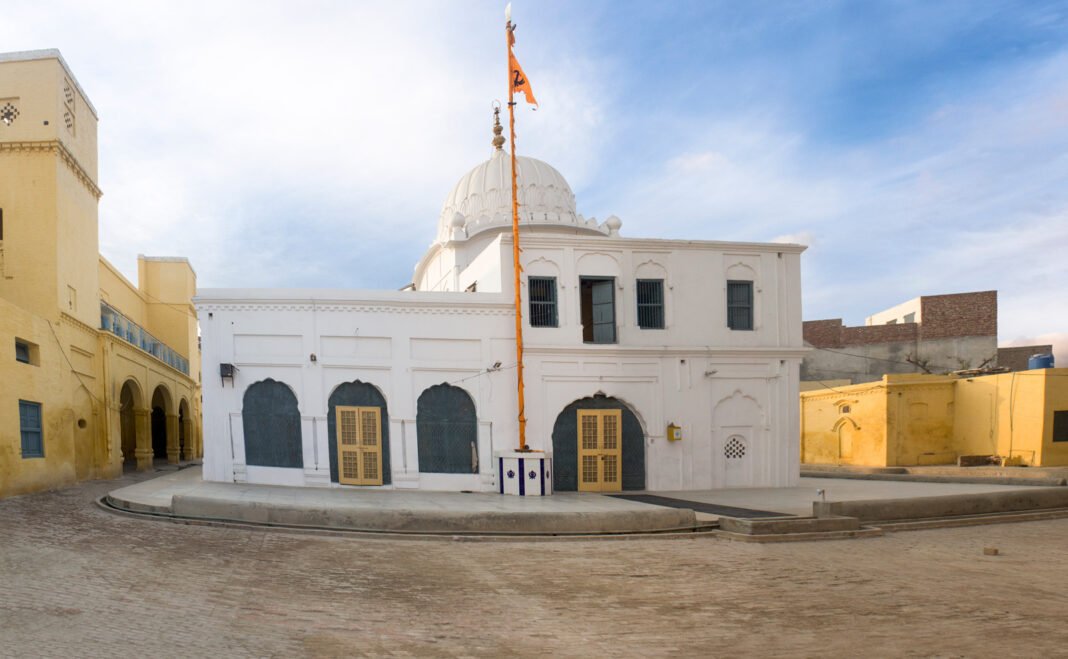
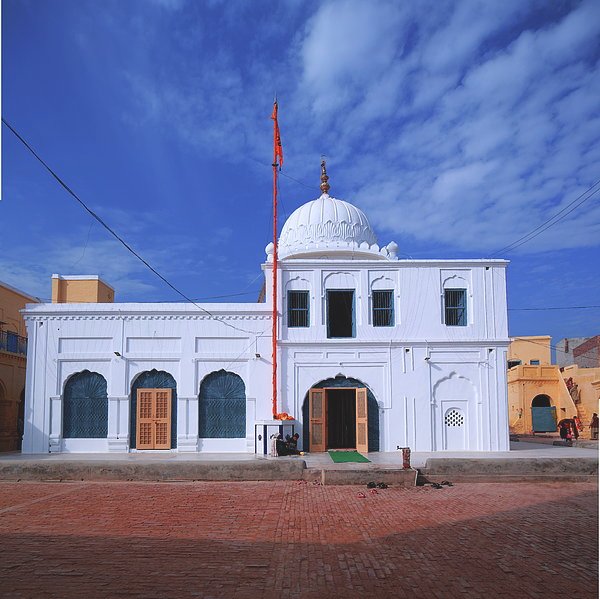
Today the shrine is a relatively small building surrounded by a courtyard, with rooms around it that once accommodated pilgrims in pre-Partition times. The city around it — about 91 km west of Lahore and 75 km east of Faisalabad, made a separate district in 2005 — remains one of the holiest destinations in the Sikh world.
Top Things to Do in Gurdwara Patti Sahib, Nankana Sahib
Stand in the Guru’s classroom
The core experience is simple and profound: enter the small shrine, sit quietly, and remember what happened here — a thirteen-year-old boy mastering the languages of three civilizations and turning a writing slate into scripture. Also, there is no grand architecture to distract you; the modesty of the building is the point. In fact, this is where genius did its homework.
Walk to Gurdwara Bal Lila Sahib, next door
Patti Sahib stands next to Gurdwara Bal Lila Sahib, the shrine of Nanak’s childhood play on the eastern side of the city. Also, the two shrines together — the school and the playground — give you the complete childhood of the Guru within a few hundred steps. Read our full Bal Lila guide before you go.
Visit Gurdwara Janam Asthan, the birthplace
No trip to Nankana Sahib is complete without the Janam Asthan. Also, the vast, imposing complex at the end of the city’s main artery, marking the spot where Guru Nanak’s house once stood and now a nationally Protected Heritage Monument. It is among the holiest sites in Sikhism, and in November, during the birth-anniversary celebrations, it is the beating heart of the Sikh world.
Explore the shrine cluster on foot
Nankana Sahib rewards walking. Also, From Patti Sahib and Bal Lila, continue a couple of kilometers east to Gurdwara Kiara Sahib — a simple, humble square building with a domed sanctum — and Gurdwara Mal Ji Sahib. In fact, each has its own character; together they are a full day of pilgrimage. Our guides to Kiara Sahib and Mal Ji Sahib cover the details.
Reflect on the Punjabi language story
Bring a translation of the Patti in Rag Asa (or read it on your phone) and read it sitting in the shrine’s courtyard. Also, knowing that Nanak’s linguistic revolution — the elevation of Punjabi into a language of philosophy — has roots in this schoolroom transforms the text from poetry into place. In fact, students of Punjabi literature should treat this as a field trip, not just a pilgrimage.
Famous Places In and Around Gurdwara Patti Sahib, Nankana Sahib
- Gurdwara Janam Asthan: The Guru’s birthplace — a vast complex and Protected Heritage Monument, the city’s spiritual centre.
- Gurdwara Bal Lila Sahib: Next door to Patti Sahib — where the young Nanak played. See our guide.
- Gurdwara Kiara Sahib: A couple of kilometres east of Bal Lila — a humble domed shrine in the cluster.
- Gurdwara Mal Ji Sahib: Another historic shrine of the Nankana cluster.
- Sheikhupura: The former district headquarters, with the Hiran Minar — a beautiful Mughal-era hunting retreat — on the route from Lahore.
How to Reach Gurdwara Patti Sahib, Nankana Sahib
Nankana Sahib lies about 91 km west of Lahore and about 75 km east of Faisalabad, on flat plains roads. Meanwhile, the shrine is in Mohalla Balila, next to Gurdwara Bal Lila — ask anyone in the city and they will point you there.
From Lahore
Take the M-2 motorway to Sheikhupura (about 56 km), then the Sheikhupura–Faisalabad Road to Nankana Sahib (about 52 km) — total roughly 108 km, about 2 hours. The shorter Jaranwala Road route is about 85–90 km. Either way, plan on roughly 2 hours.
From Islamabad
M-2 motorway south to the Sheikhupura interchange, then as above — total roughly 400 km, 5 to 6 hours.
From Karachi
Fly to Lahore (Allama Iqbal International Airport) and drive from there; the road journey from Karachi is over 1,000 km.
Nearest Airport
Allama Iqbal International Airport, Lahore — about 90–110 km by road, roughly 2 to 2.5 hours. Faisalabad International Airport is a similar distance to the west.
Road Conditions by Season
Motorway and highways are excellent year-round. Also, winter fog (December–January) can slow the M-2; monsoon rains (July–September) are the only other concern. In fact, city streets in Nankana Sahib are paved; the shrine cluster is easily walkable.
Transport Options
Private car is the most comfortable. Also, public buses and wagons run between Lahore, Sheikhupura, and Nankana Sahib; within the city, rickshaws cover the shrine cluster cheaply. Pilgrim groups usually travel by coach or tour van, especially in November.
Route Details
- Lahore → M-2 motorway → Sheikhupura interchange (approx. 56 km)
- Sheikhupura → Sheikhupura–Faisalabad Road → Nankana Sahib (approx. 52 km)
- In Nankana Sahib, head to Mohalla Balila — Gurdwara Patti Sahib stands next to Gurdwara Bal Lila
- Continue on foot: Janam Asthan, Kiara Sahib, and Mal Ji Sahib are all in the walkable cluster
Where to Stay in Gurdwara Patti Sahib, Nankana Sahib
Nankana Sahib is a proper pilgrim city, so staying over is easy — and in November. The city fills for the birth anniversary, booking ahead is essential.
Mid-range hotels: Nankana Sahib has several mid-range hotels and guesthouses catering to pilgrims — clean, air-conditioned, and walking distance from the shrines. Also, Sheikhupura, on the route from Lahore, has more options.
Budget guesthouses: Pilgrim sarais and simple guesthouses around the Janam Asthan complex offer very affordable beds, especially for Sikh jathas (pilgrim groups). Book through your tour operator in peak season.
Luxury: For full comfort, base yourself in Lahore — about 2 hours away — and visit Nankana Sahib as a day trip. Also, this works well outside the November peak.
Camping: Not applicable — this is a city pilgrimage, not wilderness.
Where to Eat: Local Foods of Gurdwara Patti Sahib, Nankana Sahib
Nankana Sahib’s food is central-Punjabi pilgrim food: hearty, vegetarian-friendly, and cheap. Also, the bazaars around the shrines serve daal, sabzi, chole, and fresh tandoori rotis. In fact, halwa puri and chanay make the classic breakfast. And the sweet shops do excellent barfi, gulab jamun, and jalebi. A full meal at a local eatery typically costs just a few hundred rupees per person.
Langar: The community kitchens at the major gurdwaras — especially Janam Asthan — serve free meals to all visitors, Sikh or not. Also, eating langar sitting in rows with hundreds of pilgrims is one of the great food experiences of the Punjab. It costs nothing.
Sheikhupura stop: If you are driving from Lahore, Sheikhupura’s bazaar is a good lunch halt. The city’s food street does the Punjabi classics well.
Weather in Gurdwara Patti Sahib, Nankana Sahib
Nankana Sahib sits on the low plains (about 187 m), with the classic central-Punjab climate. Also, approximate ranges:
| Season | Temperature Range | Conditions |
|---|---|---|
| Winter (Dec–Feb) | 5–18°C | Cool and pleasant; morning fog Dec–Jan; the prime pilgrimage season |
| Spring (Mar–Apr) | 18–33°C | Mild and green; comfortable for the walking cluster |
| Summer (May–Jul) | 30–45°C | Very hot; visit shrines early morning; November’s crowds are long gone |
| Monsoon/Autumn (Aug–Nov) | 25–38°C, cooling later | Humid with showers Jul–Sep; October clears; November is the great festival month |
Language and Culture of Gurdwara Patti Sahib, Nankana Sahib
Punjabi (Majhi dialect) is the city’s soul-language, with Urdu universal. But Nankana Sahib is also, uniquely, a city where the Punjabi language’s literary history is local heritage. Also, the story of Patti Sahib is the story of Punjabi becoming a language of philosophy. You will hear it in the kirtan at the gurdwaras and see it in the Gurmukhi on the shrine walls.
The culture is pilgrim culture: respectful, multilingual (you will hear Punjabi from Indian, British, Canadian. American visitors in November), and centered on the gurdwaras. Dress modestly, cover your head and remove your shoes before entering any shrine, wash your hands at the entrance, and accept karah prasad with both hands. Photography inside the sanctum is discouraged — ask the granthi or sevadars if unsure. If you are not Sikh, you are still welcome everywhere. The langar hall is the best place to experience that welcome.
Shopping in Gurdwara Patti Sahib, Nankana Sahib
The bazaars around the Janam Asthan complex are pilgrim bazaars: religious books, kirtan CDs, rumallas (cloths for the Guru Granth Sahib), karas (steel bangles). Also, Punjabi phulkari textiles. In fact, the city’s sweet shops are excellent — stock up on barfi and patisa for the journey home. In addition, everyday bazaars sell khussa shoes, cotton suits, and steel utensils. For a bigger retail selection, Sheikhupura and Lahore are on the route back. No large modern mall defines this trip — the pilgrim bazaar is the shopping experience.
Local Events and Festivals
One festival dominates Nankana Sahib’s calendar: Guru Nanak Gurpurab, the birth anniversary of Guru Nanak Dev Ji, celebrated in November. This is the biggest Sikh festival of the year in Pakistan — thousands of pilgrims from India (many via the Kartarpur Corridor circuit) and the worldwide diaspora converge on the Janam Asthan. The whole city, including Patti Sahib and Bal Lila, glows with kirtan, processions (nagar kirtan), and langar on a massive scale. If you want the most electric Nankana Sahib experience, come in November — but book accommodation well ahead.
On a smaller scale than at Kartarpur or Panja Sahib.. Still, Vaisakhi (April) is also observed at the city’s gurdwaras, The Sikh calendar’s other gurpurabs are marked quietly at the shrines through the year.
Travel Tips for Gurdwara Patti Sahib, Nankana Sahib
Packing Essentials
A head covering (scarf or bandana) is essential for the gurdwaras — carry your own. Also, winter visitors need a warm jacket for foggy mornings; summer visitors need sun protection and water. In fact, comfortable walking shoes matter: the shrine cluster is best done on foot. Carry cash for the bazaars and small eateries.
Safety Tips
Nankana Sahib is one of Pakistan’s most-visited pilgrim cities and is well accustomed to foreign visitors. The usual courtesies apply: modest dress, shoes off and head covered in shrines, no photography inside the sanctum without permission. Also, In November’s crowds, keep valuables secure and stay with your group.
Money & Connectivity
ATMs are available in Nankana Sahib city and Sheikhupura — but carry cash for the shrine bazaars. All major mobile networks offer 4G in the city. Fuel stations are plentiful on the M-2 and the Sheikhupura road.
Best Time to Visit Gurdwara Patti Sahib, Nankana Sahib
Autumn–Winter (October–March): The Prime Season
Cool, clear, and comfortable — and November brings Guru Nanak Gurpurab, when the city is at its most alive. This is the window every guide recommends.
Spring (March–April): Pleasant
Mild weather and smaller crowds; Vaisakhi in April adds a festive note at the gurdwaras.
Summer (May–July): Avoid Unless Necessary
Fierce plains heat. If you must come, visit the shrines at dawn and rest through midday.
Monsoon (August–September): Wet
Humid with heavy showers; the city is quiet. Also, october’s clearing skies mark the turn toward the great season.
Final Thoughts
Gurdwara Patti Sahib is small, but what happened here was enormous: a boy, a slate. The birth of a literary revolution. In this schoolroom, Guru Nanak took the languages of empires and priests and gave philosophy back to the people — in Punjabi. Five centuries later, children were still learning their letters in this same building. Education, it turns out, was always the shrine’s true relic.
Walk it with Bal Lila and Janam Asthan, come in November if you can, and read the Patti where it was written. For example, few schoolrooms in the world have earned their keep like this one. For more heritage journeys, explore our Explore Pakistan collection.
FAQs
Where is Gurdwara Patti Sahib?
In Mohalla Balila, Nankana Sahib city, Punjab — right next to Gurdwara Bal Lila Sahib, about 90 km west of Lahore.
Why is Patti Sahib important?
It marks the school where the young Guru Nanak Dev Ji studied Hindi, Sanskrit, Persian. As a result, Arabic — and where he composed the Patti in Rag Asa. Patti means the wooden slate children learned to write on.
Who were Guru Nanak’s teachers?
Pandit Gopal Das (Hindi), Pandit Brij Lal (Sanskrit). Also, Maulana Qutbuddin of Talwandi (Arabic and Persian, from age thirteen). In fact, tradition says they bowed to the boy’s understanding.
What is the best time to visit?
October to March — and especially November, the month of Guru Nanak Gurpurab. Nankana Sahib hosts its greatest celebrations.
How do I reach Nankana Sahib from Lahore?
Via the M-2 to Sheikhupura then the Sheikhupura–Faisalabad Road — about 108 km, roughly 2 hours. Buses and wagons also run the route.
Can non-Sikhs visit?
Absolutely. Also, cover your head, remove your shoes, dress modestly. You are welcome in every shrine — including the langar hall’s free community meal.
What else is nearby?
Gurdwara Bal Lila Sahib (next door), Gurdwara Janam Asthan (the birthplace), Gurdwara Kiara Sahib. Also, Gurdwara Mal Ji Sahib — a full walkable cluster.
Where should I stay?
Nankana Sahib has mid-range pilgrim hotels and budget sarais near the shrines. Also, book ahead for November. In fact, Lahore (2 hours) works as a luxury day-trip base.