Quick Facts
- Location: In the heart of old Lahore, in the courtyard between the Lahore Fort and the Badshahi Mosque — the centre of an ensemble that includes Roshnai Gate and the Samadhi of Ranjit Singh.
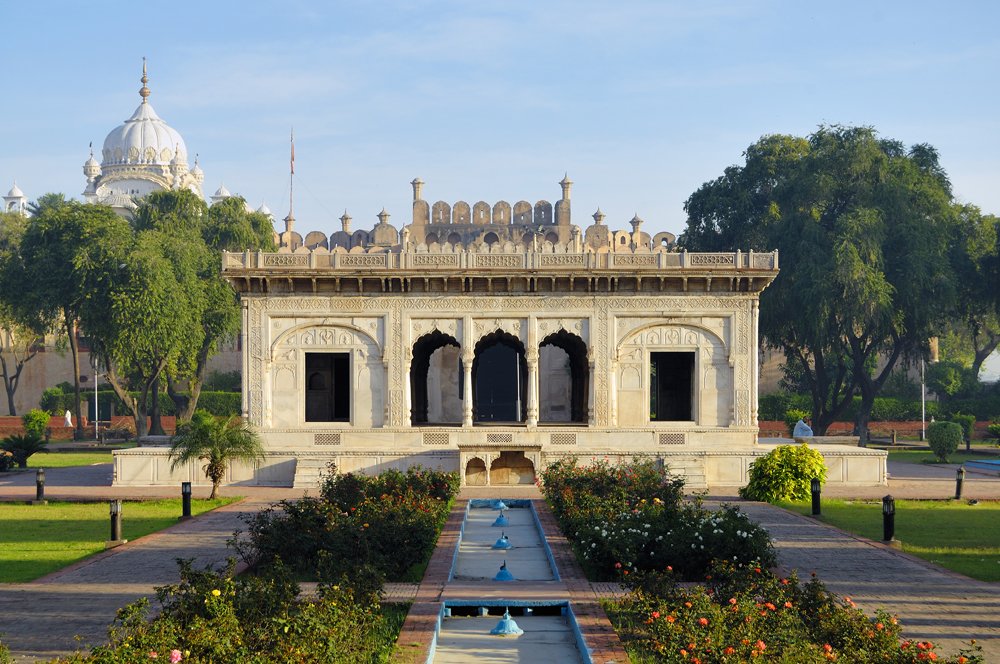
- Famous For: The white marble baradari (pavilion) built by Maharaja Ranjit Singh to celebrate his acquisition of the Koh-i-Noor diamond in 1813, with its mirrored ceiling and carved marble pillars.
- Nearest City: Lahore itself — the garden sits in the Walled City, minutes from the city’s main commercial areas.
- Accessibility: Easily reached by car, rickshaw or the Lahore Metrobus; Allama Iqbal International Airport is about 30–40 minutes away by road.
- Known Landmarks: The Hazuri Bagh Baradari, the Badshahi Mosque, Lahore Fort’s Alamgiri Gate, Roshnai Gate, the Samadhi of Ranjit Singh, and the tomb of Allama Iqbal (completed 1951) across the garden.
- Best For: History lovers, architecture and photography enthusiasts, culture seekers, and anyone visiting Lahore for the first time.
Why Visit Hazuri Bagh
If Lahore has a single spot where the whole sweep of its history stands in one frame, it is Hazuri Bagh. Also, stand in this garden and you can turn in a slow circle and take in the Mughal, Sikh and modern eras of the city at once: the marble baradari of Maharaja Ranjit Singh at the centre, the colossal red sandstone of the Badshahi Mosque on one side, the ramparts of the Lahore Fort on the other. The tomb of Allama Iqbal — the poet-philosopher of Pakistan — just across the lawns.
Few places in South Asia compress three centuries of power, art and memory into a single view like this one.
The baradari itself is the reason to come. Also, built to celebrate Ranjit Singh’s acquisition of the legendary Koh-i-Noor diamond in 1813, it is a pavilion of white marble with delicate cusped arches carried on exquisitely carved pillars — marble that was, remarkably, taken from the great Mughal mausoleums of Lahore. The central chamber, where the Maharaja held court, has a mirrored ceiling in the style of the Sheesh Mahal. Even today, after the loss of its upper storey to a 1932 storm, the pavilion has a luminous quality in the morning and evening light that makes photographers linger far longer than they planned.
Sunday Afternoons of Qisse
But Hazuri Bagh is not a museum piece. It is a living garden, and that is its other great charm. Every Sunday afternoon, storytellers gather here to recite the traditional Punjabi qisse — the epic romances of Heer Ranjha and Sassi Punnun. The Sufi poetry of the Punjab — continuing a tradition of public storytelling that is centuries old. Families picnic on the lawns, children play, and the garden fills with the easy, sociable atmosphere that makes Lahore famous. Visiting on a Sunday lets you see the garden as Lahoris see it: not a monument. A beloved public room.
And there is the practical magic of the location. As a result, Hazuri Bagh sits at the centre of Lahore’s historic core, which means it anchors a perfect day: the Badshahi Mosque next door, the Lahore Fort’s palaces and museums a short walk away, the Food Street on Fort Road for dinner. The Walled City’s bazaars beyond. If you are choosing one destination in Lahore that delivers history, architecture, culture and atmosphere in a single visit, this garden — small, beautiful and layered with stories — should be at the top of your list.
History of Hazuri Bagh
The ground Hazuri Bagh stands on has been significant since the Mughal era. When Emperor Aurangzeb built the Badshahi Mosque in the 1670s, he first had the front garden prepared and called it the ‘Abdar Khana’. At the site stood a small structure called the Serai Alamgiri, built during the mosque’s construction — and, according to tradition, this was the spot from which Aurangzeb reviewed his troops marching past. After Aurangzeb’s death in 1707, the Mughal Empire declined. The serai passed through the turbulent decades of Afghan invasions until 1765. The first Sikh ruling triumvirate of Gujjar Singh, Lehna Singh and Soba Singh took Lahore.
Lehna Singh, by one account, spent his time in the Serai Alamgiri.
The Koh-i-Noor Celebration
The garden’s transformation began with Maharaja Ranjit Singh, who took power in Lahore in 1799. Also, In 1813, at the Mubarak Haveli inside Mochi Gate, the Maharaja extracted the world-famous Koh-i-Noor diamond from the exiled Afghan ruler Shah Shuja. In fact, an event he was determined to celebrate in stone. In addition, at the suggestion of his courtier Khushal Singh Jamadar, he ordered that a marble pavilion for royalty be built in the great courtyard between the Lahore Fort and the Badshahi Mosque. The garden’s Mughal-style layout was assigned to Faqir Azizuddin.
The baradari’s construction to Khalifa Nooruddin — with the instruction that the Maharaja wanted a central structure with a mirrored roof like the one in the Sheesh Mahal.
Marble Borrowed from Emperors
The marble for the pavilion came from an extraordinary and controversial source: Ranjit Singh ordered the finest marble to be taken from Lahore’s Mughal mausoleums — including the tomb of Emperor Jahangir at Shahdara, the tomb of Zaib-un-Nisa at Nawan Kot, the tomb of Nur Jahan. Also, the tomb of Asif Khan. Within about two years, the garden, the baradari and its fountains were complete. The original structure was a 45-foot, three-storey square with a basement approached by fifteen steps, its central court — where the Maharaja held his durbar — crowned with a mirrored ceiling.
The pavilion’s troubles began with the Sikh wars. During the January 1841 siege of the Lahore Fort — Sher Singh’s 28,000-strong army outside, Maharani Chand Kaur’s 5,000 men inside — the staircase to the basement was blown up. The baradari suffered extensive damage. The British period reclaimed and re-laid the garden to its original plan. The final blow came from nature: on 19 July 1932, a huge storm struck Lahore and lightning hit the top pavilion of the Hazuri Bagh structure. The upper storey was so badly damaged that the British administration removed it entirely, and it was never rebuilt.
The basement was walled off at the same time. What you see today is roughly a third of the original building — still beautiful, still luminous, and still holding court at the centre of Lahore’s history. Across the garden, the tomb of Allama Iqbal — completed in 1951 — and the tomb of Sikandar Hayat Khan, the last Premier of the Punjab, add the modern era’s own monuments to the ensemble.
Top Things to Do in Hazuri Bagh
Admire the Marble Baradari
Give the pavilion the slow attention it deserves. Also, walk around all four sides and study the carved marble pillars and the delicate cusped arches they carry — each one a piece of Mughal funerary art repurposed into Sikh royal architecture. Step into the central chamber and look up at the mirrored ceiling, imagining Ranjit Singh holding court beneath it two centuries ago. Then step back and take in the whole composition: the white pavilion against the red sandstone of the Badshahi Mosque is one of the great colour contrasts in Pakistani architecture. The early morning and late afternoon light makes the marble glow.
Visit the Badshahi Mosque
No visit to Hazuri Bagh is complete without stepping into the mosque next door. Also, built by Aurangzeb and for centuries among the largest mosques in the world, the Badshahi Mosque’s vast courtyard, towering minarets and red-sandstone grandeur are the perfect counterpoint to the garden’s intimacy. Entry to the mosque is free; dress modestly, cover your head, and remove your shoes before entering the prayer hall.
Tour the Lahore Fort
The fort’s Alamgiri Gate rises directly beside the garden, and inside lies one of Pakistan’s richest concentrations of Mughal and Sikh architecture: the Sheesh Mahal’s mirror work, the Naulakha Pavilion, the Diwan-e-Aam and Diwan-e-Khas, and the museums. The fort is a ticketed site — buy your entry at the gate — and plan at least two to three hours. Together, the fort, the garden and the mosque form a half-day (or full-day) circuit that is the essential Lahore experience.
See the Tomb of Allama Iqbal
Just across from the garden, outside the Badshahi Mosque, stands the simple red-sandstone mausoleum of Allama Muhammad Iqbal, completed in 1951. Also, the poet-philosopher whose ideas inspired Pakistan. In fact, it is a place of quiet pilgrimage for Pakistanis, and visiting it adds a reflective, modern coda to the garden’s Mughal and Sikh stories.
Join the Sunday Qisse Gathering
If your visit falls on a Sunday afternoon, time your trip to hear the storytellers. The tradition of reciting Punjabi qisse — Heer Ranjha, Sassi Punnun — and Punjabi Sufi poetry in the garden is one of Lahore’s living cultural treasures. Even if you do not understand Punjabi, the performance — the rhythm, the crowd’s reactions, the setting — is unforgettable.
Photograph the Historic Ensemble
Hazuri Bagh is one of Pakistan’s most photographed spots for good reason: the baradari with the mosque behind it, the baradari with the fort behind it, the garden framing Roshnai Gate. Also, bring a wide-angle lens for the ensemble shots and a portrait lens for the marble details. The golden hour before sunset is the prime time.
Famous Places In and Around Hazuri Bagh
- Badshahi Mosque: Aurangzeb’s great congregational mosque, adjoining the garden — see our Badshahi Mosque travel guide.
- Lahore Fort: Palaces, the Sheesh Mahal, Naulakha Pavilion and museums, entered through Alamgiri Gate.
- Samadhi of Ranjit Singh: The Maharaja’s own mausoleum, part of the garden’s monument ensemble.
- Roshnai Gate: The illuminated gate of the old fort, framing the garden’s southern views.
- Tomb of Allama Iqbal (1951): The national poet’s mausoleum across the garden.
- Fort Road Food Street: Lahore’s famous food street near the Badshahi Mosque — dinner after sightseeing.
- Greater Iqbal Park: The vast green expanse nearby, home to the Minar-e-Pakistan — see our Greater Iqbal Park guide.
How to Reach Hazuri Bagh
Hazuri Bagh sits in the Walled City of Lahore, between the Lahore Fort and the Badshahi Mosque — one of the easiest historic sites in Pakistan to reach. Also, Within Lahore, it is minutes from the city centre by car, rickshaw or ride-hailing service. In fact, the Lahore Metrobus and Orange Line both serve the old-city area. The nearest airport is Allama Iqbal International Airport, roughly 30–40 minutes away by road depending on traffic.
Route Details
- From Islamabad (~375 km, 4–5 hours): Take the M-2 motorway south to Lahore, exit toward the city centre, and follow signs for the Badshahi Mosque / Lahore Fort. Park in the designated areas near the fort — the old city’s streets around the monuments are congested, so walking the last stretch is often fastest.
- From Karachi (~1,200 km): Fly to Lahore (about 1 hour 45 minutes) and take a taxi or ride-hailing car to the Walled City. Overland, the N-5 national highway and the motorway network connect Karachi to Lahore in roughly 16–18 hours of driving, with the train as a comfortable overnight alternative.
- From elsewhere in Lahore: Ask for “Badshahi Masjid” or “Lahore Fort” — every driver knows both. The garden lies between them; enter via the fort complex or the mosque courtyard side.
- Nearest airport: Allama Iqbal International Airport, Lahore (LHE), about 30–40 minutes by road.
Road conditions by season: Lahore’s roads are paved and good year-round. Also, the monsoon months (July–August) can bring heavy rain and waterlogged streets in the old city — wear waterproof footwear. Summer heat (May–June) makes midday sightseeing exhausting. Winter brings the famous Lahore smog, which can obscure the fort-and-mosque views on bad days — check the air quality before planning a photography trip.
Transport options: Ride-hailing cars and auto-rickshaws are the most convenient for the Walled City. Also, the Metrobus is excellent for longer cross-city hops. In fact, For a full Lahore heritage day, many visitors hire a car with a driver — or join a guided Walled City walk, which often includes Hazuri Bagh, the mosque and the fort with a knowledgeable local guide.
Where to Stay in Hazuri Bagh
You will stay in Lahore, not at the garden — and Lahore has Pakistan’s widest range of accommodation. Also, the choice comes down to which Lahore you want: the old city or the modern districts.
Walled City guesthouses: A growing number of heritage guesthouses and boutique stays have opened in and around the old city, some in restored havelis. Also, these put you within walking distance of Hazuri Bagh, the mosque and the fort, and waking up to the call to prayer over the old rooftops is an experience in itself. In fact, book well ahead — the best ones fill up in the winter season.
Mid-range hotels: The Mall Road, Gulberg and DHA areas have a deep bench of comfortable mid-range hotels with reliable air conditioning, Wi-Fi and in-house restaurants. Also, the practical choice for most travellers, typically 15–30 minutes from the Walled City depending on traffic.
Luxury hotels: Lahore’s five-star properties cluster in Gulberg and around the Cantonment, offering the full international standard for travellers who want it. Winter is peak season, so reserve early.
Budget options: Hostels and budget hotels around the railway station and in Ichhra offer very affordable beds, popular with backpackers and student travellers.
Where to Eat: Local Foods of Hazuri Bagh
Hazuri Bagh sits in the middle of one of the world’s great food cities, and eating here is half the reason to come. The garden itself is a picnic spot — but the streets around it are where Lahore’s legendary cuisine lives.
Fort Road Food Street: Just steps from the Badshahi Mosque, this is Lahore’s most famous food street. Also, a row of restaurants serving Lahori classics late into the night, with the illuminated mosque as your backdrop. Meanwhile, come here for dinner after a day of sightseeing.
Lahori chanay and halwa puri: The city’s signature breakfast — chickpeas in rich gravy with hot, puffy halwa puri, pickles and lassi. Also, the old city’s breakfast shops do it best, and mornings around the Walled City are made for it.
Nihari and murgh chholay: Slow-cooked beef nihari and chicken-and-chickpea curry are Lahore’s soul foods. Also, the old city’s nihari houses are institutions.
Falooda, rabri and lassi: Lahore’s desserts are famous across Pakistan — thick rabri, towering faloodas and the city’s peerless lassi, served in tall glasses with a slab of malai.
Dahi bhalla and gol gappay: For snacking between monuments, the chaat stalls of the old city deliver the tangy, crunchy, spicy hits that Lahoris swear by.
A full day of eating around Hazuri Bagh is very budget-friendly: street food and traditional eateries cost a fraction of modern restaurant prices. Also, the quality at the old-city institutions is unmatched. In fact, drink bottled water, eat where the crowds are, and save room for dessert — in Lahore, dessert is not optional.
Weather in Hazuri Bagh
Lahore has a classic Punjab climate: a short, pleasant winter. A brief spring; a long, fierce summer; and a monsoon that breaks the heat but drenches the streets. The garden is an open-air site, so weather shapes the visit more than at an indoor attraction.
| Season | Temperature Range | Conditions |
|---|---|---|
| Winter (Nov–Feb) | 4°C to 20°C | Cool, misty mornings; pleasant afternoons. The best sightseeing weather — but watch for smog, which can mute the fort-and-mosque views. |
| Spring (Mar–Apr) | 15°C to 32°C | Beautiful and brief. The garden is at its greenest; Basant season if the kite festival is on. |
| Summer (May–Jun) | 30°C to 42°C | Fiercely hot. Sightsee only in the early morning or late evening; the marble pavilion shimmers in the heat haze. |
| Monsoon & Autumn (Jul–Oct) | 25°C to 38°C | July–August bring heavy monsoon rain and humidity; September–October dry out into warm, pleasant autumn days. |
For photography, winter’s clear days (when the smog lifts) and the golden light of spring evenings are unbeatable. For comfort, November to March is the window — with February adding the possibility of Basant.
Language and Culture of Hazuri Bagh
Hazuri Bagh is Punjabi Lahore at its most expressive. Also, Punjabi and Urdu are the languages you will hear — in the storytellers’ qisse, in the bazaar banter, in the greetings of strangers who will happily adopt you for an afternoon. In fact, Lahore’s culture of hospitality is legendary and entirely real: Lahoris are famously warm, talkative and proud of their city. A visitor showing genuine interest in its history will rarely lack for company or advice.
The cultural notes that matter here are about respect for the sacred neighbours. The Badshahi Mosque is an active place of worship: dress modestly (cover shoulders and knees. Women should cover their heads), remove shoes before entering the prayer hall, keep voices low, and avoid visiting during Friday congregational prayers unless you are there to pray. Photography is welcome in the garden and around the mosque’s exterior, but ask before photographing worshippers. In the garden itself, the etiquette is simple: it is a shared public space — picnic, relax and enjoy, but keep it clean and keep the music down.
Shopping in Hazuri Bagh
The bazaars around the Walled City are among Pakistan’s most atmospheric shopping streets. Also, they start steps from the garden. In fact, Shah Alam Market — one of the largest wholesale and retail markets in the country — and Akbari Mandi sprawl nearby with everything from fabrics to spices. In addition, For souvenirs with a Lahore character, look for camel-skin table lamps (painted with intricate floral designs), Multani blue pottery, phulkari-embroidered textiles, traditional khussay (embroidered shoes). The old city’s spice shops, whose colours alone are worth the visit. There are modern malls in Gulberg and DHA if you need them.
The old-city bazaars are where the region’s craft traditions live — and where your money goes directly to local makers and traders. Haggle with good humour. It is expected and part of the experience.
Local Events and Festivals
Sunday Qisse Gatherings (weekly, year-round): Every Sunday afternoon, storytellers gather in Hazuri Bagh to recite the Punjabi qisse — Heer Ranjha, Sassi Punnun — and Sufi poetry. It is not a staged show but a living tradition, free and open to all. Also, the most authentic cultural event you can attend in Lahore.
Basant (February, when held): Lahore’s legendary kite festival, traditionally celebrated in February, once turned the city’s skies into a riot of colour and the old city’s rooftops into all-night parties. Kite flying has been banned since 2007 over safety concerns, with occasional officially sanctioned revivals announced — check the current year’s status before planning a trip around it. When Basant is on, the Walled City around Hazuri Bagh is its beating heart.
Travel Tips for Hazuri Bagh
Packing Essentials
Comfortable walking shoes (the fort-garden-mosque circuit involves a lot of steps and stone floors), sun protection year-round, a light shawl or scarf (useful for mosque entry and for winter mornings), a water bottle. Also, a camera with plenty of storage. You will take more photos than you expect. In winter, add a warm jacket for the misty mornings and smog-season evenings.
Safety Tips
The Walled City monuments are among Lahore’s most visited and well-policed tourist sites. The area around the fort, garden and mosque is busy and generally safe during the day. Keep valuables secure in crowds, agree rickshaw and taxi fares before setting off. It be cautious of touts offering “special” tours at inflated prices. The official guides at the fort are the reliable option. Evenings at the Food Street are lively and safe, but stick to the main streets after dark.
Money & Connectivity
ATMs are plentiful in the commercial areas around the old city, and most mid-range and upscale restaurants accept cards. But the bazaars, food stalls and small eateries are cash-only, so carry rupees in small denominations. Also, mobile data from all major networks (Jazz, Telenor, Zong, Ufone) is fast and reliable across Lahore. The fort and garden area has good coverage for maps and ride-hailing.
Best Time to Visit Hazuri Bagh
November to February — The Best Season
Winter is Lahore’s glory season: cool, often sunny days made for walking the fort-garden-mosque circuit, misty mornings that photograph beautifully. The city’s social calendar at its fullest. February can bring Basant if the festival is revived. The one caveat is smog — on bad days it dulls the views, so check air quality and aim for clear days for photography.
March to April — Lovely Spring
Short, sweet and green. Temperatures are comfortable, the garden is at its best, and the crowds are thinner than in winter. Also, an excellent time for a relaxed visit.
May to August — Hot and Monsoon
Summer in Lahore is brutal — 40°C-plus days make midday sightseeing genuinely unpleasant. If you visit now, do the monuments at dawn or dusk and spend the afternoons in the fort’s museums or the city’s air-conditioned spaces. The July–August monsoon brings dramatic skies but waterlogged old-city streets.
September to October — Pleasant Autumn
The rains retreat, temperatures soften, and the light turns golden. Also, a fine, underrated window — fewer tourists, comfortable days, and the garden glowing in autumn light.
Final Thoughts
Hazuri Bagh is small — you could walk across it in minutes — but few gardens in Pakistan carry so much history per square metre. A Mughal serai, a Sikh Maharaja’s marble celebration of the Koh-i-Noor, a British-era restoration, a storm that took the top storey in 1932. The living tradition of Sunday storytellers: it is all here, in one luminous courtyard between a fort and a mosque. For a first-time visitor to Lahore, it is the perfect introduction to the city’s layered soul. For a returning traveller, it repays every revisit with details you missed before.
Come on a winter morning or a spring evening, give the baradari the slow look it deserves, hear a qissa if it is Sunday, and end the day with dinner on Fort Road under the mosque’s floodlights. That is Lahore at its best — and it starts in this garden. Find more ideas in our Explore Pakistan collection, and pair this visit with the Badshahi Mosque and Greater Iqbal Park guides to build your full Lahore itinerary.
FAQs
Where is Hazuri Bagh?
In Lahore’s Walled City, in the courtyard between the Lahore Fort and the Badshahi Mosque — the centre of a monument ensemble that includes Roshnai Gate and the Samadhi of Ranjit Singh.
Who built Hazuri Bagh and why?
Maharaja Ranjit Singh built the garden and its marble baradari to celebrate his acquisition of the Koh-i-Noor diamond from Shah Shuja in 1813. Also, the garden was laid out by Faqir Azizuddin and the baradari built by Khalifa Nooruddin, completed around 1818.
Why is the Hazuri Bagh Baradari only two storeys today?
The original was a three-storey structure with a basement. Also, on 19 July 1932, a storm and lightning strike badly damaged the top storey. In fact, the British administration removed it and never rebuilt it, and the basement was walled off.
What is the best time to visit Hazuri Bagh?
November to February offers the best sightseeing weather. March–April is lovely and green; summer is very hot, so sightsee early or late in the day.
How do I reach Hazuri Bagh from Islamabad or Karachi?
From Islamabad, drive the M-2 motorway to Lahore (4–5 hours). Also, From Karachi, fly to Allama Iqbal International Airport (about 1 hour 45 minutes). In fact, Within Lahore, ask any driver for the Badshahi Mosque or Lahore Fort.
Is there an entry ticket for Hazuri Bagh?
The garden is accessed via the Lahore Fort complex and the Badshahi Mosque area. The fort itself is ticketed, while the mosque is free to enter. Also, check current entry arrangements at the gate.
Is Hazuri Bagh suitable for families?
Very — it is a public garden where Lahori families picnic every weekend. Also, combine it with the fort and mosque for a full family day out.
What happens at Hazuri Bagh on Sundays?
Every Sunday afternoon, storytellers gather to recite traditional Punjabi qisse like Heer Ranjha and Sassi Punnun, along with Punjabi Sufi poetry — a living cultural tradition, free for all.