Quick Facts
- Location: Hinglaj, Lasbela district, Balochistan — inside Hingol National Park, on the west bank of the Hingol River, about 250 km west of Karachi
- Altitude: Low desert gorge country of the Makran coast, roughly 20 km inland from the Arabian Sea
- Famous For: One of the 51 Shakti Peethas of Hinduism; a natural cave shrine with no man-made idol; Pakistan’s largest Hindu pilgrimage, the Hinglaj Yatra
- Nearest City: Karachi (gateway city); nearest town on the route is Uthal, headquarters of Lasbela district
- Accessibility: Road via the Makran Coastal Highway (N-10); roughly 4–6 hours from Karachi by car or pilgrim bus
- Known Landmarks: Chandragup mud volcano, Hingol River, Princess of Hope rock formation (inside the same national park)
- Best For: Pilgrims, spiritual travelers, photographers, and adventurers drawn to sacred desert landscapes
Why Visit Hinglaj Mata Temple
There are temples you visit, and then there are places that visit you. Meanwhile, that stay in your chest long after you have left. Hinglaj Mata is the second kind. Picture this: a narrow gorge in the stark Makran badlands, cliffs the color of rust and ash rising on both sides, the Hingol River glinting below — and tucked into the rock face, a low natural cave holding a small stone smeared with vermilion, worshipped as the living form of the Goddess. No marble halls, no towering gopurams, no gold. Just stone, river, desert, and faith so old it predates the very idea of a temple building.
For Hindus, this is one of the holiest places on earth. Also, a Shakti Peetha, one of the 51 sacred sites where parts of the goddess Sati are believed to have fallen, and one of only two such shrines in Pakistan.
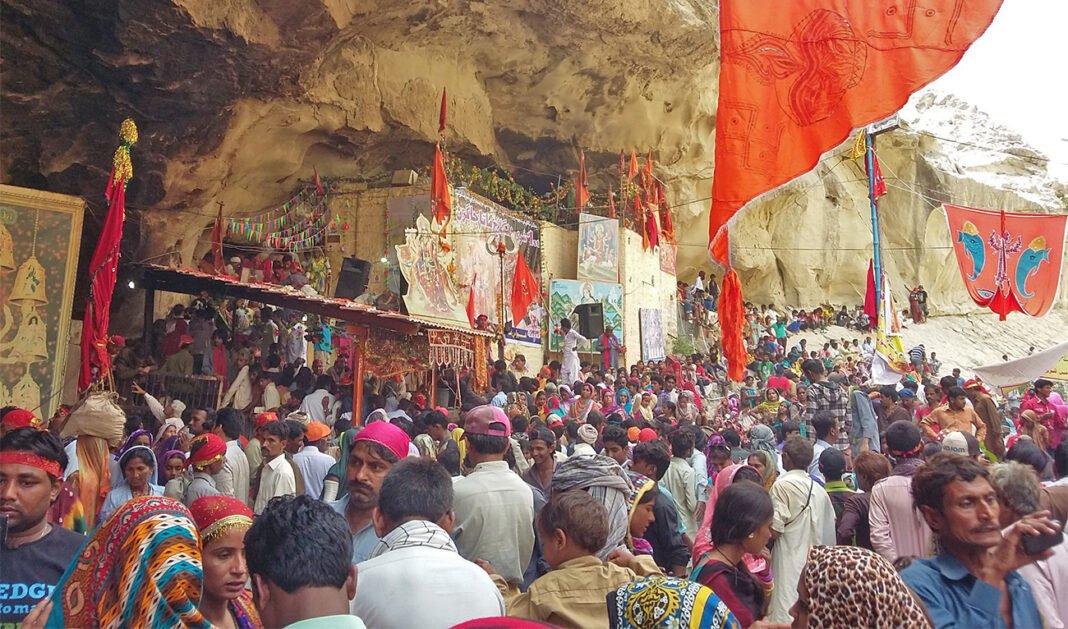
Every spring, the Hinglaj Yatra draws hundreds of thousands of pilgrims across the desert in what has become the largest Hindu pilgrimage in the country: buses rolling down the coastal highway, devotees walking barefoot over parched ground, the air ringing with “Jai Mata Di.” Even if you are not Hindu, witnessing this — respectfully, quietly — is one of the most moving human spectacles Pakistan offers. It is devotion stripped to its essence: people crossing a desert for their goddess.
Sphinx, Mud Volcanoes and the Arabian Sea
But Hinglaj rewards the non-pilgrim too. Also, the journey itself is the adventure: the Makran Coastal Highway unfurling past the Sphinx of Balochistan and the Princess of Hope, mud volcanoes steaming on the horizon, the Arabian Sea glittering to your left. Inside the national park, the landscape looks more like Mars than Earth. NASA’s own Earth Observatory has featured these badlands. Add the ritual climb of the Chandragup mud volcano, where pilgrims toss coconuts into bubbling craters. You have a day that no museum or beach resort can match.
Who should come? Spiritual seekers of any faith who want to feel what sacred geography means. Photographers — the gorge light at dawn is unreal. Road-trippers who have done the northern areas and want Pakistan’s wild southwestern frontier. And anyone who believes travel should sometimes be about reverence rather than recreation. Come in April for the Yatra if you want the full human tide. Come in the cool winter months if you want the gorge, the cave, and the silence almost to yourself.
History of Hinglaj Mata Temple
The story of Hinglaj begins in myth, and the myth is very old. Meanwhile, In the Shakta tradition of Hinduism, the goddess Sati immolated herself after her father Daksha insulted her husband Shiva. Maddened with grief, Shiva carried her body across the heavens in his cosmic Tandava dance until Vishnu’s discus cut the body into pieces that fell to earth. In fact, each place where a part fell became a Shakti Peetha — a “seat of power.” At Hinglaj, tradition holds, fell the head — the Brahmarandhra, the crown of the head.
In addition, the ancient Sanskrit text Tantrachudamani names this Peetha as Hingula, its Devi as Kottari, and her Bhairava consort as Bhimalochana. Of the 51 Peethas scattered across the subcontinent, Hinglaj is counted among the most significant. It is one of only two in Pakistan. The other being Sharada Peeth in the Neelum Valley.
What makes Hinglaj extraordinary even among Peethas is its form. The shrine was never “built” in any conventional sense: it is a natural cavern in the gorge wall, and inside it sits a low altar of mud and clay with a stone daubed in sindoor (vermilion) that is venerated as the goddess herself. Also, Local Muslim communities have long revered the site too, calling it Nani Mandir or Bibi Nani — the shrine of the revered grandmother — and for generations the pilgrimage route was protected and guided by local Baloch tribes, a quiet tradition of interfaith custodianship in one of Pakistan’s remotest corners.
From Foot Trails to the Yatra’s Hearth
For most of its history, reaching Hinglaj was an ordeal that was itself part of the worship. Pilgrims once walked more than 150 kilometres on foot through waterless desert, and the journey could take weeks. Everything changed with the completion of the Makran Coastal Highway in 2004. This put the shrine within a day’s drive of Karachi.
Over the last three decades, the Yatra has grown from a hardy regional pilgrimage into a unifying event for Pakistan’s Hindu communities — drawing devotees from Sindh, Karachi, Hyderabad, and beyond, with attendance estimates ranging from around a hundred thousand to as many as three hundred thousand in peak years. In a country where Hindus are a small minority, Hinglaj has become their great common hearth: the place where the community gathers, renews itself, and is seen.
Top Things to Do in Hinglaj Mata Temple
Enter the Cave Shrine and Pay Your Respects
The heart of the visit is the low cave itself. Also, duck through the entrance and let your eyes adjust: the small sanctum, the clay altar, the vermilion-smeared stone glowing in the lamplight. In fact, pilgrims offer coconuts, red cloth, and flowers; priests apply tilak. In addition, move slowly, speak softly, and follow the lead of the devotees around you. Photography inside the sanctum is discouraged — this is a living place of worship, not a backdrop. The power of the cave is in its simplicity: after the vast desert outside, the smallness of the shrine feels almost unbearably intimate.
Climb the Chandragup Mud Volcano
Part of the traditional pilgrimage is the ascent of Chandragup, the great active mud volcano near the shrine. The climb is steep and the grey mud can be slippery, but at the top, pilgrims toss coconuts and rose petals into the shallow bubbling crater as offerings. The view over the badlands is staggering. Even outside Yatra season, the volcano is an astonishing natural wonder — one of the largest mud volcanoes in the region, venting methane and mud instead of lava. Wear shoes with grip, carry water, and descend carefully.
Ritually Bathe in the Hingol River
On their pilgrimage, worshippers perform ritual bathing in the Hingol River, which flows year-round through this arid land — the longest river in Balochistan. The riverbanks near the shrine, with their tamarisk thickets, are also the greenest, most alive part of the gorge. Also, paddling at the edge or simply sitting by the water at sunset, watching the cliffs turn gold, is a memory you will keep.
Drive the Makran Coastal Highway Viewpoints
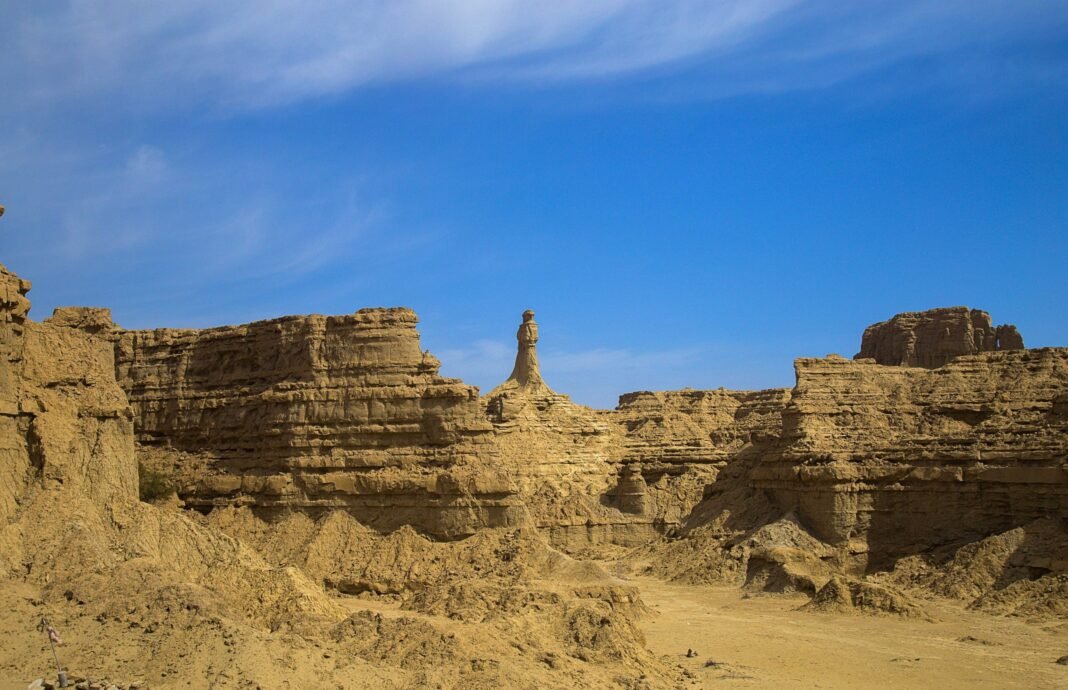
The road to Hinglaj is half the destination. Also, stop at the viewpoints for the Princess of Hope — the wind-sculpted rock figure named by Angelina Jolie — and the Sphinx of Balochistan, both natural mimetoliths inside the national park. In fact, the highway runs for about 109 kilometres through Hingol National Park, with the sea on one side and Martian mountains on the other. Dawn and late afternoon are the golden hours.
Witness the Hinglaj Yatra (April)
If your dates align with the four-day Yatra in April, around Chaitra Navaratri, come — but come as a respectful guest. Hundreds of thousands of pilgrims, night-long bhajans, the barefoot desert march, the volcano rituals: it is overwhelming in the best way. Dress modestly, do not push into ritual spaces with a camera, accept prasad graciously, and let the scale of human faith do the talking.
Stargaze in the Desert Night
Far from any city glow, the night sky over the Hingol gorge is one of Pakistan’s finest. If you overnight in the area — many pilgrims sleep under the open sky or in basic camps during the Yatra — lie back and watch the Milky Way arc over the cliffs. It is the perfect, silent counterpoint to the day’s intensity.
Famous Places In and Around Hinglaj Mata Temple
- Chandragup Mud Volcano — the great active mud volcano of the pilgrimage route; coconut offerings at its bubbling crater.
- Hingol River & Estuary — Balochistan’s longest river; marsh crocodiles, migratory birds, and mangroves near its mouth.
- Princess of Hope — the famous wind-carved rock figure, a short detour off the coastal highway.
- Sphinx of Balochistan — the natural sphinx-shaped formation guarding the highway.
- Kund Malir Beach — the celebrated golden beach further west on the coastal highway, often combined in the same trip.
- Hingol National Park — Pakistan’s largest national park, wrapping around the shrine with 6,100 sq km of desert, coast, and wildlife.
How to Reach Hinglaj Mata Temple
Hinglaj sits about 250 km west of Karachi, deep inside Hingol National Park on the Makran coast. The journey is entirely by road. Also, it is one of Pakistan’s great drives. But it is also a desert journey, so plan it with respect for distance, heat, and fuel.
From Karachi: roughly 250 km via the Makran Coastal Highway (N-10), taking 4 to 6 hours depending on stops. Also, Leave Karachi on the RCD Highway, join the N-10 at the Zero Point interchange near Uthal, and follow the coastal highway west through the national park. The shrine turnoff is well known to local drivers. From Islamabad: fly to Karachi (about 2 hours) and drive from there. The overland route is roughly 1,400 km and not sensible for this trip alone. From Lahore: the same logic applies: fly to Karachi (about 1 hour 45 minutes), then drive. The road distance is roughly 1,200 km.
Nearest airport: Jinnah International Airport, Karachi. Road conditions: the Makran Coastal Highway is a paved, generally smooth highway. It runs through remote desert with long fuel gaps — fill your tank in Karachi or at Uthal, carry extra water, and check your spare tyre. The final approach to the shrine leaves the highway for a rougher track into the gorge. A high-clearance vehicle or 4×4 is strongly recommended, especially after rains. Transport options: most visitors hire a private car or 4×4 with a driver from Karachi — the standard, safest choice.
During the April Yatra, organized pilgrim buses run from Karachi, Hyderabad, and Sukkur; seats are arranged through community organizations. Several Karachi tour operators also run guided Hingol–Hinglaj day and overnight trips that bundle transport, a guide, and beach stops.
Route Details
Step 1: Depart Karachi early (5–6 a.m.) via the RCD Highway (N-25) toward Uthal. Step 2: At Zero Point, join the Makran Coastal Highway (N-10) heading west toward Gwadar. Next, drive through Hingol National Park, passing the Princess of Hope and Sphinx viewpoints (about 190–200 km from Karachi). Then, take the marked turnoff toward the Hinglaj gorge and follow the track to the shrine parking area. Finally, continue on foot into the gorge. Also, the cave shrine is a short walk, and the Chandragup volcano a longer climb beyond.
Where to Stay in Hinglaj Mata Temple
There is no town at Hinglaj and no hotel at the shrine — the desert is the point. Also, nearly all visitors base themselves in Karachi, which offers everything from luxury five-stars to budget guesthouses. It do Hinglaj as a long day trip or an overnight excursion. Mid-range and budget hotels in Karachi’s Saddar, Clifton. DHA areas are the usual launchpads.
Book a driver the night before and agree on an early start. On the road, Uthal (the Lasbela district headquarters, about 100 km from Karachi) has simple guesthouses used by travelers breaking the journey. Camping is the adventurous option: during the Yatra, vast tented camps spring up near the shrine, and tour operators run overnight desert camps with bonfires at Kund Malir or inside the park. If you camp independently, go with a group, carry all water and food, and leave no trace. This is a fragile, sacred landscape.
Where to Eat: Local Foods of Hinglaj Mata Temple
Pack your expectations along with your picnic: the gorge has no restaurants. The food story of this trip is written on the road. Karachi is your provisioning base — stock up on water, fruit, and snacks before leaving. Also, on the highway, the dhabas around Uthal and along the N-10 serve daal, sabzi, and fresh tandoori roti, with chicken karahi at the busier stops. In Balochistan, keep an eye out for sajji — the province’s signature slow-roasted meat, traditionally lamb marinated only in salt and roasted over coals — and kaak, the hard stone-baked bread of the region.
During the Yatra, community kitchens (langars) serve free meals to pilgrims — simple, hearty, and offered with genuine warmth. Accept with gratitude and eat what you take. Carry more water than you think you need: at least 3–4 litres per person for a day trip, more in summer. A roadside meal is budget-friendly; the only real cost on this trip is transport.
Weather in Hinglaj Mata Temple
Hinglaj lies in the Makran coastal desert: fiercely hot in summer, mild and delightful in winter, and almost always dry. The gorge amplifies heat, and shade is scarce, so season choice matters more here than at most Pakistani destinations. The desert allows them.. As a result, the celebrated visiting windows — the April Yatra and the October-to-March cool season — exist precisely
| Season | Temperature Range | Conditions |
|---|---|---|
| Winter (Dec–Feb) | 10–25°C | Mild, sunny, perfect desert weather. The best season for comfortable exploration and photography. |
| Spring (Mar–Apr) | 20–35°C | Warming up; April brings the Hinglaj Yatra. Hot midday, pleasant mornings and evenings. |
| Summer (May–Sep) | 30–45°C | Extreme desert heat, especially inland. Avoid unless for the Yatra; travel only at dawn/dusk. |
| Autumn (Oct–Nov) | 18–32°C | Heat easing, clear skies returning. An excellent, crowd-free window. |
Language and Culture of Hinglaj Mata Temple
The Lasbela coast is home to Balochi and Brahui-speaking communities, with Sindhi and Urdu widely understood along the highway. Also, the culture here is Baloch: deeply hospitable, honor-bound, and quietly proud. In fact, Local Muslims have shared this sacred landscape with Hindu pilgrims for generations — many revere the shrine themselves as Bibi Nani — and visitors are expected to honor that spirit of coexistence. Dress modestly (cover shoulders and knees. Women may wish to carry a headscarf for the shrine), remove shoes where indicated, and never photograph worshippers without permission. During the Yatra, you are a guest at someone else’s great religious gathering: observe, don’t intrude.
A few words of greeting and a calm, unhurried manner will open every door on this coast.
Shopping in Hinglaj Mata Temple
There are no bazaars at the shrine — but the journey offers authentic finds. During the Yatra, temporary stalls near the shrine sell religious items: coconuts, red chunri cloth, bangles, incense, and small devotional pictures — meaningful souvenirs if you are a devotee. Also, on the road, Uthal’s small markets stock Balochi embroidery and dry fruits. Karachi, your start and end point, is the real shopping ground: Empress Market and Zainab Market for handicrafts. The city’s famous dates and dry-fruit shops for edible gifts. There are no shopping malls anywhere near the shrine — and that absence is exactly the point of coming here.
Local Events and Festivals
Hinglaj Yatra (April, four days): the great annual pilgrimage, held around Chaitra Navaratri, is the largest Hindu gathering in Pakistan — hundreds of thousands of devotees, night-long devotional singing, the barefoot desert march, ritual bathing in the Hingol River. The coconut offerings at the Chandragup mud volcano. Navaratri: the nine nights dedicated to the Goddess are also observed at the shrine with special prayers, drawing smaller but deeply devout crowds. If you plan to attend the Yatra, arrange transport and any overnight stay well in advance, and prepare for very basic conditions shared with a joyful multitude.
Travel Tips for Hinglaj Mata Temple
Packing Essentials
Sun protection is non-negotiable: wide-brimmed hat, sunglasses, high-SPF sunscreen. Meanwhile, Carry 3–4 litres of water per person, sturdy walking shoes with grip (for the volcano climb and gorge rocks), a headscarf or cap for the shrine, basic first aid. In fact, a power bank. There is no charging in the gorge. A shawl doubles as sunshade, seat, and evening warmth in winter.
Safety Tips
Travel in daylight and in a reliable, high-clearance vehicle with a full tank and a spare tyre. The desert between settlements is empty: tell someone your plan, and consider traveling with a group or a reputable tour operator, especially for overnight stays. Check current travel advisories for Balochistan before you go, stick to the main highway and the shrine route, and avoid the gorge tracks after dark. During the Yatra, follow the organizers’ guidance — they manage crowds of hundreds of thousands every year.
Money & Connectivity
Carry all the cash you need from Karachi. Also, there are no ATMs anywhere near the shrine, and only basic facilities at Uthal. In fact, mobile signals are patchy to absent in the gorge; inform family of your itinerary beforehand and download offline maps. In an emergency, the highway patrol and fellow travelers are your lifeline.
Best Time to Visit Hinglaj Mata Temple
Winter (December–February) — The Comfortable Pilgrimage
The finest weather of the year: mild days, cool nights, and the gorge at its most photogenic. Meanwhile, ideal for first-time visitors, photographers, and anyone combining the shrine with Kund Malir beach and the national park. In fact, crowds are thin outside festival dates.
Spring — April — The Yatra
The four-day Hinglaj Yatra around Chaitra Navaratri is the spiritual high point of the year and an unforgettable human spectacle. Also, expect heat, dust, and enormous crowds — and an atmosphere of devotion you will never forget. In fact, book transport early.
Autumn (October–November) — The Quiet Window
Cooling temperatures, empty roads, and the desert to yourself. Also, a superb time for a contemplative visit and for stargazing.
Summer (May–September) — Not Recommended
Brutal desert heat makes the gorge and the volcano climb genuinely punishing. Unless your visit coincides with a specific religious observance, choose another season.
Final Thoughts
Hinglaj Mata is not a destination you “tick off.” It is a place that rearranges something inside you. The scale of the desert against the smallness of the cave, the silence of the gorge against the roar of the Yatra crowds, a stone daubed with vermilion holding the faith of millions. In a world of grand, gilded temples, Hinglaj’s power is that it needs nothing but rock, river, and belief. It is also one of Pakistan’s most profound stories of coexistence: a Hindu Peetha guarded by the affection of Muslim neighbors, in a desert that belongs to everyone and no one.
If you go — and you should — go prepared, go respectfully, and go with time to spare for the highway’s wonders on either side. Pair the shrine with the vast protected wilderness of Hingol National Park that cradles it, and with Gwadar further down the coast for the full Makran story. Browse more southern adventures in our Explore Pakistan collection — and when you are ready for the mountains again, Malam Jabba and the Hunza Valley are waiting.
FAQs
Where is Hinglaj Mata Temple located?
In the Hinglaj gorge of Lasbela district, Balochistan, inside Hingol National Park on the west bank of the Hingol River — about 250 km west of Karachi and roughly 20 km inland from the Arabian Sea.
What is the best time to visit Hinglaj Mata Temple?
October to March for comfortable weather. Also, April for the great four-day Hinglaj Yatra. In fact, avoid the extreme heat of May–September.
How do I reach Hinglaj Mata from Karachi?
Drive the Makran Coastal Highway (N-10) west for about 250 km (4–6 hours). Also, a high-clearance vehicle with a full tank is recommended. In fact, many visitors hire a 4×4 with a driver or join an organized tour.
Is Hinglaj Mata safe to visit?
The shrine route via the coastal highway is a well-established pilgrimage and tourist corridor. Travel in daylight, use a reliable vehicle or tour operator, check current advisories for Balochistan, and follow local guidance — especially during the Yatra.
Families, Stay and Food
Is it suitable for families?
Yes, with caveats: the drive is long and the last stretch is rough. It suits families with older children better than toddlers. Carry all food, water, and sun protection.
Where can I stay near Hinglaj Mata?
There are no hotels at the shrine. Base yourself in Karachi (all budgets) for a day trip, use simple guesthouses at Uthal, or camp overnight with a tour operator during the Yatra season.
What food is available?
Nothing at the shrine itself — stock up in Karachi. Also, Highway dhabas serve daal, karahi, and roti. Look for Balochistan’s famous sajji and kaak; during the Yatra, free community kitchens feed pilgrims.
Why is there no idol in the temple?
Hinglaj is a natural cave shrine: the goddess is venerated as a stone smeared with vermilion (sindoor) on a low clay altar. Also, its unbuilt, elemental simplicity is considered central to its sanctity — the cave itself is the temple.