Long before the Karakoram Highway carried trucks and tourists through the mountains, it carried something far older: pilgrims, traders, and invaders walking the Silk Road between Central Asia, China, and the subcontinent. And as they walked, they carved. On boulders and cliff faces along the Indus River in what is now Gilgit-Baltistan, they left behind one of the greatest open-air art galleries on Earth — more than 50,000 petroglyphs and inscriptions stretching from Shatial to Hunza.
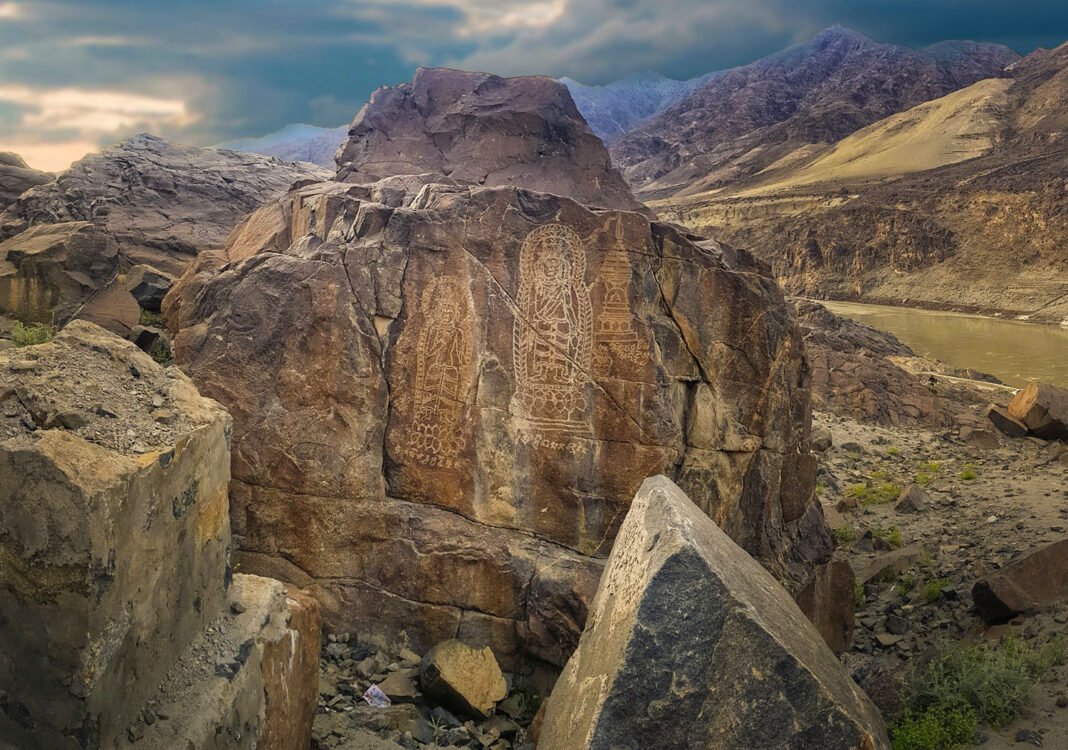
The Hodar rock carvings, in Diamer District near Chilas, are one of the ten major stations of this extraordinary heritage: Buddhist stupas, serene Buddhas, ibex, hunters, and inscriptions in lost scripts, all pecked and chiselled into desert-varnished rock up to 7,000 years ago.
If you love history you can touch, places where the past isn’t behind glass but under your fingertips, Hodar deserves a place on your Pakistan itinerary. This hodar rock carvings travel guide will help you plan the visit — what you’ll see, how to get there, and why these quiet boulders matter so much.
Quick Facts
- Location: Near Hodar village, Diamer District, Gilgit-Baltistan, Pakistan — along the Karakoram Highway between Shatial and Chilas, above the Indus River.
- Famous For: Ancient Buddhist rock art — stupas, Buddhas, and Bodhisattvas carved into boulders — plus prehistoric petroglyphs dating back as far as 5000 BC. One of ten major rock-art stations documented between Hunza and Shatial.
- Nearest City: Chilas, the headquarters of Diamer District, a short drive away on the KKH.
- Accessibility: Very accessible — the carvings lie close to the Karakoram Highway and can be visited on a day trip or a short stop while driving the KKH.
- Known Landmarks: Engraved boulders with stupa images (the German archaeologist Harald Hauptmann recorded around 3,000 stupa images across the Chilas, Thalpan, and Hodar sites), nearby Chilas I and II rock-art sites, Thalpan across the Indus.
- Best For: History lovers, archaeology enthusiasts, photographers, and KKH road-trippers who want more than mountain views.
Why Visit Hodar Rock Carvings
Pakistan’s northern mountains are famous for their peaks, but their rocks tell an equally staggering story. And Hodar is one of the best places to read it. Stand before a boulder at Hodar and you might see a beautifully detailed stupa, its dome, stairway, and parasol all rendered by a chisel-wielding Buddhist artist some fifteen hundred years ago. Turn the boulder and find ibex and markhor, hunting scenes, and stick-figure humans pecked with stone tools five thousand years before that. Few places on Earth compress so much human history into a single afternoon’s walk.
What makes Hodar special is its authenticity. Also, this is not a reconstructed heritage park with ticket booths and audio guides. It is the real thing, in situ, exactly where travellers left it — on the old Indus route that connected Gandhara with the Silk Roads. The carvings were made by the very people who walked this corridor: merchants marking a safe passage, pilgrims expressing devotion, soldiers and invaders recording their presence, and local people recording their hunts and their gods.
When you trace a carved ibex with your eyes, you are looking at the work of someone who stood on that exact spot millennia ago and felt the same mountain wind.
A Human Story on the Highway
Hodar is also the perfect cultural counterpoint to a northern areas road trip. Most KKH itineraries are all about scenery — the Indus gorge, Nanga Parbat viewpoints, the climb to Gilgit and Hunza. A stop at Hodar adds depth: suddenly the landscape has a human story stretching back to the Bronze Age. And because the site sits right on the highway corridor, it costs you almost nothing in time — an hour or two, a short walk among the boulders, and your whole journey feels richer.
For the thoughtful traveller, Hodar also carries a quiet urgency. Also, much of this rock art lies in areas affected by development, and scholars have spent decades racing to document it. The pioneering work of Pakistan’s own Ahmad Hasan Dani and Germany’s Karl Jettmar and Harald Hauptmann preserved thousands of images for posterity. Visiting respectfully, and telling others about the site, is a small way of honouring that heritage.
History of Hodar Rock Carvings
The story of the Hodar carvings begins around 5000 BC — seven thousand years ago. The earliest petroglyphs in the region show single animals, triangular human figures, and hunting scenes in which the animals are sometimes larger than the hunters. These were pecked into the rock with stone tools. Also, the thick dark patina (desert varnish) that has formed over them is itself proof of their immense age. They are the work of prehistoric communities living along the Indus, for whom the ibex and the hunt were central to life.
Centuries passed, and the Indus corridor became one of the great arteries of the ancient world. Also, from around the beginning of the Common Era, Buddhist travellers — monks, pilgrims, and merchants moving between Gandhara, Central Asia. China — began carving their faith into the rocks. These later carvings were often executed with a sharp chisel rather than pecked with stone. They are unmistakably Buddhist: stupas in domed and tower-like forms complete with stairways, platforms, and parasols. Serene Buddhas in Gandharan style; and Bodhisattvas such as Avalokiteshvara and Maitreya. Inscriptions in Kharoshthi and Brahmi scripts accompany many panels, recording names, donations, and prayers.
Invaders, Traders and Pilgrims
The carvings were left by an extraordinary cast: invaders, traders, and pilgrims passing along the trade route, as well as local people. Also, a short Kharoshthi inscription found at Chilas mentions “Kaboa” — interpreted by the great Pakistani archaeologist Ahmad Hasan Dani as the Kharoshthi form of “Kamboja,” suggesting this region was once part of the ancient Kamboja kingdom. Dani, who laid the foundation of rock-art studies in Pakistan, wrote about these sites in his books “Chilas: The City of Nanga Parbat” and “Human Records on the Karakoram Highway.”
Systematic documentation began in earnest with the German-Pakistani expeditions: the ethnologist Karl Jettmar pieced together the region’s history from the inscriptions in his “Rockcarvings and Inscriptions in the Northern Areas of Pakistan” and the later “Between Gandhara and the Silk Roads,” while Harald Hauptmann of the Heidelberg Academy spent decades recording the sites — including Hodar, which he listed among the ten main field stations between Shatial and Thalpan (Shatial, Harban, Diamer-Basha, Khanbari, Thor, Minar-Gah, Oshibat, Hodar, Chilas, and Thalpan). Hauptmann recorded some 3,000 images of stupas alone across the Chilas, Thalpan, and Hodar sites.
Later Pakistani scholars, including Muhammad Nasim Khan, continued the survey and documentation work.
Why here? Scholars note that these carving clusters sit near sharp bends and crossings of the Indus — natural road stations where caravans rested overnight. Also, with time to wait, travellers worshipped, reflected, and carved. What began as roadside devotion grew, over centuries, into one of the densest concentrations of rock art anywhere in the world.
Top Things to Do in Hodar Rock Carvings
Walk Among the Engraved Boulders
The core experience is beautifully simple: walk the boulder fields and find the carvings. Also, look for the stupa panels — domed structures with stairways and parasols — and the serene Buddha and Bodhisattva figures in Gandharan style. In fact, the ibex and hunting scenes are older and often subtler; look for them on flatter, more weathered surfaces. Early morning or late afternoon light rakes across the carvings and makes them far easier to see and photograph.
Read the Landscape
Hodar’s carvings only make full sense in their setting. Also, stand back and take in the Indus bending below, the Karakoram Highway threading the gorge. In fact, the barren mountains rising on every side. This was the Silk Road corridor — every caravan between Central Asia and the subcontinent funnelled through valleys like this one. The geography explains the art.
Visit the Chilas Rock Art Sites
A short drive away are the even richer Chilas I and II sites. Also, Chilas I sits above the Karakoram Highway opposite the Thalpan Bridge, with a celebrated panel of the Bodhisattvas Avalokiteshvara and Maitreya beside a large stupa with a Brahmi inscription. In fact, Chilas II and the Shing Nala site (on the right bank of the Indus) hold more superb Buddhist engravings. Combine Hodar with these in a single day for the full picture.
Cross to Thalpan
Across the Indus from Chilas I lies Thalpan, home to some of the finest stupa engravings in the region — including a Buddha in preaching pose seated on a lotus, surrounded by five stupas. The contrast between the sites deepens your appreciation of the tradition’s range.
Photograph the Petroglyphs
The carvings photograph beautifully in low, raking light. Also, a polarising filter helps cut glare on the varnished rock. In fact, remember: never chalk, paint, or wet the carvings to make them show up better — oils and chemicals damage the patina permanently.
Famous Places In and Around Hodar Rock Carvings
- Chilas I rock art site: The richest nearby site — Bodhisattva panels and inscribed stupas above the KKH.
- Chilas II and Shing Nala: More superb Buddhist engravings on both banks of the Indus.
- Thalpan: Across the river — preaching Buddha and intricate stupa panels.
- Shatial: Another major carving station down the KKH toward the south, with its own stupa clusters.
- Chilas town: Diamer District headquarters — bazaar, food, and fuel stop.
- Nanga Parbat viewpoint: The classic KKH viewpoint of the 8,126-metre giant, a short drive from Chilas.
How to Reach Hodar Rock Carvings
Hodar sits on the Karakoram Highway corridor in Diamer District, between the Shatial area and Chilas town — one of the most straightforward heritage stops in the northern areas. Also, the nearest hub is Chilas.
From Islamabad: Take the Karakoram Highway north via Mansehra, Battagram. Also, Besham to Chilas — roughly 450–470 km, typically 10–12 hours of driving with the mountain road conditions. Many travellers break the journey overnight in Naran (in season) or Besham. From Chilas, Hodar is a short drive along the KKH toward Shatial. Alternatively, in summer (roughly June to October), the shorter route via Naran and the Babusar Pass reaches Chilas from the Kaghan side — spectacular and several hours quicker when open.
From Lahore: Drive or take the motorway to Islamabad, then follow the Islamabad route above. Allow two days with an overnight stop.
Reaching Hodar from Karachi
From Karachi: Fly to Islamabad (around 2 hours), then continue by road as above. There are no airports near Chilas; the nearest are Gilgit and Skardu, both a long drive away.
Nearest airport: Gilgit Airport (domestic, weather-dependent), roughly a 4–5-hour drive from Chilas on the KKH.
Road conditions by season: The KKH through the Indus gorge is open year-round but prone to landslides, especially in the monsoon (July–August) — check conditions before travelling. The Babusar Pass route is seasonal (approximately June–October) and closed by snow in winter. Summer in the gorge is intensely hot; winter is cold but the road stays open.
Transport options: NATCO and other coach services run Islamabad–Gilgit via Chilas daily. Also, private cars and hired vans give you the freedom to stop at the carving sites. In fact, From Chilas, a local taxi or your own vehicle covers the short hop to Hodar. The boulder fields themselves are explored on foot — wear sturdy shoes, as the terrain is rough and there are no developed paths.
Route Details
- Drive the KKH from Islamabad/Mansehra north to Chilas (or via Naran–Babusar in summer).
- Base yourself in Chilas town for the night.
- Drive the KKH a short distance toward Shatial to reach the Hodar area; ask locally for the exact boulder fields, as signage is minimal.
- Explore on foot in the cool of morning or late afternoon; combine with Chilas I and II the same day.
- Continue north to Gilgit and Hunza, or return south — the carvings make a perfect stop in either direction.
Where to Stay in Hodar Rock Carvings
Hodar is a village, not a tourist town. Also, you stay in nearby Chilas, which has a solid range of options for a KKH transit town.
Mid-range hotels in Chilas: Several mid-range hotels and guesthouses cluster along the KKH in Chilas town, offering clean rooms, attached baths, and generator backup (load-shedding is common). Also, these are the comfortable choice for most visitors.
Budget guesthouses: Simple, inexpensive guesthouses and rest houses serve backpackers and coach travellers — basic but friendly.
Government rest houses: The area has government-run rest houses that can sometimes be booked through the relevant departments — quiet and well-located if you can arrange it.
Camping: Not recommended at the carving sites themselves. Also, the terrain is rocky, water is scarce, and summer heat in the gorge is fierce. In fact, camp only at established spots with permission.
Where to Eat: Local Foods of Hodar Rock Carvings
Chilas town runs on hearty highway food. Also, the dhabas along the KKH serve the classics done well: chicken and mutton karahi, daal fry, mixed sabzi, and fresh tandoori rotis, with chai to finish. In fact, chapli kebabs — the great Pashtun contribution to the region’s cuisine, given the Pashtun settlers in the area — are a must-try. In summer, Chilas is known for its fruit: pomegranates, figs, and grapes from the irrigated orchards are sold fresh in the bazaar.
Carry plenty of water and snacks for the boulder fields. There are no shops at the carvings, and the gorge heat is unforgiving. A dhaba meal in Chilas is very budget-friendly. If you’re continuing to Gilgit, you’ll find a wider restaurant scene there. If heading south, Naran (in season) has the full tourist-food range.
Weather in Hodar Rock Carvings
Hodar sits in the Indus gorge, one of the hottest inhabited valleys in the northern areas. Summers are genuinely fierce — this is desert heat bouncing off rock walls — while winters are cold and dry. Also, the shoulder seasons are the sweet spot for exploring the boulder fields on foot.
| Season | Temperature Range | Conditions |
|---|---|---|
| Winter (Dec–Feb) | -2 to 12°C | Cold, dry, clear. Good for sightseeing; nights near freezing. |
| Spring (Mar–May) | 15 to 35°C | Warming fast. March–April is pleasant; May turns hot. |
| Summer (Jun–Aug) | 30 to 45°C+ | Extremely hot in the gorge. Visit carvings only at dawn or dusk; carry water. |
| Autumn (Sep–Nov) | 15 to 32°C | The best season — clear skies, manageable heat, perfect light for the carvings. |
Language and Culture of Hodar Rock Carvings
The people of the Chilas and Hodar area are predominantly Shina speakers, with Pashtun settlers speaking Pashto. Also, Urdu and some English are widely understood. Diamer District has a conservative, traditional mountain culture — dress modestly (this matters here more than in Hunza), greet people politely, and ask permission before photographing anyone.
Culturally, the carvings themselves are the point: this valley was Buddhist for centuries before the arrival of Islam. The rock art is the most eloquent surviving witness to that era. Treat the site as what it is — an open-air museum and, for many, a sacred place. Do not climb on carved boulders unnecessarily, never add your own marks (graffiti on petroglyphs is vandalism of a 7,000-year-old heritage), and take all litter with you. If you meet local guides or elders who know the sites, listen — their knowledge of which boulder holds what is often better than any book.
Shopping in Hodar Rock Carvings
Chilas bazaar covers the practical needs: dried fruit (especially the local pomegranates in season), nuts, and basic supplies for the road north. You’ll find simple handicrafts — woollen items, traditional caps — but this is not a handicraft hub like Hunza or Skardu. Shop with modest expectations and you’ll find honest, inexpensive goods. There are no shopping malls in Diamer District. For serious souvenir hunting, save it for Gilgit or Hunza further north.
Travel Tips for Hodar Rock Carvings
Packing Essentials
Sun protection is non-negotiable in the gorge: hat, sunglasses, high-SPF sunscreen, and at least two litres of water per person. Also, sturdy walking shoes with ankle support for the boulder fields, a camera with a polarising filter. A small first-aid kit. A pair of binoculars helps spot high carvings on cliff faces.
Safety Tips
The boulder fields are wild terrain — watch your footing, especially on loose scree, and don’t explore alone in the heat of the day. Also, tell your hotel where you’re going. The KKH itself demands respect: drive in daylight, check landslide updates in monsoon season, and keep fuel topped up — stations are sparse in the gorge.
Money & Connectivity
Carry cash in Pakistani rupees — Chilas has limited ATM coverage and the carving sites have none. Mobile signals (SCO, Telenor, Zong, Jazz) work along the KKH corridor but can drop in the deeper gorge stretches. Download offline maps before you leave Islamabad.
Best Time to Visit Hodar Rock Carvings
October to November — Ideal
Clear skies, comfortable temperatures, and the low autumn sun rakes beautifully across the carvings. Also, this is the best time for photography and unhurried exploring.
March to April — Very Good
Pleasant spring weather before the gorge heats up. Wildflowers in the irrigated patches; good light; fewer travellers.
May to September — Hot but Possible
Visit the boulders only at dawn or late afternoon to avoid dangerous heat. Also, the Babusar route is open, making access from Naran easy. In fact, monsoon landslides can disrupt the KKH — check road status.
December to February — Quiet
Cold but clear; the carvings are still accessible. The Babusar route is closed, so come via the KKH from the south. Fewer facilities open in Chilas.
Final Thoughts
The Hodar rock carvings will never have the fame of Taxila or Mohenjo-daro, and that is precisely their charm. Also, here, seven thousand years of human presence lie scattered across a hillside above the Indus, free for anyone willing to look closely. In fact, in an age of curated experiences, Hodar offers something rarer: discovery. You find the stupas yourself. You puzzle out the ibex yourself. And for a moment, across the millennia, you are in direct contact with the hands that made them.
If your northern journey takes you up the Karakoram Highway — and it should — give Hodar an hour of your day. Also, walk slowly, look carefully, and leave only footprints. The stones have waited thousands of years for visitors; they will reward the ones who come with respect.
FAQs
Where are the Hodar Rock Carvings located?
Near Hodar village in Diamer District, Gilgit-Baltistan, along the Karakoram Highway between Shatial and Chilas, above the Indus River.
What can I see at Hodar?
Ancient petroglyphs including Buddhist stupas, Buddhas and Bodhisattvas (around 1,500 years old), plus much older prehistoric carvings of animals and hunting scenes dating back as far as 5000 BC, with inscriptions in Kharoshthi and Brahmi scripts.
What is the best time to visit Hodar Rock Carvings?
October–November and March–April offer the best weather and light. Also, summer is extremely hot in the gorge — visit at dawn or dusk. Winter is cold but the KKH stays open.
How do I reach Hodar?
Drive the Karakoram Highway to Chilas (10–12 hours from Islamabad, or via Naran–Babusar in summer), then a short drive along the KKH to the Hodar area. The boulder fields are explored on foot.
A Safe Roadside Heritage Stop
Is Hodar safe for tourists?
Yes — it is a roadside heritage stop on the main highway. Also, Take normal mountain-road precautions, carry water, and explore the boulders in daylight.
Is Hodar suitable for families?
Yes, with supervision — children love spotting the animal carvings. Also, keep them close on the uneven boulder terrain and avoid the midday heat.
Where can I stay near Hodar?
In Chilas town — mid-range hotels, budget guesthouses, and rest houses along the KKH, a short drive from the carvings.
Can I combine Hodar with other rock art sites?
Absolutely — and you should. Also, Chilas I and II, Shing Nala. Thalpan are all nearby and together form one of the world’s great rock-art landscapes. Our Chilas rock carvings guide covers the neighbouring sites in detail.
For more on the region, read our Chilas Valley travel guide, compare with the rock art of Punjab in our Chenab Nagar rock art guide, or browse the full Explore Pakistan collection.