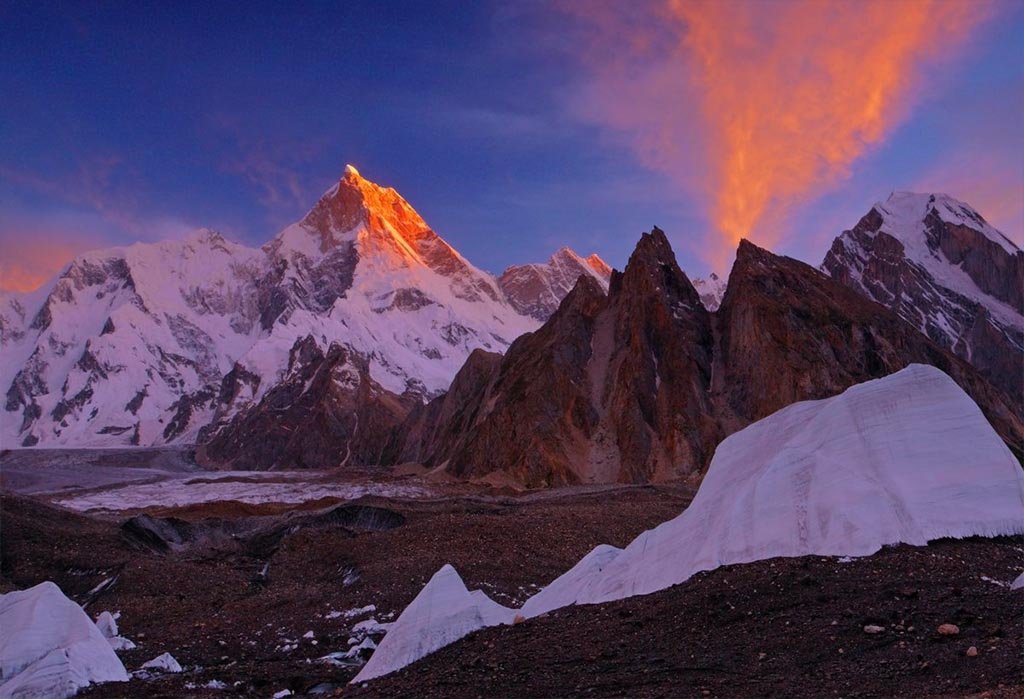
At the end of the road, past the last village, the Karakoram simply takes over. Hushe Valley — the highest inhabited valley of Ghanche District in Baltistan — is where Pakistan’s greatest mountains stop being postcards and start being neighbours. Masherbrum (7,821 m) fills the sky. The spear of Laila Peak rises over the Gondogoro Glacier. And from this quiet Balti valley begin some of the most legendary treks on Earth, including the crossing of Gondogoro La to K2’s base camp. If your heart beats faster at the thought of the high Karakoram without the crowds, this Hushe Valley travel guide will help you plan the journey of a lifetime.
Quick Facts
- Location: Ghanche District, Gilgit-Baltistan — the last valley on the road past Khaplu, in the Masherbrum mountains of the Karakoram
- Altitude: Hushe village sits around 3,180 m (10,420 ft); the valley floor ranges roughly 3,050–3,600 m
- Famous For: Gateway to Gondogoro La (5,585 m), Masherbrum Base Camp, Laila Peak (6,096 m), and the K6/K7 base camps
- Nearest City: Skardu — about 140 km, 6–8 hours by jeep via Khaplu
- Accessibility: Jeep-only mountain road from Khaplu; no public transport to the valley itself
- Known Landmarks: Masherbrum (7,821 m), Laila Peak, Gondogoro Glacier, Charakusa Glacier, Kande village
- Best For: Trekkers and mountaineers, adventure travellers, culture seekers, photographers
Why Visit Hushe Valley
Most travellers to the Karakoram go where the crowds go — Hunza, Fairy Meadows, the K2 base camp trail from Askole. Hushe is the alternative for those who want the same calibre of mountains with a fraction of the footfall. This is the last permanently inhabited settlement before the great glaciers begin, a place where terraced barley fields end and the ice world starts, and the transition happens within a single day’s walk. Trekkers here have called it the Yosemite of Pakistan — granite walls, hanging glaciers, and meadows that feel designed for wonder.
The mountain credentials are beyond argument. Above the valley rises Masherbrum (7,821 m), once known as K1 and often called the Queen of Peaks, its vast south face dominating the road into Hushe. Nearby stand the needle of Laila Peak (6,096 m) — one of the most photographed summits in the Karakoram — and the formidable pair of K6 (7,281 m) and K7 (6,934 m) above the Charakusa Glacier. And then there is Gondogoro La, the 5,585-metre pass whose 1986 route linked Concordia and K2 base camp to Hushe, making this valley the exit — or entrance — of one of the world’s great trekking circuits.
But Hushe is not only about summits. It is a living Balti valley, and that may be its deepest reward. The people of Hushe and its gateway village Kande have hosted expeditions since the 1960s, when Hushe men first began working as cooks and porters for mountaineering teams. Three decades of trekking tourism have brought real change — the village is no longer the desperately poor place it once was — but the welcome remains genuine, the culture intact, and the apricot orchards and stone houses as photogenic as ever. Stay in a village guesthouse, share a meal with a Balti family, and the Karakoram stops being scenery and becomes home.
Finally, consider the sheer exclusivity of the experience. While hundreds crowd the famous viewpoints elsewhere, Hushe’s trails remain quiet. You can walk for days in the Gondogoro or Charakusa valleys and meet almost no one but shepherds, ibex and the occasional expedition. For the traveller who wants the Karakoram raw — this is it.
History of Hushe Valley
Hushe’s story is Baltistan’s story in miniature. The valley’s people are Balti, of Tibetan descent, speaking a Tibetan dialect and carrying a culture shaped by centuries on the old trade routes between Baltistan, Ladakh and Yarkand. Like the rest of Baltistan, the valley converted to Islam centuries ago — the region’s distinctive Noorbakhshi and Shia traditions took root here — but the Tibetan imprint survives in the language, the architecture of stone-and-timber houses, the terraced fields, and the polo grounds.
For most of its history, Hushe was remote to the point of isolation — a cluster of villages at the end of a gorge, farming barley and apricots, cut off by snow for months each year. The modern era arrived with the mountaineers. From the 1960s onward, Hushe men began working as porters and cooks for the great Karakoram expeditions, and the valley’s fortunes slowly changed. Where Askole served the Baltoro, Hushe served the Masherbrum range — its men became the backbone of expeditions to Masherbrum, the Gasherbrums’ southern approaches, and the Charakusa’s granite towers.
The pivotal year was 1986, when a route was established connecting Concordia on the upper Baltoro Glacier to Hushe via the Gondogoro Pass. Suddenly the valley was on the map of world trekking: every K2 base camp trek that exits over Gondogoro La descends into Hushe, and the village became the place where exhausted trekkers first meet green fields again. International trekking companies have run trips here for over thirty years, funding schools, clinics and community projects along the way — a model of how mountain tourism, done right, can transform a valley.
Today Hushe sits within the Central Karakoram National Park, and its future is being written as a balance between growing adventure tourism and preserving the fragile high-mountain environment and the Balti way of life. The road from Khaplu has improved, guesthouses have multiplied, and the valley that was once “extremely remote and impoverished” now welcomes the world — on its own terms.
Top Things to Do in Hushe Valley
Trek to Masherbrum Base Camp
The valley’s classic trek. The trail climbs from Hushe through shepherd pastures and juniper forest toward the mighty south face of Masherbrum (7,821 m), one of the most beautiful big-mountain faces in the Karakoram. The base camp area offers staggering close-up views and a genuine expedition atmosphere. Allow 4–6 days round trip from Hushe with a local guide; the best months are June to September.
Cross Gondogoro La (5,585 m)
One of the world’s great trekking passes. The full K2 base camp–Gondogoro La circuit starts at Askole, climbs the Baltoro to Concordia, and exits over the pass into Hushe — about three weeks of the finest mountain travel on Earth. Crossing the La itself is a serious undertaking: an alpine start (often around 1–2 a.m.), crampons, fixed ropes on the steep snow slopes, and a dawn panorama of four 8,000-metre peaks — K2, Broad Peak, Gasherbrum I and Gasherbrum II. Only attempt with an experienced outfitter and proper acclimatisation. Our Gondogoro La travel guide covers the pass in detail.
Gaze at Laila Peak
You don’t need to climb it to be moved by it. The spear-like spire of Laila Peak (6,096 m) rises above the Gondogoro Glacier, its perfect needle profile visible from camps at Khuspang and along the trek. First climbed in 1987 and first skied from the summit in 2018, it is a mountaineer’s mountain — but for trekkers it is pure theatre.
Explore the Charakusa Valley
The side valley east of Hushe leads to the Charakusa Glacier and the base camps of K6 and K7, among the most dramatic granite towers in the Karakoram. KE Adventure’s notes call this stretch “pure Karakoram magic,” and they’re right — ibex on the precipices, wild roses and juniper lower down, and a silence you can feel. A superb 3–5 day side trek from Hushe.
Walk to Kande Village
Kande is the gateway village below Hushe, where the jeep road effectively begins the high valley. A walk between Kande and Hushe passes through the classic Balti landscape — terraced fields, apricot orchards, irrigation channels, and children who will race you to the next bend. It is the gentlest, most human way to experience the valley.
Meet the Balti Culture
Accept every invitation. Village guesthouses and homestays offer a window into Balti life — the food, the music, the stories of expeditions past. Many Hushe families have three generations of mountain-porter history; ask an elder about the early expeditions and settle in for an evening.
Photography and Stargazing
Masherbrum at dawn, Laila Peak catching the last light, the Milky Way over silent glaciers — Hushe is brutally photogenic. The air is thin, dry and clear; night skies here are among the darkest in Pakistan.
Famous Places In and Around Hushe Valley
- Masherbrum (7,821 m) — the Queen of Peaks, filling the head of the valley
- Laila Peak (6,096 m) — the Karakoram’s most perfect needle
- Gondogoro La (5,585 m) — the great pass to Concordia and K2
- Gondogoro Glacier — the ice highway below the pass
- Charakusa Glacier — gateway to K6 (7,281 m) and K7 (6,934 m)
- Chogolisa (7,665 m) — the bride of the Masherbrum range, visible from the high camps (see our Chogolisa travel guide)
- Kande village — the gateway settlement below Hushe
- Khaplu — the district headquarters en route, with its restored palace and mosque
How to Reach Hushe Valley
Reaching Hushe takes commitment — which is exactly why it remains unspoiled. There are no shortcuts, but the journey is magnificent.
- From Islamabad: Fly to Skardu (about 1 hour, weather permitting — the most popular option) or drive the Karakoram Highway via Chilas (20+ hours; break the journey with an overnight stop). From Skardu, jeeps run to Khaplu and onward to Hushe — roughly 140 km and 6–8 hours on mountain roads.
- From Lahore: Fly to Islamabad, then connect to Skardu; or drive to Islamabad and follow the Islamabad routing.
- From Karachi: Fly to Islamabad or Skardu (via Islamabad) — the only sensible option.
- Nearest airport: Skardu Airport, with regular flights from Islamabad.
Road conditions by season: The Skardu–Khaplu–Hushe road is a mountain jeep track — rough, narrow in places, and impassable in winter snow. It is reliably open roughly June to October. Landslides can cause delays after heavy rain.
Transport options: 4×4 jeeps are the only practical transport into the valley — hired in Skardu or Khaplu, or arranged through a trekking operator (strongly recommended, as operators handle the logistics chain). There is no public transport to Hushe itself.
Route Details
- Fly (or drive) from Islamabad to Skardu.
- Drive east from Skardu along the Indus and then the Shyok River to Khaplu (the Ghanche district headquarters) — about 3–4 hours on an improving road.
- From Khaplu, take the jeep road up the Hushe gorge, passing through Kande village.
- Arrive in Hushe (about 3,180 m) — the road ends and the trails begin.
- Trekking parties typically spend a night or two acclimatising in the village before heading for Masherbrum base camp, Gondogoro or Charakusa.
For the wider Baltistan region, see our Explore Pakistan collection and the Gasherbrum IV travel guide for the neighbouring giants.
Where to Stay in Hushe Valley
Accommodation here is simple, warm and refreshingly uncommercialised.
Village guesthouses and homestays: Hushe and Kande have a growing number of family-run guesthouses — basic rooms, home-cooked Balti food, and hosts who know every trail in the valley. This is the best way to experience Hushe; book through a local operator or ask in Khaplu, as online listings are thin.
Trekking camps: On the trails, you sleep in expedition tents at established camps (Khuspang, Saicho and others on the Gondogoro route; base camp sites on the Masherbrum and Charakusa approaches). Operators provide full camp support with cooks and porters — the Hushe valley’s men have been doing this work since the 1960s.
Khaplu and Skardu: For proper hotels — from mid-range to comfortable — stay in Khaplu (closer, with the Serena palace hotel and local guesthouses) or Skardu (widest choice) before and after your valley time.
Where to Eat: Local Foods of Hushe Valley
Balti cuisine is hearty, Tibetan-influenced mountain food — exactly what you want at 3,000 metres.
Dishes to try: Mamtu (steamed meat dumplings), balay (hand-pulled noodle soup), khambir (thick wholewheat bread baked on hot stones, eaten with apricot oil or butter tea), and chamus (fresh apricot juice in summer). Butter tea — salty, warming, an acquired taste you’ll acquire fast — is the social fuel of the valley. Dried apricots, apricot kernels and local honey are the classic take-homes.
Where to eat: Your guesthouse or homestay is the kitchen that matters — meals are typically included and cooked by the family. On trek, expedition cooks produce astonishingly good food at 4,000 m+. Khaplu town has dhabas and small restaurants for the drive in and out.
Costs: Village meals are inexpensive and generous; expedition catering is bundled into trek packages. Carry cash — there are no card facilities in the valley.
Weather in Hushe Valley
Hushe is a cold desert at over 3,000 m: intense sun by day, freezing nights, and very little rain. The trekking season is short and precious. Temperatures are approximate.
| Season | Temperature Range | Conditions |
|---|---|---|
| Winter (Dec–Feb) | -15°C to -2°C | Deep snow; road closed; valley cut off — for locals only |
| Spring (Mar–May) | -5°C to 12°C | Melting snow; road reopens late spring; few visitors |
| Summer (Jun–Aug) | 8°C to 25°C | Peak trekking season; long clear days; cold nights even in July |
| Autumn (Sep–Nov) | -5°C to 15°C | Golden poplars; crisp and quiet; road closes with the first heavy snow |
Language and Culture of Hushe Valley
The valley speaks Balti, a Tibetan dialect — you will hear its distinctive cadence in every guesthouse. Urdu is widely understood, and many guides speak good English. The culture blends Tibetan heritage with Islamic faith; the people are renowned across the Karakoram for their hospitality and their mountaineering tradition.
Visitors should dress modestly, ask before photographing people, and respect the rhythms of village life — prayer times, meal times, and the agricultural calendar that still governs the valley. If you’re invited to a family meal or a cup of butter tea, accept: these are the moments you’ll remember longer than any summit view. Bargaining is gentle here, not aggressive; a fair price offered with a smile works best.
Shopping in Hushe Valley
Hushe itself has no shops to speak of — plan to buy supplies in Skardu or Khaplu. Khaplu’s bazaar, on your way in, is the place for authentic souvenirs: handwoven Balti woollens, traditional Balti caps, apricot oil and dried apricots, and local handicrafts. Prices are fair and the shopping is refreshingly free of tourist-trap pressure. There are no shopping malls anywhere in the region — Skardu has the nearest proper markets.
Travel Tips for Hushe Valley
Packing Essentials
A warm down jacket, thermal layers, a windproof shell, and a four-season sleeping bag — nights are cold even in August. Sturdy broken-in trekking boots, trekking poles, glacier sunglasses, high-SPF sunscreen, a headlamp, water purification, and a comprehensive first-aid kit including altitude medication (consult your doctor). A power bank and a good camera are mandatory.
Safety Tips
Altitude is the main risk: Hushe village itself is at 3,180 m, and treks go far higher. Acclimatise properly, ascend slowly, and descend if you develop persistent headache, nausea or dizziness. Never attempt Gondogoro La or any glacier route without an experienced local guide and proper equipment — crevasses, avalanches and rockfall are real hazards. Hire porters through reputable operators; the valley’s guiding tradition is its safety net. Check current permit requirements for peaks and restricted areas with your operator before you travel.
Money & Connectivity
Carry all cash in Pakistani rupees — there are no ATMs or banks in the valley (Khaplu has limited banking). Mobile signals are weak to nonexistent beyond Khaplu; tell family your itinerary and expected return before you lose coverage. Satellite communicators are worth considering for long treks.
Best Time to Visit Hushe Valley
Summer (June to September) — The Season
The only real window for trekking. The road is open, the high camps are accessible, and the Gondogoro La crossing is in condition (best earlier in the season, late June to July, before snow bridges weaken). July and August are busiest; book jeeps, guides and guesthouses ahead.
Autumn (September to October) — Golden and Quiet
Clear skies, golden trees, and empty trails — beautiful for valley walks and photography, though high passes may already be out of condition. Confirm road status before committing.
Spring (April to May) — The Thaw
The valley wakes up, but snow still blocks the high routes and the road may not be open. For valley culture rather than trekking, late May can work.
Winter (November to March) — Closed
Deep snow closes the road and the valley hibernates. Only for highly experienced winter mountaineers with full local support.
Final Thoughts
Hushe is the Karakoram with the volume turned down and the grandeur turned up. It asks more of you than Hunza does — a longer road, a rougher jeep track, thinner air — and it gives back more than almost anywhere else in Pakistan: the Queen of Peaks at breakfast, a 6,000-metre needle at sunset, and evenings with Balti families who have lived in the shadow of giants for generations.
Whether you come to cross Gondogoro La, to stand beneath Masherbrum, or simply to walk the quiet lanes of Kande with the greatest mountains on Earth for company, Hushe will recalibrate your sense of what a valley can be. Go in summer, go with respect, and go prepared — the last village before the glaciers does not disappoint. For a gentler northern escape afterwards, our Malam Jabba guide is the perfect contrast.
FAQs
Where is Hushe Valley located?
In Ghanche District, Gilgit-Baltistan — the last valley past Khaplu in the Masherbrum mountains of the Karakoram. Hushe village sits at about 3,180 m and is the highest settlement in the district.
What is the best time to visit Hushe Valley?
June to September for trekking — the road is open and the high routes (Masherbrum base camp, Gondogoro La, Charakusa) are in season. The valley is snowbound and inaccessible roughly November to March.
How do I reach Hushe Valley from Islamabad?
Fly to Skardu (about 1 hour), then take a 4×4 jeep via Khaplu to Hushe — about 140 km and 6–8 hours on mountain roads. The road journey from Islamabad via the Karakoram Highway takes 20+ hours.
Is Hushe Valley safe for trekkers?
Yes, with the right preparation. Go with an experienced local guide and reputable operator, acclimatise properly, and never attempt glacier passes without proper equipment. The valley’s people are famously hospitable.
What is Gondogoro La and can beginners cross it?
Gondogoro La (5,585 m) is the high pass linking Concordia/K2 base camp with Hushe. It is a serious undertaking — crampons, fixed ropes, an alpine start — suited to fit, acclimatised trekkers with mountaineering support, not beginners.
Where can I stay in Hushe Valley?
Family-run guesthouses and homestays in Hushe and Kande, expedition tent camps on the trails, and hotels in Khaplu and Skardu before and after.
What food is Hushe known for?
Balti mountain cuisine — mamtu dumplings, balay noodle soup, khambir bread with apricot oil, salty butter tea, and summer apricots.
Which peaks can I see from Hushe Valley?
Masherbrum (7,821 m), Laila Peak (6,096 m), K6 (7,281 m), K7 (6,934 m) and Chogolisa (7,665 m) — plus, from the high passes, K2, Broad Peak and the Gasherbrums.