High on the rocky foothills above the Indus, where the Khasor range drops toward the Chashma Barrage, stand the ruins of a forgotten kingdom. The Kafirkot Temples — two ancient fortified temple complexes in Dera Ismail Khan district, Khyber Pakhtunkhwa — are the remains of the Hindu Shahi civilisation that ruled these lands around the 7th century CE, long before the Ghaznavid armies swept through in the 11th century. Five ruined temples, massive defensive walls of strange honey-combed stone. A silence so complete you can hear the wind move through thirteen centuries of history.
This Kafirkot Temples travel guide gives you the full picture: why these ruins deserve your journey, the real history of the Hindu Shahis, what to see at both the northern and southern complexes, how to reach them from Islamabad, Lahore and Karachi, where to stay and eat in Dera Ismail Khan, weather by season, and practical advice for visiting a remote archaeological site. Also, for more heritage destinations, see the Explore Pakistan collection.
Quick Facts
- Location: Foothills of the Khasor range, overlooking the Indus near the Chashma Barrage, Dera Ismail Khan District, Khyber Pakhtunkhwa
- Altitude: Low rocky hills above the Indus plain (no high-altitude figure recorded)
- Famous For: 7th-century Hindu Shahi temples and forts; one of the great pre-Islamic archaeological sites of Pakistan
- Nearest City: Dera Ismail Khan — the southern (Bilot) complex is about 55 km north of the city
- Accessibility: By road from Dera Ismail Khan or Mianwali, then a climb on foot up the rocky hill; a private car or hired jeep is the practical option
- Known Landmarks: The five temples, the fort walls, the Indus river and Chashma Barrage below
- Best For: History lovers, archaeology enthusiasts, photographers, and travellers seeking Pakistan’s least-visited ancient sites
Why Visit Kafirkot Temples
Pakistan’s Gandharan Buddhist sites — Taxila, Takht-i-Bahi — are justly famous. Also, the Hindu Shahi chapter of the country’s history is far less visited, and Kafirkot is its most evocative ruin. This is not a manicured archaeological park with ticket booths and signboards. It is a genuine lost world: crumbling temples of porous, honey-combed stone on a windswept ridge, with the Indus glittering below and almost no other visitors. If you have ever wanted to stand alone in a place where history feels undiscovered, Kafirkot delivers that rare thrill.
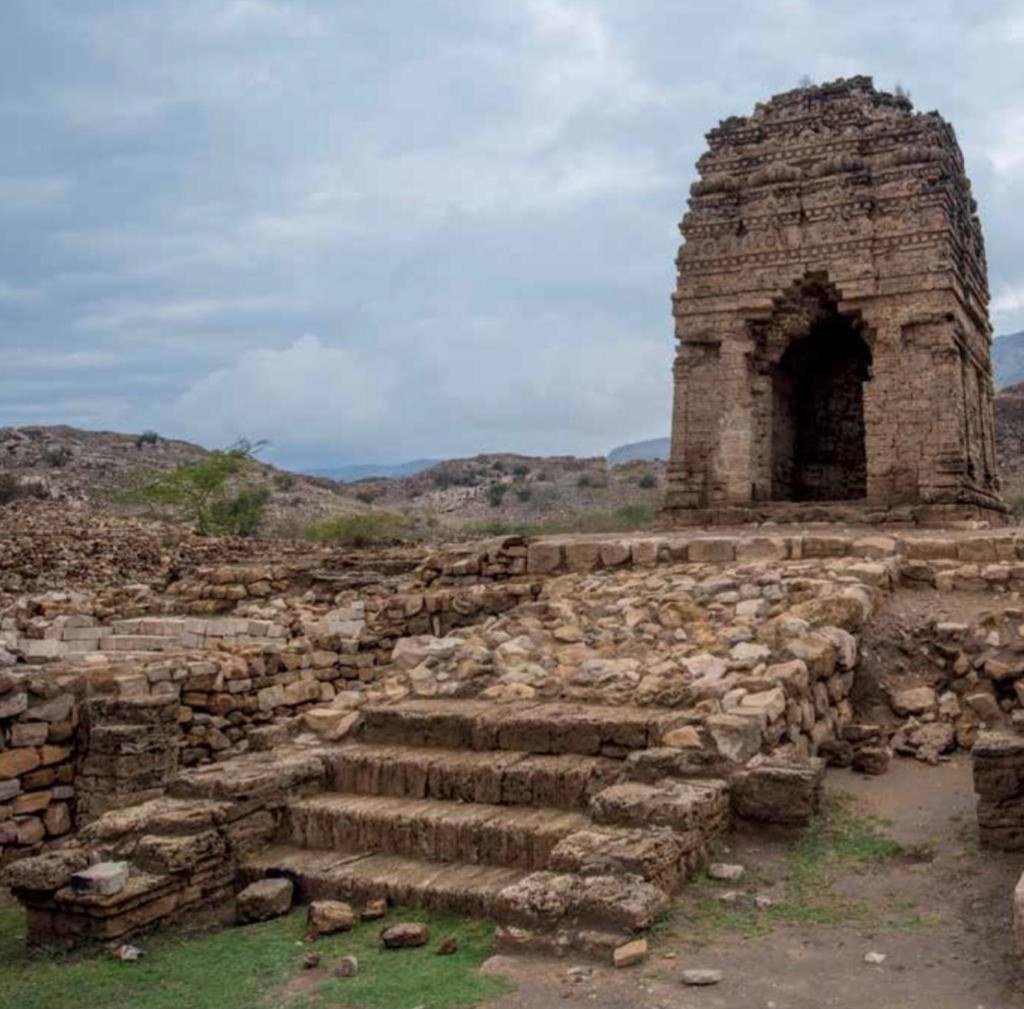
The architecture itself rewards the journey. The temples are built of a curiously honey-combed, drab-coloured stone that is not found in the adjacent hills. Also, the 1915 District Gazetteer of Mianwali recorded the local tradition that it was brought by river all the way from Khushalgarh. The carving, though weathered by a millennium of wind, still shows the skill of the Shahi builders: fine work on walls and ceilings, well-preserved inner chambers, stairways climbing to upper openings. Some restoration work has been done on the standing temple. Its upper floor offers one of the great views in southern Khyber Pakhtunkhwa.
Kafirkot is also a journey into a Pakistan most travellers never see — the southern districts of Khyber Pakhtunkhwa, the Indus at the Chashma Barrage, the market towns of Dera Ismail Khan with their famous sohan halwa. Also, come here and you will understand that Pakistan’s history did not begin in 1947, or even with the Mughals: it runs back through the Ghaznavids, the Hindu Shahis. The ancient Hindu civilisation of the Indus that the old gazetteers described with such awe.
History of Kafirkot Temples
The Kafirkot complexes were built by the Hindu Shahis, the Hindu dynasty that ruled the Gandhara and upper Punjab regions in the first millennium CE. Also, the northern complex (Tilot Kafirkot) and the southern complex (Bilot Kafirkot), about 50 km apart, each consisted of a fortified enclosure — a great outer defensive wall of massive rough stone blocks — containing groups of small Hindu temples. The standing remains are dated to around the 7th century CE, though the sites’ history likely runs deeper.
The Hindu Shahis at Their Peak
The Hindu Shahis were the successors, in this region, of the Buddhist Kabul Shahis. Also, the two lines split, with the Hindu Shahis establishing their kingdom along the Indus. In fact, at the height of Shahi power under King Jayapala, the kingdom stretched from Kabul and Bajaur in the northwest to Multan in the south and the Punjab plains in the east, with the Indus running through its heart.
The Shahis were prolific temple builders: their shrines ran in a chain from Nandana at the eastern end of the Salt Range, through Malot, Katas and Amb, to the west bank of the Indus at the foothills of the Sulaiman and Hindu Kush ranges — Kafirkot and Bilot among them. Eight major temple complexes are attributed to the dynasty.
The end came in the early 11th century. Also, threatened by the rising Ghaznavid power, Jayapala marched on Ghazni — and the long struggle between the Hindu Shahis and the Ghaznavids began. Mahmud of Ghazni’s campaigns pushed deep into the subcontinent, and the Shahi kingdom fell. The Kafirkot forts were destroyed in the 11th century, and the temples were left to the wind.
The only legends that cling to the ruins, recorded in the old gazetteer, tell of the last Hindu rajas, Til and Bil — from whom the two forts take their local names, Tilot and Bilot — “but all traces of rulers and ruled are now lost.”
In the modern era, Kafirkot’s treasures have scattered. Also, sculptures and architectural fragments from the site were dispersed to museums across Pakistan and the world. One of the largest collections outside Pakistan sits in the British Museum in London. The site itself remained little-known until recent years. Pakistani travellers, vloggers and heritage enthusiasts began making the journey — and the ruins started, slowly, to take their place in the country’s tourism story.
Top Things to Do in Kafirkot Temples
Explore the southern (Bilot) complex
Most visitors start at Bilot Kafirkot, near the town of Bilot Sharif about 55 km north of Dera Ismail Khan. Also, climb the rocky hill to the fort enclosure and walk among the temple ruins. In fact, the standing temple here has seen some restoration. In addition, its chambers, stairways and carved ceilings are the best-preserved at either site. Take your time: the complex rewards slow looking. The play of light on the honey-combed stone is best in the morning.
Climb to the northern (Tilot) complex
The northern Kafirkot, south of Kundal near the Chashma Barrage, is the wilder of the two — a steeper climb, fewer visitors. Also, a more complete sense of discovery. In fact, the fort’s great main gate and the terraces of ruined towers unfold as you ascend. The route from the Chashma road involves leaving the main road for the Kundal–Lakki Marwat track, with the serene Chashma Lake alongside — a beautiful drive in itself.
Study the stonework
Look closely at what you are standing on: the porous, honey-combed drab stone that the builders supposedly floated down the river from Khushalgarh, the massive rough blocks of the outer defensive walls, the carved doorways and ceilings. Also, Kafirkot is a masterclass in ancient military-religious architecture. A fort that was also a temple precinct, built to guard the Indus crossing below.
Take in the Indus panorama
Both forts were sited for command of the river. Also, the views are spectacular: the Indus winding below, the Chashma Barrage in the distance, the Khasor hills rolling away. In fact, sunset from the northern fort, with the river turning gold, is one of the great unsung views in Pakistani heritage travel. Bring a wide-angle lens.
Visit the Chashma Barrage and lake
Combine the temples with the Chashma Barrage on the Indus. Also, the reservoir and its surroundings are scenic, with green fields and water birds. In fact, the drive along the lake to the northern complex is part of the experience.
Famous Places In and Around Kafirkot Temples
- Bilot Sharif — the town below the southern complex, with its own shrines and bazaars
- Chashma Barrage — the great Indus barrage near the northern complex
- Kundal — the village near the northern fort, a good tea stop
- Dera Ismail Khan city — the historic Indus city, famous for sohan halwa
- Mianwali — the neighbouring Punjab city on the route from the east
How to Reach Kafirkot Temples
Kafirkot is remote but reachable: the practical base is Dera Ismail Khan city, from which both complexes are day trips by hired car or jeep. Also, the southern (Bilot) fort is about 55 km north of DI Khan. The northern (Tilot) fort lies off the Chashma road toward Kundal.
From Islamabad: Drive to Dera Ismail Khan via Mianwali — roughly 300 km, 5–6 hours on the N-50 and connecting roads. Also, from DI Khan, hire a car for Bilot (about 55 km north, 1–1.5 hours) or for the Chashma road toward the northern complex. In fact, public vans run Islamabad–DI Khan; for the forts themselves you need private transport.
From Lahore: Drive via Bhakkar and Mianwali to DI Khan — a full day’s drive of roughly 400–450 km, 7–9 hours. Most travellers break the journey or start very early. Also, alternatively, drive to Mianwali and approach the northern complex from the east via the Chashma road.
From Karachi: Fly to Islamabad (about 2 hours) and continue by road as above, or fly to Multan and drive northwest to DI Khan. Meanwhile, the full road journey from Karachi is two very long days — flying to Islamabad first is the sensible option.
Nearest airport: Dera Ismail Khan has an airport with limited domestic flights. Islamabad International is the reliable gateway, 5–6 hours’ drive away. Road conditions: The DI Khan–Bilot and Chashma roads are paved but rural. The final approaches to both forts are rocky tracks requiring a high-clearance vehicle. The last stretch to each fort is on foot up a steep, rocky hill. Transport options: Private car or hired jeep with a local driver is strongly recommended. Do not rely on public transport beyond DI Khan.
Route Details
- Islamabad → Mianwali → Dera Ismail Khan (N-50; 5–6 hours). Overnight in DI Khan.
- DI Khan → Bilot Sharif (about 55 km north; 1–1.5 hours) for the southern complex; climb the hill to the fort on foot.
- For the northern complex: DI Khan → Chashma road → Kundal–Lakki Marwat track; climb to Tilot fort on foot.
- Carry water, sun protection and sturdy shoes — there are no facilities at either site.
- Return to DI Khan the same day; allow a full day if visiting both complexes.
Where to Stay in Kafirkot Temples
There is no accommodation at the ruins — stay in Dera Ismail Khan city. Also, DI Khan has a solid range of mid-range hotels and guesthouses along its main roads, serving business travellers and visitors to the region. They are simple, clean and inexpensive. A few better-appointed hotels cater to government and corporate guests. Book by phone ahead in winter, when the weather brings more visitors to the region.
For travellers approaching from the east, Mianwali offers similar mid-range options and works as an alternative base for the northern complex. If you prefer more comfort, the practical move is to overnight in Islamabad or Multan and make Kafirkot a long day trip. But you will miss the early-morning light on the stones, which is the best time to photograph them. Wherever you stay, arrange your car and driver the evening before: the forts are not places to arrive at without transport sorted.
Where to Eat: Local Foods of Kafirkot Temples
Eat in Dera Ismail Khan, where the food is one of the genuine rewards of the trip. Also, the city’s signature is sohan halwa — the dense, nut-studded sweet for which DI Khan is famous across Pakistan. It travels well and everyone will thank you.. As a result, buy it from the old city’s halwais and carry boxes home, The region’s savoury food reflects its Saraiki-Pashtun character: chapli kebabs, char-grilled tikkas, hearty daal and fresh tandoori naan from the bazaar tandoors.
The towns of Bilot Sharif and Kundal have tea shops and small dhabas for chai and snacks.. Still, near the forts, eat before you go: there are no restaurants at either complex, Also, carry water and packed food for the climbs. A full dhaba meal in DI Khan is very budget-friendly. Even the city’s better restaurants are modestly priced by big-city standards.
Weather in Kafirkot Temples
Dera Ismail Khan district is hot — one of the hotter parts of Khyber Pakhtunkhwa — with mild winters that make October to March the comfortable season for climbing the forts. Summer visits are possible but punishing; the rocky hills offer no shade.
| Season | Temperature Range | Conditions |
|---|---|---|
| Winter (Dec–Feb) | Around 5–22°C | Mild and sunny; the ideal season for the forts |
| Spring (Mar–Apr) | Around 15–35°C | Warming fast; visit early in the day |
| Summer (May–Aug) | Around 30–45°C | Extremely hot; monsoon humidity July–August; avoid midday climbs |
| Autumn (Sep–Nov) | Around 18–35°C | Cooling from October; good for sightseeing by late October |
Language and Culture of Kafirkot Temples
Dera Ismail Khan sits at a cultural crossroads. Saraiki is widely spoken in the district, alongside Pashto. Also, DI Khan is in Khyber Pakhtunkhwa. In fact, Pashtun and Saraiki communities have lived side by side here for centuries — and Urdu works everywhere. The region is conservative and deeply hospitable: dress modestly, greet people warmly, and accept the inevitable offers of chai.
Two notes for heritage visitors. First, these are the ruins of Hindu temples in a Muslim-majority region — treat them with the same respect you would any sacred site. Also, it do not climb on carved masonry or remove stones. Meanwhile, second, the forts are genuinely remote: tell your hotel where you are going, travel with a local driver, and avoid wandering the hills after dark. The villages around the sites — Bilot Sharif, Kundal — are welcoming to visitors who arrive with courtesy.
Shopping in Kafirkot Temples
The souvenir of this trip is edible: Dera Ismail Khan’s sohan halwa, bought from the city’s famous sweet shops, is the gift to bring home. DI Khan’s bazaars also sell local dry fruits, dates and traditional sweets. Also, the city’s markets are good for everyday Pakistani shopping — fabrics, leather goods and household items at small-town prices.
There are no souvenir shops at the forts themselves (and no shopping malls in the immediate area. Also, this is rural Khyber Pakhtunkhwa, and the bazaars are the real thing). In fact, bargaining is expected in the bazaars; in the fixed-price sweet shops, it is not. Carry cash: cards are of limited use outside the city’s main hotels.
Travel Tips for Kafirkot Temples
Packing Essentials
Sturdy hiking shoes with good grip (the climbs are steep and rocky), sun hat and high-SPF sunscreen, at least two litres of water per person, snacks, a fully charged phone. Also, a camera with a wide-angle lens. A walking stick helps on the descents.
Safety Tips
Travel with a local driver who knows the area; the tracks to both forts are unsigned. Start climbs in the morning and be off the hills well before dark. The stonework is ancient and fragile — do not climb on walls or enter unstable chambers. Check the local security situation before travelling, as you should for any trip in the region, and keep your hotel informed of your plans.
Money & Connectivity
Withdraw cash in Dera Ismail Khan — there are ATMs in the city but none near the forts. Mobile coverage reaches the towns and main roads but is unreliable on the hills; download offline maps. All major networks operate in DI Khan city.
Best Time to Visit Kafirkot Temples
Winter (December–February) — the best season
Mild, sunny days in the low 20s and cool nights make this the perfect season for climbing both forts. Also, clear skies give the best views over the Indus.
Spring (March–April) — good, but go early
Pleasant mornings, hot afternoons. Also, start the climbs at dawn and plan to be down by midday.
Summer (May–August) — avoid
Extreme heat makes the exposed rocky climbs genuinely dangerous in the middle of the day. If you must come, visit only at sunrise.
Autumn (September–November) — the second-best season
Temperatures fall from October; by November the weather is excellent and the light is beautiful for photography.
Final Thoughts
Kafirkot is not an easy destination. That is exactly why it matters. In an age when every beautiful place in Pakistan has a car park and a selfie queue, these thousand-year-old temples still stand in something close to solitude. Also, the wind, the stones, the river below, and the long, strange story of the Hindu Shahis written in honey-combed rock. It is the kind of place that reminds you how deep this country’s history goes.
Go in winter, climb both forts, buy the sohan halwa in DI Khan, and stand on the ridge at sunset watching the Indus turn to gold. Also, few travel days in Pakistan are this rewarding. In fact, for more of the country’s ancient sites, explore the Explore Pakistan collection.
FAQs
Where are the Kafirkot Temples located?
In Dera Ismail Khan District, Khyber Pakhtunkhwa — two fortified complexes in the Khasor foothills overlooking the Indus near the Chashma Barrage: Tilot (northern) Kafirkot near Kundal and Bilot (southern) Kafirkot near Bilot Sharif.
How old are the Kafirkot Temples?
The standing remains date to around the 7th century CE, built by the Hindu Shahi dynasty. The forts were destroyed in the 11th century during the Ghaznavid conquests.
What is the best time to visit Kafirkot?
October to March, when the weather is mild and sunny. Avoid the extreme heat of May to August.
How do I reach Kafirkot from Islamabad?
Drive to Dera Ismail Khan via Mianwali (about 300 km, 5–6 hours), then hire a car or jeep: Bilot is about 55 km north of DI Khan. The northern complex is reached via the Chashma road.
Are the Kafirkot Temples safe to visit?
Yes, with sensible precautions: travel with a local driver, visit in daylight, stay on the established climbs, and check conditions before you go. The sites are remote, so plan accordingly.
Can families visit Kafirkot?
Active families with older children will manage the climbs. Also, the steep, rocky ascents are not suitable for small children or anyone with limited mobility.
Where should I stay?
In Dera Ismail Khan city, which has mid-range hotels and guesthouses. Also, there is no accommodation at the forts themselves.
What food is the area famous for?
Dera Ismail Khan’s sohan halwa is the essential taste — and the essential souvenir. Also, the city’s dhabas serve excellent chapli kebabs, tikkas and fresh naan.