Most travellers come to Katas Raj for the Hindu temples — the shikhara spires rising around a sacred green pond in the Salt Range hills of Chakwal. But beneath and beside those temples lies an older story, one that begins two thousand years before the first Hindu shrine was built here. The Katas Raj Stupa Remains are the weathered bones of a Buddhist stupa raised in the age of Emperor Ashoka, in the 3rd century BCE — a monument the great Chinese pilgrim Xuanzang himself recorded seeing in the 7th century, ringed by ten springs.
This is a destination for travellers who love layers. In a single afternoon at Katas Raj, you can stand on Ashokan Buddhist masonry, climb to Hindu temples of the Shahi kings, look across at a Sikh-era haveli, and hear legends of the Mahabharata’s Pandava brothers — all arranged around a pond that Hindus believe was formed from the tears of Lord Shiva. Few sites in Pakistan compress so much history into so small a space.
This Katas Raj Stupa Remains travel guide focuses on the Buddhist heart of the complex — what the stupa was, who built it, and how to see it — while giving you everything you need to explore the full Katas Raj ensemble: why it deserves your visit, the best time to go, how to reach it, and how to plan the perfect Salt Range day trip.
Quick Facts
- Location: Katas Raj temple complex, near Choa Saidan Shah, Chakwal District, Punjab — in the Salt Range, off the M-2 motorway via the Kallar Kahar interchange
- Altitude: Around 600 metres (2,000 feet) in the Salt Range hills
- Famous For: Remains of a 3rd-century BCE Buddhist stupa attributed to Emperor Ashoka; the wider Katas Raj complex of Hindu temples around a sacred pond
- Nearest City: Chakwal (about 40 km); Choa Saidan Shah is the nearest town
- Accessibility: Good by road — about 2.5 to 3.5 hours from Islamabad and 5 to 6 hours from Lahore; the final approach is through Salt Range roads with some narrow stretches
- Known Landmarks: The stupa’s stone base east of the temples, the Satghara (seven temples), the sacred pond (Katasar), Hari Singh Nalwa’s haveli
- Best For: History and archaeology lovers, Buddhist heritage travellers, Hindu pilgrims, photographers, and Salt Range road-trippers
Why Visit Katas Raj Stupa Remains, Chakwal
There is a particular thrill in standing somewhere Xuanzang stood. In the 7th century CE, the great Chinese Buddhist pilgrim travelled through this region and recorded a stupa surrounded by ten springs — a monument already ancient in his day. Modern scholars identify his description with Katas, and some link the area with the ancient Buddhist kingdom of Simhapura (also called Singhapura). When you climb the small hillock to the stupa remains at Katas Raj, you are quite literally following in the footsteps of one of history’s greatest travellers.
The stupa itself is humble today — a stone masonry base, roughly 10 to 12 metres square and rising about 4 metres, its sixteen courses of stonework visible in the exposed eastern section, partly cloaked in vegetation. It does not shout; it whispers. But that whisper carries across twenty-three centuries, back to the reign of Ashoka the Great, the Mauryan emperor whose patronage spread Buddhism across the subcontinent in the 3rd century BCE. There are not many places in Punjab where you can touch Ashokan masonry.
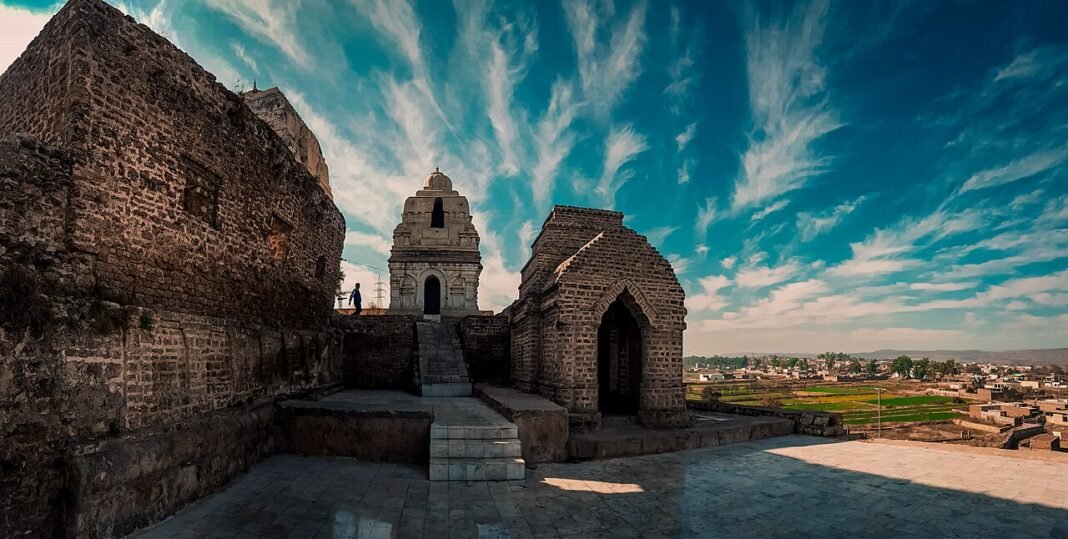
And then there is everything around it. The stupa sits just 40 metres east of the Satghara temples, at a slightly lower level — so your visit naturally unfolds into the full Katas Raj experience: the seven ancient temples in the Kashmiri architectural style, the great sacred pond, the medieval havelis, the Sikh-era fort of Hari Singh Nalwa. It is one of Pakistan’s great layered sites, where Buddhist, Hindu, and Sikh heritage stand side by side, and where the Mahabharata, Al-Biruni, and Guru Nanak all left their footprints. If you care about the deep history of this land, Katas Raj is unmissable — and the stupa is where that history begins.
History of Katas Raj Stupa Remains, Chakwal
The Buddhist chapter of Katas is the oldest. According to archaeological research, the stupa east of the temple group was built by Emperor Ashoka in the 3rd century BCE — a stone masonry structure set in lime mortar, raised on a platform with a flight of steps approaching from the east. What survives today is the base: roughly 10-12 metres square, rising about 4 metres from the trench level, with as many as sixteen layers of stone masonry countable in the exposed eastern face. Time and vegetation have softened it, but its scale and antiquity are unmistakable.
The stupa was already famous thirteen centuries ago. The 7th-century Chinese pilgrim Xuanzang (Huen Tsang) visited the area and reported a Buddhist stupa surrounded by ten springs — an account that later scholars connected with Katas, identifying the region with the ancient Buddhist kingdom of Simhapura. In 1872-73, Sir Alexander Cunningham — the British engineer turned archaeologist who became the first Director General of the Archaeological Survey of India — visited Katas Raj and confirmed the findings: the stone of Ashoka ringed by ten springs, with ruins of a monastery on a nearby mound. Cunningham also traced the wall of a gateway tower of the old fortifications leading to the Satghara temples.
Around and above the Buddhist foundations rose the Hindu Katas Raj we see today. The temples are believed to have existed at least since the 7th century and are mostly attributed to the Hindu Shahis (615-950 AD); the earlier shrines date to the latter half of the 6th century AD, while the smaller temples were built around 900 years ago. The Satghara group — seven temples at a higher elevation — was built in a style similar to the Kashmiri temples of the Karkota and Varma dynasties (600-900 CE), and the region was indeed part of those Kashmiri dynasties’ sphere from 625 to 939 AD. Cunningham judged Katas the second holiest place in Punjab for Hindus after Jawalamukhi.
Legend wraps the stones thickly. The complex takes its name from the Sanskrit Kataksha, “tearful eyes”: the sacred pond is believed to have formed from the tears Lord Shiva shed after the death of his wife Sati (the second tear, they say, fell at Ajmer and formed Pushkar Lake). Hindu tradition holds that the five Pandava brothers of the Mahabharata spent part of their exile here, in the land of Dvaitavana, and that the famous riddle contest with the Yakshas — the Yaksha Prashna — took place at this very pool. In the 11th century, the great Muslim scholar Al-Biruni is believed to have spent time at Katas studying Hinduism. Sikh tradition holds that Guru Nanak visited the site during his travels, and a gurdwara associated with his stay stands a little distance from the pond. The Sikh era added the haveli-fort of Hari Singh Nalwa, Ranjit Singh’s most famous general, on the hill above.
The temples were abandoned by Hindus during the migrations of 1947. The site spent years under the Punjab government’s archaeology department before being handed to the federal Evacuee Trust Property Board (ETPB), and the Government of Pakistan has undertaken renovation efforts since 2005. Today Katas Raj — stupa, temples, pond, and all — stands as one of Pakistan’s most significant multi-faith heritage sites, drawing Hindu pilgrims from around the world, especially at Maha Shivratri.
Top Things to Do in Katas Raj Stupa Remains, Chakwal
Examine the Stupa Base
Make the stupa your first stop, before the temples pull you in. It sits east of the Katas Raj temple group, about 40 metres away at a lower level — you will need to climb a small hillock to reach it. Walk around the base slowly: the roughly 10-12 metre square platform, the exposed eastern section with its sixteen visible courses of stone masonry, the worn steps that once ascended from the east. Information boards at the site explain Cunningham’s findings. Remember you are looking at 3rd-century BCE masonry — older than almost everything else you will see all day.
Climb to the Satghara Temples
The Satghara — the group of seven temples — stands at a higher elevation than the rest of the complex, and the climb is worth it. These are the oldest-feeling structures at Katas, built in the Kashmiri style of the Karkota and Varma dynasties, and only four of the seven remain intact today. The highest temple, dating to roughly 650-900 CE, was itself a Buddhist site before it became a Shiva temple — another layer in Katas’s palimpsest. Narrow, dark staircases wind between tall stone walls up to rooftops with commanding views.
Visit the Shiva, Ramachandra, and Hanuman Temples
Around the sacred pond stand the principal Hindu shrines: the main Shiva temple beside the water, the Ramachandra temple, and the Hanuman temple, each on raised square platforms with carved detail. Some retain intricate carvings and traces of fresco; others survive as noble stone frameworks. A local guide can point out which is which and tell the stories attached to each.
Contemplate the Sacred Pond
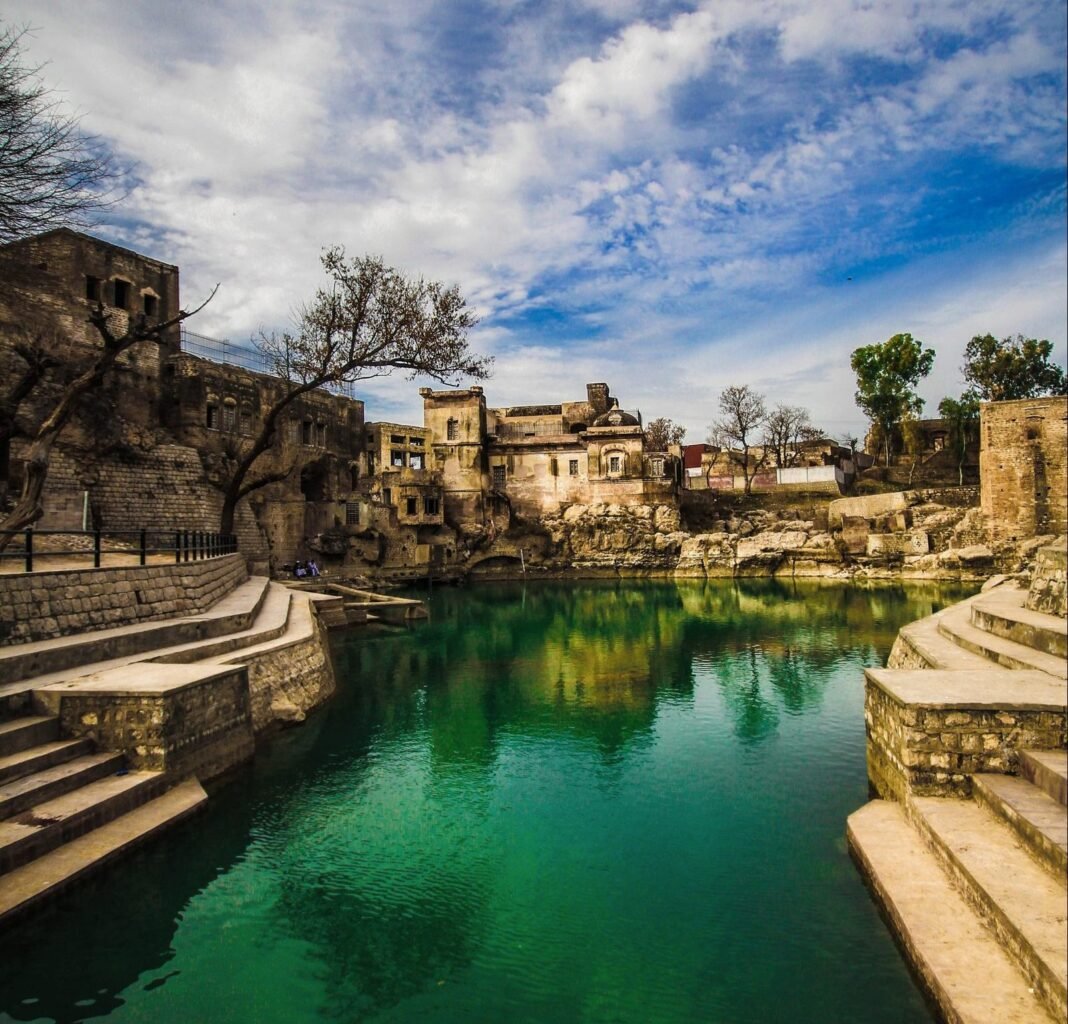
The Katasar — the still, green-blue pond at the heart of the complex — is the spiritual centre of Katas Raj. Hindus believe its waters are the tears of Shiva, and pilgrims bathe here seeking blessings and forgiveness; some attribute healing powers to the water. Walk its perimeter quietly, watch the temples reflected in the surface, and understand why this small body of water has drawn pilgrims for over a thousand years. Note that falling groundwater levels have threatened the pond in recent years, making conservation efforts here especially important.
Explore Hari Singh Nalwa’s Haveli
On the hill above the complex stands the haveli-fort of Hari Singh Nalwa, the legendary general of Maharaja Ranjit Singh. From here the entire Katas Raj compound spreads out below you — temples, pond, stupa mound, and the Salt Range hills beyond. It is the best viewpoint on the site and a fine piece of Sikh-era military architecture in its own right.
Hire a Guide and Take Your Time
Katas Raj rewards the unhurried. Local guides are available at the site (agree on a fee beforehand) and transform the visit — they will open the doors of the highest Satghara temple, lead you up the narrow staircases to the rooftops, and untangle the layers of legend and history. Allow at least two hours for the complex; a half day if you are combining it with Khewra.
Famous Places In and Around Katas Raj Stupa Remains, Chakwal
- Khewra Salt Mine: The world’s second-largest salt mine, an easy pairing with Katas Raj — combine both in one Salt Range day.
- Kallar Kahar: The Salt Range town with its own scenic lake, about 24 km from Choa Saidan Shah via the M-2 interchange.
- Tilla Jogian: The sacred hill complex of the Nath yogis, roughly 100 km by road — see our Tilla Jogian travel guide.
- Choa Saidan Shah: The nearest town, your stop for fuel and supplies on the way in.
- Amb Temples: Another ancient temple complex of the Salt Range/Potohar region — see our Amb Temples travel guide.
- Katas Village: The surrounding countryside, with its Salt Range scenery and rural Punjab life.
How to Reach Katas Raj Stupa Remains, Chakwal
Katas Raj sits in the Salt Range near Choa Saidan Shah, and the standard approach is via the M-2 Lahore-Islamabad motorway: exit at the Kallar Kahar interchange, then follow the road toward Choa Saidan Shah (about 24 km). After passing the town and a cement factory, the temple complex comes into view, nestled in the hills. The motorway stretch is fast and comfortable; the final Salt Range roads are narrower in places, so daytime travel is recommended.
From Islamabad, Katas Raj is about 140-160 km — roughly 2.5 to 3.5 hours, making it one of the capital’s best day trips. From Lahore, it is about 250-260 km, roughly 5 to 6 hours each way — feasible as a very long day trip but far more enjoyable with an overnight stay in the Salt Range. From Karachi, fly to Islamabad and drive; the road journey from Karachi is the better part of two days. The nearest airport is Islamabad International, about 150 km away.
Public transport will not get you to the complex directly. The practical options are a private car, a hired car with driver, or a tour van — the latter popular with groups combining Katas Raj and Khewra Salt Mine. If you are driving yourself, a standard car handles the route fine in dry weather; after rain, the Salt Range stretches demand more care.
Route Details
Islamabad to Katas Raj (approx. 140-160 km, 2.5-3.5 hours): M-2 motorway toward Lahore → exit at Kallar Kahar interchange → follow signs to Choa Saidan Shah (24 km) → continue to the Katas Raj complex. Start early to enjoy the site in the morning light and leave time for Khewra in the afternoon.
Lahore to Katas Raj (approx. 250-260 km, 5-6 hours): M-2 motorway toward Islamabad → exit at Kallar Kahar interchange → as above. Consider overnighting at Kallar Kahar to split the journey.
The classic Salt Range day: Katas Raj (morning, 2 hours) → Khewra Salt Mine (afternoon) → return via M-2. The two sites pair beautifully: one above ground and ancient, one below ground and geological.
Where to Stay in Katas Raj Stupa Remains, Chakwal
There is no accommodation inside the archaeological complex — and you would not want to be anywhere else but exploring. Katas Raj is overwhelmingly a day trip from Islamabad/Rawalpindi, and that is how most visitors do it: arrive mid-morning, explore for two to three hours, optionally add Khewra, and drive home by evening.
If you prefer to overnight in the Salt Range, Kallar Kahar is the natural base — the town has long hosted tourist motels and guesthouses around its lake, catering to Salt Range travellers. Choa Saidan Shah and Chakwal city (about 40 km away) have basic hotels and guesthouses. For Lahore-based visitors making a weekend of it, Kallar Kahar’s guesthouses make a pleasant halfway stop. During Maha Shivratri, when Hindu pilgrims arrive in numbers, nearby accommodation fills up — book ahead.
Where to Eat: Local Foods of Katas Raj Stupa Remains, Chakwal
Here is the most useful food advice for Katas Raj: bring your own snacks and water. There is no café or restaurant at the complex itself — seasoned visitors pack a picnic. The site rewards walkers, and you will want energy for the climbs between the stupa, the Satghara temples, and the haveli.
For proper meals, Choa Saidan Shah and Kallar Kahar have dhabas and small restaurants serving Punjabi staples — daal, chicken karahi, fresh tandoori naan, and chai — at very budget-friendly prices. The Salt Range region is known for its peanuts and dry fruits, sold in local markets and excellent road-trip provisions. If you combine the trip with Khewra, the mine’s visitor area has more developed food options. And if you are day-tripping from Islamabad, you are back in the capital’s restaurants by dinner. Carry at least two litres of water per person — there is no reliable drinking water at the complex.
Weather in Katas Raj Stupa Remains, Chakwal
The Salt Range at 2,000 feet is a touch cooler and breezier than the Punjab plains, but summer here is still seriously hot and winter nights can bite. The complex is almost entirely outdoors — temples, climbs, and open courtyards — so the October-to-March window that every Katas Raj travel guide recommends is genuinely the right call. Winter brings the clearest views across the Potohar plateau.
| Season | Temperature Range | Conditions |
|---|---|---|
| Winter (Dec-Feb) | Approx. 5-18°C | Cool, clear, ideal for climbing around the complex; cold mornings — bring a jacket |
| Spring (Mar-Apr) | Approx. 15-30°C | Pleasant and green; wildflowers in the hills; lovely light for photography |
| Summer (May-Jun) | Approx. 28-42°C | Extremely hot on the exposed stone; visit at opening time or postpone |
| Autumn (Oct-Nov) | Approx. 12-30°C | Clear skies and comfortable temperatures; excellent for the full complex |
Note: the monsoon (July-September) brings humidity and heavy showers; the Salt Range roads and stone steps get slippery — wear shoes with good grip.
Language and Culture of Katas Raj Stupa Remains, Chakwal
The local language is Punjabi in its Potohari dialect, with Urdu universally understood. Around the temples you will also hear Hindi and English from Hindu pilgrim groups visiting from abroad — Katas Raj is an international pilgrimage site, and the atmosphere during festivals is wonderfully cosmopolitan.
This is a sacred site for two religions and a heritage site for everyone, so etiquette matters. Remove your shoes before entering temple sanctums. Dress modestly — covered shoulders and knees. Do not touch carvings or climb on fragile structures; the stupa masonry and temple stonework are ancient and irreplaceable. Photography of the architecture is welcome, but be discreet around pilgrims at prayer, and always ask before photographing people. If you visit during Maha Shivratri, expect large devotional crowds — observe respectfully, give pilgrims space at the pond, and let the ceremonies unfold. The site is managed by the Evacuee Trust Property Board; follow staff guidance on access to inner shrines.
Shopping in Katas Raj Stupa Remains, Chakwal
There are no souvenir shops inside the complex, so set expectations accordingly — Katas Raj is about the stones, not the shopping. What the wider area offers is authentic and worth picking up. If you combine the trip with Khewra, the salt mine’s shops sell the famous pink salt lamps, salt crafts, and edible rock salt — genuine local products at fair prices. Choa Saidan Shah’s bazaar covers everyday goods, and the region’s peanuts, rewri, and dry fruits make excellent edible souvenirs. Small vendors sometimes set up near the complex during festival times selling religious items and snacks. There are no shopping malls anywhere near the site — and honestly, that is part of its appeal.
Local Events and Festivals
Maha Shivratri (February/March): The great night of Shiva is the biggest event in the Katas Raj calendar. Hindu pilgrims from across Pakistan — and from India, Nepal, and around the world — gather at the temples, and devotees bathe in the sacred pond seeking blessings and forgiveness. The complex glows with lamps and devotion; it is the single most atmospheric time to visit, but also the most crowded, so arrive early and book accommodation well ahead.
Smaller Hindu observances are marked through the year by visiting pilgrim groups, and the site occasionally hosts cultural and interfaith events highlighting its multi-religious heritage. Check locally for anything scheduled around your visit.
Travel Tips for Katas Raj Stupa Remains, Chakwal
Packing Essentials
Sturdy walking shoes with good grip (you will climb hillocks, narrow temple staircases, and uneven stone), sun protection, at least two litres of water per person, snacks or a picnic, and a camera with plenty of battery — the site is extremely photogenic. A light scarf is useful for sun, dust, and temple etiquette. In winter, bring a warm layer; the Salt Range wind is sharp.
Safety Tips
Katas Raj is a managed archaeological site and generally safe, but the terrain demands respect: the stupa hillock, Satghara staircases, and haveli paths are steep and uneven — watch your step, supervise children closely, and avoid the narrow rooftop staircases if you are uneasy with heights. Start early and finish by late afternoon; the Salt Range roads are best driven in daylight. Keep to the complex and marked paths; the surrounding hills are wild.
Money & Connectivity
Carry cash — there are no ATMs at the complex, and the nearest reliable ones are in Choa Saidan Shah or Kallar Kahar. Entry is generally ticketed at a nominal fee (confirm current rates locally). Mobile signals from the major networks work around the complex, though data can be patchy among the hills. Download offline maps before you leave the motorway.
Best Time to Visit Katas Raj Stupa Remains, Chakwal
October to March — The Ideal Season
Cool, clear, and comfortable — the definitive window for this Katas Raj Stupa Remains travel guide to recommend. Winter light rakes beautifully across the temple stonework, the climbs are pleasant, and February-March brings the unforgettable Maha Shivratri pilgrimage.
March to April — The Green Shoulder
Spring in the Salt Range is lovely: mild temperatures, green hills, and wildflowers. An excellent time for combining Katas Raj with Khewra and the Kallar Kahar lake.
May to September — Avoid
Summer heat on the exposed stone is punishing, and the monsoon makes the climbs slippery. If you must come, arrive at opening time and plan to leave by late morning.
Final Thoughts
The Katas Raj Stupa Remains will not overwhelm you with grandeur — and that is exactly why they matter. In their quiet, weathered way, they are the oldest voice at Katas Raj: a 3rd-century BCE Buddhist foundation beneath a 7th-century Hindu florescence, beside a Sikh-era fort, wrapped in legends of Shiva’s tears and the Pandavas’ exile. To walk from the stupa’s Ashokan base up to the Satghara temples is to walk through two thousand years of this land’s spiritual history in about forty metres.
Come in the cool months, bring a picnic and a guide, give the complex the half day it deserves, and pair it with Khewra for the perfect Salt Range circuit. Katas Raj is Pakistan’s heritage at its most layered — Buddhist, Hindu, Sikh, and legendary all at once — and the stupa is where the story starts. For more journeys into the country’s ancient past, explore our Explore Pakistan series.
FAQs
Where are the Katas Raj Stupa Remains located?
Within the Katas Raj temple complex near Choa Saidan Shah, Chakwal District, Punjab — in the Salt Range, about 40 metres east of the Satghara temples at a lower level, reached via the M-2 Kallar Kahar interchange.
How old is the stupa at Katas Raj?
The stupa is attributed to Emperor Ashoka and dated to the 3rd century BCE — over 2,300 years old. The 7th-century Chinese pilgrim Xuanzang recorded seeing it surrounded by ten springs.
What is the best time to visit Katas Raj?
October to March, when the weather is cool and clear. February-March brings the Maha Shivratri festival; avoid May to September for heat and monsoon rains.
How do I reach Katas Raj from Islamabad and Lahore?
From Islamabad (~140-160 km, 2.5-3.5 hours) and from Lahore (~250-260 km, 5-6 hours), take the M-2 motorway, exit at Kallar Kahar, and follow the road to Choa Saidan Shah and the complex.
Is Katas Raj safe for families?
Yes, it is a managed heritage site popular with families. Supervise children on the steep climbs and staircases, wear sturdy shoes, and visit in daylight.
Where can I stay near Katas Raj?
Most visitors day-trip from Islamabad. Kallar Kahar has tourist motels and guesthouses, and Chakwal city (40 km) has basic hotels — book ahead during Maha Shivratri.
What food is available at Katas Raj?
There is no café at the complex — bring your own food and water. Dhabas in Choa Saidan Shah and Kallar Kahar serve Punjabi staples at budget-friendly prices.
Can I combine Katas Raj with Khewra Salt Mine?
Yes — it is the classic Salt Range pairing. Visit Katas Raj in the morning (about 2 hours) and Khewra in the afternoon, returning via the M-2.