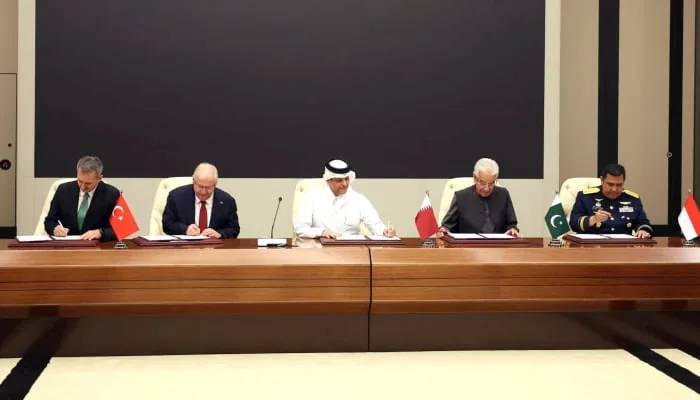
Pakistan, Qatar, Turkiye and Indonesia signed the Badr defence pact, a multilateral defence cooperation agreement, in Doha on Wednesday, committing to closer collaboration on defence production, joint training and military research.
The Turkish defence ministry announced the signing of the Badr Memorandum of Understanding, saying the accord reflected the four countries’ desire to deepen cooperation and build partnerships across their defence sectors. Pakistan’s Foreign Office had not issued a statement on the pact at the time of reporting.
Who signed the Badr defence pact
Defence Minister Khawaja Muhammad Asif signed the memorandum on behalf of Pakistan and was visible in photographs shared by the Turkish defence ministry from the ceremony in the Qatari capital.
The other signatories were Turkish Defence Minister Yasar Guler, Qatar’s Deputy Prime Minister and Minister of State for Defence Affairs Sheikh Saud bin Abdulrahman bin Hasan Al Sani, and Indonesia’s Deputy Defence Minister Yusuf Jauhari. Haluk Gorgun, who heads Turkiye’s Secretariat of Defence Industries, also attended the ceremony.
Reuters quoted the Turkish ministry as saying the Badr defence pact was aimed at defence cooperation and strengthening the defensive capabilities of all four signatories.
What the agreement covers
According to the Turkish defence ministry, the accord will support joint military exercises and training, cooperation on research and development, and shared efforts to improve each country’s defence industry.
The ministry described the agreement as holding “substantial economic importance”, adding that the accord was meant to build cooperation in military production and technical military training. Anadolu Agency quoted the ministry as saying the memorandum would help develop solutions and industrial sectors aligned with advances in modern defence systems.
“By leveraging the unique military production capabilities of each country, the initiative will facilitate cooperation and integration, enhance defence industrial capacities, and enable the fulfilment of the needs of allied and friendly nations,” the ministry said in its statement.
A wider web of defence ties
The Badr defence pact extends a pattern of deepening defence diplomacy around Pakistan that has accelerated in recent months. In August, Turkiye signed a mutual defence pact with Pakistan and Saudi Arabia, the Makkah defence alliance, under which an attack on any one party is treated as an attack on all. Qatar publicly welcomed that agreement as a contribution to regional security and stability.
Turkiye brings considerable weight to the new arrangement. It fields NATO’s second-largest army, runs a robust domestic defence industry and maintains a military base in Qatar, where it has been helping Gulf states strengthen their defences. Indonesia, meanwhile, has been expanding its own defence-industrial cooperation with Ankara.
The signing also comes as Pakistan juggles several regional security tracks at once. This week, Pakistan’s NCA adviser warned India against any attempt to alter the strategic balance in South Asia, while Field Marshal Asim Munir’s visit to Tehran coincided with the reopening of the Pakistan-Iran border.
Why it matters for Pakistan
For Pakistan, the Badr defence pact opens a formal channel for defence-industrial collaboration with three partners that each bring distinct strengths: Turkiye’s manufacturing base, Qatar’s procurement capacity and Indonesia’s growing defence sector. Joint exercises and training exchanges would add a practical military dimension beyond the industrial cooperation.
The agreement stops short of the mutual-defence commitments of the Makkah pact. It is a cooperation framework, not a collective-defence treaty, and its real test will be whether the promised joint projects in production and research take shape in the months ahead.
What happens next
The Turkish defence ministry said the accord would strengthen ties between the four countries’ defence industries and support collaboration for security and shared objectives. Further details, including any planned joint exercises or production ventures, are expected as the partners move from signatures to implementation. Pakistan’s Foreign Office is also expected to comment on the agreement.
Frequently asked questions
What is the Badr defence pact?
It is a memorandum of understanding on defence cooperation signed by Pakistan, Qatar, Turkiye and Indonesia in Doha, covering defence production, joint military training, exercises and research and development.
Which countries signed the Badr memorandum?
Pakistan, Qatar, Turkiye and Indonesia. Their defence ministers, or deputy ministers in the case of Qatar and Indonesia, signed the document on October 21, 2026.
Who signed the pact on behalf of Pakistan?
Defence Minister Khawaja Muhammad Asif signed for Pakistan at the ceremony in Doha, according to the Turkish defence ministry.
How is the Badr pact different from the Makkah defence pact?
The Makkah pact, signed in August by Pakistan, Saudi Arabia and Turkiye, is a mutual-defence agreement treating an attack on one as an attack on all. The Badr memorandum is a cooperation framework focused on defence industry, training and research, without mutual-defence commitments.