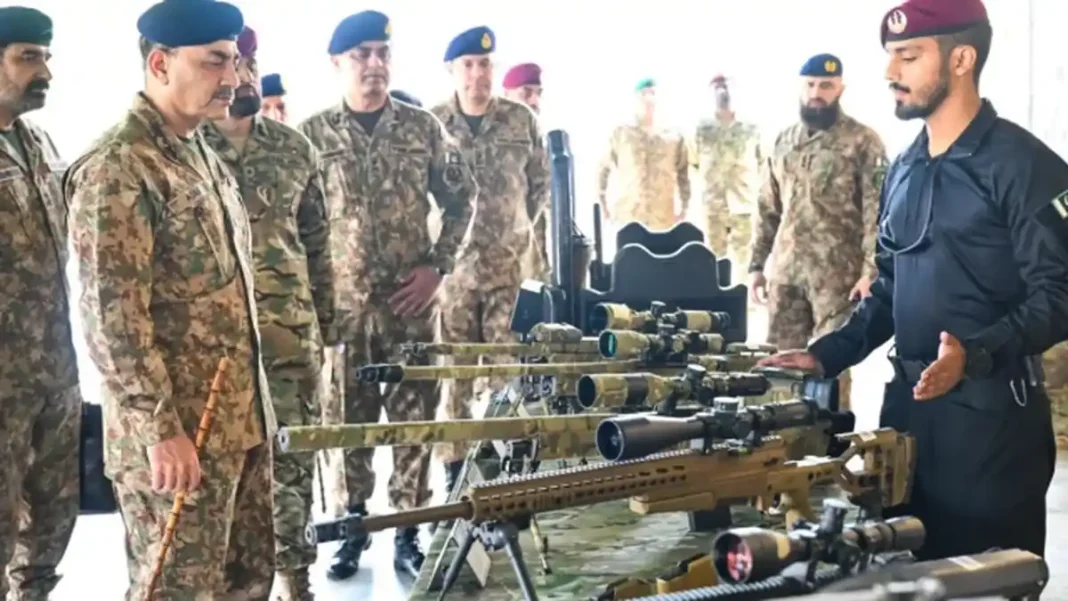
CDF Munir SSG Visit Stresses Home-Grown Defence
Chief of Defence Forces (CDF) and Chief of Army Staff Field Marshal Syed Asim Munir on Thursday stressed continuous training, stronger home-grown defence capabilities and steady operational readiness to stay ahead of new security threats, the military’s media wing said.
He spoke during a visit to the headquarters of the Special Services Group (SSG) in Tarbela, where he reviewed the elite force’s specialised training, operational preparedness and mission-oriented readiness, according to a statement issued by the Inter-Services Public Relations (ISPR).
CDF Munir SSG visit: what happened at Tarbela
During the visit, the field marshal was briefed on the SSG’s specialised training regime and operational capabilities.
“He also witnessed a display of state-of-the-art specialised equipment and a demonstration showcasing SSG’s combat proficiency, agility and precision in executing special operations,” the ISPR said.
Addressing SSG officers and soldiers, the field marshal praised their professional conduct, strong morale and steadfast dedication to their responsibilities.
The military chief was received by the SSG general officer commanding on his arrival at the headquarters. Later, he laid a floral wreath at the Martyrs Monument and offered prayers for martyrs.
A day after the Fa’az missile test
The visit came a day after Pakistan successfully conducted the flight test of its first indigenously developed Fa’az air-to-air missile, marking a major step in the country’s aerospace and defence capabilities.
According to the ISPR, the missile is fitted with a state-of-the-art terminal guidance system and can engage enemy aerial targets at longer ranges. Feature Pakistan reported the Fa’az test on November 3.
The military has been modernising its operational capabilities, strengthening indigenous defence production and preparing troops for new forms of warfare.
In August, the field marshal visited the Pakistan Ordnance Factory in Wah, where he reviewed its production capabilities, export potential and contribution to the country’s defence industrial base. He also witnessed tests and trials of locally designed and manufactured arms and ammunition. The military highlighted ongoing indigenisation and industrial upgradation efforts during the visit.
Before that, in May, the Pakistan Army successfully conducted a training launch of the indigenously developed Fatah-4 ground-launched cruise missile. According to ISPR, the exercise was aimed at enhancing operational efficiency and validating the technical parameters of the missile’s various subsystems.
The wider push for home-grown weapons
The Tarbela visit fits a pattern of public emphasis on self-reliance that has run through the past week. The field marshal met a Chinese minister at GHQ on October 26 and joined a joint meeting in Tehran the same day, and a civil-military huddle on November 4 agreed to scale up intelligence-based operations in Khyber Pakhtunkhwa.
Each step points the same way. The Fa’az test showed that Pakistan can build advanced weapons at home. The POF visit showed that its factories can produce and export them. The SSG visit showed that its special forces train with that equipment and stay ready to use it.
The message from Tarbela was plain: training and home-grown capability, kept together, are what keep the force ahead of changing threats.
The Express Tribune reported the visit on Thursday night.
Frequently asked questions
Where is the SSG headquarters?
The Special Services Group headquarters is in Tarbela, where Field Marshal Asim Munir visited on Thursday, November 5.
What did the CDF review during the SSG visit?
He reviewed the SSG’s specialised training, operational preparedness and mission-oriented readiness, and watched a display of specialised equipment and a combat demonstration.
What is the Fa’az missile?
Fa’az is Pakistan’s first indigenously developed air-to-air missile. It carries a state-of-the-art terminal guidance system and can engage enemy aerial targets at longer ranges. It was flight-tested a day before the SSG visit.
Why does indigenous defence matter for Pakistan?
Home-grown weapons cut reliance on foreign suppliers, keep production and jobs in Pakistan, and let the armed forces shape equipment to their own needs, as shown by the Fa’az test and the POF Wah visit.