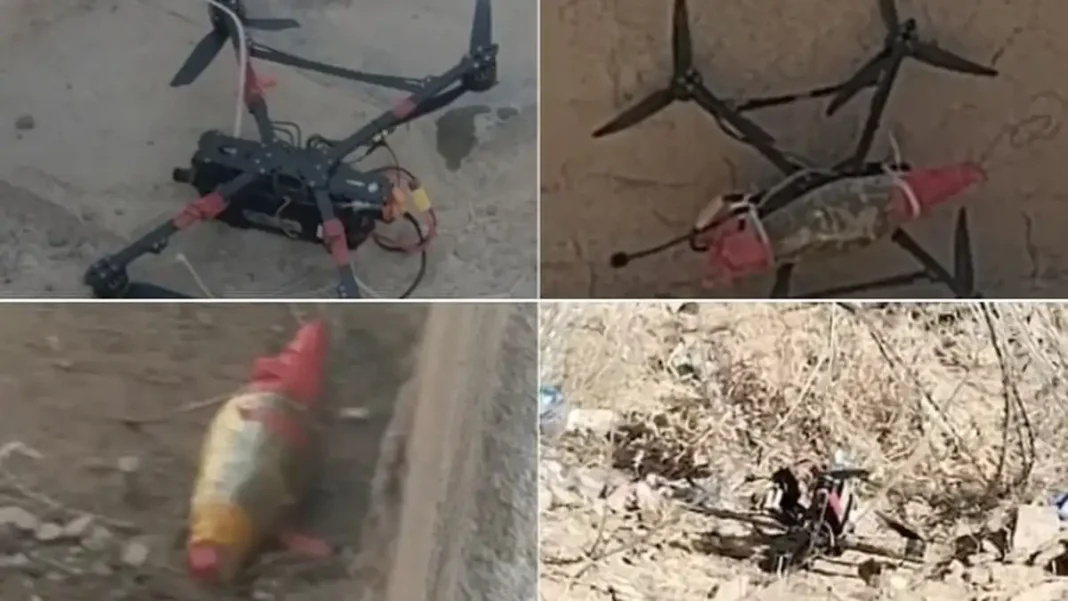
Kharan Drones Shot Down Before Checkpost Strike
Security forces shot down five Kharan drones before they could strike a security checkpost in Balochistan, security sources said on Friday. The drones were aimed at a checkpost in the Albat area of Kharan district, and none reached its target.
No casualties or property damage were reported in the incident, the sources said. The attempted strike failed, and the checkpost was not hit.
According to the sources, the drones were launched by members of Fitna al-Hindustan, a group which security sources describe as an Indian proxy. The sources said security personnel responded promptly and destroyed all five drones before they could reach the installation.
What happened in Albat
The checkpost in Albat was the intended target, the sources said. Security forces detected the incoming drones and intercepted them in time, preventing any strike on the post.
Reports described the drones as low-grade machines. The available reports did not specify what payloads the drones carried, how they were guided, or whether they were flown as a coordinated group. Those details should not be assumed from the number of drones alone. What is established is simpler: five drones were sent toward one checkpost, and all five were destroyed before impact.
The incident fits a pattern that has become familiar along Pakistan’s western border. Last month, security sources said Pakistan shot down eight drones after they entered the country’s airspace from Afghanistan. The armed forces’ air defence system detected all eight in time and intercepted them, the sources said at the time. They also said the air defence system along the Pak-Afghan border, operated by the Pakistan Air Force, remains fully operational around the clock.
Why the drone threat matters for Balochistan
For people living near checkposts in districts such as Kharan, the threat has changed shape. Attacks that once came only by road or on foot can now arrive from the air, and defending a fixed post means detecting small, low-flying machines in time to stop them.
Balochistan has borne the heaviest share of militant violence in recent months. Analysis of the Kharan incident, citing Pakistan Institute for Conflict and Security Studies figures, put Balochistan’s share at 131 terrorist attacks in September 2026, or 58.2 per cent of the national total of 225. That scale explains why a failed drone attempt still draws attention: it shows a method being tested, even when the immediate result is a failure for the attackers.
Security operations continue across the province. A security operation in Kech left one person dead earlier this month, and security fears in Bajaur led to a 10-day ban on pillion riding. The wider cross-border dispute also remains unresolved. Pakistan has urged Kabul to stop militant groups from using Afghan territory for attacks inside Pakistan, a position Kabul has disputed, while Islamabad has rejected Afghan claims over the Angoor Adda incident and Khyber Pakhtunkhwa’s governor has warned the Afghan Taliban after firing at Angoor Adda.
What happens next
The immediate danger from this attempt has passed, since all five drones were destroyed and no one was hurt. The open questions are about the follow-up: whether investigators recover useful wreckage, whether the launch site is traced, and whether similar attempts follow in other districts.
Pakistan launched Operation Ghazab lil-Haq in February 2026, months after a ceasefire agreed with Afghanistan in October 2025 following border clashes. Despite several rounds of talks, Islamabad and Kabul have yet to settle their differences over militant groups operating from Afghan soil. Until that dispute is resolved, checkposts in Balochistan will keep facing the same test: detect the next attempt early enough to stop it, as the Albat post did on Friday.
Where did the incident take place?
The drones targeted a security checkpost in the Albat area of Kharan district, Balochistan.
Was anyone hurt?
No. Security sources reported no loss of life and no property damage.
Who do security sources blame?
Security sources attributed the attempt to Fitna al-Hindustan, which they describe as an Indian proxy. That attribution comes from the sources, not from an independent claim.