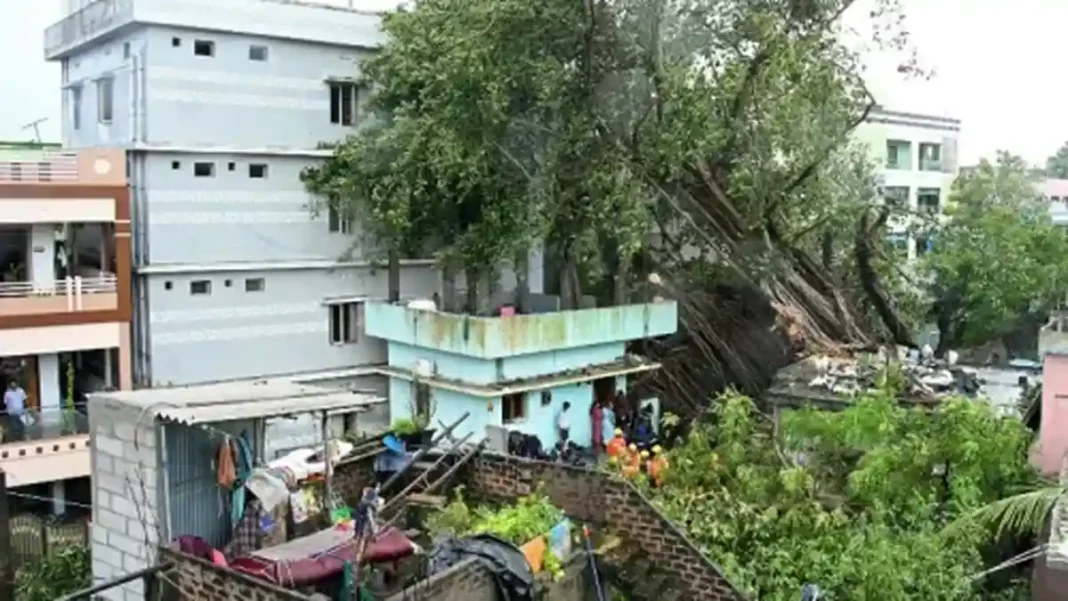
Cyclone Arnab Leaves Six Dead on India’s East Coast
Cyclone Arnab deaths rose to at least six on Thursday, one day after the storm barrelled through India’s eastern coast with heavy rain and gusty winds. Officials said power supply in several areas along the coast remained disrupted, while a cargo vessel with 20 crew members on board stayed grounded off Andhra Pradesh.
The toll comes from a Reuters report carried by The Express Tribune, citing officials. The Times of India, citing local officials, put the death toll higher, at nine, with deaths caused by electrocution as well as tree and house collapses. Dawn’s morning edition had reported three deaths, so the figures have climbed through the day as local counts came in. Readers should treat the toll as provisional until state authorities publish a consolidated count.
Arnab, classified by the India Meteorological Department as a very severe cyclonic storm, made landfall in Andhra Pradesh early on Wednesday. It was the third-highest category on the department’s scale. Feature Pakistan reported the landfall as it began, with winds gusting to 150 kilometres per hour, and covered the evacuation of nearly 100,000 people before the storm arrived.
Cyclone Arnab deaths: toll still unclear
The gap between the official count of six and the newspaper count of nine is normal in the first day after a storm. Electrocution deaths point to fallen power lines, while tree and house collapses point to wind damage. Both causes suggest the danger did not end when the storm’s centre moved inland.
Andhra Pradesh Chief Minister N Chandrababu Naidu said advances in technology enabled the government to identify the areas likely to face the greatest impact and limit loss of life and property. The claim will be tested against the final toll and the damage survey, but the evacuation itself clearly reduced exposure: about 50,000 people were moved to safety in Andhra Pradesh and 48,000 in neighbouring Odisha before landfall.
Power lines down across the coast
At least 15,000 electricity poles were damaged by the cyclone, Naidu was quoted as saying in a statement. Power supply had been restored in most districts, but Konaseema and West Godavari districts were still without supply in parts on Thursday.
The scale of pole damage explains why restoration is uneven. Crews must clear fallen trees and debris before they can rebuild lines, and coastal roads may still be blocked in places. For households, the outage matters as much as the wind did: without power, water pumps, mobile charging and cold storage all stop, and the risk from damaged wiring rises after dark.
A Marshall Islands-flagged cargo vessel, with 20 crew members on board, remained stalled on Thursday because of rough seas. The vessel was grounded off the coast of Andhra Pradesh during the storm. Officials gave no update on the crew’s condition in the report, and rescue in heavy seas remains difficult until conditions ease.
Storm weakens as it moves inland
The storm has now weakened into a remnant depression. The India Meteorological Department said the depression, over south Chhattisgarh and adjoining south Odisha, moved nearly northwards at 18 kilometres per hour during the six hours to 8:30 am Indian time on Thursday.
Inland movement brings a different risk. The wind falls, but heavy rain continues, and low-lying areas in Chhattisgarh and Odisha face waterlogging and swollen streams. Authorities in those states will watch river levels through Thursday night, even as coastal Andhra Pradesh turns to repair work.
Arnab’s centre stayed close to the shoreline as it moved slowly north-westwards, and its northern spiral band pushed further inland during Wednesday morning. Slow storms drop more rain over the same districts, which is why the damage is spread across power networks, housing and shipping rather than confined to the landfall point.
For India, Arnab is the latest test of a system that has improved markedly at forecasting tracks and moving people out of harm’s way. The evacuation numbers show that part worked. The deaths, the pole damage and the stranded vessel show where the next test lies: in building lines, homes and ports that can survive the wind, and in counting the human cost quickly once the storm passes.