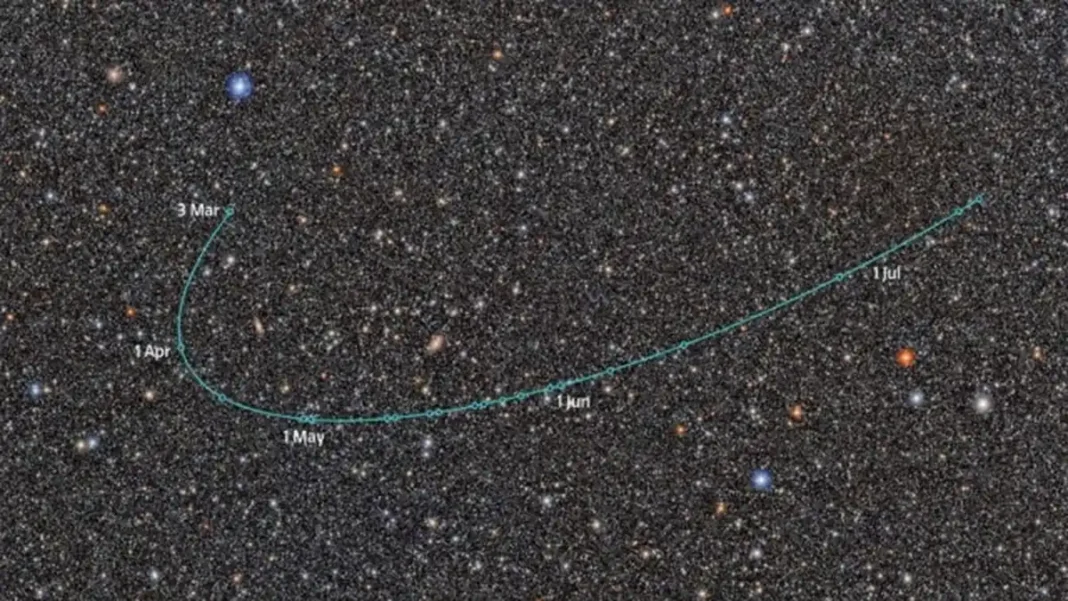
Scientists using a telescope in Chile have found a new dwarf planet candidate beyond Pluto. The object, named 2026 ED138, may join the small roster of dwarf planets recognised by the International Astronomical Union.
Researchers put its diameter at between roughly 600 and 1,500 kilometres. It orbits about 46 times farther from the Sun than Earth does. Pluto, by comparison, orbits at an average of about 40 times Earth’s distance from the Sun.
The object was spotted using the new Vera C. Rubin Observatory, on the summit of Cerro Pachon mountain in central Chile. The observatory is a joint initiative of the United States National Science Foundation and the Department of Energy.
Further observations are needed to confirm that the object is a dwarf planet. If confirmed, 2026 ED138 would join five other dwarf planets recognised by the union. Those are Pluto, Eris, Haumea and Makemake, all of which orbit beyond Neptune, and Ceres, which sits in the main asteroid belt between Mars and Jupiter.
Based on current data, 2026 ED138 would rank among the largest of the dwarf planets.
How the dwarf planet candidate was found
Astrophysicist Matt Holman, of the Center for Astrophysics at Harvard and the Smithsonian, first spotted the object. He ran a computer programme he helped develop through data collected by Rubin earlier in 2026, scanning billions of detections of moving objects.
When 2026 ED138 appeared, Holman said he first reacted with excited disbelief. He then checked for a false positive or an error in the programme. His colleague Mario Juric, the Rubin solar system lead scientist, then found 20 additional observations of the object in Rubin’s catalogue, dating back to March 2026. Using older sources, researchers traced its orbit back about 10 years.
Holman spotted the object on October 13, 2026. The Rubin Observatory announced the candidate on October 27, 2026. Juric described it as roughly 1,000 kilometres across, and said it is the largest object found beyond Neptune in about 20 years.
“For me, what this demonstrates is that many exciting discoveries remain to be made with the Rubin Observatory and other telescopes,” Holman said.
What makes a world a dwarf planet
The International Astronomical Union sets four tests for dwarf planet status. The body must orbit the Sun, and it must not be a moon. Its own gravity must have pulled it into a near-round shape. And it must not have cleared its neighbourhood of other objects.
That last test is the one that removed Pluto from the list of planets in 2006. Pluto orbits the Sun and is round, but it shares its region with other icy bodies, so it does not meet the formal definition of a planet.
Confirmation of 2026 ED138 will take time. Holman has warned that the object is still a candidate, and that pinning down its physical size will take a few months, probably. Size matters because it shows whether gravity has shaped the body into a round world.
The Rubin Observatory gives astronomers a strong tool for that work. It houses the largest digital camera ever built for astronomy, and it can image the entire sky every three days. It saw first light in June 2025, and it will survey the southern sky again and again for 10 years. Each pass can reveal objects that earlier surveys missed.
Pakistan has its own growing stake in space science. The country confirmed its first space mission plans earlier this year, as reported here: Pakistan First Space Mission Confirmed by Iqbal. The national space agency also opened a space technology conference in Islamabad, covered here: SUPARCO Opens Space Technology Conference in Islamabad.
What happens next
Astronomers will keep tracking 2026 ED138 to refine its orbit and measure its size. If the measurements confirm a round, Sun-orbiting world that has not cleared its neighbourhood, the union can add a sixth name to the dwarf planet list.
If not, the object will still stand as one of the largest icy bodies found beyond Neptune in two decades, and as an early sign of what Rubin can find.
What is 2026 ED138?
It is an icy object orbiting beyond Pluto, spotted in data from the Vera C. Rubin Observatory in Chile. Its diameter is estimated at between 600 and 1,500 kilometres.