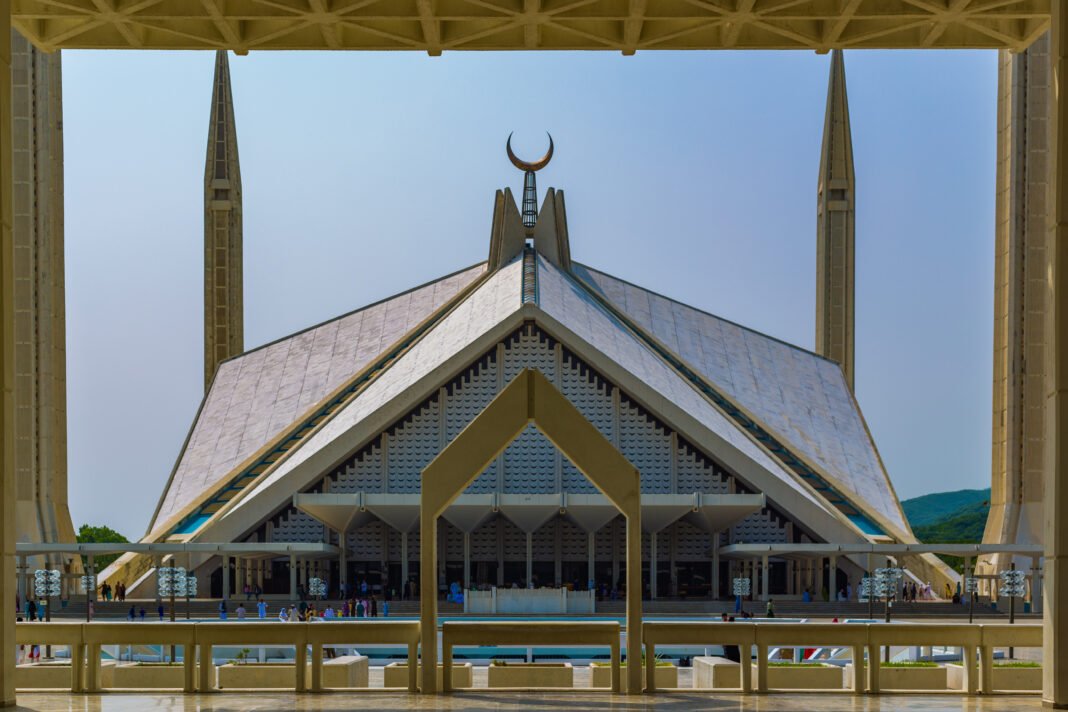
Every capital city has one building that explains it. In Islamabad, that building is the Faisal Mosque — a vast white tent of concrete pitched against the green wall of the Margalla Hills, visible from almost anywhere in the city. It has no dome, which breaks every rule you thought you knew about mosque architecture, and that is exactly why you can’t stop looking at it. Whether you come to pray, to photograph, or simply to stand in one of the most extraordinary modern sacred spaces on Earth, the Faisal Mosque rewards the trip many times over. This Faisal Mosque travel guide will tell you why it deserves a place on your itinerary, the best time to visit, and how to experience it respectfully and fully.
Quick Facts
- Location: Northern end of Faisal Avenue (Shahrah-e-Islamabad), at the foothills of the Margalla Hills, Islamabad
- Altitude: Around 600 meters (1,970 feet) above sea level
- Famous For: Its radical Bedouin-tent design with no dome, four 80-meter minarets, and its status as Pakistan’s national mosque and most iconic landmark
- Nearest City: Islamabad itself — the mosque is within the capital
- Accessibility: Very easy — a short drive from anywhere in Islamabad/Rawalpindi by car, taxi, or ride-hailing; free entry
- Known Landmarks: The eight-sided tent prayer hall, the four Turkish-style minarets, the marble courtyard, the calligraphy by Sadequain, the tomb of Zia-ul-Haq beside the mosque
- Best For: Architecture lovers, photographers, spiritual travelers, families, and first-time visitors to the capital
Why Visit Faisal Mosque
Because it is unlike any mosque you have ever seen. The great mosques of the Islamic world announce themselves with domes — but the Faisal Mosque, designed by Turkish architect Vedat Dalokay, rises as an eight-sided concrete shell inspired by a Bedouin desert tent, its triangular folds climbing to a point against the Margalla Hills. Four pencil-thin minarets, 80 meters tall in the Turkish tradition, frame the composition. The effect is startling and beautiful: a building that manages to be both radically modern and deeply Islamic, fusing contemporary lines with the ancient geometry of sacred space. When it was completed in 1986, it was the largest mosque in the world — a title it held until 1993 — and it remains the sixth-largest by capacity today.
Then step inside, and the scale does something to you. The main prayer hall is vast, pillar-less, and flooded with light; the great chandelier hangs like a constellation, and the main wall carries calligraphy by Sadequain, Pakistan’s most celebrated artist. Even if you are not Muslim, standing in that luminous, silent space — with the Margallas visible through the glass — is a genuinely moving experience. The mosque is open to respectful visitors of all faiths outside prayer times, and it welcomes them warmly.
The setting multiplies the magic. The mosque sits on 190,000 square meters of grounds at the foot of the Margalla Hills, and the broad marble courtyard offers one of the finest views in Islamabad — the city spread below, the hills rising behind. Photographers get the shot of a lifetime at almost any hour: the white concrete glows at sunrise, stands crisp against blue midday skies, and turns amber at sunset. Come at Maghrib and watch the lights come on across the courtyard as the call to prayer echoes off the hills.
Finally, come because this building tells Pakistan’s story. Conceived in 1966 when Saudi King Faisal visited Pakistan and pledged a grand national mosque, funded by Saudi Arabia, designed by a Turk, built by Pakistani engineers and workers — it is a monument to Islamic solidarity and national aspiration. It has hosted history, from the International Islamic University’s early years to the tomb of a president beside its walls. To visit Islamabad without seeing the Faisal Mosque is like visiting Paris without seeing the Eiffel Tower — technically possible, but why would you?
History of Faisal Mosque
The story of the Faisal Mosque begins in 1966, when King Faisal bin Abdul-Aziz of Saudi Arabia visited Pakistan and supported the Pakistani government’s initiative to build a grand national mosque in the new capital, Islamabad. The King pledged to finance the project — a gesture of Islamic brotherhood that would define the building’s identity.
In 1969, an international design competition was held: 43 architects from 17 countries submitted proposals. The winner was Vedat Dalokay, a Turkish architect, whose daring design broke with centuries of domed mosque tradition in favor of a tent-like, eight-sided concrete shell. The choice was controversial — many traditionalists criticized the unconventional design and the absence of a dome — but the jury saw in it a bold new language for Islamic architecture. Dalokay would later win the Aga Khan Award for Architecture for the project.
Construction began in 1976, executed by the National Construction Limited of Pakistan under Azim Khan, with Pakistani engineers and workers carrying out the work. King Faisal had been assassinated in 1975, before a single stone was laid; both the mosque and the road leading to it were named in his honor. His successor, King Khalid, laid the foundation stone in October 1976 and signed the construction agreement in 1978. Saudi Arabia funded the entire project at a cost of over 130 million Saudi riyals — roughly 120 million US dollars at the time. The mosque was completed in 1986, and the first prayer was held on 18 June 1988.
Since then, the mosque has been woven into the nation’s life. It housed the International Islamic University in its early years before the university moved to its own campus in 2000. The tomb of former president Zia-ul-Haq lies beside the mosque. And the initial criticism of the design faded as the completed building’s scale, form, and setting against the Margalla Hills won over skeptics — today it is universally recognized as a masterpiece of modern Islamic architecture and the defining symbol of Pakistan’s capital.
Top Things to Do in Faisal Mosque
Stand Inside the Tent Prayer Hall
The pillar-less main hall is the heart of the experience: an enormous, light-filled, eight-sided space that can hold around 10,000 worshippers. Look up at the folded concrete planes of the “tent,” take in Sadequain’s calligraphy on the main wall, and the great chandelier suspended above. Visit outside the five daily prayer times if you are there to sightsee, dress modestly, remove your shoes, and keep your voice low — this is first and foremost a working house of worship.
Walk the Marble Courtyard
The vast courtyard and surrounding grounds — which together with the hall can accommodate hundreds of thousands of worshippers — offer the classic postcard views: the tent silhouette against the Margalla Hills, the four minarets framing the sky. Early morning and late afternoon give the best light and the thinnest crowds.
Photograph the Four Minarets
The slender, 80-meter (260-foot) minarets, inspired by Turkish mosque architecture, are among the tallest in the world. They photograph beautifully from the courtyard corners, from Faisal Avenue below, and from the Margalla viewpoints above — where the whole mosque appears as a white jewel at the foot of the hills.
Visit at Sunset and Maghrib
Time your visit for the golden hour. As the sun drops behind the hills, the white concrete warms to amber, the courtyard lights flicker on, and the Maghrib call to prayer rolls across the grounds. It is the single most atmospheric hour of the day here.
See the Tomb of Zia-ul-Haq
Beside the mosque lies the tomb of former president Muhammad Zia-ul-Haq, a quiet, simple memorial that adds a layer of Pakistan’s political history to the visit.
Combine with the Margalla Hills
The mosque sits at the foot of the Margalla Hills National Park. Pair your visit with a drive up to Daman-e-Koh for the classic aerial view of the mosque, or hike one of the Margalla trails (Trail 5 is a favorite) for a morning in the forest before descending to the mosque.
Famous Places In and Around Faisal Mosque
- Daman-e-Koh — the terraced viewpoint in the Margalla Hills with the definitive panoramic view of the mosque (see our Daman-e-Koh travel guide).
- Margalla Hills Trails — Trail 3, Trail 5, and others offer forest hikes minutes from the mosque.
- Shakarparian and Pakistan Monument — the national monument and its museum, with sweeping views over Islamabad.
- Shah Allah Ditta Caves — ancient Buddhist-era caves on the Margalla slopes, a fascinating half-day trip.
- Taxila — the great Gandharan archaeological site, an easy day trip from Islamabad (see our Taxila travel guide).
- Lok Virsa Heritage Museum — Pakistan’s folk heritage museum near Shakarparian.
How to Reach Faisal Mosque
The Faisal Mosque is one of the easiest major landmarks in Pakistan to reach — it sits inside Islamabad at the northern end of Faisal Avenue, at the foot of the Margalla Hills. From anywhere in Islamabad (Blue Area, F-6, F-7, E-7, DHA) it is a 10 to 25-minute drive; from Rawalpindi, allow 30 to 45 minutes depending on traffic. Ride-hailing apps operate throughout the twin cities and will drop you at the mosque’s parking area. Entry is free, and the mosque is open daily to visitors outside prayer times — plan 1 to 1.5 hours for a proper visit.
From Lahore, Islamabad is about 375 km via the M-2 motorway — roughly 4 to 5 hours by car or bus, or a 1-hour flight to Islamabad International Airport followed by a 45-minute drive into the city. From Karachi, fly to Islamabad (about 2 hours) and drive in; the overland drive is roughly 1,400 km and takes 18 to 20 hours. From Peshawar, it’s about 190 km via the M-1 (2.5 to 3 hours). The nearest airport is Islamabad International Airport, about 40 km southwest of the mosque.
Route Details
- Within Islamabad: Take Faisal Avenue (Shahrah-e-Islamabad) north toward the Margalla Hills — the mosque’s white tent is visible long before you arrive. Follow signs to the visitor parking.
- From the airport: Take the Srinagar Highway / Kashmir Highway east into the city, then join Faisal Avenue north to the mosque (about 45 minutes).
- From Rawalpindi: Come via Murree Road or the Islamabad Expressway, then Faisal Avenue north.
- Visiting etiquette: Dress modestly (covered shoulders and knees; women should carry a headscarf), remove shoes before entering the prayer hall, and avoid visiting during the five daily prayer times if you are sightseeing.
- Best light: Early morning (7–9 AM) for soft light and few crowds, or the hour before sunset for golden-hour photography.
Where to Stay in Faisal Mosque
The Faisal Mosque is a daytime visit within Islamabad, so your stay is really about choosing your base in the capital — and Islamabad does hospitality well. Luxury travelers will find the city’s well-known five-star hotels along and near the main avenues, offering the polished comfort you’d expect in a capital. Mid-range hotels and guesthouses cluster in sectors like F-6, F-7, and Blue Area, putting you 10 to 20 minutes from the mosque with easy access to restaurants and shopping. Budget travelers can choose from the many guesthouses and budget hotels in the older sectors and in neighboring Rawalpindi, where prices drop significantly. Wherever you stay, keep the mosque on your first full day — seeing it early gives you your bearings for the whole city, and Daman-e-Koh at sunset makes the perfect bookend.
Where to Eat: Local Foods of Faisal Mosque
You won’t find food stalls inside the mosque grounds — but Islamabad’s food scene is minutes away, and it is one of the country’s best. For the classic capital experience, head to Melody Food Street in G-6 for old-Islamabad flavor: chapli kebabs, seekh kebabs, karahi, and fresh naan at local prices. The markets of F-7 (Jinnah Super) and F-10 offer everything from desi BBQ to continental cafes, and the restaurants along the Margalla Road corridor serve dinner with hill views. Don’t leave without trying proper chapli kebab, a plate of chicken karahi, and — for breakfast — halwa puri with lassi from a traditional nashta spot. Islamabad’s cafes also do excellent coffee and desserts if you need a modern breather between heritage stops. A satisfying desi meal in the capital is very reasonably priced; expect budget-friendly local eateries and mid-range restaurants to cover most needs without strain.
Weather in Faisal Mosque
Islamabad enjoys one of the pleasantest climates of any South Asian capital, thanks to its elevation and the Margalla Hills. Winters are cool and crisp, spring is glorious, summers are hot but less brutal than the plains, and the monsoon brings dramatic, drenching rain. The mosque visit is mostly outdoors (courtyard and grounds), so the season shapes the experience — winter mornings can be misty and magical, while summer afternoons demand a hat and water.
| Season | Temperature Range | Conditions |
|---|---|---|
| Winter (Nov–Feb) | Around 3–18°C | Cool, crisp, often sunny; occasional fog on winter mornings; the pleasantest season for sightseeing |
| Spring (Mar–Apr) | Around 15–30°C | Islamabad at its most beautiful — flowering trees, clear skies, perfect walking weather |
| Summer (May–Jun) | Around 25–40°C | Hot afternoons; visit early morning or evening, and the marble courtyard can glare — bring sunglasses |
| Monsoon (Jul–Aug) | Around 25–35°C | Heavy, dramatic rainfall; the hills turn lush green; carry an umbrella and check forecasts |
| Autumn (Sep–Oct) | Around 18–32°C | Warm days, pleasant evenings; a lovely shoulder season for the mosque and the trails |
Language and Culture of Faisal Mosque
Urdu and English are both widely spoken in Islamabad — you’ll have no trouble communicating at the mosque, where staff and volunteers are used to international visitors. The mosque is a working national mosque, so the culture of the visit is the culture of worship: reverent, calm, and welcoming. Dress modestly — long trousers or skirts, covered shoulders, and a headscarf for women (carry one; they are also often available at the entrance). Remove your shoes before stepping onto the prayer-hall carpet, switch your phone to silent, and avoid walking directly in front of someone praying. Non-Muslim visitors are welcome outside prayer times and are often given warm, proud tours by volunteers. Photography is generally allowed in the courtyard and hall, but always ask before photographing individuals, and never photograph worshippers during prayer.
Shopping in Faisal Mosque
There are no shops inside the mosque — and that’s as it should be. For souvenirs, head to the markets of Islamabad: Jinnah Super (F-7) and Safa Gold Mall area for everyday shopping, and the handicraft shops around Lok Virsa and Saidpur Village for Pakistani crafts — blue pottery from Multan, woodwork, shawls, and truck-art pieces. The weekly bazaars (like the Sunday bazaar in H-9) are treasure hunts for textiles and local goods at local prices. For a modern mall experience, Islamabad has several large, verifiable shopping malls including Centaurus Mall in F-8. Buy your prayer beads (tasbih) and caps from the small vendors near the mosque parking if you like — they make simple, meaningful keepsakes.
Local Events and Festivals
The Faisal Mosque’s great annual moments are the Eid congregations. On Eid-ul-Fitr and Eid-ul-Adha (dates move each year with the Islamic lunar calendar), tens of thousands of worshippers fill the hall, courtyard, and grounds for the Eid prayers — one of the largest religious gatherings in the country and a profoundly moving sight even for non-Muslim observers (do check access arrangements, as the mosque is extremely crowded on these days; see our places to visit in Islamabad on Eid-ul-Adha). The holy month of Ramadan also brings special nightly Taraweeh prayers with large congregations. Beyond the religious calendar, the mosque grounds are a popular backdrop for national-day photography and a fixture of every visiting dignitary’s itinerary — on any given week you may share the courtyard with a foreign delegation or a wedding photoshoot.
Travel Tips for Faisal Mosque
Packing Essentials
Modest clothing (this is non-negotiable here), a headscarf, socks (you’ll remove your shoes, and the marble can be hot or cold), sunglasses and sunscreen for the courtyard, and a camera with plenty of battery. A small bag is fine; large luggage is unnecessary.
Safety Tips
Islamabad is among Pakistan’s safest cities for visitors, and the mosque complex is well-managed and secure. Standard sense applies: keep valuables close in crowds (especially on Eid), stay hydrated in summer, and follow the instructions of mosque staff. The marble courtyard is slippery when wet — take care during monsoon visits.
Money & Connectivity
Entry is free and there is little to spend money on at the mosque itself, but carry some cash for parking-area vendors and nearby food. ATMs are plentiful across Islamabad. Mobile signals from all major networks are excellent throughout the capital, and free Wi-Fi is common in nearby cafes and malls.
Best Time to Visit Faisal Mosque
Winter (November to February) — The Classic Season
Crisp air, clear views of the Margallas, and comfortable walking weather make winter the ideal season. Morning mist around the minarets is a photographer’s bonus.
Spring (March to April) — The Beautiful Season
Islamabad blooms, the skies are at their clearest, and the courtyard glows. Arguably the prettiest weeks of the year to see the mosque.
Summer (May to June) — Go Early or Late
Hot afternoons, but magical early mornings and evenings. The long summer twilight gives you extended golden-hour photography.
Monsoon and Autumn (July to October) — The Dramatic Season
Monsoon clouds piling over the Margallas behind the white tent make for epic photographs between showers; autumn brings back the clear, pleasant days.
Final Thoughts
The Faisal Mosque shouldn’t work — a domeless mosque, a tent of concrete, a design that scandalized traditionalists. And yet it works so completely that it has become the face of a nation. Come to see an architectural legend, stay for the silence of the great hall and the sunset over the courtyard, and leave understanding why Pakistanis point to this building with such pride.
Pair it with Daman-e-Koh for the view from above and the Margalla trails for the forest, and you have the essential Islamabad day. Few buildings in the world reward a visit as generously as this one — don’t miss it. For more ideas, browse our Explore Pakistan collection and our Malam Jabba guide for the mountains beyond.
FAQs
Where is Faisal Mosque located?
Faisal Mosque is in Islamabad, Pakistan, at the northern end of Faisal Avenue (Shahrah-e-Islamabad), at the foothills of the Margalla Hills.
What is the best time to visit Faisal Mosque?
November to February for the coolest, clearest weather; March–April for the most beautiful skies. Visit early morning or before sunset for the best light.
How do I reach Faisal Mosque?
It’s a 10–25 minute drive from anywhere in Islamabad via Faisal Avenue, or 30–45 minutes from Rawalpindi. Ride-hailing apps will drop you at the visitor parking. Entry is free.
Is Faisal Mosque open to non-Muslims?
Yes — respectful visitors of all faiths are welcome outside the five daily prayer times. Dress modestly, remove your shoes in the prayer hall, and keep noise to a minimum.
Is Faisal Mosque good for families?
Very — the vast courtyard gives children room to move, the architecture fascinates all ages, and the visit is free. Combine it with Daman-e-Koh for a full family outing.
Where should I stay near Faisal Mosque?
Anywhere in Islamabad works — mid-range hotels in F-6/F-7 and Blue Area are 10–20 minutes away, with luxury options on the main avenues and budget guesthouses in older sectors and Rawalpindi.
What food should I try near Faisal Mosque?
Head to Melody Food Street for chapli kebabs and karahi, try halwa puri for breakfast, and explore the cafes and BBQ restaurants of F-7 and the Margalla Road corridor.
Why does Faisal Mosque have no dome?
Turkish architect Vedat Dalokay, who won the 1969 international competition (43 architects from 17 countries), designed it as an eight-sided concrete shell inspired by a Bedouin tent — a deliberate, celebrated break from traditional domed mosque architecture.