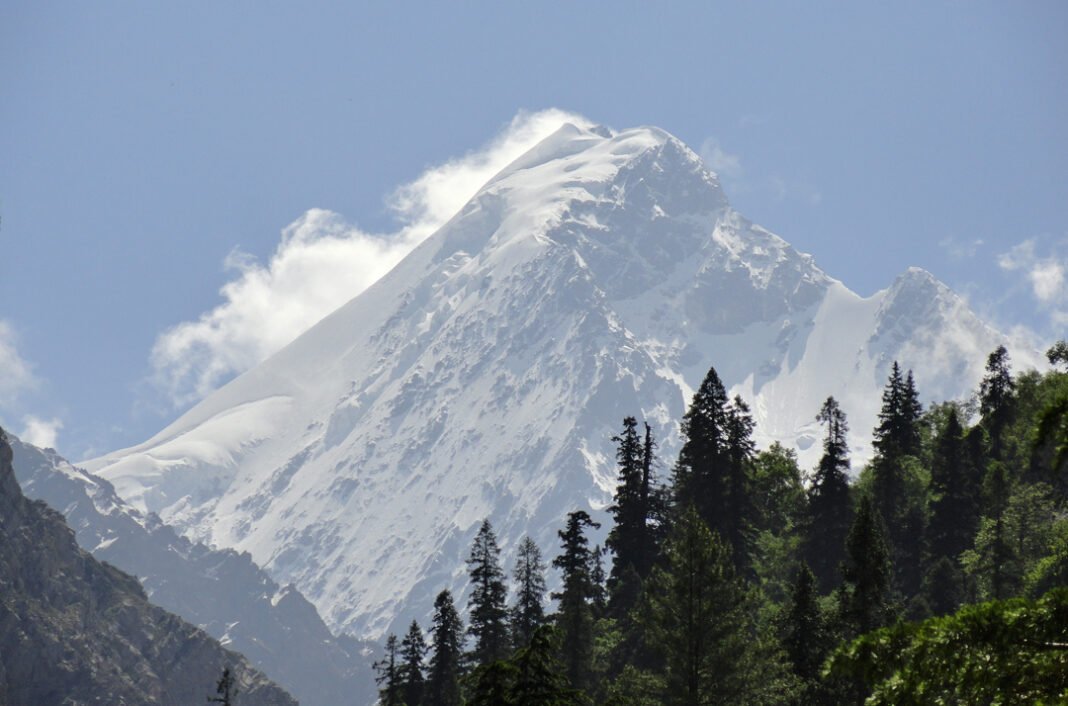
Every great mountain valley has a peak that defines it — the one locals point to, the one that fills the horizon at the end of the road. In Swat, that peak is Falak Sar. Rising to around 5,918 metres (19,416 feet) in the Hindu Kush, it is the highest mountain in Swat, and its name means “a peak touching the sky.” Locals call it “Mini K2” for its striking pyramid shape. This Falak Sar travel guide will help you decide whether this giant belongs on your adventure list — whether you are a mountaineer dreaming of its north ridge, a trekker aiming for base camp, or a traveler who simply wants to stand in Matiltan and watch the evening light strike the highest summit in the valley.
Let us be honest from the start: Falak Sar is not a casual tourist stop. It is a serious expedition mountain — icy, crevassed and remote, climbed for the first time in 1957 and summited by the first Pakistani team only in 2020. But you do not need to climb it to love it. The journey to its doorstep runs through Kalam, one of Pakistan’s most beautiful valleys, past pine forests, alpine lakes and the glaciers of Matiltan. The trek toward Falak Sar’s base camp — the “Chhota K2” trail — is one of the great high-mountain walks of the Hindu Kush, and even the view of the peak from the valley floor is worth the long drive north.
This guide covers everything: the climbing history, what trekkers and sightseers can actually do, how to reach Kalam and Matiltan from Islamabad, Lahore and Karachi, where to stay, what to eat, the mountain weather through the seasons, and the best time to visit Falak Sar. If the high Hindu Kush is calling you, read on.
Quick Facts
- Location: Ushu–Matiltan area, upper Swat, Khyber Pakhtunkhwa — on the border of Swat Valley and Kandia Valley (Kohistan), in the Hindu Kush range
- Altitude: Around 5,918 metres (19,416 feet) — the highest peak in Swat (some estimates put it slightly higher); followed by Mankial Sar
- Famous For: Being Swat’s highest summit; its “Mini K2” pyramid shape; serious mountaineering on the north ridge; the base-camp trek from Matiltan
- Nearest City: Mingora/Saidu Sharif, about 110 km south; Kalam (11 km from Matiltan) is the trekking base
- Accessibility: Road to Kalam (7-8 hours from Islamabad), then jeep track to Matiltan and Ushu; beyond that, only on foot — the summit is an expedition
- Known Landmarks: The Falak Sar massif itself, the Matiltan glaciers, Ushu Valley, Mahodand and Kundol lakes nearby
- Best For: Experienced mountaineers, serious trekkers, adventure photographers — and sightseers who want Swat’s grandest mountain view
Why Visit Falak Sar
There is a particular thrill in standing at the foot of a mountain that very few people have climbed. Falak Sar has seen only a handful of ascents in nearly seventy years — a New Zealand team in 1957, a few international expeditions since, the first Pakistani team in 2020, and the first ski descent in 2023. When you look up at its ice-fluted faces from the Falak Sar valley, you are looking at one of the last great unconquered-feeling peaks of the Hindu Kush. For mountaineers, that rarity is the whole point: this is not Everest base camp with its crowds, but a genuine frontier.
For trekkers who are not ready for 6,000-metre climbing, the approach is the reward. The trail from Matiltan up the Falak Sar valley runs through some of the wildest scenery in Swat — hanging glaciers, high pastures, the roar of meltwater streams. The base-camp trek (often called the Chhota K2 track) is demanding but non-technical in good conditions, and it delivers the classic expedition feeling: big mountains, empty valleys, nights under absurdly starry skies. It is the kind of trek that turns casual hikers into lifelong mountain people.
And for everyone else — the sightseers, the families in Kalam, the photographers — Falak Sar is simply the most dramatic thing on the horizon. From Matiltan, just 11 km from Kalam, the peak’s snowy massif dominates the view, and on a clear morning it is close enough to feel enormous. Combine it with Mahodand Lake, the Ushu forest and the trout streams of Gabral, and you have the full Kalam experience with the highest peak in Swat as its backdrop. You do not have to climb a mountain to let it change your trip.
A word of honest advice: this is a mountain that demands respect. Its route is full of steep icy glaciers, wide crevasses and enormous bulk of ice and rock — the 2022 local summiteers who climbed it without formal equipment called it one of the most dangerous 6,000-metre peaks in the Hindu Kush. Come to admire, trek and photograph; attempt the summit only with proper experience, equipment and local guides. The mountain will still be there when you are ready.
History of Falak Sar
Unlike the palaces and forts of the plains, Falak Sar’s history is written by climbers. The mountain was climbed for the first time in 1957 by W.K.A. Berry and C.H. Tyndale-Biscoe of New Zealand, via the north ridge — a bold achievement in an era when the Hindu Kush was still barely mapped by outsiders. The second ascent was made by Dr. Wolfgang Stephen, an Austrian climber who also climbed Distaghil Sar and Malika Parbat. In the years that followed, expeditions came and went; a Japanese expedition from Yamaguchi University — Yoshiyuki Nagahiro and Toshiyuki Akiyama — traveled by car from Peshawar through Saidu Sharif to Matiltan, trekked up the Falak Sar valley, established base camp at 11,000 feet, and summited.
For decades, no Pakistani team stood on the summit. That changed on August 17, 2020, when Hamza Anees, Ahmed Mujtaba and Adnan Saleem became the first Pakistanis to reach the top, climbing the north ridge in alpine style — including two nights in a snow cave. Their expedition, documented in a popular video series, brought Falak Sar to national attention and inspired a new generation of Pakistani mountaineers.
In 2022, two local climbers from Swat itself — Sayyed Zeeshan Umer and Noman Khalil — summited without guides, porters or formal equipment, completing the expedition in six days and dedicating the climb to their families. And in June 2023, Falak Sar entered skiing history: Bine Žalohar, Tom Grant and Aaron Rolph made the first ski descent from the summit, skiing right off the top (with three 50-metre rappels down an ice field on the face). Each chapter adds to the mountain’s legend — and each reminds you that this is a peak for the well-prepared.
Top Things to Do in Falak Sar
See the Peak from Matiltan
The single most accessible Falak Sar experience: drive or jeep 11 km from Kalam to Matiltan, and look up. The tallest peak of the Falak Sar massif is visible from here, rising over the glaciers and forests, with an unnamed 6,096-metre peak nearby. Come in the early morning when the air is clearest, and stay for the alpenglow if the weather holds. This is the view that sells the whole trip — bring a zoom lens.
Trek Toward Base Camp (Chhota K2 Track)
The trek up the Falak Sar valley from Matiltan toward base camp is the classic Falak Sar adventure for non-climbers. It is a multi-day walk through high pasture and glacier country, with the peak growing ever larger ahead of you. The trail is rugged and the terrain around the glaciers demands care — go with an experienced local guide, carry proper gear, and check conditions before you set out. Rescue services (Rescue 1122) operate in the region, but the mountains are remote: self-sufficiency is essential.
Climb It — Only If You Are Ready
The north ridge remains the standard route, and it is a genuine expedition: steep ice, crevasse fields, vertical reliefs and extreme altitude. Organized expeditions need full mountaineering equipment, acclimatization schedules and experienced high-altitude guides and porters from the region. If you are building toward 6,000-metre peaks, Falak Sar is a worthy objective — but it is not a first mountain.
Explore the Ushu Valley
Falak Sar stands in the Ushu Valley region, and the valley itself deserves a day. Ushu’s hill station sits 8 km from Kalam at 2,300 metres, surrounded by forests and meadows, with the Swat River’s tributaries running through it. Walk the forest trails, picnic by the streams, and look up at the peaks ringing the valley — Falak Sar among them.
Combine with Mahodand, Kundol and Kandol Lakes
Kalam is the gateway to a string of spectacular alpine lakes, and any Falak Sar trip should include at least one. Mahodand Lake, the most famous, is a classic jeep excursion from Kalam; Kundol Lake near Utror and Kandol Lake offer quieter alternatives. The lakes, the glaciers of Matiltan and the great peak itself make a perfect high-mountain triangle.
Famous Places In and Around Falak Sar
Kalam Valley: The base for everything — 99 km north of Mingora at 2,000 metres, where the Swat River is born from the Gabral and Ushu rivers.
Matiltan: 11 km from Kalam; glacier country and the trailhead for Falak Sar, with the peak visible from the valley.
Mahodand Lake: The famous alpine lake of the Kalam region — pair it with your Falak Sar viewpoint day.
Bahrain, Swat: The riverside town on the road to Kalam, famous for its bazaar and trout — see our Bahrain Swat travel guide.
Malam Jabba: Swat’s ski resort and year-round mountain destination — our Malam Jabba guide covers it in depth.
How to Reach Falak Sar
All routes to Falak Sar run through Kalam. The mountain itself has no road — the last motorable point is Matiltan, and from there it is boots only.
From Islamabad: Drive to Mingora/Saidu Sharif via the Swat Motorway — about 4-5 hours — then continue 99 km north to Kalam (another 2.5-3 hours on the mountain road). The full Islamabad–Kalam journey takes around 7-8 hours by car. Public transport: coaches and vans run from Islamabad/Peshawar to Mingora, then local vans and jeeps to Kalam.
From Lahore: Take the M-2 to Islamabad, then follow the Islamabad route above — a long day’s drive (10-12 hours total). Most Lahore travelers break the journey or travel overnight to Mingora. Alternatively, fly Lahore–Islamabad and drive from there.
From Karachi: Fly to Islamabad (about 2 hours), then drive to Kalam as above. There is no practical road-only option from Karachi — it is a two-day drive. Book flights early in summer, when northern tourism peaks.
Kalam to Matiltan: 11 km by jeep on a non-metalled road — hire a 4×4 in Kalam (30-45 minutes). Beyond Matiltan, the Falak Sar valley trail is foot-only; arrange guides and porters in Kalam or Mingora before heading up.
Road conditions: The Mingora–Kalam road is paved but winding, with landslide-prone stretches in the monsoon and snow blockages in winter. The Kalam–Matiltan track requires a jeep year-round. Always check locally on road status before departing, especially outside summer.
Route Details
Step 1: Islamabad → Mingora/Saidu Sharif via the Swat Motorway (fuel up and stock supplies in Mingora — the last proper town). Step 2: Mingora → Bahrain → Kalam, 99 km of mountain road; Bahrain makes a good lunch stop. Step 3: In Kalam, hire a jeep and finalize guides, porters and supplies for the trek. Step 4: Jeep Kalam → Matiltan (11 km). Step 5: Trek Matiltan → up the Falak Sar valley toward base camp — multi-day, with the 1957 and 2020 expeditions’ north-ridge route visible above you. Register your plans with someone reliable in Kalam before heading into the valley.
Where to Stay in Falak Sar
There is no accommodation on the mountain — you sleep in Kalam, Matiltan’s campsites, or in tents on the trek. Kalam town has the widest choice in upper Swat:
Mid-range hotels and resorts: Kalam has numerous hotels and a few larger resorts outside town with views of the surrounding peaks — comfortable rooms, hot water (usually), and on-site restaurants. Book well ahead for June–August.
Guesthouses: Family-run guesthouses in Kalam and Ushu offer simpler, cheaper rooms with home-style food — a good choice for trekkers watching their budget.
Camping: The classic option for the Falak Sar approach. Campsites operate around Kalam and Matiltan in season, and expedition teams camp in the valley. Bring a proper four-season setup if you are heading high — night temperatures near the glaciers stay near or below freezing even in summer.
We do not name specific hotels here because availability and quality change season to season in Kalam — check recent reviews before booking, and confirm heating and hot water if traveling in the shoulder season.
Where to Eat: Local Foods of Falak Sar
Kalam’s food scene is built for hungry trekkers. The region’s signature dish is Swati trout — fresh brown trout from the cold streams, especially around Gabral and the Ushu River, fried or grilled simply and served with lemon. It is genuinely excellent and worth the trip alone. Standard northern Pakistani fare is everywhere: chicken karahi, daal, chapli kebabs, fresh tandoori roti and rice dishes, plus the Chinese-Pakistani staples every mountain hotel serves.
For breakfast, expect parathas, omelets and chai; dhabas along the Mingora–Kalam road serve hearty, cheap meals. Prices in Kalam run higher than in the plains — everything travels up the mountain road — but a filling meal remains reasonable, and trout, while the priciest item on most menus, is still far cheaper than in the cities. Carry dry rations, energy bars and water-purification for the trek itself; beyond Matiltan there are no shops.
Weather in Falak Sar
Falak Sar creates its own weather — but your trip planning revolves around Kalam’s climate, since that is where you sleep and start. Kalam sits at 2,000 metres with a mild, temperate mountain climate: average annual temperature around 13.4°C, July the hottest month (averaging 24.1°C), January the coldest (averaging 1.5°C), and about 639 mm of annual precipitation. On the peak itself, temperatures stay well below freezing for most of the year, and storms can arrive in any season. The table below is for the Kalam–Matiltan valley; add serious cold and wind for anything above base camp.
| Season | Temperature Range (Kalam valley) | Conditions |
|---|---|---|
| Winter (Dec–Feb) | -2 to 10°C | Heavy snow; Kalam often cut off by road; peak in full winter conditions — expeditions only for the highly experienced |
| Spring (Mar–Apr) | 5 to 18°C | Wettest period (April averages 93 mm rain); snowmelt, landslides possible; roads reopen gradually |
| Summer (Jun–Aug) | 15 to 25°C | The trekking and climbing season; long daylight, meadows in bloom; afternoon clouds common; November is the driest month overall |
| Autumn (Sep–Nov) | 5 to 20°C | Clear, golden and dry — beautiful for sightseeing; nights turn cold; snow returns to high peaks by November |
Language and Culture of Falak Sar
Lower Swat speaks Pashto (the Yusufzai dialect), while the upper valleys around Kalam — including the approach to Falak Sar — are home to Dardic Kohistani communities with their own languages (such as Gawri). Urdu is widely understood by anyone in tourism, and basic English works in Kalam’s hotels. Learning a few Pashto or Urdu greetings earns warm smiles on the trail.
Swat’s mountain culture is famously hospitable — guests are honored, and trekkers are routinely offered tea in villages and shepherd huts. Return the respect: dress modestly (cover shoulders and knees, for everyone), ask before photographing people (especially women), and keep noise down in villages and camps. Hire local guides and porters rather than bringing everything from the cities — the mountain economy depends on it, and local knowledge of glaciers, weather and routes is irreplaceable. Leave no trace: carry all waste back down to Kalam.
Shopping in Falak Sar
There are no shops beyond Matiltan — buy everything in Mingora or Kalam. Kalam’s bazaar sells the classic Swat souvenirs: woolen shawls and embroidered caps, Swati honey, dry fruits (walnuts, apricots), and local handicrafts. Bahrain’s riverside bazaar, on the road up, is another good stop for shawls and trout-side shopping. Prices are tourist prices — bargain lightly and cheerfully. There are no shopping malls anywhere on this route, and that is entirely the point: the souvenirs here are mountain-made.
Travel Tips for Falak Sar
Packing Essentials
For the valley (sightseeing/trekking): layered clothing, a warm down or fleece jacket, waterproof shell, sturdy broken-in trekking boots, sun protection (the high-altitude sun is fierce), headlamp, water purification, and a basic first-aid kit. For a summit attempt: full expedition kit — technical ice tools, ropes, crevasse-rescue gear, four-season tent, and high-altitude clothing. Whatever your plan, carry more warm layers than you think you need; mountain weather turns fast.
Safety Tips
This is the serious section — read it twice. Falak Sar’s glaciers are crevassed and its weather unpredictable; the route has injured even experienced teams. Never trek or climb alone; always go with a qualified local guide; register your itinerary in Kalam; carry a satellite communicator if heading high; and build in acclimatization days. Watch for glacier hazards and rockfall, especially in warm afternoons. If conditions look wrong, turn back — the mountain rewards patience, not stubbornness. For casual visitors: the Matiltan viewpoint and lake excursions are safe and spectacular — you do not need to go high to have a great trip.
Money & Connectivity
Carry all the cash you will need from Mingora — ATMs thin out badly beyond Bahrain, and Kalam’s machines are unreliable. Mobile signals (all major networks) reach Kalam but fade quickly up the valley; expect little to no signal beyond Matiltan. Download offline maps before leaving Mingora, and tell someone your plans.
Best Time to Visit Falak Sar
Summer (June to August) — The Season
The only realistic window for base-camp treks and summit attempts: snow consolidated, days long, Kalam in full bloom. July is the warmest month and the busiest — book Kalam accommodation well ahead. Afternoon cloud build-ups are normal; start trekking days early.
Autumn (September to October) — Beautiful and Quiet
Clear skies, golden larches and fewer crowds make early autumn lovely for sightseeing and the Matiltan viewpoint. High routes get cold fast, though — trekking windows close as October advances.
Winter (November to March) — Only for Expeditions
Kalam is snowbound and often road-closed; Falak Sar is in full Himalayan winter. Only highly experienced winter mountaineers should consider it, with complete self-sufficiency.
Spring (April to May) — The Thaw
Valley flowers and roaring snowmelt rivers, but trails are muddy, landslide risk is real, and high snow remains dangerous. Late May can work for lower-valley sightseeing as roads fully reopen.
Final Thoughts
Falak Sar is not the easiest destination in this series — it is the wildest. A 5,918-metre giant at the head of a glacier valley, climbed by a handful of teams in seventy years, visible from a jeep track 11 km from a tourist town: that contrast is what makes it special. Whether you come to attempt the north ridge, to trek toward base camp, or simply to stand in Matiltan and watch the light move across the highest peak in Swat, you will leave with a deeper sense of what the Hindu Kush really is.
Plan it for summer, respect the mountain, hire local guides, and give Kalam’s lakes and forests their due on the way. Swat has gentler pleasures too — our Malam Jabba guide and the Hunza Valley guide cover them — but for raw high-mountain drama, Falak Sar stands alone. Pack warm, start early, and look up.
FAQs
Where is Falak Sar located?
In upper Swat, Khyber Pakhtunkhwa, on the border of Swat Valley and Kandia Valley (Kohistan) in the Hindu Kush — approached via Kalam and Matiltan.
How high is Falak Sar?
Around 5,918 metres (19,416 feet), making it the highest peak in Swat, followed by Mankial Sar. Its name means “a peak touching the sky,” and locals call it “Mini K2.”
Can beginners climb Falak Sar?
No. It is a technical expedition peak with steep glaciers and crevasses, first climbed in 1957 and first summited by Pakistanis in 2020. Beginners should enjoy the Matiltan viewpoint and the base-camp trek instead.
What is the best time to visit Falak Sar?
June to August for trekking and climbing; September–October for clear-weather sightseeing. Winter brings heavy snow and road closures around Kalam.
How do I reach Falak Sar from Islamabad?
Drive to Mingora via the Swat Motorway (4-5 hours), continue 99 km to Kalam (2.5-3 hours), then jeep 11 km to Matiltan. The full journey takes about 7-8 hours.
Where can I stay near Falak Sar?
In Kalam — mid-range hotels and resorts, family guesthouses, and seasonal campsites. On the trek itself, you camp. Book ahead in summer.
Is Falak Sar safe for tourists?
The Kalam–Matiltan sightseeing route and lake excursions are safe for regular tourists. The high mountain is dangerous and demands proper equipment, guides and experience — never go alone.
What should I eat in the Kalam valley?
Fresh Swati trout from the mountain streams is the must-try dish, alongside chicken karahi, chapli kebabs, daal and tandoori roti at Kalam’s hotels and dhabas.