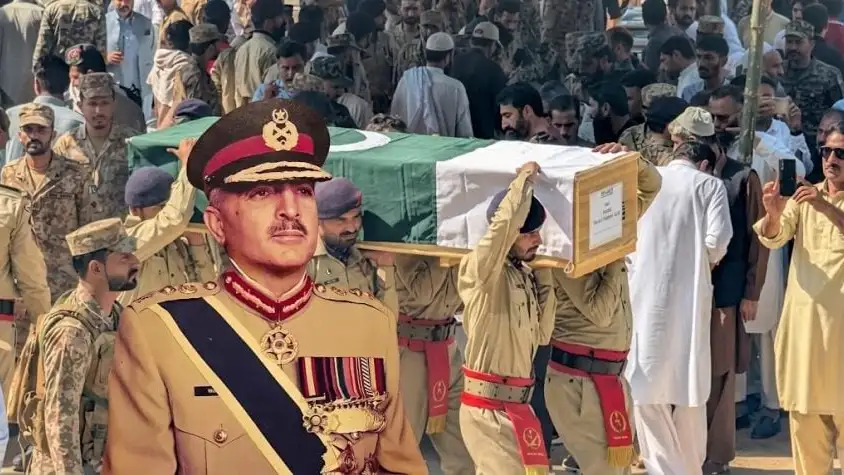
Former army chief General Abdul Waheed Kakar has died in Rawalpindi at the age of 89, the military media wing said on Monday. Abdul Waheed Kakar dies after a military career that lasted more than three decades and took him to the top of the Pakistan Army during one of the most tense political periods in the country’s history.
The Inter-Services Public Relations (ISPR) said Chief of Army Staff and Chief of Defence Forces Field Marshal Asim Munir expressed deep sorrow at the death. The ISPR said Field Marshal Munir, along with all ranks of the Pakistan Army, paid tribute to what it called the late general’s distinguished military career, leadership and invaluable services to the army.
President Asif Ali Zardari and Prime Minister Shehbaz Sharif also condoled the death. The president conveyed heartfelt condolences to the family and prayed for the late general’s forgiveness. The prime minister said he felt deep grief and sorrow, and he praised General Kakar’s invaluable services to the army. Both leaders offered condolences to the bereaved family and prayed for strength for the family in its loss.
Abdul Waheed Kakar dies: a soldier from Peshawar
General Kakar was born in Peshawar in 1937, into a Pashtun family with roots in the Kakar tribe of Balochistan. He was the nephew of Sardar Abdur Rab Nishtar, a leading figure in the Pakistan Movement. He joined the Pakistan Military Academy and was commissioned into the Frontier Force Regiment in 1959.
His service covered both wars with India in 1965 and 1971. In the 1965 war, he served in the Chawinda sector near Sialkot. In the 1971 war, he served in the Sulemanki sector. Over the years that followed, he held a series of senior posts, including General Officer Commanding of the 16th Infantry Division, Adjutant General at General Headquarters, and commander of XII Corps in Quetta.
His career changed course in January 1993, when army chief General Asif Nawaz Janjua died suddenly. General Kakar was serving as corps commander in Quetta at the time. He was picked to lead the army even though several officers were senior to him. He took command on January 12, 1993, and he stayed in the post until January 12, 1996, completing a full three-year tenure.
The Kakar Formula and the 1993 settlement
General Kakar is best remembered for his role in the political crisis of 1993. President Ghulam Ishaq Khan and Prime Minister Nawaz Sharif were locked in a bitter struggle, and the president had dismissed the prime minister’s government in April 1993. The crisis threatened to drag the country into a longer period of instability.
General Kakar played a central part in the talks that ended the standoff. In July 1993, both the president and the prime minister stepped down. The settlement became known as the Kakar Formula, and it remains part of Pakistan’s political history more than three decades later.
The deal opened the way for a caretaker government led by Moeen Qureshi, followed by fresh general elections. Those elections brought Benazir Bhutto back to power. Unlike earlier periods of military intervention, General Kakar did not impose martial law or take over the government. That restraint is a key part of how his tenure is remembered.
After his term ended in 1996, reports said Benazir Bhutto offered him an extension, but he declined it and retired on schedule. After leaving the army, he kept a low profile.
What his death marks for Pakistan
General Kakar belonged to a generation of officers shaped by the wars of 1965 and 1971 and by the political turbulence of the 1990s.
The tributes from the military leadership, the president and the prime minister underline the respect he held across institutions. The ISPR said the army shares the grief of the bereaved family and offers heartfelt condolences. The president and the prime minister used similar words, praying for mercy for the departed general and patience for his family.
Who was General Abdul Waheed Kakar?
General Abdul Waheed Kakar was a former chief of army staff who led the Pakistan Army from January 12, 1993, to January 12, 1996. He was born in Peshawar in 1937 and was commissioned into the Frontier Force Regiment in 1959.