Quick Facts
- Location: Fateh Jang Tehsil, Attock District, Punjab, Pakistan — on the edge of the Kala Chitta Range, beside the M-1 motorway
- Altitude: Low scrub-forest hills of the Attock uplands (a few hundred metres above the surrounding plains)
- Famous For: Subtropical thorn-scrub forest, the Punjab urial, marked nature trails, and easy wildlife watching near Islamabad
- Nearest City: Fateh Jang (minutes away); Islamabad roughly an hour’s drive via the M-1
- Accessibility: Easy — the reserve sits right by the M-1 motorway; best visited October to March
- Known Landmarks: Kala Chitta Range, Kheri Murat village, the M-1 motorway corridor
- Best For: Nature lovers, birdwatchers, hikers, photographers, families, and school groups
Why Visit Kheri Murat Reserve Forest
Pakistan’s great wilderness usually demands a long journey — a flight north, a two-day drive, a trek at altitude. Kheri Murat asks for none of that. This protected forest of thorn-scrub hills sits in Fateh Jang Tehsil of Attock District, right beside the M-1 motorway, roughly an hour from Islamabad — and it is one of the easiest places in the country to walk into real, protected nature. Declared a national park in 2020 as part of Pakistan’s Protected Areas Initiative, the reserve covers about 8,740 acres of the Kala Chitta Range’s foothills, and it is managed by the Punjab Wildlife and Parks Department as a living conservation landscape.
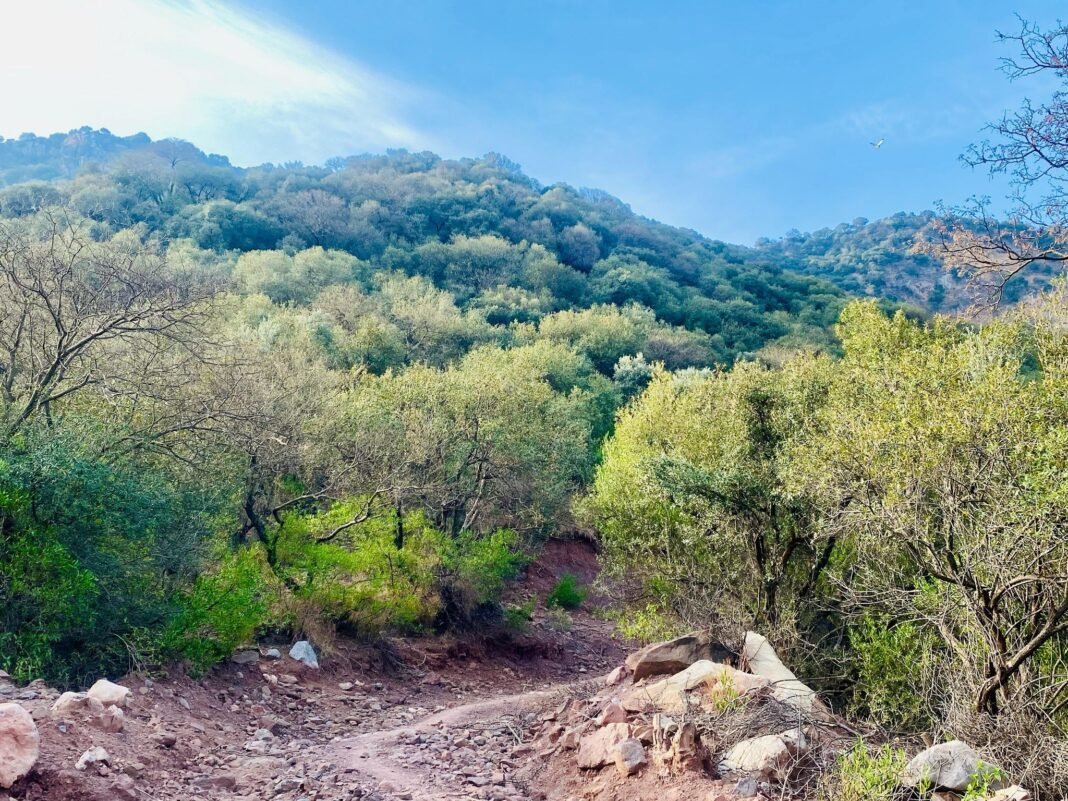
What makes it special is what lives here. The hills are classic subtropical thorn scrub — kikar, wild olive, sanatha, and bansa — and they shelter the Punjab urial, the wild sheep of the Salt Range and Attock uplands, along with partridges, the Indian python, and a rich community of resident and migratory birds documented by avifaunal surveys. The department has laid out marked nature trails and runs guided tours, so you are not wandering blindly: you walk with people who know where the urial graze and which thicket the partridges favour.
Kheri Murat is perfect for the traveler who wants wilderness without the expedition. It suits families with children (the trails are gentle, the trip is a half day), birdwatchers and photographers chasing the urial and raptors, hikers training for bigger mountains, and school or university groups studying ecology. Islamabad and Rawalpindi residents can be on a trail within ninety minutes of leaving home — there is simply no excuse not to know this place. The best time to go is October through March, when the weather is cool and pleasant and wildlife is most active. For more easy escapes near the capital, see our places to visit in Islamabad guide and the wider Explore Pakistan collection.
History of Kheri Murat Reserve Forest
Kheri Murat’s story begins in the colonial era. The forest was declared a reserve forest under Section 34 of the Indian Forest Act of 1878 — one of the many tracts across Punjab set aside for regulated forestry more than a century ago. For generations it remained working forest land of the Attock Forest Division: grazed, harvested, and lived alongside by the villages around its boundaries — nine villages to the north, eight to the south, Kheri Murat village and the Rawalpindi side to the east, and the hills near Gali Jagir village to the west.
The modern chapter opened in 2020. As part of the federal Protected Areas Initiative and the Green Stimulus programme — the conservation arm of the 10 Billion Tree Tsunami vision — the government announced six model national protected parks across Pakistan, one for each region. The Punjab site chosen was Kheri Murat in Attock: 8,740 acres to be developed as a model national park with proper management, eco-tourism, and green jobs for local youth. Adviser to the Prime Minister on Climate Change Malik Amin Aslam announced during his 2020 visit to Attock that hunting, shooting, killing, or capturing any wild animal inside the park — and within a three-mile radius of its boundaries — would be prohibited, giving the Punjab urial and the pressured partridge populations real legal protection for the first time.
The Punjab Cabinet formally approved the national park notification in July 2020, with a follow-up notification issued in 2023, and the site is now listed in the World Database on Protected Areas. Management rests with the Punjab Wildlife and Parks Department, which runs the marked trails, guided tours, and visitor information. What was once an overlooked patch of scrub forest beside the motorway is becoming one of Punjab’s flagship conservation landscapes — and visiting it, respectfully, is part of what keeps it protected.
Top Things to Do in Kheri Murat Reserve Forest
Walk the Marked Nature Trails
The reserve’s trail network is its greatest asset for casual visitors. The paths wind through thorn scrub and over low ridges, graded for ordinary walkers rather than mountaineers, and they are the best way to experience the forest’s ecology up close: the gnarled kikar and wild olive, the sanatha shrubs, the seasonal grasses. Go in the morning when the light is soft and the birds are active, wear sturdy shoes (the ground is stony), and carry water — there are no shops on the trails.
Join a Guided Wildlife Tour
The Punjab Wildlife and Parks Department runs guided tours of the reserve, and they are worth booking. The guides know the urial’s habits — where the herds water, which slopes they favour in the cool months — and can point out the field signs most visitors walk straight past: tracks, droppings, browse lines on the shrubs. Contact the department ahead of your visit to arrange a guide; the official pages list opening hours of 9:00 AM to 5:00 PM. A guided walk transforms the forest from “nice hills” into a living story.
Watch for the Punjab Urial
The Punjab urial (Ovis vignei punjabiensis) is the reserve’s flagship mammal — a wild sheep with magnificent curved horns, found in the Salt Range and Attock uplands and nowhere else on earth quite like this. Dawn and dusk are the hours; scan the open slopes and ridge lines with binoculars, move quietly, and keep your distance. Seeing a herd ram silhouetted on a Kala Chitta ridge is one of Punjab’s great wildlife moments, and Kheri Murat is among the most accessible places to earn it.
Birdwatch the Scrub
Avifaunal surveys have documented a healthy mix of resident and migratory birds in and around the park, and the thorn scrub is prime habitat. Grey and black partridges — the very birds under poaching pressure that the park was created to protect — skulk through the undergrowth; raptors ride the thermals over the ridges; and winter brings migrants down from the north. Bring binoculars, a field guide to Pakistani birds, and patience: the scrub rewards those who stand still.
Photograph the Kala Chitta Landscape
The Kala Chitta — the “Black Forest” range — makes a dramatic backdrop: dark scrub-covered ridges rolling to the horizon, red earth tracks, and huge Punjab skies. The golden hours are spectacular here, and the contrast of thorn forest against the motorway corridor is a striking study in modern Pakistan. Drone users should check current regulations and the department’s rules before flying in a protected area.
Learn the Forest’s Botany
Kheri Murat is a living textbook of subtropical thorn forest. Vegetation surveys of the landscape record Acacia nilotica (kikar), Prosopis juliflora (mesquite), Dodonaea viscosa (sanatha), Adhatoda vasica (bansa), and Olea ferruginea (wild olive) across the elevation zones. Many of these species have traditional medicinal and practical uses that local communities know intimately — ask your guide; the ethnobotany of the Attock hills is a subject in itself.
Famous Places In and Around Kheri Murat Reserve Forest
- Kala Chitta Range — the forested ridge system the reserve sits on, with its own national park designation nearby
- Fateh Jang — the nearest town, with bazaars and basic services
- Attock Fort and Attock Khurd — the historic river crossing on the Indus, under an hour away
- Taxila — the ancient Gandharan city and UNESCO World Heritage Site, reachable as a combined day trip
- Margalla Hills National Park — Islamabad’s own protected hills, for a second day of trails
How to Reach Kheri Murat Reserve Forest
Reaching Kheri Murat is refreshingly simple. From Islamabad, take the M-1 motorway west toward Peshawar and exit for Fateh Jang — the reserve lies in Fateh Jang Tehsil, right by the motorway corridor, roughly an hour’s drive from the capital depending on your starting point. The park’s own publicity notes its location “on both sides of the motorway,” which tells you how accessible it is. From Lahore, take the M-2 to Islamabad and continue on the M-1 — about 400 km total, or 4.5–5 hours of motorway driving, making it an easy long day trip or a relaxed overnight. From Karachi, the road journey is very long (around 1,400 km via the motorway network); the practical approach is to fly to Islamabad and drive the final hour.
The nearest airport is Islamabad International Airport, about an hour from the reserve by road. There is no railway station at the forest itself; the nearest practical railheads are in Rawalpindi/Islamabad and Attock. Public transport can get you to Fateh Jang town by van or bus from Rawalpindi’s Pirwadhai or Faizabad stands, but from Fateh Jang to the trailheads you will want a hired car or a ride arranged through your guide — the reserve is spread out and the trailheads are not on public routes.
Road conditions are excellent by the M-1, but the final tracks into the hills are unpaved and stony — a normal car manages in dry weather, though higher clearance is more comfortable. Visit in the October–March window when the tracks are dry and firm; the summer monsoon (July–September) can make the hill tracks slippery and the heat genuinely oppressive. Fuel up and buy supplies in Fateh Jang or on the motorway — there are no facilities inside the reserve.
Route Details
- Islamabad → M-1 motorway: join the M-1 toward Peshawar from the Islamabad interchange (~30–40 minutes to the Fateh Jang exit area).
- M-1 → Fateh Jang: exit the motorway for Fateh Jang town; the reserve’s hills rise just beyond the town.
- Fateh Jang → reserve trailheads: local roads and forest tracks to the marked trail starts — arrange the final leg with your guide or a hired car.
- From Lahore: M-2 to Islamabad, then as above (~4.5–5 hours total).
- Allow half a day for the reserve itself: a morning guided walk plus a picnic lunch covers it well.
Where to Stay in Kheri Murat Reserve Forest
There is no accommodation inside the reserve — it is a protected forest, not a resort — and that is as it should be. The practical options form three tiers. Fateh Jang town, minutes away, has basic hotels and guesthouses suitable for a no-frills overnight; they are simple, cheap, and perfectly adequate if you want a dawn start on the trails. Islamabad and Rawalpindi, about an hour away, offer the full range from budget hostels to luxury hotels — this is what most visitors choose, pairing a Kheri Murat morning with the capital’s restaurants by evening. Camping is not an established facility in the reserve; do not assume you can pitch a tent without the department’s explicit permission.
For most travelers, the winning formula is a day trip from Islamabad: leave at 7 AM, walk with a guide through the cool morning, lunch in Fateh Jang, and home by mid-afternoon. If you are combining the reserve with Attock Fort or Taxila — both excellent pairings — an overnight in the area makes the itinerary relaxed rather than rushed.
Where to Eat: Local Foods of Kheri Murat Reserve Forest
Pack your trail food and eat your main meals in town — that is the honest advice. There are no restaurants or dhabas inside the reserve, so carry water, fruit, sandwiches, and snacks for the walk, and carry every wrapper back out with you. Fateh Jang’s bazaar serves classic Punjabi roadside fare: fresh tandoori roti, daal, chicken karahi, and doodh patti from the dhabas near the bus stand — hearty, cheap, and exactly what a morning on the trails earns you.
The Attock region has its own food traditions worth sampling: the area is known for its dairy, and fresh lassi and saag in season are local staples. If you are driving back to Islamabad, the motorway service areas offer standard fast food and desi options. A dhaba lunch in Fateh Jang is very budget-friendly; treat it as part of the experience rather than an afterthought.
Weather in Kheri Murat Reserve Forest
Kheri Murat has the classic climate of the Punjab uplands: hot summers, a monsoon interlude, and the mild, golden winters that make it a wildlife destination. The reserve’s own field guides name October to March as the best time to visit, and the weather table shows why — cool mornings, warm afternoons, and clear skies, with animals active through the day. Summer (May–June) is fiercely hot and best avoided; the monsoon (July–September) brings humidity and slippery tracks.
| Season | Temperature Range | Conditions |
|---|---|---|
| Winter (Dec–Feb) | 3°C to 20°C | Cool, crisp, and clear; best wildlife watching; cold mornings — bring a jacket |
| Spring (Mar–Apr) | 12°C to 30°C | Pleasant; wildflowers and new growth; excellent for birdwatching |
| Summer (May–Jun) | 28°C to 42°C | Very hot and dry; wildlife inactive midday; avoid visiting |
| Monsoon/Autumn (Jul–Nov) | 18°C to 35°C | Monsoon humidity Jul–Sep; October–November turns dry and golden — prime season begins |
Language and Culture of Kheri Murat Reserve Forest
The reserve sits in the cultural landscape of northern Punjab’s Attock region. Punjabi — in its northern dialects — and Hindko are the everyday languages of the surrounding villages, with Urdu universally understood. The communities around the forest are agricultural and pastoral: wheat and gram in the fields, livestock on the hills, and a strong tradition of military and public service that Attock is famous for.
Visitors should remember that the forest edge is also people’s farmland and grazing land. Greet villagers politely, ask before crossing cultivated fields or photographing people, and keep to the marked trails — straying damages both habitat and crops. Dress modestly as you would anywhere in rural Punjab. If a herder offers you tea — and they might — accept it; some of the best wildlife tips in the reserve come from the men who walk these hills every day.
Shopping in Kheri Murat Reserve Forest
The reserve itself has no shops, which is part of its charm. Fateh Jang’s bazaar covers the basics: snacks, water, hats, and simple outdoor supplies. The Attock region is known for quality dairy products, and seasonal fruit from the orchards around the towns makes good edible souvenirs. For serious shopping — outdoor gear, books, cameras — stock up in Islamabad or Rawalpindi before you come. There are no shopping malls near the reserve, and none are needed for a half-day nature trip.
Travel Tips for Kheri Murat Reserve Forest
Packing Essentials
Sturdy walking shoes (the trails are stony), a hat and sunscreen, at least two litres of water per person, binoculars for the urial and birds, a camera with a zoom lens, a light jacket for winter mornings, insect repellent, and a small first-aid kit. A field guide to the birds of Pakistan turns a walk into an education. Carry a rubbish bag — the reserve has no bins, and everything you bring in leaves with you.
Safety Tips
Kheri Murat is a gentle, well-managed reserve, but it is still wild country. Stay on the marked trails; the scrub hides thorns, loose stone, and the occasional snake — including the Indian python, which deserves respectful distance. Do not approach or feed any wild animal, and never try to touch a urial: they are wild, fast, and protected by law. Walk with a guide if it is your first visit, tell someone your plans, and be off the hill tracks before dark. Hunting of any kind is strictly prohibited within the park and its buffer zone, with heavy penalties.
Money & Connectivity
Carry cash: Fateh Jang has banks and ATMs, but the reserve has no card facilities and your guide will expect cash payment. Mobile signals from all major networks generally reach the area given its proximity to the motorway, but coverage is patchy in the dips and valleys of the hills — download offline maps and do not rely on live navigation on the forest tracks.
Best Time to Visit Kheri Murat Reserve Forest
October to November — the golden opening
The monsoon is over, the scrub turns gold-green, the air clears, and the wildlife returns to daytime activity. This is many regulars’ favourite window: comfortable walking weather, active birds, and the urial visible on the slopes. The reserve’s guides consider the season officially open.
December to February — peak wildlife season
Cool, crisp winter days are the best time to see the Punjab urial, as the herds come down to the lower slopes and feed through the day. Mornings are cold — frost is common — so start after sunrise and layer up. Migratory birds add to the spectacle, and the low winter light is a photographer’s gift.
March — spring’s brief flourish
Wildflowers bloom, the birds are in full song, and temperatures are ideal before the heat builds. A lovely shoulder month, though the season winds down as April warms up.
April to September — avoid
Summer heat makes midday walking miserable and the wildlife nocturnal; the monsoon then turns the hill tracks slippery. Save Kheri Murat for the cool months — and spend your summer in the northern valleys instead, starting with our Malam Jabba guide.
Final Thoughts
Kheri Murat Reserve Forest is proof that you do not need a plane ticket to find wilderness in Pakistan. An hour from Islamabad, beside one of the country’s busiest motorways, a protected landscape of thorn scrub and black ridges shelters wild sheep, partridges, pythons, and the whole intricate web of the Kala Chitta foothills. Its 2020 declaration as a national park was a promise — that this forest would be managed, guarded, and shared — and every respectful visit helps keep that promise.
Go in winter, walk with a guide, stand still until the scrub starts moving around you, and watch a urial ram pick his way along a ridge that has looked exactly like this for ten thousand years. Then drive home for dinner. There are few places in Pakistan where the wild and the everyday sit this close together — and that is exactly why Kheri Murat deserves your visit. History buffs can pair the trip with nearby Attock Fort for a full day of nature and heritage.
FAQs
Where is Kheri Murat Reserve Forest located?
In Fateh Jang Tehsil of Attock District, Punjab, on the edge of the Kala Chitta Range beside the M-1 motorway — roughly an hour’s drive from Islamabad. The reserve forest covers about 8,740 acres.
What is the best time to visit Kheri Murat Reserve Forest?
October to March, when the weather is cool and dry and wildlife — especially the Punjab urial — is most active. December to February is the peak wildlife-watching season.
How do I reach Kheri Murat from Islamabad?
Drive the M-1 motorway toward Peshawar and exit for Fateh Jang (about an hour). From Fateh Jang, local roads and forest tracks lead to the marked trailheads — arrange the final leg with a guide or hired car.
Is Kheri Murat Reserve Forest safe for families?
Yes. The marked trails are gentle, the reserve is managed by the Punjab Wildlife and Parks Department with guided tours available, and it works perfectly as a half-day family outing from Islamabad.
Can I see the Punjab urial at Kheri Murat?
It is one of the most accessible places in Pakistan to see this wild sheep. Go in the cool months, walk with a department guide at dawn or dusk, scan the open slopes with binoculars, and keep quiet and still.
Where can I stay near Kheri Murat?
There is no accommodation inside the reserve. Stay in basic hotels in nearby Fateh Jang, or — the most popular option — base yourself in Islamabad/Rawalpindi and visit as a day trip.
What food is available at Kheri Murat?
Nothing inside the reserve, so pack trail snacks and water. Eat hearty, budget-friendly Punjabi dhaba food in Fateh Jang’s bazaar before or after your walk.
Is hunting allowed in Kheri Murat?
No. Since its declaration as a national park, all hunting, shooting, killing, or capturing of wild animals is prohibited inside the park and within a three-mile radius of its boundaries, with heavy penalties.