Deep in the deserts of western Balochistan stands a fortress with one of the strangest birth stories in Pakistan: a fort that could not be built until a wandering holy man marked its foundations with a mystic’s wand, whose bricks were carried six kilometres by a human chain, and whose eleven sister fortresses once guarded a desert kingdom against Afghanistan, Kalat and the caravans of foreign traders. Kharan Fort — the Fort of Azad Khan — is not a polished tourist attraction. It is a ruin, weathered and half-forgotten, and that is precisely its power.
This Kharan Fort travel guide is for travelers who want the Balochistan that few Pakistanis ever see: raw, ancient, and utterly unforgettable.
Quick Facts
- Location: Kharan town, Kharan District, Balochistan, Pakistan — the fort overlooks the town from its central position.
- Altitude: Around 720 metres (approximately 2,370 feet) above sea level; desert plain ringed by barren mountains.
- Famous For: The 19th-century mud-and-brick fortress of Azad Khan Nosherwani; the legend of the human chain and the saint’s wand; Iranian-style desert military architecture.
- Nearest City: Quetta, approximately 280–290 km northeast (about 4–6 hours by road).
- Accessibility: Road only, via the Quetta–Taftan highway (N-40) and the Nushki–Kharan road; nearest airport is Quetta International.
- Known Landmarks: Kharan Fort itself, the Nausherwani tombs near Mashkel, the Kharan desert landscape.
- Best For: History enthusiasts, heritage photographers, off-the-beaten-path adventurers, and travelers interested in Baloch tribal history.
Why Visit Kharan Fort (Fort of Azad Khan)
Let us be honest: nobody visits Kharan Fort for manicured lawns and gift shops. You visit because you want to stand in a place where history was made by hand — literally, brick by brick, passed from palm to palm across six kilometres of desert. The fort of Azad Khan is one of the great untold stories of Pakistani heritage: a 19th-century desert citadel built by a tribal chief who defied empires, in a region so remote that most travel guides do not even mention it. For the traveler who has done the northern valleys and wants something genuinely different, Kharan is the frontier.
The fort’s legend alone is worth the journey. When Azad Khan Nosherwani set out to build his central fortress, every attempt collapsed for lack of water — wells and karez (underground water channels) were dug again and again, and every one failed. Finally a spiritual figure close to the chief was called upon. He led Azad Khan north of the town to Dilkasha and marked the site of the karez and the fort with his mystic’s wand — and from that day, local tradition holds, the karez water has flowed in the same measure ever since.
Whether you believe the miracle or not, the story is still told in Kharan today, and standing in the fort’s huge courtyard with the desert wind moving through its dome-shaped chambers, it is easy to feel why.
A Balochistan Beyond the Headlines
Kharan Fort is also a journey into a Balochistan that the headlines never show: the hospitality of the Nausherwani tribe, the stark beauty of the “yellow mountains” (kharan means yellow in Balochi) at dawn, the ancient tombs of Mashkel. A desert silence so complete it feels sacred. This is not easy tourism — the roads are long, the facilities basic, the summer heat fierce. But travelers who make the effort come back with the same verdict: it was worth every kilometre.
History of Kharan Fort (Fort of Azad Khan)
The story of the fort begins with the Nausherwani tribe, around whom all of Kharan’s local history turns. Oral historians of the area say the Nausherwanis migrated from Iran to the Kharan region sometime in the 14th century AD, under the leadership of Mir Abbas Khan. Marching first toward Sistan on the edge of present-day Kharan district, Mir Abbas married into the local Peerakzai tribe, slowly gathered power, and eventually succeeded the Peerakzai chief as the new chief of the area.
The British gazetteers would later describe the Nausherwanis as “a race of strong-willed, bold and adventurous men,” who used their desert-protected country to organize raiding expeditions against their neighbours while professing fitful allegiance to Persia, Kalat and Afghanistan in turns.
The fort itself was raised many generations later by Azad Khan Nosherwani. Also, they took control of Kharan in 1789 and ruled as chief through the 19th century. To secure his desert state politically and militarily — against Afghanistan to the north, the powerful Khanate of Kalat to the east. The foreign traders crossing his territory — Azad Khan built eleven fortifications around the city, with the great central fort as the keystone. The state he governed had been established around 1697 as a vassal of Kalat.
It would remain a princely state through the British era, accede to Pakistan on 17 March 1948, join the Balochistan States Union on 3 October 1952, and finally merge into West Pakistan on 14 October 1955.
Building the Fort: A Local Epic
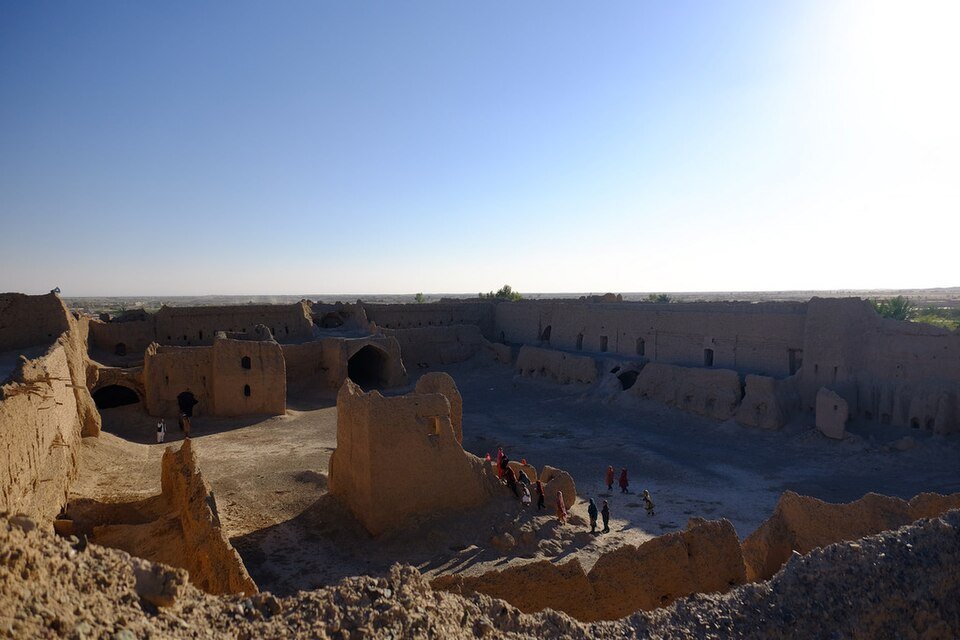
The construction of the central fort became a local epic. Built in the Iranian architectural style — solid burnt bricks, dome-shaped structures for security — its bricks were transported from about six kilometres away through a human chain of workers, a feat still remembered in Kharan’s oral history. Also, the water crisis that nearly killed the project. In fact, the spiritual guide’s intervention at Dilkasha, gave the fort a founding myth as enduring as its walls. The fort was laid out to overlook the whole of Kharan city, with windows in its exterior walls positioned to watch for enemy movement, a huge courtyard, capacious rooms for various purposes.
A mosque standing just outside its walls.
Today the fort is an archaeological site in fragile condition. Decades of neglect have left its mud-and-brick fabric weathered — the remains, as one recent account puts it, “tell the story of the oldest dynasties of Balochistan.” It stands as a monument not just to a chief and his eleven forts, but to a desert civilization that held its own between empires for centuries.
Top Things to Do in Kharan Fort (Fort of Azad Khan)
Explore the Fort Ruins
Walk the fort’s huge courtyard, peer into its domed chambers, and climb to the vantage points that once watched the whole city. Also, the scale is impressive — local accounts describe the fort covering around 400 square yards — and the Iranian-style brickwork and dome structures reward close looking. Go with a local guide if you can find one. The oral histories of the human chain and the saint’s wand are best heard on the spot where they happened.
Photograph the Desert Architecture
Kharan Fort is a heritage photographer’s dream: burnt-brick walls against an enormous desert sky, domed silhouettes at golden hour. Also, the weathered textures of two centuries of wind. In fact, early morning and late afternoon give the best light. Midday in summer is punishing for both camera and photographer.
Visit the Nausherwani Tombs at Mashkel
Near Qila Ladgasht in Mashkel town, within Kharan district, stand the Nausherwani tombs. A set of nine square tombs each crowned with a single large dome, built nearly 800 years ago during the Arghun dynasty. Also, two had collapsed by 2004 and the rest are fragile. They are among the oldest Islamic funerary monuments in the region and a natural companion visit to the fort.
Experience the Kharan Desert Landscape
The district’s very name means “yellow mountain” in Balochi. Also, the barren ranges around Kharan town glow amber at dawn and dusk. In fact, take an evening drive to the desert’s edge, watch the light change on the ridges, and experience the profound silence of one of Pakistan’s emptiest landscapes.
Meet the Local Community
Kharan’s Baloch hospitality is legendary. Also, accept the tea, listen to the stories of Azad Khan and the eleven forts, and browse the town bazaar for a glimpse of daily life in Pakistan’s far west. Visitors are rare here. The welcome is correspondingly warm.
Famous Places In and Around Kharan Fort (Fort of Azad Khan)
- Kharan Fort (Fort of Azad Khan) — the 19th-century central fortress overlooking Kharan town.
- Nausherwani Tombs, Mashkel — nine 800-year-old domed tombs near Qila Ladgasht.
- Dilkasha — the site north of town where tradition says the saint marked the fort’s karez with his wand.
- Kharan Bazaar — the town’s main market, for a taste of local desert-town life.
- The Raskoh and surrounding ranges — the barren “yellow mountains” that give Kharan its name.
How to Reach Kharan Fort (Fort of Azad Khan)
Kharan sits in western Balochistan, and getting there is an expedition — plan it as one. Also, you will love it. In fact, the fort stands in Kharan town itself, overlooking the city centre. Anyone in town can direct you to it.
From Islamabad: Fly to Quetta (about 1.5 hours), then drive to Kharan. The road journey from Islamabad to Quetta is roughly 900 km (12–14 hours) via the motorway network and N-25 — most travelers fly this leg. From Quetta, Kharan is approximately 280–290 km southwest via the N-25 and N-40 (Quetta–Taftan highway), then the road south to Kharan — about 4 to 6 hours depending on conditions.
From Lahore: Fly to Quetta via Karachi or Islamabad, then drive as above. The full road journey from Lahore exceeds 1,500 km and is not recommended as a single trip — break it in Multan or Sukkur if driving.
From Karachi: The most practical southern route. Drive the N-25 (RCD Highway) from Karachi to Quetta — about 650 km, 8 to 10 hours — then continue on the N-40 toward Kharan. Total Karachi–Kharan road distance is approximately 600 km via Quetta, taking 12 to 16 hours overall. Alternatively, fly Karachi to Quetta (about 1.5 hours) and drive the final leg.
Airports, Roads and Transport
Nearest airport: Quetta International Airport, approximately 280–290 km from Kharan. Also, there is no commercial airport at Kharan. Dalbandin Airport (Chagai) is the closest small airfield but has no scheduled passenger services for tourists.
Road conditions by season: The Quetta–Kharan route is paved but passes through rugged, remote terrain with limited services — carry fuel, water and food. Summer heat makes breakdowns dangerous; winter is the comfortable driving season. Check the security situation and travel advisories before departure, travel in daylight, and consider going with a local driver who knows the route.
Transport options: A private 4×4 with a local driver is strongly recommended. The final approaches and desert tracks are rough. Public vans and buses connect Quetta and Kharan from Quetta’s transport terminals (slow but very cheap). Tour operators in Quetta occasionally run western Balochistan circuits; for a fort-focused trip, a private arrangement is far better.
Route Details
- Reach Quetta by air (from Islamabad, Karachi or Lahore) or by road on the N-25.
- From Quetta, take the N-25/N-40 southwest toward Nushki and the Taftan highway.
- Turn south onto the Kharan road (via the Nushki–Kharan link) and drive through desert terrain to Kharan town — roughly 4 to 6 hours from Quetta.
- In Kharan town, head for the town centre; the fort’s walls are visible overlooking the city. Park nearby and explore on foot.
- For the Nausherwani tombs, continue to Mashkel town and ask locally for Qila Ladgasht.
Where to Stay in Kharan Fort (Fort of Azad Khan)
Be realistic: Kharan is a remote desert district town, not a tourist hub, and accommodation is basic. The town has a handful of simple hotels and guesthouses catering to traders, officials and the occasional traveler — expect clean-enough rooms, fans or basic air-conditioning, and home-style food rather than luxury. Also, book nothing in advance online (listings are unreliable). Your driver or a local contact can find you the best available option on arrival.
Government rest houses exist in the district and are sometimes available to travelers with prior permission — ask through the district administration or a Quetta-based tour operator well ahead of your trip. Also, for most visitors, the practical strategy is to base in Quetta, where proper mid-range and upper-mid-range hotels are plentiful, and visit Kharan as a long day trip or an overnight expedition. In fact, camping in the desert is possible for well-equipped groups traveling with local guides. It demands full self-sufficiency: water, fuel, food, shelter and communications.
Whatever you choose, carry a sleeping bag liner, a headlamp, and patience. Also, and you will be rewarded with some of the darkest, starriest night skies in Pakistan.
Where to Eat: Local Foods of Kharan Fort (Fort of Azad Khan)
Kharan’s food is classic Balochi desert cuisine — built on lamb, wheat and fire. The dish to seek out is sajji, the legendary whole lamb (or chicken) roasted slowly over coals, served with kaak, the hard stone-baked bread of the Baloch nomads. Dampukht — meat slow-cooked in its own steam in a sealed pot — is another regional specialty, rich and deeply savoury. In Kharan town’s small restaurants and dhabas you will also find Pakistani staples: daal, sabzi, karahi and fresh chapati at very budget-friendly prices.
Dates from the region’s palms are excellent, and doodh patti (milky tea) is the social drink — accept every cup offered. Also, meat is the centrepiece of hospitality here. Vegetarian travelers should stock up on daal, eggs and vegetables in the bazaar and be ready to explain their needs with a smile. Carry snacks and plenty of water for the road — services between Quetta and Kharan are sparse. A full dhaba meal in Kharan town typically costs only a few hundred rupees per person.
Weather in Kharan Fort (Fort of Azad Khan)
Kharan has a true desert climate: scorching summers, surprisingly cool winters, and very little rain. Also, the barren mountains that give the district its name (“yellow mountain”) radiate heat in summer and chill in winter. Plan around the heat — it is the single biggest factor in a Kharan trip. Approximate ranges for this Kharan Fort travel guide:
| Season | Temperature Range | Conditions |
|---|---|---|
| Spring (Mar–Apr) | Approx. 20–32°C | Warming up; pleasant mornings, hot afternoons; occasional dust winds. |
| Summer (May–Aug) | Approx. 35–45°C | Fiercely hot and dry; travel only with full water, shade and vehicle preparation. |
| Autumn (Sep–Nov) | Approx. 22–34°C | Cooling down; October–November is excellent for visiting. |
| Winter (Dec–Feb) | Approx. 5–20°C | Cool days, cold desert nights; the most comfortable season for sightseeing. |
Language and Culture of Kharan Fort (Fort of Azad Khan)
Kharan is Baloch country. Balochi is the language of home and bazaar. Also, Urdu is understood by most adults and everyone in official or trade roles. In fact, the Nausherwani tribe remains central to local identity, and tribal codes of honour and hospitality — meyman-nawazi — are taken seriously: a guest is a trust. You will be treated as one.
Culture here is conservative and tribal. Also, dress very modestly (long sleeves, covered legs. Women should cover their hair in town and villages), ask permission before any photography of people, and accept hospitality graciously — refusing food or tea can offend. Fridays are quiet; plan around prayer times. The desert communities are devout and traditional, but also famously generous to travelers who show respect. A few words of Balochi greeting go an enormously long way.
Shopping in Kharan Fort (Fort of Azad Khan)
Kharan’s bazaar serves a desert trading town, not tourists — which makes it fascinating. Also, look for Balochi embroidery (some of Pakistan’s finest needlework, on shawls, caps and dress panels), dates and dried fruits, and sturdy camel-wool products. Nomadic traders sometimes sell handmade items in the market; prices are low and bargaining is expected but good-natured.
There are no malls, no souvenir shops, and no one selling “I visited Kharan Fort” mugs — buy what the locals buy. Also, you will carry home something genuine. Meanwhile, stock up here on anything you need for the onward desert road: the next proper market is hours away.
Travel Tips for Kharan Fort (Fort of Azad Khan)
Packing Essentials
Sun protection is non-negotiable: wide-brimmed hat, high-SPF sunblock, sunglasses, and light long-sleeved clothing. Carry far more water than you think you need, plus oral rehydration salts. Meanwhile, a headlamp, a basic first-aid kit, a power bank, and a scarf or shemagh against dust complete the kit. In winter, add a warm jacket — desert nights bite.
Safety Tips
Western Balochistan demands serious trip planning. Check current government travel advisories before you go, travel only in daylight, go with a trusted local driver or guide, keep family informed of your route and timings, and carry a charged phone with a local SIM. Do not wander into the desert alone, keep to known tracks, and register your presence with local authorities or your hotel. The people of Kharan are welcoming — the risks are logistical (heat, remoteness, breakdowns), so prepare for those meticulously.
Money & Connectivity
Carry all the cash you will need — ATMs in Kharan are unreliable and card payments essentially non-existent. Mobile coverage is patchy: Jazz and Telenor have the best chance in the town itself, but expect long dead zones on the road. Download offline maps before leaving Quetta, and do not count on mobile data outside the town.
Best Time to Visit Kharan Fort (Fort of Azad Khan)
Winter (November–February): The Ideal Window
The best time by far. Also, cool days (around 5–20°C), crisp desert air, golden light on the brickwork, and comfortable driving. This is when Kharan Fort is at its most visitable — plan your trip in these months if you have the choice.
Spring (March–April): The Shoulder Season
Still workable, especially March. Mornings are pleasant, though afternoons grow hot and dust winds can pick up. Carry extra water and plan sightseeing for early morning and late afternoon.
Autumn (October): The Second Spring
October brings relief from summer and some of the year’s clearest desert skies — an excellent single-month window for photography and comfortable exploration.
Summer (May–September): For the Hardy Only
Temperatures of 35–45°C make midday sightseeing punishing and even dangerous. If you must travel in summer, restrict all outdoor activity to dawn and dusk, travel in an air-conditioned vehicle, and carry abundant water. Also, most travelers should simply wait for winter.
Final Thoughts
Kharan Fort will never be an easy destination. That is exactly why it matters. In an age of identical tourist circuits, the Fort of Azad Khan offers something almost extinct: a genuine encounter with a history nobody has packaged for you. Also, the human chain that carried its bricks, the saint’s wand that found its water, the eleven fortresses of a desert chief who faced down empires. These are stories you earn by making the journey, not ones you consume from a viewpoint platform.
Go in winter, go prepared, go with respect for the Baloch people who keep this history alive in their telling of it. Also, walk the courtyard where Azad Khan’s men once stood watch, look out over the yellow mountains at sunset. You will understand what the old travelers knew: the far corners of Pakistan guard its deepest stories. For more journeys off the beaten path, explore our Explore Pakistan collection — and if the mountains call next, our Malam Jabba guide awaits.
FAQs
Where is Kharan Fort (Fort of Azad Khan) located?
In Kharan town, Kharan District, western Balochistan, Pakistan — the fort overlooks the town centre, roughly 280–290 km southwest of Quetta by road.
Who built Kharan Fort and when?
It was built in the 19th century by Azad Khan Nosherwani, the Nausherwani chief who took control of Kharan in 1789. Also, he raised eleven fortifications around the city. The central fort, built in Iranian style with burnt bricks and domed structures, is the one that survives as Kharan Fort.
What is the best time to visit Kharan Fort?
November to February, when desert temperatures are cool (around 5–20°C). October and March are workable shoulder months. Avoid May–September, when heat reaches 35–45°C.
How do I reach Kharan Fort?
Fly or drive to Quetta, then drive approximately 280–290 km (4–6 hours) southwest via the N-25/N-40 and the Kharan road. A private 4×4 with a local driver is strongly recommended; public vans also connect Quetta and Kharan.
Safety, Legends and Nearby Sights
Is Kharan Fort safe for tourists?
The local people are famously hospitable, but western Balochistan requires careful planning: check current travel advisories, travel in daylight with a trusted local driver, carry ample water and fuel, and keep to known routes. The main risks are heat and remoteness.
What is the legend of the fort’s construction?
Local tradition says every attempt to build the fort failed for lack of water until a spiritual guide led Azad Khan to Dilkasha and marked the karez site with his mystic’s wand — after which the water flowed steadily. The fort’s bricks were reportedly carried six kilometres by a human chain of workers.
Where can I stay near Kharan Fort?
Kharan town has basic hotels and guesthouses. Also, rest houses may be available with prior permission. In fact, most travelers base in Quetta (good hotels) and visit Kharan as a day trip or overnight expedition.
What else can I see near Kharan Fort?
The 800-year-old Nausherwani tombs near Mashkel (nine domed tombs from the Arghun dynasty), the Dilkasha site of the fort legend, Kharan’s bazaar. Also, the starkly beautiful “yellow mountain” desert landscape itself.