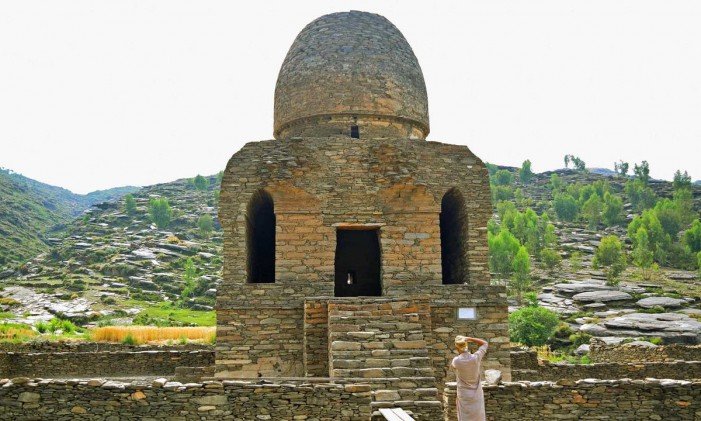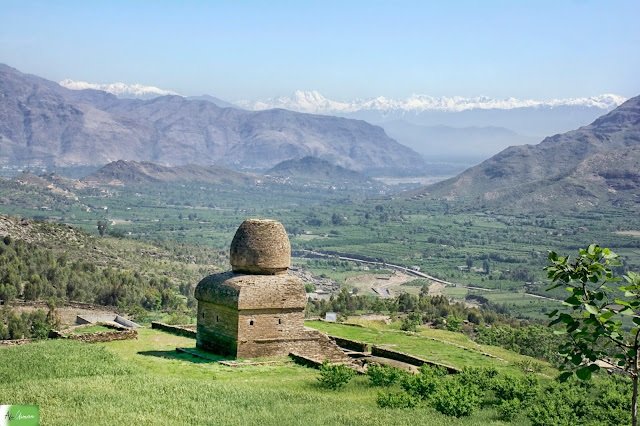
On the right bank of the Swat River, a few kilometers west of Barikot along the metalled road toward Nimogram, stands a stupa unlike any other in the valley. The Gumbatuna Stupa rises in five distinct storeys — a square base carrying four circular drums — with a monastery on its northern side and the Shamozai hills climbing behind it. It is one of the architectural oddities of Gandharan Buddhism, a site rich enough that heritage writers have called it a potential rival to Swat’s most famous monuments — and fragile enough that the same writers have warned it could be lost. This Gumbatuna Stupa Swat travel guide is for the traveler who wants the valley’s deeper story: what the stupa is, why its five storeys matter, and how to see it before the modern world closes in around it.
Quick Facts
- Location: Right bank of the Swat River, about 6 km west of Barikot village on the road toward Nimogram, near Shamozai, Swat District, Khyber Pakhtunkhwa
- Altitude: Valley floor, around 700–800 meters above sea level
- Famous For: A five-storey Buddhist stupa (1st–5th century CE) — square first storey with four circular storeys above — and a monastery on its north side
- Nearest City: Barikot (~6 km); Mingora about 20 km away
- Accessibility: Directly off the metalled Barikot–Nimogram road; reachable by car year-round, easiest with a private or hired vehicle
- Known Landmarks: The five-storey main stupa, the northern monastery remains, carved Gandharan reliefs from the site now displayed in the Swat Museum
- Best For: Heritage travelers, students of Buddhist architecture, photographers, anyone tracing the Gandharan trail beyond the famous sites
Why Visit Gumbatuna Stupa, Swat
Most of Swat’s stupas follow a familiar Gandharan formula — dome on a square base, votive stupas around it. Gumbatuna breaks the formula. Its five-storey elevation, square below and circular above, is a rare survival in the archaeology of the region, the kind of structure that makes architectural historians stop and take notes. If you have seen Amluk-Dara and Butkara and think you have seen Swat’s Buddhist architecture, Gumbatuna will quietly correct you. It is different, it is imposing, and it is standing in a wide valley with almost no one around.
The site also tells a story the polished monuments do not: the story of heritage under pressure. The monastery on the stupa’s north side is hemmed in by modern houses; the complex faces weathering, vandalism and encroachment, and Pakistani heritage writers have been sounding the alarm about Gumbatuna for years. Visiting is not just sightseeing — it is a small act of witness. Tourism, attention and local pride are among the few forces that have ever saved a threatened monument, and Gumbatuna needs all three.
And then there is the sheer pleasure of the place. The valley here is broad and luminous, drained by the Swat River running in braided channels, with the archaeological remains scattered over some 1,500 by 1,000 meters of terraced fields. A spring rises in a gully north of the sacred area. Stand at the stupa in the late afternoon, with the river glinting below and the hills turning amber, and you will wonder why this is not on every Swat itinerary. Go now, while it is still quiet.
History of Gumbatuna Stupa, Swat
The name itself is a small lesson in the local language: “gumbatuna” is the plural of the Pashto word “gumbat,” meaning dome — so the site is literally “the domes.” The Buddhist establishment here belongs to the long flourishing of Buddhism in Swat, the ancient Uddiyana that was one of Gandhara’s holiest regions. The stupa is broadly dated to the 1st–5th centuries CE, spanning the Kushan era — when Gandharan art reached its zenith under kings like Kanishka — and the centuries that followed. Its architecture and sculptural fragments place it firmly in the mature Gandharan tradition.
The site entered the archaeological record through Sir Aurel Stein, who first mentioned Gumbatuna in 1930 in the Memoirs of the Archaeological Survey of India. Small-scale excavations were carried out by Barger and Wright (published 1941), and Professor Giuseppe Tucci of the Italian Archaeological Mission followed in 1955–56. The stupa’s significance was formally recognized in modern scholarship when it was featured in “Buddhist Architecture in the Swat Valley, Pakistan” by Domenico Faccenna and Piero Spagnesi (2014), the standard reference on the valley’s sacred buildings. Carved relief panels from Gumbatuna — including stepped-pyramid motifs with Buddha images in black schist, dated to the 2nd–3rd century CE — are preserved in the Swat Museum, proof of the artistic refinement the site once displayed.
In recent decades Gumbatuna has become a symbol of the threats facing Pakistan’s Gandharan heritage. A well-known heritage report described the site as facing “eminent extinction” — prone to vandalism and the weathering of the elements, its monastery pressed by encroaching construction. The site is listed under Khyber Pakhtunkhwa’s Antiquities Act and falls under the provincial Directorate of Archaeology and Museums, but conservation resources have been thin, and heritage advocates continue to press for active protection. When you visit, you are seeing a monument at a hinge point in its history — which is all the more reason to go, to photograph, and to tell others.
Travelers should know that older sources sometimes use “Gumbat” and “Gumbatuna” interchangeably. This guide covers the five-storey stupa complex west of Barikot on the Nimogram road. Its close neighbor — the restored double-domed stupa in the Kandag Valley south of Barikot — is covered in our separate Gumbat Stupa, Barikot guide; the two sites pair naturally in a single day.
Top Things to Do in Gumbatuna Stupa, Swat
Study the Five-Storey Elevation
This is the reason to come. Walk slowly around the main stupa and read its architecture from the ground up: the quadrangular first storey, then four circular storeys rising above it. The form is unusual in Gandharan building — most stupas here are single-domed — and it gives the monument a stepped, almost tower-like presence. Bring the Faccenna and Spagnesi description in your head, or simply stand back and let the proportions speak: this was a building designed to be seen from across the valley.
Visit the Northern Monastery
On the north side of the stupa lie the remains of the monastery — the living quarters of the monks who served the shrine. The archaeology here is less consolidated than the stupa itself, and modern houses now press close, which makes the visit quietly moving: you are looking at sacred ground and ordinary village life occupying the same space. Walk it respectfully, stay on the visible paths, and do not enter private courtyards.
Trace the Sacred Geography
The remains are scattered over a wide area — roughly 1,500 meters north to south and 1,000 meters east to west — across terraced fields sloping into the Shamozai range. Climb a little above the complex and take in the whole layout: stupa, monastery, fields, the spring in the gully to the north, the Swat River braiding through the valley below. Few sites in Swat let you read a Buddhist sacred landscape this clearly.
Continue to the Swat Museum
After the site, drive to the Swat Museum in Saidu Sharif and find the Gumbatuna pieces — the carved schist reliefs with their stepped-pyramid decoration and seated Buddhas. Seeing the sculptures the stupa once wore, now safe in glass cases, completes the story the weathered stones begin. It is one of the most satisfying site-to-museum pairings in the valley.
Famous Places In and Around Gumbatuna Stupa, Swat
- Gumbat Stupa, Barikot — the double-domed 2nd-century stupa in the Kandag Valley; the natural companion visit.
- Shingardar Stupa — the imposing stupa on the left bank of the river near Ghalegay, almost opposite Gumbatuna; visible across the valley.
- Nimogram stupas — three stupas further along the same road, making a logical onward stop.
- Bazira (Barikot) — Alexander’s 327 BCE conquest city, excavated by the Italian mission.
- Amluk-Dara Stupa — Swat’s most celebrated stupa, near Mingora.
- Butkara-III — the excavated stupa complex at Mingora’s edge.
- Bahrain — the riverside bazaar town upstream, for trout lunches and mountain air.
How to Reach Gumbatuna Stupa, Swat
Gumbatuna is one of the easier Swat stupas to reach: it sits right by the metalled road from Barikot village toward Nimogram, about 6 km west of Barikot, on the right bank of the Swat River. You can drive essentially to the site. From Mingora, head west to Barikot (about 20 km), then follow the Nimogram road; the stupa complex is visible from the road in the wide valley at the foot of the Shamozai hills.
From Islamabad: About 235 km, roughly 4–4.5 hours — M-1 to the Colonel Sher Khan Interchange, then the Swat Motorway (M-16) to Chakdara, then the N-95 to Barikot and onward to the site.
From Lahore: About 480 km via M-1 and the Swat Motorway, roughly 7–8 hours; most travelers route via Islamabad.
From Karachi: Around 1,700 km by road — fly to Islamabad and drive. Saidu Sharif airport has only limited, intermittent commercial service, so Islamabad remains the practical gateway.
Transport options: A private car or a hired car/jeep from Mingora is the straightforward choice — the site is roadside, so any vehicle will do. Coaches (Daewoo and others) connect Islamabad with Mingora; from Mingora, local vans run to Barikot, and a rickshaw or taxi can cover the last 6 km to the stupa. For a full heritage day, hire a driver in Mingora and combine Gumbatuna with Gumbat, Bazira and the Swat Museum.
Route Details
Islamabad → M-1 → Colonel Sher Khan Interchange → M-16 Swat Motorway (tunnels, bridges, Katlang rest area) → Chakdara Interchange → N-95 alongside the Swat River → Barikot → west on the metalled Nimogram road → Gumbatuna Stupa (roadside, ~6 km). The entire route is paved and comfortable for any car; the motorway has cut the old journey dramatically. Fuel and food are available in Barikot; carry water for the site.
Where to Stay in Gumbatuna Stupa, Swat
Stay in Mingora or Saidu Sharif, about 20 km east — the valley’s accommodation hub and the right base for a Gandharan heritage circuit.
Luxury: The Swat Serena Hotel in Saidu Sharif — lawns, gardens, and mountain views about 5 km from downtown Mingora — is the valley’s established upscale address and a comfortable base for heritage touring. Reserve ahead in the May–August season.
Mid-range: Mingora’s main roads offer a solid band of mid-range hotels catering to domestic tourists, most with breakfast included and parking. This tier gives you the best balance of comfort, location and value for a multi-site archaeology day.
Budget and guesthouses: Simple guesthouses in Barikot put you closest to the stupas, and Mingora has budget hotels near the transport stands. Basic, clean, and fine for travelers who spend daylight at the sites.
Heritage tip: base yourself in Saidu Sharif and you can do the Swat Museum first thing in the morning, then drive the Barikot road for Gumbatuna, Gumbat and Bazira in one unhurried loop.
Where to Eat: Local Foods of Gumbatuna Stupa, Swat
Eat in Barikot or Mingora — there is nothing at the stupa itself, so plan your meals around the drive. The valley’s Pukhtun kitchens do a short menu brilliantly: chapli kebab with its crisped edges, slow-cooked lamb karahi, smoky tikka and seekh kebab from roadside grills, and kabuli pulao crowned with caramelized carrots and raisins. Fresh tandoori roti arrives by the stack, and Swati qehwa — light green tea, sometimes with cardamom — closes every meal the local way.
In Mingora you will also find trout on restaurant menus, sourced from the colder waters upstream, plus the bazaar staples of the region: walnuts, dried apricots, wild honey and roasted corn in season. A full meal at a Barikot or Mingora dhaba generally costs a few hundred rupees per person. Eat where the grills are busiest, drink the qehwa, and save room for the honey.
Weather in Gumbatuna Stupa, Swat
The site sits on the valley floor near Barikot, so expect the valley-floor climate: cool dry winters, a glorious spring, hot exposed summers on the open ground, and a monsoon peak in July–August. There is no shelter at the stupa, so sun and rain both matter for your planning.
| Season | Temperature Range | Conditions |
|---|---|---|
| Winter (Dec–Feb) | 2–14°C | Dry and clear; cold mornings, crisp afternoons. Excellent visibility for photography. |
| Spring (Mar–May) | 12–30°C | The prime season — green fields, wildflowers, soft light on the masonry. |
| Summer (Jun–Aug) | 20–36°C | Hot on the open site; heaviest rain in August. Go at dawn, museum at midday. |
| Autumn (Sep–Nov) | 10–28°C | Clear and golden; harvest season in the terraces. A superb second window. |
Language and Culture of Gumbatuna Stupa, Swat
This is Yusufzai Pashtun country: Pashto is the mother tongue, Urdu is widely understood, and the ethic of the valley is hospitality. Do not be surprised if a villager walking past the stupa stops to greet you, or if tea is pressed on you in Barikot — accepting graciously is part of the journey here.
Visit as a respectful guest. Dress modestly, ask before photographing people, keep to the archaeological ground and off private fields and courtyards — the monastery area in particular sits close to homes. Never pocket pottery shards or stone fragments; they are protected antiquities and, more importantly, they belong to the story of this place. If you can find a local guide in Barikot, take one: the site’s history is richer told by someone whose family has lived beside it for generations.
Shopping in Gumbatuna Stupa, Swat
Buy nothing at the stupa; buy everything in Mingora. The bazaars there are the valley’s treasure chest: Swati embroidered shawls and waistcoats, hand-loomed woolens, carved wooden handicrafts, and gemstones — Swat’s emerald mines are ancient and still working. Edible souvenirs travel best: walnuts, dried apricots and mulberries, wild honey, and the local roasted corn flour. Haggle gently; it is part of the ritual and nobody minds.
Travel Tips for Gumbatuna Stupa, Swat
Packing Essentials
Hat, sunglasses and sunscreen — the site is completely exposed. Sturdy shoes for rubble and terrace edges. Water and snacks, because the nearest shop is back in Barikot. A camera you trust, and a notebook if you are the kind of traveler who likes to sketch plans of five-storey stupas.
Safety Tips
The Barikot–Nimogram road is a normal, settled rural road used by tourists daily. Visit in daylight, park sensibly off the metalled road, and tell your hotel your route. Do not climb the stupa masonry — the structure is ancient and partially fragile — and keep children close on the terrace edges.
Money & Connectivity
Everything near the site is cash-only; the nearest ATMs are in Barikot town and Mingora. Jazz and Telenor give the best valley coverage, with Zong usable in the towns. Save offline maps before leaving Mingora — the signal thins in the valley folds.
Best Time to Visit Gumbatuna Stupa, Swat
Spring (March–May) — the essential season
The valley is green, the river is full, the light is kind. This is when the stupa looks its most monumental against the fresh terraces. If you make one trip, make it now.
Autumn (September–November) — the photographer’s season
Harvest gold, clear air, long shadows across the five storeys. October is close to perfect for a heritage circuit of the valley.
Winter (December–February) — the solitary season
Cold mornings, empty site, crystalline views of the hills. Dress warmly and you may have Gumbatuna entirely to yourself.
Summer (June–August) — the early-bird season
Hot and occasionally very wet. Visit at first light, retreat to the Swat Museum or Mingora’s bazaars by late morning, and you will still have a fine day.
Final Thoughts
Gumbatuna is the kind of site that makes you reconsider what “famous” means. It is architecturally extraordinary, historically deep, and set in one of the loveliest valleys in Pakistan — yet it stands half-forgotten, its monastery edged by new houses, its future uncertain. The travelers who come here now are not just tourists; they are witnesses, and witnesses matter.
Pair it with its neighbor Gumbat Stupa, the Bazira excavations and the Swat Museum, and you will have spent one of the richest heritage days Swat offers. Then tell someone about it. Monuments survive when people care about them — and Gumbatuna, with its five storeys against the Shamozai hills, deserves to be cared about. Find more journeys like this in our Explore Pakistan collection.
FAQs
Where is Gumbatuna Stupa located?
On the right bank of the Swat River, about 6 km west of Barikot village on the metalled road toward Nimogram, near Shamozai in Swat District, Khyber Pakhtunkhwa.
What is the best time to visit Gumbatuna Stupa?
March to May for green landscapes and ideal walking weather; September to November for golden autumn light. Winter is clear and crowd-free; summer visits are best at dawn.
How do I reach Gumbatuna Stupa from Islamabad?
About 235 km via the M-1, the Swat Motorway (M-16) to Chakdara, and the N-95 to Barikot — roughly 4–4.5 hours — then 6 km west on the Nimogram road. A private car or hired vehicle from Mingora is the easiest option.
Is Gumbatuna Stupa safe to visit?
Yes. It sits beside a normal rural road in settled, tourist-friendly Swat. Visit in daylight and follow the usual common-sense precautions for rural heritage sites.
Is Gumbatuna Stupa suitable for families?
Yes — the site is roadside and easy to access, and children enjoy the open ruins. Supervise them on the masonry and bring water, hats and snacks as there is no shade or shops.
Where can I stay near Gumbatuna Stupa?
Mingora and Saidu Sharif (about 20 km away) offer the full range, from the Swat Serena Hotel to mid-range hotels and budget guesthouses. Simple guesthouses are also available in Barikot town.
What food is available near Gumbatuna Stupa?
Eat in Barikot or Mingora: chapli kebab, lamb karahi, tikka, kabuli pulao and Swati qehwa at dhabas and restaurants, typically a few hundred rupees per person. Trout is on menus in Mingora.
What makes Gumbatuna Stupa architecturally unique?
Its five-storey elevation — a square first storey with four circular storeys above — is rare in Gandharan architecture. Carved reliefs from the site, including 2nd–3rd century schist panels, are preserved in the Swat Museum.