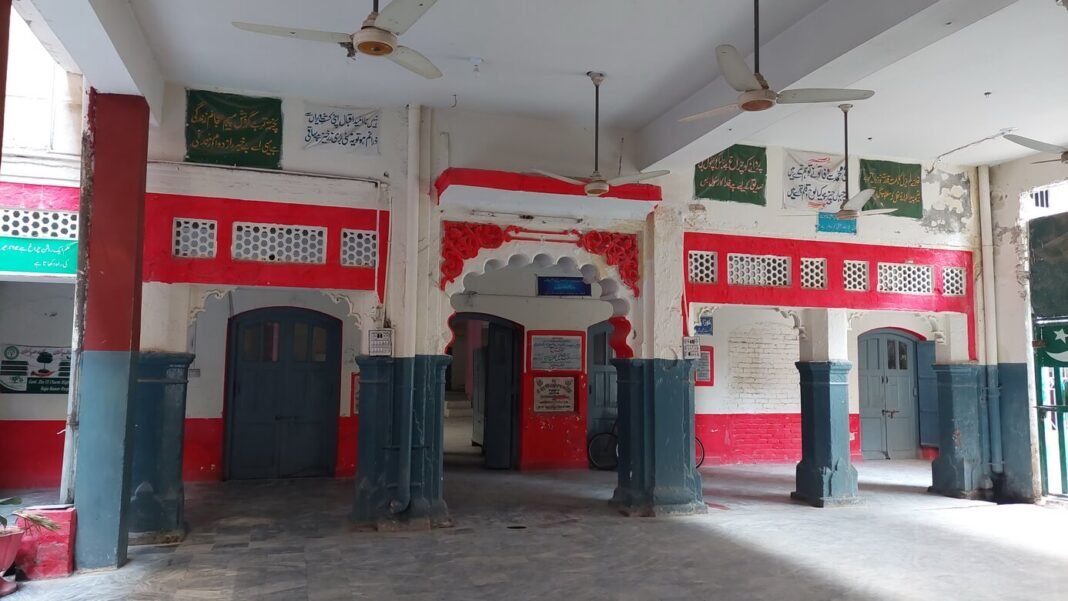
In the glorious chaos of Raja Bazaar — Rawalpindi’s oldest, loudest, most delicious market — stands a big double-storeyed building that was once the beating heart of the city’s Akali Sikhs. The Gurdwara Singh Sabha, built in 1930 by the Guru Singh Sabha in memory of Sardar Mol Singh and Channa Devi, held elegant pilgrims’ rooms, a graceful langar hall and a beautiful prakashasthan, endowed with agricultural land and shops across the city. Today it houses a government high school, and the Palki Sahib still rests in the main hall while Gurmukhi inscriptions wait on the stones for someone to read them. If your idea of travel is standing where a community’s history is literally written on the walls — and then stepping out into one of the subcontinent’s great old bazaars for siri paye — this Gurdwara Singh Sabha, Rawalpindi travel guide will convince you that the old city deserves a day of your Pakistan trip, and show you exactly how to spend it.
Quick Facts
- Location: Raja Bazaar, old city Rawalpindi, Punjab, Pakistan — a few yards from the mosque, temple and seminary quarter at the bazaar’s core
- Famous For: Being the center of Rawalpindi’s Akali Sikhs; its large double-storeyed building with elegant pilgrims’ rooms, langar hall and prakashasthan; Gurmukhi stone inscriptions, including one recording its 1930 construction
- Nearest City: Rawalpindi itself; Islamabad roughly 25–30 km northeast
- Accessibility: Excellent — road and rail; nearest airport Islamabad International; Rawalpindi Junction on the main railway line
- Known Landmarks: The gurdwara/school building itself, the neighboring mosque-temple-gurdwara cluster, Raja Bazaar, Sarrafa Bazaar (Gurdwara Bhai Mani Singh)
- Best For: Sikh heritage travelers, old-city explorers, photographers, food lovers, students of Partition and pluralism
- Visit Tip: The building is a working government boys’ school — view it respectfully from outside and seek the principal’s permission before entering
Why Visit Gurdwara Singh Sabha, Rawalpindi
The first reason is the building itself, and what it says. The Gurdwara Singh Sabha is not a ruin and not a museum — it is a living palimpsest. The double-storeyed structure the Akali Sikhs raised in 1930 was built to impress: big, beautiful, with pilgrims’ rooms, a langar hall and a prakashasthan described by every survey as elegant. Endowed with agricultural land outside the city and shops inside it, it was an institution, not just a shrine — the headquarters of Sikh religious life in Rawalpindi. Stand before it today and you read the whole 20th century in its bricks: the confidence of the 1930s Sikh community, the rupture of 1947, and the decades since, in which a government boys’ school has kept the roof on and the classrooms full. The Palki Sahib — the palanquin of the holy scriptures — is still placed in the main hall of the school. Gurmukhi inscriptions still run across the stones. Few heritage sites in Pakistan let you touch history this directly.
The second reason is the stone that tells its own story. The historian Iqbal Qaiser, the great documenter of Pakistan’s Sikh shrines, records that one of the building’s plaques states the gurdwara was built in 1930 by the Guru Singh Sabha, in memory of Sardar Mol Singh and Channa Devi, by their son — who acquired the land for Rs 2,000. Think about that figure for a moment: two thousand rupees for the land under what became the Akali headquarters of a major Punjabi city. The plaque is still there, and the school’s principal has asked researchers and archaeologists to translate the Gurmukhi writings for him. Visit as a heritage traveler and you join a small, ongoing act of recovery — every visitor who reads, photographs and shares these inscriptions helps keep them from being forgotten.
The third reason is the pluralism on the doorstep. A few yards from the gurdwara, in the quarter that became the focal point of the 2013 Ashura violence, stand a mosque, a temple and this gurdwara side by side — a troika that an Express Tribune report called a depiction of the city’s “multi-religious character and pluralistic past.” Rawalpindi before 1947 was a city where these communities lived cheek by jowl, and Raja Bazaar still wears that history in its street plan. To visit the Gurdwara Singh Sabha is to visit the idea of the undivided Punjab in miniature — complicated, contested, but undeniably shared.
And then there is the sheer pleasure of the setting. Raja Bazaar is one of the great old-city markets of the subcontinent — a dense, fragrant maze of cloth merchants, spice sellers, jewelers and food stalls that has barely changed its rhythm in a century. A morning at the gurdwara flows naturally into a day of old-city wandering: the Nirankari gurdwara nearby in its own historic bazaar, the Gurdwara Bhai Mani Singh in Sarrafa Bazaar, the Namak Mandi, and lunch that you will remember for years. If Islamabad’s planned boulevards have left you hungry for the real, old, delicious Pakistan, Raja Bazaar — and the Singh Sabha gurdwara at its heart — is the answer.
History of Gurdwara Singh Sabha, Rawalpindi
The Gurdwara Singh Sabha belongs to the confident final chapter of Sikh Rawalpindi. By the early 20th century, Rawalpindi was one of the great Sikh cities of undivided Punjab — a commercial and administrative center with a large, prosperous Sikh population, its own Singh Sabha reform movement, and a skyline of gurdwaras. The Guru Singh Sabha of Rawalpindi, part of the wider Singh Sabha movement that had been reforming and organizing Sikh religious life since the 1870s, resolved to build a central shrine worthy of the city’s Akali Sikhs.
According to the stone plaque recorded by the historian Iqbal Qaiser, the gurdwara was built in 1930 in memory of Sardar Mol Singh and Channa Devi, by their son, who acquired the land for Rs 2,000 — a substantial sum for the time, and a measure of the family’s devotion. The result was a large double-storeyed building, celebrated in every account for its beauty: elegant rooms for pilgrims, a graceful langar hall, and a fine prakashasthan (the chamber of the scriptures). The shrine was richly endowed — agricultural land in the countryside and shops inside the city were dedicated to its upkeep, the classic Sikh model of a self-sustaining religious institution. It became, in the phrase of every survey since, the center of the Akali Sikhs of Rawalpindi.
Then came 1947. Partition emptied Rawalpindi of most of its Sikh population, and the great gurdwaras of the city — Singh Sabha, Bhai Mani Singh, Nirankari, Damhial — lost their sangats overnight. Like many minority shrines across Punjab, the Singh Sabha building passed into government hands, and a government high school began functioning in it — the use it retains to this day. The school’s administration reclaimed 52 marlas of the gurdwara’s land from encroachers who wanted to build a shopping plaza on it, preserving the compound. The Palki Sahib remains in the main hall; the Gurmukhi inscriptions remain on the stones, awaiting translators.
The building’s modern story is one of quiet custodianship. The school principal, Sheikh Tariq, has welcomed heritage researchers — including Dr. Ayesha Pamela Rogers, who traveled from Lahore to document the city’s heritage buildings — and has asked every archaeologist who visits to help translate the Gurmukhi inscriptions. The gurdwara, the neighboring temple and the nearby mosque have never been formally documented in the city’s heritage surveys, which makes every careful visitor’s record a small contribution to their preservation. The Singh Sabha gurdwara stands today as Rawalpindi’s most eloquent monument to its Sikh century: not restored, not ruined, but in use — a schoolhouse with scriptures in the main hall.
Top Things to Do in Gurdwara Singh Sabha, Rawalpindi
See the Great Double-Storeyed Building from Raja Bazaar
Approach the gurdwara the way its builders intended — on foot, through the bazaar. The building rises big and confident above the shopfronts of Raja Bazaar, its double storeys and Sikh-era brickwork unmistakable once you know what to look for. Walk around the exterior slowly: the massing, the arched openings, the courtyard walls all speak of a 1930 institutional building designed for both worship and community life. Early morning, before the bazaar hits full frenzy, is the best time for photographs and for really seeing the architecture.
Read the 1930 Plaque and the Gurmukhi Inscriptions
With the school administration’s permission, look for the stone plaques — including the one recording the gurdwara’s construction in 1930 by the Guru Singh Sabha in memory of Sardar Mol Singh and Channa Devi, on land acquired for Rs 2,000. The Gurmukhi inscriptions scattered across the building’s stones are the site’s most precious feature: primary sources, carved in stone, waiting to be read. Photograph them carefully (ask first) — heritage researchers actively seek new readings of these texts.
Pay Respects at the Palki Sahib in the Main Hall
The Palki Sahib — the palanquin that holds the holy scriptures, regarded by Sikhs as the living Guru — is still placed in the main hall of the school. This is the sacred heart of the building, and it deserves the reverence of any gurdwara: cover your head, remove your shoes, keep your voice low, and do not photograph worship or the scriptures without explicit permission. Time your visit outside school hours or during a break, and always ask the staff first.
Walk the Mosque–Temple–Gurdwara Quarter
A few yards from the gurdwara stand a mosque and a temple — the pluralistic troika that tells Rawalpindi’s deeper story. Walk the lanes between them slowly. This quarter, near the seminary that was the focal point of the 2013 Ashura clashes, is where the city’s layered religious history is most visible and most poignant. It is a walk that rewards the historically minded traveler more than any single monument could.
Pair It with Rawalpindi’s Other Great Gurdwaras
The Singh Sabha gurdwara anchors a full day of Sikh heritage in the old city. Walk to the Gurdwara Nirankari in nearby Narankari Bazaar — the birthplace of the Nirankari movement and site of the first Sikh-rites marriage — and to the Gurdwara Bhai Mani Singh in Sarrafa Bazaar, the shrine of the great Sikh martyr-scholar, also now a school. Together the three (plus Gurdwara Damhial on the city’s edge) map the whole arc of Sikh Rawalpindi. Our Explore Pakistan series covers each in depth.
Famous Places In and Around Gurdwara Singh Sabha, Rawalpindi
- Gurdwara Nirankari, Rawalpindi — birthplace of the Nirankari movement; a short walk through the old bazaars
- Gurdwara Bhai Mani Singh, Rawalpindi — the martyr-scholar’s shrine in Sarrafa Bazaar
- Gurdwara Damhial, Rawalpindi — the Chhevin Patshahi shrine on the city’s outskirts
- Raja Bazaar — the old city’s great market: cloth, spices, jewelry and street food
- Namak Mandi and Narankari Bazaar — historic food and wholesale quarters around the gurdwaras
- Liaquat Bagh — the historic public garden (formerly Company Bagh) at the edge of the old city
- Taxila — the ancient Gandharan city, about an hour northwest — combinable as a second day
How to Reach Gurdwara Singh Sabha, Rawalpindi
The gurdwara sits in Raja Bazaar, at the core of Rawalpindi’s old city — which means it is one of the easiest heritage sites in Pakistan to reach, and one of the trickiest to drive to. From anywhere in Rawalpindi or Islamabad, take Murree Road or the old Grand Trunk Road toward Raja Bazaar; then park and walk. Do not attempt to drive into the bazaar’s inner lanes — they are a glorious, honking maze of rickshaws, handcarts and shoppers. Park at a plaza on Murree Road or near Fawara Chowk and walk in (10–15 minutes). Ask for the Singh Sabha gurdwara or the government school in Raja Bazaar — every shopkeeper knows it.
From Islamabad (25–30 km), the drive via the Islamabad Expressway and Murree Road takes 45 minutes to an hour. From Lahore (about 370 km), take the M-2 motorway to the Thalian/Rawalpindi interchange (4–4.5 hours), then into the old city. From Karachi (about 1,400 km), fly to Islamabad International Airport (about 2 hours) and drive 45–60 minutes to Rawalpindi, or take the train to Rawalpindi Junction — one of Pakistan’s great railway stations, itself worth seeing — and a rickshaw to Raja Bazaar. The nearest airport is Islamabad International Airport; Rawalpindi is also on the main Karachi–Peshawar railway line with frequent service.
Transport options: private car or hired car to the edge of the bazaar, then feet. Ride-hailing cars and auto-rickshaws will drop you at Fawara Chowk or Bara Market. For the full old-city day, hire a local guide at the bazaar — they know the gurdwara lanes, the food stalls, and the shortcuts. Tour vans can be arranged through Rawalpindi/Islamabad operators for heritage circuits covering the Singh Sabha, Nirankari and Bhai Mani Singh gurdwaras.
Route Details
Islamabad → Raja Bazaar (the standard approach): Islamabad Expressway south to Faizabad, then Murree Road into Rawalpindi. Continue past Liaquat Bagh to Fawara Chowk. Park in a plaza lot, then walk east into Raja Bazaar’s lanes toward the gurdwara/school quarter. Total: 25–30 km, 45–60 minutes plus walking time.
Lahore → Rawalpindi: M-2 motorway north to the Rawalpindi/Thalian interchange, then the old GT Road or the motorway link into the city and on to Raja Bazaar. About 370 km, 4–4.5 hours. Best as an overnight trip with a full old-city day.
Karachi → Rawalpindi: Fly to Islamabad International (2 hours) and drive, or rail to Rawalpindi Junction (20–24 hours on the express trains) and rickshaw to the bazaar. This is a northern-Punjab trip — combine with Taxila and Islamabad.
Road conditions: All approach roads are major highways in good condition year-round. Inside Raja Bazaar, you are a pedestrian — wear comfortable shoes, keep valuables close in the crowds, and carry small cash for the bazaar.
Where to Stay in Gurdwara Singh Sabha, Rawalpindi
Stay in Rawalpindi or Islamabad — the gurdwara is a daytime old-city visit, not an overnight destination in itself. Rawalpindi offers mid-range hotels along Murree Road and near the railway station, plus budget guesthouses in the Saddar and Raja Bazaar areas (basic but atmospheric, and a short walk from the morning’s sightseeing). Islamabad, 45 minutes away, has the full range: luxury hotels in the Blue Area and diplomatic enclave, mid-range hotels in F-6/F-7, and guesthouses everywhere. For a heritage-focused trip, Rawalpindi itself is the better base — you wake up in the old city and walk to the bazaar before the crowds.
Name no hotel without verification is the rule here, so the practical advice: book through a reputable platform, read recent reviews, and prefer places near Murree Road or Saddar for the shortest hop to Raja Bazaar. If you are doing the full Sikh-heritage circuit (Singh Sabha, Nirankari, Bhai Mani Singh, Damhial) plus Taxila, allow two nights in Rawalpindi.
Where to Eat: Local Foods of Gurdwara Singh Sabha, Rawalpindi
This is where the trip pays delicious dividends. Raja Bazaar and its surrounding food streets are among the great eating quarters of Punjab. Start the morning with siri paye — the slow-cooked trotters-and-head stew that is Rawalpindi’s signature breakfast — with hot kulchay or naan. Follow with chanay (chickpea curry), halwa puri, and glasses of thick, malai-topped lassi. For lunch, the bazaar’s kebab shops do superb seekh kebabs, chicken tikka and kebab rolls; the old city’s katlama and kulfi stalls handle dessert.
The Namak Mandi area near the gurdwaras has legendary desi food streets where a full meal costs little — budget a few hundred rupees per person at a dhaba, more at the sit-down restaurants of Saddar and Murree Road. Do not miss the bazaar’s doodh jalebi in the evening and the fresh sugarcane juice stalls in winter. Carry water; eat where the locals queue — the longest line is always the review that matters.
Weather in Gurdwara Singh Sabha, Rawalpindi
Rawalpindi sits at the foot of the Margalla Hills, which gives it slightly kinder weather than Lahore — cooler evenings, a real winter, and monsoon drama in July and August. The gurdwara visit is a walking visit through crowded bazaars, so heat and rain both matter.
| Season | Temperature Range | Conditions |
|---|---|---|
| Winter (Dec–Feb) | 3–18°C | Crisp, sunny days; cold mornings — perfect bazaar-walking weather; carry a warm layer |
| Spring (Mar–Apr) | 15–30°C | The best season — mild, clear, flowers in the parks; ideal for the old-city walk |
| Summer (May–Jun) | 25–40°C | Hot and dry; start at dawn, retreat to shade/cafes by noon |
| Monsoon (Jul–Sep) | 25–35°C | Heavy, dramatic downpours; bazaar lanes get slippery and crowded — carry rain cover |
| Autumn (Oct–Nov) | 15–30°C | Dry, golden and comfortable — the second-best window after spring |
Language and Culture of Gurdwara Singh Sabha, Rawalpindi
The old city’s language is Punjabi — the Pothwari dialect of the Potohar plateau — with Urdu universal in the bazaar and English understood in hotels. Shopkeepers respond warmly to a greeting in Punjabi or Urdu; bargaining is expected in the bazaar (start at half the quoted price for souvenirs, smile throughout).
Culturally, remember two things. First, the gurdwara is a working school: visit outside class hours when possible, ask the principal’s or staff’s permission before entering, keep your voice down in corridors, and do not disrupt classes. Second, the quarter’s recent history is sensitive — the 2013 violence centered very near here. Be respectful, avoid political discussions with strangers, and let the buildings do the talking. At the Palki Sahib, observe full gurdwara etiquette: cover your head, remove shoes, wash hands if facilities exist, and never photograph the scriptures or worshippers without explicit permission. Modest dress (covered shoulders and knees) is the norm across the old city.
Shopping in Gurdwara Singh Sabha, Rawalpindi
Raja Bazaar is one of Pakistan’s great shopping experiences, and it surrounds the gurdwara on all sides. The bazaar’s specialties: cloth and shawls (the wholesale cloth market is legendary — Pashmina-style shawls, lawn, khaddar), spices sold from fragrant sacks, jewelry in Sarrafa Bazaar (gold and silver, sold by weight — buy only from established shops), dry fruits, and traditional footwear (khussay). Bara Market, nearby, is famous for imported goods and electronics at sharp prices.
For Sikh-heritage souvenirs — books on Punjab history, rumalla cloth, kara bracelets — ask in the bazaar’s book and religious-goods shops. There is no modern shopping mall inside the old city (malls exist on the city’s outskirts and in Islamabad), and honestly you will not miss them: Raja Bazaar is the attraction. Bargain cheerfully, carry cash (many old shops are cash-only), and keep your wallet secure in the crowds.
Travel Tips for Gurdwara Singh Sabha, Rawalpindi
Packing Essentials
Comfortable broken-in walking shoes — you will be on your feet for hours on uneven lanes. A headscarf or dupatta (for the gurdwara and for sun). Sunscreen and a cap in summer; a warm jacket in winter. A small daypack with water, hand sanitizer and tissues. Your phone/camera fully charged — the bazaar is endlessly photogenic, but always ask before photographing people or shop interiors.
Safety Tips
Raja Bazaar is crowded but generally safe for tourists in daylight; the main risks are pickpockets and traffic, not crime. Keep valuables in a front pocket or money belt, hold your bag in front in dense crowds, and watch for motorcycles and rickshaws in narrow lanes. Visit the gurdwara/school in the morning on a weekday for the calmest experience. If you are a foreign visitor, carry your passport and register your travel plans with your hotel. Avoid the area during major religious processions unless you are with a local guide who knows the routes.
Money & Connectivity
ATMs are plentiful around Fawara Chowk, Murree Road and Saddar — withdraw before entering the bazaar’s inner lanes, where many shops are cash-only. All mobile networks (Jazz, Telenor, Zong, Ufone) have strong 4G coverage across Rawalpindi. Free Wi-Fi is available in most hotels and many Saddar cafes. For the best rates, use a local SIM with a data package.
Best Time to Visit Gurdwara Singh Sabha, Rawalpindi
Spring (March–April): The Perfect Season
Mild days, clear skies, and the old city at its most walkable — spring is the ideal time for the Raja Bazaar heritage walk. Temperatures sit in the 15–30°C range, the school is in session (so arrange your visit thoughtfully), and the food streets are in full swing. This is also the season of Vaisakhi (mid-April): while the Singh Sabha building is no longer an active gurdwara, the festival fills Punjab’s Sikh calendar and gives your heritage trip its living context — nearby active shrines celebrate it.
Autumn (October–November): The Second-Best Window
Dry, golden, comfortable — autumn rivals spring for bazaar walking. The post-monsoon light is superb for photography, the crowds are thinner than in spring, and the winter food specialties (like saag and fresh sugarcane juice) begin appearing.
Winter (December–February): Crisp and Atmospheric
Cold mornings, brilliant afternoons — excellent for sightseeing if you dress warmly. The bazaar’s winter foods (hot doodh jalebi, gajar ka halwa) are at their peak. Mornings can be foggy; plan indoor or bazaar time early and the gurdwara exterior for midday light.
Summer and Monsoon (May–September): Visit with Care
May–June heat makes midday bazaar-walking punishing — go at dawn and retreat by 11 a.m. The July–September monsoon brings spectacular downpours that flood lanes and snarl traffic; if you visit then, wear quick-dry shoes, carry rain protection, and keep the itinerary flexible.
Final Thoughts
The Gurdwara Singh Sabha will not give you the polished experience of a restored monument. It will give you something better: a building that never stopped being used, in a bazaar that never stopped being alive. The Akali headquarters of 1930 became the schoolhouse of today, and the Palki Sahib still sits in the main hall, and the Gurmukhi stones still wait for readers. That continuity — faith to education, shrine to school, without demolition — is its own kind of preservation, and it is worth traveling to see.
Come in spring, when the old city is at its kindest. Walk the bazaar, read the plaque, stand quietly in the main hall, and then eat your way back through Raja Bazaar as the afternoon light turns the brickwork gold. Pair it with the Nirankari and Bhai Mani Singh gurdwaras for the full story of Sikh Rawalpindi, and you will leave understanding this city — and the Punjab it belongs to — more deeply than any guidebook could manage. For more journeys into the country’s living heritage, follow our Explore Pakistan series.
FAQs
Where is Gurdwara Singh Sabha, Rawalpindi?
It is in Raja Bazaar, in Rawalpindi’s old city, Punjab — a few yards from the quarter where a mosque, a temple and the gurdwara stand together. It currently houses a government boys’ high school.
What is the best time to visit Gurdwara Singh Sabha, Rawalpindi?
March–April and October–November offer the best weather for walking the old city. Winter is crisp and good too; summer heat and monsoon rains make sightseeing harder.
How do I reach the gurdwara from Islamabad?
Drive 25–30 km via the Islamabad Expressway and Murree Road to Fawara Chowk in Rawalpindi (45–60 minutes), park, and walk 10–15 minutes into Raja Bazaar’s lanes. Do not try to drive into the bazaar itself.
Can I go inside the gurdwara?
The building is a working school. View the exterior freely from the bazaar, and ask the principal’s or staff’s permission before entering. Visit outside class hours when possible and be respectful of students.
Is Gurdwara Singh Sabha safe for tourists and families?
Yes in daylight — it is a busy commercial area. Keep valuables secure in crowds, watch traffic in narrow lanes, and carry your ID.
Where can I stay near Gurdwara Singh Sabha?
Stay in Rawalpindi (mid-range hotels on Murree Road, guesthouses in Saddar/Raja Bazaar) or Islamabad (full range, 45 minutes away). Rawalpindi is the better base for old-city sightseeing.
What food should I try in Raja Bazaar?
Siri paye for breakfast, chanay and halwa puri, seekh kebabs and kebab rolls for lunch, doodh jalebi and kulfi for dessert — plus thick malai lassi. Eat where the locals queue.
What does the 1930 plaque say?
According to the historian Iqbal Qaiser, a stone plaque records that the gurdwara was built in 1930 by the Guru Singh Sabha in memory of Sardar Mol Singh and Channa Devi, by their son, who acquired the land for Rs 2,000.