Quick Facts
- Location: Walled City of Lahore, near Mori Gate (southern half), close to Bhatti Gate and Lohari Gate — Gali Bazaar, Mohalla Sathan
- Altitude: Around 220 metres (plains of Lahore)
- Famous For: Being the finest surviving Sikh-era haveli in Lahore — the only one that preserves its original ornamentation and architecture — and the tragic story of the prince who lived barely a day as Maharaja
- Nearest City: Lahore itself; the haveli stands inside the historic Walled City
- Accessibility: Easy — enter the Walled City via Delhi Gate, Mori Gate or Bhatti Gate; the haveli currently houses the Government Victoria Girls’ High School, so seek permission from the school authorities to explore beyond the exterior
- Known Landmarks: The haveli’s frescoed western facade, the Jharoka-e-Darshan balcony, and the Rang Mahal (Sheesh Mahal) pavilion on the top floor
- Best For: Heritage lovers, architecture enthusiasts, photographers, Sikh-history travelers, and anyone who wants the Walled City beyond the usual circuit
Why Visit Haveli Nau Nihal Singh
Behind the walls of a working girls’ school in old Lahore hides one of the most beautiful buildings the Sikh Empire ever produced. Also, the Haveli of Nau Nihal Singh — built in 1836–37 by Maharaja Ranjit Singh for his grandson — is officially the Government Victoria Girls’ High School. It is unofficially a masterpiece: the only Sikh-era haveli in Lahore that still keeps its original ornamentation and architecture. The western facade blazes with frescoes in the vivid Kangra style. The great jharoka balcony above the entrance carries carved winged figures, parrots and fish in sculpted brickwork.
And on the top floor, a small mirrored pavilion — the Rang Mahal, also called the Sheesh Mahal — turns daylight into scattered jewels.
A Shakespearean Tragedy in Stone
Then there is the story, and it is pure Shakespeare. Nau Nihal Singh, the brilliant young grandson for whom this mansion was raised, became Maharaja of the Punjab on 5 November 1840 — and was fatally injured the very next day, dying before his reign had properly begun. His widow died within the year. His mother Chand Kaur, who retired to this very haveli on a pension of 900,000 rupees, was battered to death by her own servants in 1842. To walk these rooms is to walk through the most dramatic eighteen months in Sikh history, in the house where much of the aftermath unfolded.
For the heritage traveler, the haveli fills the gap every Lahore itinerary has. Visitors do the Fort, the Badshahi Mosque, the Samadhi of Ranjit Singh — and leave without seeing how the Sikh aristocracy actually lived. Also, this mansion, rectangular in plan, rising through a basement and four storeys around a great courtyard, is that missing chapter: domestic Sikh architecture at its most refined, with the Kangra frescoes, the cut-brick masonry and the mirrored ceilings that made it famous.
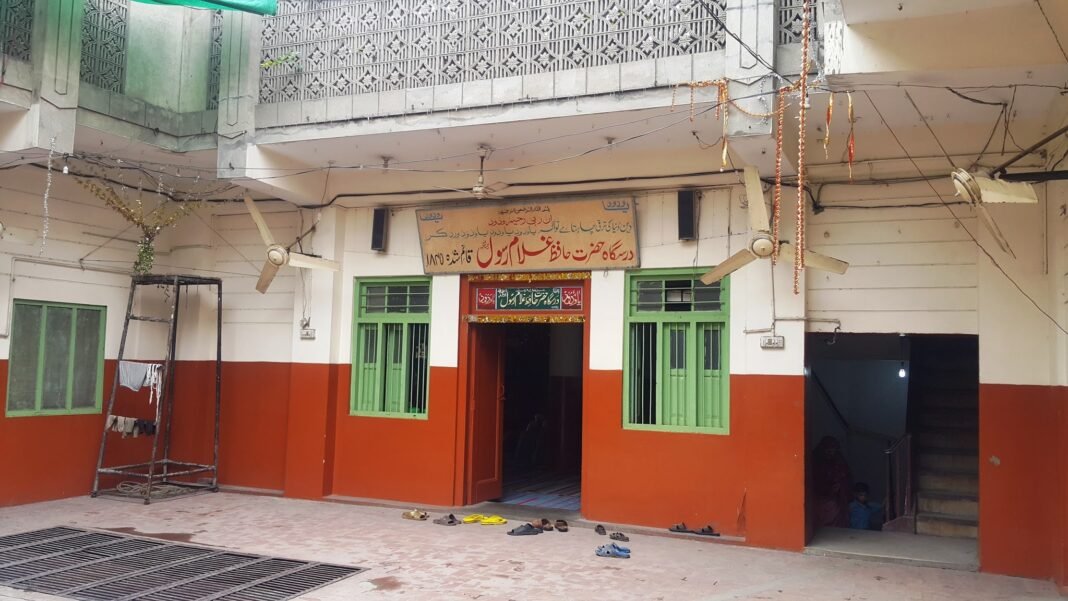
A practical honesty first: this is a functioning school, not a museum. Also, you admire the celebrated exterior freely from Gali Bazaar. The interiors — the frescoed chambers, the courtyard, the Rang Mahal — require permission from the school authorities, which is routinely granted to respectful visitors, especially in the morning. That small effort is part of the charm. The Haveli Nau Nihal Singh is not heritage on a platter. It is heritage you are invited into, and the invitation makes the visit unforgettable. If you love old Lahore, this is the address you should know by heart.
History of Haveli Nau Nihal Singh
The haveli was built around late 1836–37 by Maharaja Ranjit Singh, founder of the Sikh Empire, as a personal residence for his grandson Kanwar Nau Nihal Singh — the only son of Kharak Singh and Chand Kaur. Also, contemporary accounts associate its construction with Nau Nihal Singh’s wedding in 1837, and his grandmother Maharani Datar Kaur is recorded as having taken a considerable personal interest in the mansion’s decoration and embellishment. In fact, what rose in the southern Walled City, near Mori Gate, was no ordinary townhouse: a rectangular, four-storeyed palace-mansion with a basement, built to proclaim the power and taste of the Sikh court at its zenith.
A One Day Reign and Its Aftermath
The prince they built it for barely lived to enjoy it. Nau Nihal Singh succeeded his father as Maharaja of Punjab on 5 November 1840 — and on 6 November, returning from Kharak Singh’s cremation, he was fatally injured when a stone gateway collapsed on him (the circumstances have been debated ever since). He died the next day, aged nineteen, after a reign of a single day: one of the great tragedies of Sikh history. In 1841 his widow, Bibi Sahib Kaur, delivered a stillborn son minutes before her own death — extinguishing the direct line and plunging the succession into crisis.
The haveli then became the stage for the tragedy’s final act. The dowager Maharani Chand Kaur gave up her claim as regent and retired to this mansion on a pension of 900,000 rupees. But her enemies still saw her as a threat, and on 11 June 1842 her own servants battered her to death with wooden pikes — murdered in the very house they had raised for her son’s glory.
With the British annexation of the Punjab, the mansion passed out of royal hands and in 1892 became government property. Since the British colonial era — for well over a century — it has housed the Victoria Girls’ High School, today the Government Victoria Girls’ High School. Generations of Lahore’s schoolgirls have studied under the Kangra frescoes and the mirrored ceilings, which may be the most poetic adaptive reuse in the Walled City: a prince’s palace, become a school, still standing, still original.
Top Things to Do in Haveli Nau Nihal Singh
Study the Western Facade
Start where everyone starts: the western frontage on Gali Bazaar. Also, the facade is divided into two great sections — the entryway portion profusely decorated with frescoes in the vivid Kangra style, the other pierced with numerous windows — and it repays long, slow looking. In fact, this is the most photographed Sikh-era facade in Lahore, and morning light brings out the fresco colors best. Stand across the lane, take your time, and notice how the decoration grows denser and more confident as your eye rises toward the jharoka.
Admire the Jharoka-e-Darshan
Above the entrance sits the haveli’s signature feature: a large jharoka balcony of sculpted brickwork crowned with a small bulbous half-dome. This was the Jharoka-e-Darshan, from which the Maharaja would appear before subjects gathered below. Also, it carries five small arches, flanked by two smaller jharokas. Its carvings are a delightful puzzle — winged human figures that echo both Islamic angels and the Hindu garuda, parrots, frontally-viewed fish carved with East Asian influence, floral pedestals. A serpent-like figure at the dome’s base recalling the Naga. No other balcony in Lahore compresses so many traditions into one composition.
Seek Out the Rang Mahal (Sheesh Mahal)
If permission takes you inside and upward, the prize is the top-floor pavilion known as both the Rang Mahal and the Sheesh Mahal — not to be confused with the Lahore Fort’s famous Sheesh Mahal. Also, this one is smaller, more intimate, and all the more magical for it. Its wooden ceiling is divided into geometric compartments, each set with a small mirror, centered on a sun motif called the Surya. Blind arches between the windows hold miniature paintings in gold, blue, red and orange. It is the most beautiful room in the house and the culmination of everything the haveli was built to be.
Walk the Courtyard and Chambers
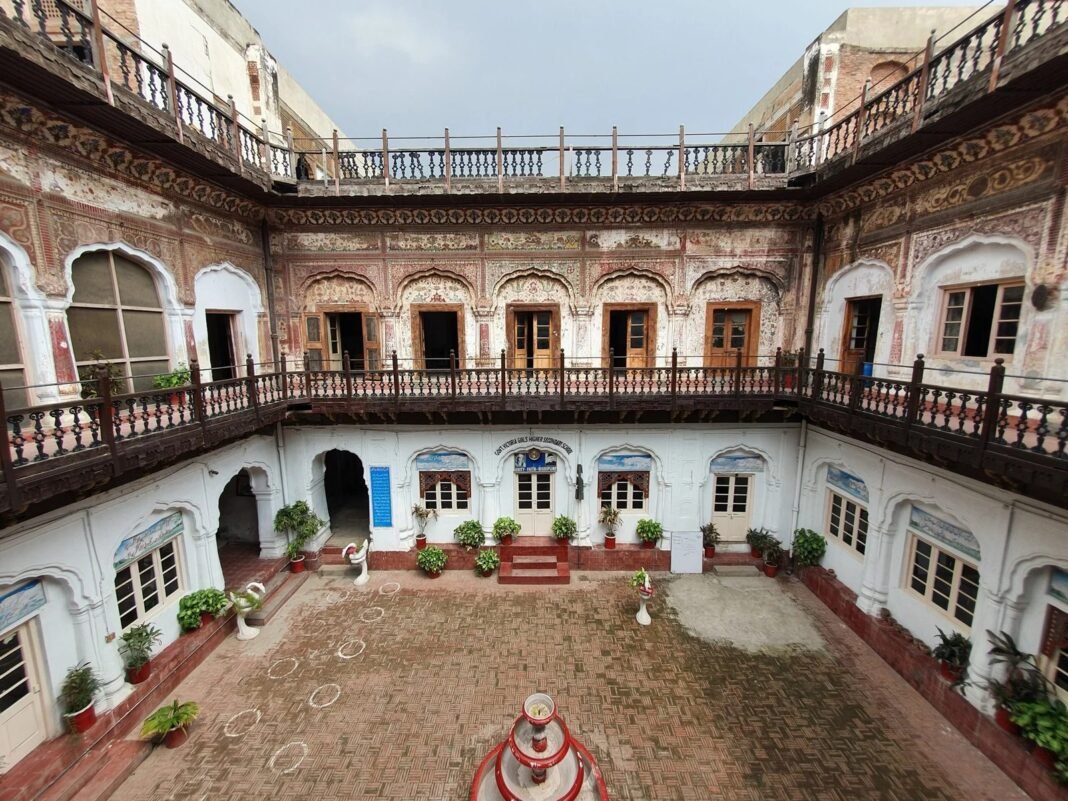
The mansion is rectangular in plan around a spacious courtyard ringed with residential chambers. Also, the classic haveli arrangement, executed at palace scale. In fact, the lower two storeys span the full footprint; the upper levels step back in the traditional manner. Even a brief permitted walk through the courtyard gives you the domestic scale of Sikh aristocratic life: the cool shaded chambers, the carved woodwork, the sense of a household built for ceremony and for family at once.
Pair It with the Walled City Circuit
The haveli sits within easy reach of Lahore’s greatest monuments. Also, it deserves to be the insider’s stop on a full Walled City day: the Badshahi Mosque, the Lahore Fort, the Samadhi of Maharaja Ranjit Singh and Gurdwara Dera Sahib — the grandfather’s memorial, a short walk from the grandson’s house. In fact, the contrast is the point: the empire’s public splendor at the Fort, its private refinement at the haveli.
Famous Places In and Around Haveli Nau Nihal Singh
- Lahore Fort & Badshahi Mosque: The Mughal-Sikh citadel complex, minutes away — the essential pairing.
- Samadhi of Maharaja Ranjit Singh & Gurdwara Dera Sahib: The grandfather’s memorial, beside the Fort.
- Delhi Gate & Shahi Hammam: The restored Mughal gate and royal baths of the Walled City.
- Wazir Khan Mosque: The jewel-box Mughal mosque, a short walk through the old city.
- Fort Road Food Street: Lahore’s famous food street, for the evening after the heritage walk.
- Naag Temple & Ath Dara: Further Sikh-era sites in the Fort complex, for the completist.
How to Reach Haveli Nau Nihal Singh
The haveli is inside Lahore’s Walled City, so reaching it means reaching old Lahore — which is easy from anywhere in Pakistan. From Islamabad, take the M-2 motorway to Lahore — about 375 km, roughly 4.5 hours by car — or hop on any of the frequent buses, wagons and trains. The railway journey is comfortable and drops you at Lahore Junction, a short ride from the Walled City. From Karachi, fly to Allama Iqbal International Airport (about 2 hours) or take the train or luxury coach north — roughly 1,210 km by road, an overnight journey most travelers fly instead.
The nearest airport is Allama Iqbal International Airport, with connections across Pakistan and abroad. Also, from the airport or railway station, take a ride-hailing car or taxi to the Walled City — ask for Delhi Gate or Mori Gate. The haveli lies in the southern half of the Walled City near Mori Gate, by Bhatti and Lohari Gates, in Gali Bazaar, Mohalla Sathan. The last stretch is on foot through the old-city lanes. These is exactly as it should be: the approach through the bazaars is part of the experience.
Road conditions are a non-issue — this is Lahore — but the Walled City’s lanes are narrow, crowded and partly pedestrianized. Do not attempt to drive into the old city; park at the Delhi Gate or Fort parking areas and walk. Visit in the morning: the light is best for the facade, the lanes are calmer. The school authorities are most approachable about interior visits before the school day is in full swing.
Route Details
- Reach Lahore — M-2 from Islamabad (~4.5 hrs), flight or train from Karachi, GT Road from Gujranwala/Sialkot side.
- Get to the Walled City — taxi or ride-hailing to Delhi Gate or Mori Gate; park and continue on foot.
- Walk to Gali Bazaar, Mohalla Sathan — in the southern Walled City near Mori Gate; ask for the Victoria Girls’ High School / Nau Nihal Singh Haveli.
- Admire the western facade — the frescoed frontage is best in morning light.
- Request interior permission — politely ask the school authorities; if granted, see the courtyard, chambers and the Rang Mahal pavilion.
Where to Stay in Haveli Nau Nihal Singh
You stay in Lahore, and Lahore has everything. Also, for this visit, the smartest base is near the Walled City or in Gulberg/Model Town with easy access to it: the old city’s own guesthouses put you steps from the gates. In fact, the mid-range and luxury hotels of Gulberg, DHA and Model Town offer full comfort a 20–30 minute drive away. Heritage travelers who want atmosphere should look at the boutique guesthouses in and around the Walled City — waking up inside the old city walls is an experience in itself.
Budget travelers are well served by the hostels and budget hotels around Lahore Junction and Anarkali. Also, luxury travelers can choose from the city’s established five-star properties. In fact, whatever your tier, one night is the minimum for the Walled City done properly — the haveli in the morning, the Fort and mosques through the day, Fort Road Food Street at night.
Where to Eat: Local Foods of Haveli Nau Nihal Singh
You are in Lahore, which means you are in the food capital of Pakistan — plan your meals with the seriousness they deserve. Also, around the Walled City, the institutions are: Fort Road Food Street, the rooftop-lined street facing the Badshahi Mosque, perfect for a dinner with the illuminated mosque as your backdrop. In fact, the old city’s paye (slow-cooked trotters) and nihari shops, best at breakfast. Chanay with naan from the Anarkali-side dhabas. And lassi — sweet, salty or the legendary peday wali — from the old city’s famous lassi shops.
For sweets, the Walled City’s jalebi fried in desi ghee and falooda with kulfi are non-negotiable. The broader Lahori canon — chicken karahi, mutton kuna, chargha, daal — is available everywhere, but near the haveli, eat old-city style: on a rooftop or at a counter, with your hands, among Lahoris. Budget-friendly street food and mid-range restaurants cluster around Fort Road, Delhi Gate and Anarkali. Fine dining waits in Gulberg and DHA for those who want it. Drink bottled water, pace yourself, and accept that you will not eat this well again until your next Lahore trip.
Weather in Haveli Nau Nihal Singh
Lahore’s weather is plains-Punjab weather turned up a notch: winters are cool and foggy, summers are famously fierce. Also, the monsoon brings dramatic relief. For Walled City walking — lanes, rooftops, facades — the cool season is overwhelmingly the best. Summer visits are entirely possible but should be built around early mornings, air-conditioned middays and evenings on Fort Road.
| Season | Temperature Range | Conditions |
|---|---|---|
| Winter (Dec–Feb) | 5°C to 20°C | Cool, often foggy mornings; the prime heritage season — clear afternoons, perfect walking weather |
| Spring (Mar–Apr) | 15°C to 33°C | Pleasant and brief; excellent for sightseeing before summer |
| Summer (May–Jun) | 28°C to 45°C | Intensely hot; sightsee at dawn, rest midday, emerge for food streets at night |
| Monsoon/Autumn (Jul–Nov) | 20°C to 38°C | Monsoon rains July–August; autumn pleasant again from October |
Language and Culture of Haveli Nau Nihal Singh
Punjabi is the language of the Walled City’s lanes, Urdu the language of its shops and schools. Also, you will get by in English at hotels and major sites. The culture is old-Lahori: warm, witty, food-obsessed and proud to the point of theater. Lahoris consider their city the cultural capital of Pakistan and will tell you so within minutes of meeting you — agree with them. It saves time.
For the haveli visit specifically, remember you are entering a working girls’ school. Dress modestly, keep noise down, do not photograph students, and accept whatever access the authorities grant with grace. They are doing you a kindness by sharing their school’s extraordinary building. At the nearby gurdwaras and the Badshahi Mosque, the usual courtesies apply: cover your head where required, remove shoes, and dress to cover shoulders and knees. In the Walled City generally, a smile and a little Urdu go further than any guidebook.
Shopping in Haveli Nau Nihal Singh
The Walled City is one of Pakistan’s great shopping districts. Meanwhile, the haveli visit drops you in the middle of it. Anarkali Bazaar — one of the oldest surviving markets in South Asia — sells everything from traditional khussay and embroidered shawls to crockery and electronics across its old and new sections. Urdu Bazaar, by the Walled City, is the book lover’s paradise: publishers, stationers and second-hand bookshops stacked floor to ceiling.
Look for phulkari embroidery, camel-skin lamps, brass work and traditional jewelry in the old-city shops, and mithai from the famous sweet shops to carry home. Also, bargaining is expected in the bazaars and part of the fun — start at half the quoted price and meet in the middle with good humor. In fact, for fixed-price modern retail, Fortress Square and the Gulberg malls are a drive away. The old city’s bazaars are the authentic Lahore shopping experience.
Travel Tips for Haveli Nau Nihal Singh
Packing Essentials
Comfortable walking shoes are the single most important item. Also, the Walled City is a walking destination and its lanes are uneven. Bring sun protection, a water bottle, a head covering for religious sites, and modest clothing. A camera is essential for the facade and the old-city lanes. Keep it discreet inside the school and never photograph students.
Safety Tips
The Walled City is busy and safe for travelers in daytime, with the usual big-city precautions: keep valuables secure in crowds, agree transport fares in advance, and drink bottled water. Also, the lanes around Mori Gate and Bhatti Gate are working neighborhoods — respectful behavior earns respectful treatment. In fact, evenings at Fort Road Food Street are lively and well-policed. The standard advice to stay aware after dark applies as it would in any major city.
Money & Connectivity
ATMs are everywhere in Lahore and mobile coverage is excellent on all networks. Also, the old-city bazaars, rickshaws and street-food stalls are cash businesses — keep small notes. Most restaurants and hotels accept cards, but the lanes run on rupees.
Best Time to Visit Haveli Nau Nihal Singh
Winter (November to March) — The Best Season
Cool, clear and made for walking: November to March is unambiguously the best time to visit the haveli and the Walled City. Also, the frescoes glow in the low winter sun, the lanes are comfortable all day. In fact, the school visit is most pleasant.
Spring (March to April) — Short and Sweet
A lovely shoulder season before the heat — comfortable for full days of sightseeing, with the city’s gardens at their best.
Summer (May to August) — Early Birds Only
Lahore’s legendary heat makes midday Walled City exploration punishing. Also, come at dawn for the facade, retreat to air conditioning, and return for Fort Road’s evening food scene.
Autumn (September to October) — The Return of Comfort
Post-monsoon Lahore turns pleasant again; October is an excellent month for heritage walks without winter’s fog.
Final Thoughts
The Haveli Nau Nihal Singh is the Walled City’s best-kept open secret: a prince’s palace hiding inside a girls’ school, a tragedy in carved brick and mirror-work, the finest Sikh-era mansion in Lahore — and most visitors walk right past its lane without knowing. Also, now you know. Go in the morning, look up at the jharoka where a Maharaja once showed himself to his people, and if the school doors open for you, climb to the little mirrored pavilion where the ceilings still scatter sunlight the way they did in 1837.
Lahore rewards the curious traveler like no other city in Pakistan. Also, the haveli is curiosity’s reward in concentrated form. In fact, pair it with the Fort, the mosque and the Food Street. You will have done the Walled City properly — empire and elegance, public and private, in a single unforgettable day. For more heritage destinations, keep exploring our Explore Pakistan guides, from Malam Jabba to the valleys of Hunza.
FAQs
Where is Haveli Nau Nihal Singh?
Inside Lahore’s Walled City, near Mori Gate in the southern half — close to Bhatti Gate and Lohari Gate, in Gali Bazaar, Mohalla Sathan. Also, it currently houses the Government Victoria Girls’ High School.
Who was Nau Nihal Singh?
The grandson of Maharaja Ranjit Singh and son of Kharak Singh, for whom the haveli was built in 1836–37. Meanwhile, he became Maharaja of Punjab on 5 November 1840 and died the next day, aged nineteen, after a reign of a single day.
Can tourists go inside the haveli?
The exterior can be admired freely from the street. Also, the interior — courtyard, chambers and the Rang Mahal — is part of a working school. In fact, you need permission from the school authorities. Respectful morning visits are often accommodated.
What makes it architecturally special?
It is the only Sikh-era haveli in Lahore preserving its original ornamentation: Kangra-style frescoes, a carved Jharoka-e-Darshan balcony with winged figures and fish motifs, cut-brick masonry. Also, a top-floor mirrored Rang Mahal (Sheesh Mahal) pavilion.
What is the best time to visit?
November to March, when Lahore’s weather is cool and clear — ideal for Walled City walks and for photographing the facade in soft winter light.
How do I reach the Walled City?
From anywhere in Lahore, take a taxi or ride-hailing car to Delhi Gate or Mori Gate and continue on foot. Also, From Islamabad it is ~4.5 hours via the M-2 motorway; from Karachi, fly to Allama Iqbal International Airport.
Is it suitable for families?
Yes — the exterior viewing and the surrounding Walled City circuit suit all ages. Keep children close in the crowded lanes, and note that interior access depends on school permission.
What else should I see nearby?
The Lahore Fort, Badshahi Mosque, Samadhi of Maharaja Ranjit Singh, Gurdwara Dera Sahib, Delhi Gate, Shahi Hammam, Wazir Khan Mosque — and Fort Road Food Street in the evening.