Some of Lahore’s greatest treasures are not the ones on the postcards. They are the ones hidden between houses on a quiet lane in Baghbanpura, behind a locked gate on a small walled plot, where a small Mughal tomb wears a roof of blue and yellow tilework like a crown. This is the Tomb of Jani Khan, also called Khan-i-Khanan, a mid-eighteenth-century burial chamber with a curvilinear roof of enameled mosaic laid in zigzag patterns, frescoed flowers on its interior walls, and a history tangled up with the last great drama of Mughal Punjab. If you have already seen the Shalimar Gardens and the Lahore Fort, and you want the Lahore that even Lahoris walk past without noticing, Jani Khan’s Tomb is waiting.
Fair warning: this is not a polished monument with a ticket counter and a guided tour. It is a protected archaeological site in a residential neighborhood, and the door to its enclosure is usually locked. But that is precisely the point. Visiting Jani Khan’s Tomb is an act of discovery, the kind of travel that rewards the curious with a story, a photograph, and the quiet thrill of standing before something beautiful that the crowds have forgotten. This Jani Khan’s Tomb travel guide will tell you the real history, both versions of it, and how to plan a visit that pairs the tomb with the great garden monuments of Baghbanpura.
Quick Facts
- Location: Baghbanpura, Lahore, Punjab, southwest of the garden of Mahabat Khan and south of the road to the Shalimar Gardens
- Famous For: A small Mughal tomb with an unusual curvilinear roof decorated in blue and yellow enameled tile mosaic in zigzag patterns, and frescoed floral interiors
- Nearest City: Lahore, about 5 km from the city center along the Grand Trunk Road
- Accessibility: Easy to reach by car, taxi, or ride-hailing from anywhere in Lahore; the tomb sits in a residential lane, a short walk from the main Baghbanpura road
- Known Landmarks: The tiled pyramidal dome, the three arched openings, the nearby Shalimar Gardens
- Best For: History lovers, heritage photographers, off-the-beaten-path explorers, and travelers doing a deep Lahore itinerary
- Best Time to Visit: October to March, avoiding Lahore’s fierce summer and the winter smog peaks
Why Visit Jani Khan’s Tomb
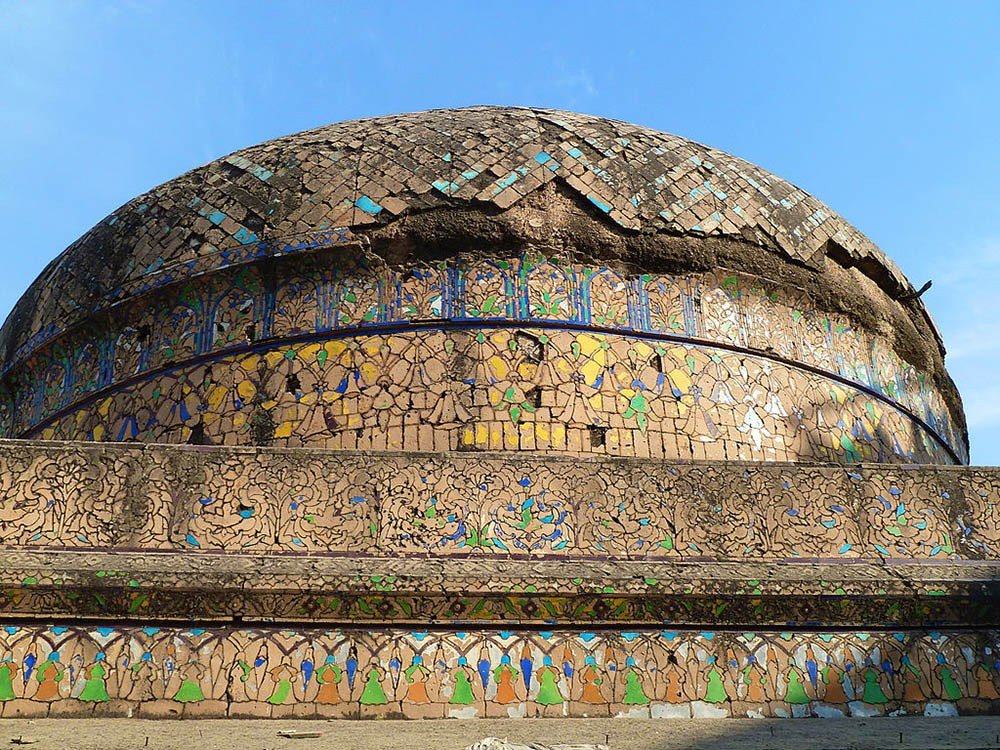
Because it is one of the most architecturally unusual tombs in Lahore. The city’s great Mughal mausoleums, Jahangir’s, Nur Jahan’s, Asif Khan’s, are grand and well known. Jani Khan’s is something else: a compact, rectangular chamber, just 8.2 by 7.7 meters, crowned with a curvilinear roof of a strikingly pleasing shape, worked in enameled mosaic in a zigzag pattern. The dome is dressed in porcelain tiles of blue and yellow, some still surviving after nearly three centuries. Architecture writers single out the roof form as uncommon in Lahore, and once you have seen it, you will recognize its silhouette anywhere. Locals even have their own name for it: Neela Burj, the Blue Tower.
Because its history reads like a novel with two endings. Who was Jani Khan? One account says he was the father-in-law of Moin-ul-Mulk, the powerful Mughal governor of Punjab, who died in 1778, and that the tomb holds three graves of the family. Another, from the British-era historian Kanhaiya Lal’s History of Lahore, says he was the son of the minister Nawab Qamar-ud-Din Khan and the brother of Moin-ul-Mulk himself, titled Intizam-ud-Daulah, appointed commander of the Punjab army, and the man who repelled the first invasion of Ahmad Shah Abdali. The Pakistan Today archives preserve both traditions and note the tomb’s likely construction during the reign of Muhammad Shah or his son Ahmed Shah. You do not get to resolve the debate on a single visit, but standing before the tomb with both stories in your head is the kind of experience no museum label can give you.
Because it is a window into a vanished Lahore. The tomb once stood in its own garden with a beautiful gateway, part of the belt of tomb-gardens that lined the Grand Trunk Road after the Shalimar Gardens were built. The gateway was dismantled in the late 1800s, the garden was swallowed by the growing city, and today the tomb hides between houses on a small plot bounded by a wall. Visiting is a walk through the archaeology of urban change itself: Mughal garden, colonial dismantling, modern neighborhood, all in one lane.
And because it pairs beautifully with the Shalimar Gardens. The tomb lies just south of the road to Shalimar, so a morning that begins among the fountains and terraces of the great Mughal garden can end with this small, strange, lovely mausoleum a few minutes away. For travelers building a full Explore Pakistan tour of the country’s Mughal heritage, from the Badshahi Mosque to the Grand Jamia Mosque, Jani Khan’s Tomb is the hidden chapter that makes the story complete.
History of Jani Khan’s Tomb
To understand the tomb, you have to understand Baghbanpura, the “Town of Gardeners.” About five kilometers from old Lahore along the Grand Trunk Road, Baghbanpura grew up around the people who tended the great Mughal gardens. When the Shalimar Gardens were laid out, the whole corridor along the GT Road filled with villages, shrines, and tomb-gardens of the Mughal nobility: Bhogiwal, Begumpura, Baghbanpura. Jani Khan’s tomb was one of these garden tombs, raised in the southwest garden of Mahabat Khan in Baghbanpura, and it was built, by the best historical accounts, during the reign of the Mughal emperor Muhammad Shah or his son Ahmed Shah, in the middle decades of the eighteenth century.
The man in the grave is where the histories diverge. The commonly repeated account holds that Jani Khan was the father-in-law of Moin-ul-Mulk, better known as Mir Mannu, the Mughal governor of the Punjab, and that he died in 1778. In this telling, the tomb is a family monument of the governor’s circle, holding three graves within its chamber. The competing account comes from Kanhaiya Lal, the nineteenth-century historian of Lahore, who wrote that Jani Khan was the son of the minister Nawab Qamar-ud-Din Khan and the brother of Moin-ul-Mulk, bearing the title Intizam-ud-Daulah. Lal credits him with real military glory: appointed commander of the Punjab army, he helped repel the first invasion of Ahmad Shah Abdali, the Afghan ruler whose incursions would eventually help end Mughal power in the Punjab. Contemporary press retellings of the tomb’s story preserve both versions and note that Jani Khan may have died in the same 1748 campaign against Abdali, or a year after, and was buried near the family graveyard in Mir Mannu’s garden.
What the stones themselves say is clearer. The tomb is a rectangular chamber, 8.2 by 7.7 meters, opened through three arched sides, a plan that lets light and air move through the building. Its glory is the roof: a beautiful curvilinear form, almost pyramidal, decorated with enameled mosaic work in a zigzag pattern, and a dome dressed in blue and yellow porcelain tiles, of which some tilework survives to this day. The neck of the dome carries pottery work in floral patterns closely similar to those on the tomb of Sharf-un-Nisa Begum, the Cypress Tomb, built in 1745, which helps anchor Jani Khan’s tomb in the same mid-eighteenth-century moment. Inside, the walls carry floral and plant decoration in fresco, and three simple kutcha graves stand in the chamber; the original, finer graves were probably lost during the Sikh period.
The tomb’s later history is a small tragedy of urban growth. It once stood in a garden with a handsome gateway, but the gateway was dismantled in the late 1800s and the garden disappeared under houses, until only the tomb remained, hidden on a small walled plot between residential buildings. Today the structure is protected under the Antiquities Act of 1975 (as amended in 1992) and is listed by the federal Department of Archaeology and Museums, though it remains in private ownership and the enclosure door is kept locked. Heritage writers have argued for years that it deserves proper conservation, ticketing, and tours; for now, it waits quietly for the travelers who seek it out.
Top Things to Do in Jani Khan’s Tomb
Study the Zigzag Tile Roof
The roof is the reason to come. Walk slowly around the small chamber and study the curvilinear form, the enameled mosaic laid in zigzag, and the surviving patches of blue and yellow porcelain tile on the dome. It is a roof unlike any other tomb roof in Lahore, and it rewards close looking: the geometry of the zigzag, the way the tiles catch the light, the floral pottery work on the dome’s neck echoing the Cypress Tomb of 1745. Bring a zoom lens; the best details are high up.
Read the Frescoed Interior
If you can arrange access to the enclosure, step inside and look at the floral and plant frescoes on the interior walls. Mughal fresco work of this period is increasingly rare in situ, and the combination of exterior tile mosaic with interior painted flowers makes the small chamber feel like a jewel box. The three kutcha graves within are simple and unmarked; treat them with the respect due to any burial place.
Walk the Three Arched Sides
The tomb is open through three arched sides, an unusual and graceful arrangement that makes the small building feel larger than its 8.2 by 7.7 meters. Circle it slowly and notice how each arch frames a different view: the lane, the neighboring rooftops, the sky. It is a masterclass in how Mughal builders used openness and geometry to dignify a modest structure.
Pair It With the Shalimar Gardens
The tomb sits just south of the road to the Shalimar Gardens, so the natural itinerary is to do both in one outing. Spend the morning among Shalimar’s terraces, water channels, and fountains, the great garden that made Baghbanpura what it is, then drive the few minutes to Jani Khan’s lane for the hidden counterpart: the garden tomb without its garden. The contrast, imperial splendor and quiet survival, is the whole story of Mughal Lahore in miniature.
Famous Places In and Around Jani Khan’s Tomb
- Shalimar Gardens – the great Mughal garden minutes away, the reason Baghbanpura exists; the essential pairing for this trip
- Cypress Tomb (Tomb of Sharf-un-Nisa Begum) – the 1745 tomb whose floral tile patterns echo Jani Khan’s dome; for the serious Mughal-tomb enthusiast
- Lahore Fort and Badshahi Mosque – the imperial core of Mughal Lahore, about 20-30 minutes west; see our Badshahi Mosque guide
- Tomb of Jahangir, Shahdara – the great riverside mausoleum complex across the Ravi
- Grand Jamia Mosque, Bahria Town – Lahore’s modern architectural marvel; see our Grand Jamia Mosque travel guide
- Food Street, Fort Road – the celebrated eating street near the fort for your evening meal
- Anarkali and Ichhra Bazaars – Lahore’s historic shopping streets for fabrics, food, and old-city atmosphere
How to Reach Jani Khan’s Tomb
The tomb is in Baghbanpura, on the Grand Trunk Road side of Lahore, about 5 km from the city center and just south of the road to the Shalimar Gardens. Any driver in Lahore knows Baghbanpura; the last stretch is a residential lane, so it helps to have the coordinates (approximately 31.58 N, 74.37 E) or a local contact to point out the walled plot. Because the enclosure is usually locked, go with modest expectations about entry and generous expectations about the experience of finding it.
From Islamabad: About 375 km via the M-2 motorway, roughly 4 to 5 hours. Enter Lahore and follow the GT Road / Canal Road corridor east toward Baghbanpura and the Shalimar Gardens.
From Lahore (city center): About 5 to 8 km depending on your starting point, 20 to 40 minutes by car. Take the GT Road toward Baghbanpura/Shalimar; ride-hailing apps (Careem, inDrive, Uber) all serve the area and are the simplest option for visitors.
From Karachi: About 1,200 km. Fly to Allama Iqbal International Airport (about 10 km from Baghbanpura) and take a taxi or ride-hailing car from the terminal.
Nearest airport: Allama Iqbal International Airport, Lahore, roughly 10 km from the tomb.
Road conditions and transport: Lahore’s main roads are excellent; the lanes of Baghbanpura are narrower but navigable by car and rickshaw. Public transport options include the Metrobus and the Orange Line, but for a heritage-hopping day, a hired car or ride-hailing is far more practical. Visit in daylight, dress respectfully for a residential religious-adjacent site, and remember that the tomb stands on a private walled plot: admire it from the lane, ask politely if anyone is about, and do not attempt to force entry.
Route Details
- From central Lahore, take the Grand Trunk Road east toward Baghbanpura and the Shalimar Gardens.
- Turn south off the Shalimar road into the Baghbanpura lanes, southwest of the garden of Mahabat Khan; use the coordinates (31.58 N, 74.37 E) or ask locals for the “Neela Burj” (Blue Tower).
- Park on the main lane and walk the short distance to the walled plot; view the tomb respectfully from outside the enclosure.
- Combine with the Shalimar Gardens (minutes away) and, if time allows, the Cypress Tomb and the old city’s food streets.
Where to Stay in Jani Khan’s Tomb
Stay in Lahore proper; Baghbanpura is a residential area, not a hotel district. Lahore offers the full spectrum: luxury five-star hotels on and around the Mall Road and in Gulberg and DHA, comfortable mid-range business hotels, and a dense stock of guesthouses that suit heritage travelers well. For this itinerary, the most convenient bases are the hotels along Canal Road and in Gulberg, both an easy drive from Baghbanpura and the Shalimar Gardens. Budget travelers will find clean, simple hotels in the old city and around the railway station, though traffic noise is part of the bargain. Book ahead on winter weekends, when Lahore’s wedding and festival season fills the good rooms.
Where to Eat: Local Foods of Jani Khan’s Tomb
You are in Lahore, which means you are in the food capital of Pakistan, so plan your meals as carefully as your sightseeing. Near Baghbanpura and along the GT Road you will find the Lahori staples done properly: siri paye (trotter stew) for breakfast, nihari, haleem, daal with tandoori naan, and chargha. For the full experience, end your heritage day at Food Street on Fort Road near the Lahore Fort, where the barbecue smoke rises against the illuminated fort walls, or try the old city’s legendary halwa puri breakfasts and the thick, sweet lassi served in tall glasses. A satisfying dhaba or mid-range restaurant meal in Lahore is very budget-friendly; even the famous names rarely strain the wallet by international standards. Carry water and, in summer,ORS or lassi breaks; Lahore’s heat is serious.
Weather in Jani Khan’s Tomb
Lahore has one of the most extreme urban climates in Pakistan: a fierce, long summer, a short but real winter, and a monsoon that can flood streets in an afternoon. The tomb itself is a small, quick visit, but you will be out in the lanes and at the Shalimar Gardens around it, so the season shapes the day. Winter mornings can be wrapped in the notorious Lahore smog, particularly in December and January.
| Season | Temperature Range | Conditions |
|---|---|---|
| Winter (Dec-Feb) | 5-20°C | Cool and pleasant, but December-January can bring heavy smog; check air quality and prefer clearer days. |
| Spring (Mar-Apr) | 18-35°C | Warm and lovely; arguably the best season, with clear skies and comfortable sightseeing weather. |
| Summer (May-Jun) | 32-45°C | Extremely hot; sightsee only early morning or late afternoon, hydrate constantly. |
| Autumn (Sep-Nov) | 20-36°C | Cooling off after the monsoon; October and November are excellent for heritage walks. |
Note: the monsoon (July to September) brings heavy downpours; the tomb visit is short and the lanes can get muddy.
Language and Culture of Jani Khan’s Tomb
Baghbanpura speaks Punjabi first and Urdu everywhere, with English common in hotels and among younger Lahoris. Lahore’s culture is famously warm, loud, and generous: expect to be asked where you are from, offered directions you did not ask for, and possibly invited for chai. The tomb sits in a residential neighborhood, so keep voices low, dress modestly, and remember you are a guest in people’s street. Ask before photographing residents, and if the enclosure is locked, accept it gracefully; the exterior, the roof, and the lane itself are the experience. A small courtesy goes a long way here, and Lahoris repay it many times over.
Shopping in Jani Khan’s Tomb
There is no souvenir shop at the tomb, so fold shopping into the wider Lahore day. Anarkali Bazaar, one of South Asia’s oldest markets, is the classic stop for fabrics, traditional shoes, and street food. Ichhra Bazaar is beloved for affordable fashion and household goods. For Mughal-themed keepsakes, books on Lahore’s history, and handicrafts, the shops around the Lahore Fort and in the old city do a brisk trade, and the city’s modern malls (Emporium, Packages) cover everything else. If your trip falls in winter, the dry-fruit sellers of Akbari Mandi are a seasonal pleasure. Bargaining is expected in the bazaars; a smile and a first offer at half the asking price is the local ritual.
Travel Tips for Jani Khan’s Tomb
Packing Essentials
Comfortable walking shoes for the lanes, a hat and sunscreen (Lahore’s sun is strong even in winter), and a camera with a zoom lens for the high tilework details. Carry water, hand sanitizer, and small-denomination rupees for rickshaws and snacks. In winter, a mask is worth packing for smoggy days; in summer, a scarf or umbrella against the sun.
Safety Tips
Baghbanpura is an ordinary residential-commercial area; normal urban awareness applies. Visit in daylight, keep valuables secure, and use registered ride-hailing rather than hailing random vehicles late at night. The tomb plot’s walls and the lane are uneven in places, so watch your footing. As with any walled private plot, do not climb the walls; the structure is protected and fragile.
Money & Connectivity
Carry cash in rupees; small notes for rickshaws, snacks, and bazaar shopping. ATMs are everywhere in Lahore, including near Baghbanpura’s main roads. All major mobile networks offer strong 4G coverage across the city, and most hotels and restaurants have Wi-Fi.
Best Time to Visit Jani Khan’s Tomb
Spring (March to April) – The Sweet Spot
Clear skies, warm days, cool evenings, and the city’s gardens at their best. This is the finest season for a Baghbanpura heritage day, pairing the tomb with the Shalimar Gardens in full spring.
Autumn (October to November) – The Heritage Season
The monsoon has washed the city clean, temperatures are falling, and the light is golden. October and November are ideal for walking the old lanes and photographing tilework.
Winter (December to February) – Good With Caveats
Daytime temperatures are pleasant for sightseeing, but December and January can bring dense smog that dulls the light and the air. Check conditions and choose clearer days; February is usually lovely.
Summer (May to September) – For the Hardy
May and June are brutally hot; July to September adds monsoon downpours. If summer is your only window, do the tomb and Shalimar at dawn, retreat to air conditioning by noon, and come back out for Food Street in the evening.
Final Thoughts
Jani Khan’s Tomb is not trying to impress you, and that is its power. It is a small, strange, beautiful building with a zigzag crown of blue and yellow tiles, two competing histories, and a lane in Baghbanpura that most of Lahore has forgotten. The great monuments tell you what empires wanted you to remember; this one tells you what the city actually kept.
Go in the morning, find the Neela Burj, stand quietly before its arches, and then let the Shalimar Gardens complete the picture. Some travelers collect famous sights; the best ones collect stories. This tomb is a story, and it is waiting in a walled plot in Baghbanpura for whoever cares enough to look. When you are ready for more of the country’s hidden heritage, our Explore Pakistan collection is full of places just like it.
FAQs
Where is Jani Khan’s Tomb located?
In Baghbanpura, Lahore, Punjab, southwest of the garden of Mahabat Khan and south of the road to the Shalimar Gardens, about 5 km from central Lahore along the Grand Trunk Road.
What is the best time to visit Jani Khan’s Tomb?
October to March, with spring (March-April) and autumn (October-November) the most pleasant; avoid the fierce summer heat and check smog conditions in December-January.
How do I reach Jani Khan’s Tomb from central Lahore?
Take the GT Road east toward Baghbanpura/Shalimar (20-40 minutes by car); ride-hailing apps are the simplest option. The tomb is in a residential lane, so use the coordinates (31.58 N, 74.37 E) or ask locals for the “Neela Burj.”
Is Jani Khan’s Tomb safe for tourists?
Yes. It sits in an ordinary residential area of Lahore; visit in daylight, take normal urban precautions, and respect the private walled plot.
Can I go inside Jani Khan’s Tomb?
The enclosure door is usually locked and the plot is privately owned, so most visitors admire the tomb from the lane. If someone is present, ask politely; never force entry or climb the walls.
Is Jani Khan’s Tomb good for families?
Yes, as a short stop on a wider Lahore heritage day. The visit takes under an hour and pairs well with the Shalimar Gardens, which children tend to love.
Where should I stay when visiting Jani Khan’s Tomb?
In Lahore proper: hotels along Canal Road and in Gulberg are convenient for Baghbanpura, with options from luxury to budget guesthouses.
Who was Jani Khan?
Histories differ: one account makes him the father-in-law of the Mughal governor Moin-ul-Mulk (died 1778); another, from Kanhaiya Lal’s History of Lahore, makes him the governor’s brother, titled Intizam-ud-Daulah, a commander who repelled Ahmad Shah Abdali’s first invasion.