If you are traveling in Islamabad with children, there is one park the whole city grew up with, and it was a gift from another country. Japanese Park sits at the foot of the Margalla Hills in the Marghazar area, a green playland of swings, slides, jungle gyms, and picnic lawns that Japan gave to the children of Pakistan in 1985. Generations of Islamabadis have birthday-party memories here; after a full Japanese-funded renovation in 2015, the park got 32 new rides and a second life. It is not the grandest park in the capital, and it does not try to be. It is the happiest one, and for families, that makes it essential.
This Japanese Park travel guide is written for the parent planning a day out, the grandparent with a picnic basket, and the traveler who wants to see the softer, greener side of the capital. You will learn the real history of the gift, what is actually inside the gates, the best time of year to go, and how to pair the park with Daman-e-Koh and the Margalla Hills for a perfect family day. It is a small outing with a big heart, and it costs almost nothing.
Quick Facts
- Location: At the foot of the Margalla Hills in the Marghazar area, on Pir Sohawa Road (Khayaban-e-Iqbal), Saidpur, Islamabad, next to the former Islamabad Zoo
- Famous For: Islamabad’s best-known children’s park, a 1985 gift from Japan to the children of Pakistan, renovated with Japanese grant aid in 2015
- Nearest City: Islamabad itself, about 8.5 km (roughly 14 minutes) from the city center
- Accessibility: Very easy; a short drive or ride-hailing trip from anywhere in Islamabad, on the road toward Daman-e-Koh and Pir Sohawa
- Known Landmarks: The Japanese-built playground rides, the dinosaur sculptures, the Margalla Hills backdrop, nearby Daman-e-Koh viewpoint
- Best For: Families with young children, picnics, school outings, and anyone wanting a relaxed green escape in the capital
- Best Time to Visit: February to April (spring blossoms) and October to November (cool and clear); pleasant mornings year-round except mid-summer midday
Why Visit Japanese Park
Because it is a story you can play in. Most parks are just parks; this one is a forty-year friendship between two countries, built for children. In December 1985, the Government of Japan provided the park and its play equipment as a gift from the children of Japan to the children of Pakistan, marking the visit of Japanese Prime Minister Yasuhiro Nakasone. When you push your child on a swing here, you are using a small piece of diplomatic history, and there is something genuinely moving about a playground that exists because one nation’s children wanted another nation’s children to have fun.
Because it is the rare attraction designed entirely around young children. Islamabad has grander green spaces, Fatima Jinnah Park’s vast lawns, the rose gardens, the hill trails, but Japanese Park is the one built at a child’s scale: swings, slides, monkey bars, climbing frames, a jungle gym, a wooden bridge, trampolines and bouncing cushions, even dinosaur sculptures to discover. The 2015 renovation, funded by Japan with grant aid of around 80 million yen, replaced the worn-out original equipment and added 32 new rides, all reinstalled by Japanese engineers and technicians. For parents, that means modern, purpose-built play equipment in a contained, watchable space.
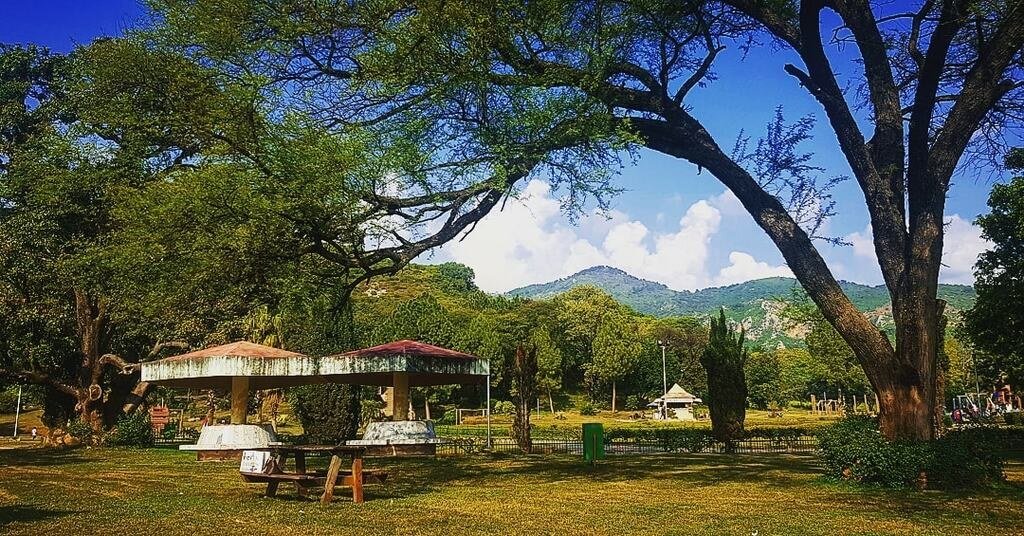
Because of where it sits. The park lies right at the foot of the Margalla Hills, with wooded slopes rising directly behind it, and Daman-e-Koh visible above on the road that climbs past the gates. Few playgrounds anywhere have a mountain backdrop like this. In spring, the park’s flowering trees, including trees visitors compare to cherry blossoms, turn the lawns into something out of a postcard, and the terraced gardens and trimmed bushes make it one of the prettiest small parks in the city.
And because it is the easiest great day out in Islamabad. Entry costs a small fee, the park is a short drive from the city center, an hour or two is plenty, and it pairs naturally with the attractions stacked along the same hillside road: the Saidpur Model Village with its restaurants, the Daman-e-Koh viewpoint, and the Lok Virsa heritage museum. For families building an Islamabad itinerary or browsing our Explore Pakistan collection, Japanese Park is the low-effort, high-joy stop that children remember longest.
History of Japanese Park
The park’s story begins on December 30, 1985, when the Japanese Park and Garden opened at the foothills of the Margalla Hills, next to what was then the Islamabad Zoo. It was constructed with the help of the Japanese government as a gift for Pakistani children, and contemporary accounts describe it as an immediate success: through the late 1980s and the 1990s it was the most popular entertainment space for the capital’s children, the place a generation of Islamabadis remembers from school trips and family Sundays, with its excellent play area of swings, monkey bars, and slides, its lush lawns, and its terraced gardens.
Then came the long decline. Through the 2000s, maintenance faltered, and the original Japanese equipment, then approaching thirty years old, deteriorated. Press reports from the period describe swings and monkey bars in poor condition, accidents and injuries, and falling visitor numbers; the beloved park of the 1990s became a cautionary tale about neglected public space. The Capital Development Authority, which runs the park, faced a beloved landmark slowly falling apart.
The turnaround came from the same source as the original gift. The Japanese government agreed to assist the CDA in remodeling the park through its grant aid program, providing new play equipment worth around 80 million yen. Japanese engineers and technicians reinstalled the swings, monkey bars, and slides and added 32 new rides to the playland. On December 31, 2015, the renovated park was inaugurated at a ceremony attended by the Japanese Ambassador, Hiroshi Inomata, along with CDA officials, schoolchildren in kimonos and Pakistani dress, and both countries’ national anthems. The ambassador called the park a token of friendship gifted three decades earlier and expressed the hope that it would serve its purpose for another thirty years.
Since the renovation, the park has settled back into its role as the capital’s family playground, hosting school outings, birthday picnics, and, on occasion, larger events: in November 2016 the grounds were even booked for the Islamabad Eat Food Festival, a sign of how central the park is to the city’s idea of a good day out. Next door, the old Marghazar Zoo was closed by court order in 2020 and its animals, including the famous elephant Kaavan, were moved to sanctuaries, with plans to redevelop the site as a wildlife conservation and rehabilitation center, a change that has made the whole hillside feel greener and calmer. Through it all, the Japanese Park has remained what it was built to be: a gift, still giving.
Top Things to Do in Japanese Park
Let the Kids Loose on the Japanese Rides
This is the main event. The playground holds the full 2015-renewed set: swings, slides, monkey bars, climbing frames, a jungle gym, a wooden bridge, trampolines, and a jumping castle, many of them from the Japanese-funded renewal. Children tend to divide their time between the classic swings and the climbing structures; parents tend to divide theirs between the benches and the cameras. Give it a good hour, minimum.
Picnic on the Lawns
The park’s broad, shady lawns and picnic areas are made for the great Pakistani family picnic: a dastarkhwan spread on the grass, thermoses of chai, and home-cooked food while the children run between courses. The terraced gardens and trimmed bushes give the grounds a cared-for feel that rewards a slow afternoon. Bring your own spread, as the park is more about your picnic than its concessions.
Hunt for the Dinosaur Sculptures
One of the park’s quirkiest features is its set of dinosaur sculptures, tucked among the greenery for children to discover. They make excellent photo subjects and give younger kids a small expedition to organize while the adults rest. Ask a park attendant to point you toward them if they are not immediately obvious.
Enjoy the Spring Blossoms
Visit in March or April and the park shows its most beautiful face: flowering trees, including trees with a cherry-blossom look that nod to the park’s Japanese origins, bloom across the lawns in fresh color. It is the closest thing in Islamabad to a hanami moment, and photographers should not miss it.
Pair the Park With Daman-e-Koh and Saidpur Village
The park sits on the road that climbs to Daman-e-Koh, so the classic family day is to do the playground in the morning, drive up to Daman-e-Koh for the panoramic view over Islamabad, and come back down through Saidpur Model Village for lunch at one of its restaurants. Three stops, one hillside, zero long drives: it is the capital’s easiest family circuit. If you like comparing the city’s green spaces, our Ankara Park guide and Fatima Jinnah Park guide cover two more favorites.
Famous Places In and Around Japanese Park
- Daman-e-Koh – the beloved viewpoint above the park, with sweeping views over Islamabad; on the same road, minutes up the hill
- Saidpur Model Village – the restored historic village at the foot of the hills, with restaurants, craft shops, and old temples
- Margalla Hills – the wooded hills rising behind the park, with famous walking trails (Trail 3, Trail 5) for older kids and adults
- Shah Faisal Mosque – the capital’s iconic mosque, a short drive from the hills
- Lok Virsa Heritage Museum – Pakistan’s folk heritage museum near Shakarparian, a fine cultural pairing
- Pakistan Monument and Museum – the national monument with its museum, also near Shakarparian
- Marghazar (former zoo) site – the closed zoo next door, being redeveloped as a wildlife conservation center
How to Reach Japanese Park
Reaching the park could hardly be simpler: it is inside Islamabad, on Pir Sohawa Road (Khayaban-e-Iqbal) in Saidpur, at the foot of the Margalla Hills next to the former zoo, about 8.5 km from the city center. Any driver or ride-hailing app in the capital knows the Marghazar Zoo road; the park is right there. Because it is a morning-to-evening outing, you can slot it into any Islamabad day without rearranging your plans.
From Islamabad (city center): About 8.5 km, roughly 14 minutes by car. Head toward the Margalla Hills on Pir Sohawa Road / Khayaban-e-Iqbal via Saidpur; the park is next to the former Islamabad Zoo, below Daman-e-Koh.
From Lahore: About 375 km via the M-2 motorway, 4 to 5 hours. Enter Islamabad and follow signs for the Margalla Hills / Daman-e-Koh / Saidpur.
From Karachi: About 1,400 km. Fly to Islamabad International Airport and take a taxi or ride-hailing car into the city (about 45 minutes to an hour depending on traffic).
Nearest airport: Islamabad International Airport, with taxis, ride-hailing cars, and hotel shuttles at the terminal.
Road conditions and transport: Islamabad’s roads are excellent, and Pir Sohawa Road is a well-maintained hillside road. Ride-hailing apps (Careem, inDrive, Uber) cover the park easily, and there is parking near the entrance for those driving themselves. Public vans and Suzuki pickups run along the main roads toward Saidpur, but for a family with picnic gear, a car or ride-hailing is far more comfortable. The park is generally open daily from morning to evening; a small entry fee (around PKR 30 per person by most accounts) applies, but confirm the current fee and timings at the gate, as both can change.
Route Details
- From central Islamabad (Blue Area / Jinnah Super), head north toward the Margalla Hills on Khayaban-e-Iqbal / Pir Sohawa Road via Saidpur.
- Pass the Saidpur Village turn and continue to the Marghazar area; the park entrance is next to the former Islamabad (Marghazar) Zoo.
- Park near the entrance, pay the small entry fee, and enter the playland. Allow 1-2 hours.
- Optional: continue up the same road to Daman-e-Koh for the viewpoint, then descend via Saidpur Village for lunch.
Where to Stay in Japanese Park
You do not stay at the park; you stay in Islamabad, which is the point, the park is a city outing, not a destination requiring an overnight. The capital’s hotels span every tier: luxury five-stars around the Blue Area and on the Margalla slopes, solid mid-range business hotels in the F and G sectors, and a wide range of guesthouses that suit families well, many with kitchenettes useful for picnic prep. For a Japanese Park day, the most convenient bases are the hotels and guesthouses of sectors F-6, F-7, and E-7, closest to the Margalla Hills. Families who want the hills on their doorstep can look at the resorts and guesthouses along the Pir Sohawa road itself, but book ahead on spring weekends, when the whole city heads for the blossoms.
Where to Eat: Local Foods of Japanese Park
Inside the park, expect the cheerful basics: snack stalls near the entrance selling tea, cold drinks, pakoras, and packaged snacks, the fuel of a thousand Pakistani picnics. But the real move is to bring your own food. A home-packed picnic, parathas, kebabs, biryani in a daigcha, fruit, and a thermos of doodh patti, eaten on the lawns while the children play, is the authentic Japanese Park experience and the one generations of Islamabadis remember.
If you would rather eat out, the options stack up along the same hillside. Saidpur Model Village, minutes away, has well-known restaurants serving desi and continental food in a restored village setting. Daman-e-Koh has cafes with a view. And back in the city, Islamabad’s food streets and the restaurants of F-7, F-8, and Kohsar Market cover everything from chapli kebabs to sushi. A family day of park plus Saidpur lunch is the classic formula, and it is kind to the wallet: park entry is nominal, and even a good restaurant lunch in Islamabad is very reasonable by international standards.
Weather in Japanese Park
Islamabad has the most forgiving climate of Pakistan’s big cities, but it still has seasons, and they matter for a park day. Spring is the glory season, with blossoms and perfect temperatures. Summer brings heat and the monsoon, when the Margalla Hills turn a deep, dramatic green but afternoons can be steamy. Winter is crisp and sunny, with cold mornings, and the hills sometimes catch a dusting of frost. Because the park is all outdoors, with limited shade over the play equipment, time your visit for morning or late afternoon in the warmer months.
| Season | Temperature Range | Conditions |
|---|---|---|
| Winter (Dec-Feb) | 3-15°C | Crisp, sunny days with cold mornings; dress in layers. Lovely for midday park visits. |
| Spring (Mar-Apr) | 15-28°C | The best season: blossoms in the park, green hills, perfect picnic weather. |
| Summer (May-Jun) | 28-40°C | Hot, especially midday; come early morning or late afternoon, bring water and sun hats. |
| Autumn (Sep-Nov) | 15-30°C | Clear and pleasant after the monsoon; October and November are excellent for the park. |
Note: the monsoon (July-August) brings heavy rain; the hills look spectacular but park visits need a weather check.
Language and Culture of Japanese Park
Islamabad is Pakistan’s most linguistically mixed city: Urdu is the common tongue, Punjabi (including the local Potohari) and Pashto are widely heard, and English is comfortable for almost any visitor need, from the park gate to the restaurant table. Park culture is family culture: expect multigenerational groups, elaborate picnics, and a relaxed, festive atmosphere on weekends and public holidays. Ordinary courtesy applies: keep the lawns clean, use the bins, keep an eye on children near the road, and respect other families’ picnic space. If you visit during a school trip rush, usually weekday mornings in spring, the rides get busy; late afternoons are calmer.
Shopping in Japanese Park
The park itself is not a shopping destination beyond its snack stalls and the occasional vendor selling balloons, toys, and ice cream near the entrance, all part of the fun for children. For real shopping, pair the park day with the city: the craft shops and village stalls of Saidpur Model Village for handicrafts and souvenirs, Jinnah Super and Kohsar Market for boutiques and books, and the Sunday bazaars for everything else. If the children fall in love with the park’s Japanese connection, the bookshops of F-7 have a good children’s section for the ride home.
Travel Tips for Japanese Park
Packing Essentials
For a picnic day: a groundsheet or dastarkhwan, food and drinks in coolers, wet wipes, a rubbish bag (leave the lawn as you found it), sun hats and sunscreen, and a change of clothes for children who will find every muddy corner. A football or cricket set earns its place in any Pakistani park bag. In winter, add jackets for the breezy hillside; in summer, add extra water and a small first-aid kit with antiseptic for playground scrapes.
Safety Tips
The park is a well-used, family-oriented public space and is generally safe in daylight hours. Standard sense applies: supervise children on the climbing equipment, keep valuables out of sight, and stay within the park boundaries rather than wandering onto the hillside roads. Check the condition of any ride before letting small children use it, as public equipment takes heavy use. The Margalla Hills are beautiful but are wild terrain; do not attempt the trails from the park without preparation.
Money & Connectivity
Carry small cash in rupees for the entry fee, snacks, and vendors; the amounts are tiny but card machines are not guaranteed at the stalls. ATMs are plentiful across Islamabad. Mobile coverage from all major networks is excellent at the park, and 4G data works well for maps and ride-hailing on the way out.
Best Time to Visit Japanese Park
Spring (February to April) – The Blossom Season
The undisputed best time. Flowering trees bloom across the park, the Margalla Hills are at their greenest, and the temperatures are made for picnics. March weekends are the busiest; go on a weekday morning for the calmest experience.
Autumn (October to November) – The Clear Season
Post-monsoon clarity, comfortable temperatures, and thinner crowds. An excellent second choice, with golden afternoon light that photographers love.
Winter (December to February) – The Crisp Season
Sunny, cool days are lovely for a midday park visit, though mornings are cold and the grass can be damp. Layer up and aim for 11 am to 3 pm.
Summer (May to August) – Mornings Only
May and June are hot; July and August add monsoon rain. The park still works as an early-morning outing (gates open early), but avoid the midday sun, and always check the weather in the monsoon months.
Final Thoughts
Japanese Park will not be the most dramatic stop on your Pakistan journey. It will not make your friends gasp the way the mountains do. But if you travel with children, or if you simply like places with a gentle story, it may be the stop they talk about longest. A playground given by one country’s children to another’s, renewed by the same friendship thirty years later, sitting in the green lap of the Margalla Hills: that is a lovely thing to spend a morning inside.
Pack the picnic, bring the grandparents, let the kids run themselves happy on the Japanese swings, and then drive up to Daman-e-Koh to watch the sun drop behind the city. Some destinations you visit to be amazed; this one you visit to be glad. For more family-friendly ideas across the country, explore our Explore Pakistan guides, from the snowy fun of Malam Jabba to the valleys of Hunza.
FAQs
Where is Japanese Park located?
At the foot of the Margalla Hills in the Marghazar area of Islamabad, on Pir Sohawa Road (Khayaban-e-Iqbal), Saidpur, next to the former Islamabad Zoo and below Daman-e-Koh.
What is the best time to visit Japanese Park?
February to April for spring blossoms and perfect picnic weather; October-November is also excellent. In summer, go early morning or late afternoon.
How do I reach Japanese Park from central Islamabad?
It is about 8.5 km (14 minutes) by car: head toward the Margalla Hills on Pir Sohawa Road via Saidpur. Ride-hailing apps and taxis all serve the park.
Is there an entry fee for Japanese Park?
Entry is free or carries a very small fee (around PKR 30 per person by most accounts); confirm the current fee and timings at the gate.
Is Japanese Park safe for children?
Yes. It is a family-oriented public park with modern playground equipment from the 2015 Japanese-funded renovation. Supervise children on climbing equipment as you would anywhere.
Is Japanese Park good for picnics?
Absolutely; picnicking is one of its main draws. Bring your own food and a groundsheet, use the bins, and combine it with the lawns’ spring blossoms for the full experience.
What happened to the zoo next to Japanese Park?
The Marghazar (Islamabad) Zoo was closed by court order in 2020; its animals, including the elephant Kaavan, were moved to sanctuaries, and the site is planned as a wildlife conservation and rehabilitation center.
Why is it called Japanese Park?
It was a gift from the Government of Japan to the children of Pakistan, opened on December 30, 1985, marking the visit of Japanese Prime Minister Yasuhiro Nakasone; Japan also funded its 2015 renovation.