Quick Facts
- Location: Chatekal Valley (Jarogo Banda), Matta Tehsil, Upper Swat, Khyber Pakhtunkhwa
- Altitude: Around 7,000 feet above sea level (per traveller GPS readings)
- Famous For: One of Pakistan’s tallest waterfalls at 400 feet (120 metres), pine-forest setting in the Hindu Kush, easy-to-moderate forest trek, new camping pods
- Nearest City: Mingora (~55 km); Matta town (~30 km)
- Accessibility: Paved road from Matta via Fazal Banda Road to a parking area, then a 45-minute to 1.5-hour forest trek with stream crossings
- Known Landmarks: The main 400-foot cascade, a smaller companion waterfall, the alpine meadows of Jarogo Banda above the fall
- Best For: Adventure-loving day trippers, families with active kids, trekkers, photographers, campers and anyone adding a wild waterfall to a Swat itinerary
Why Visit Jarogo Waterfall
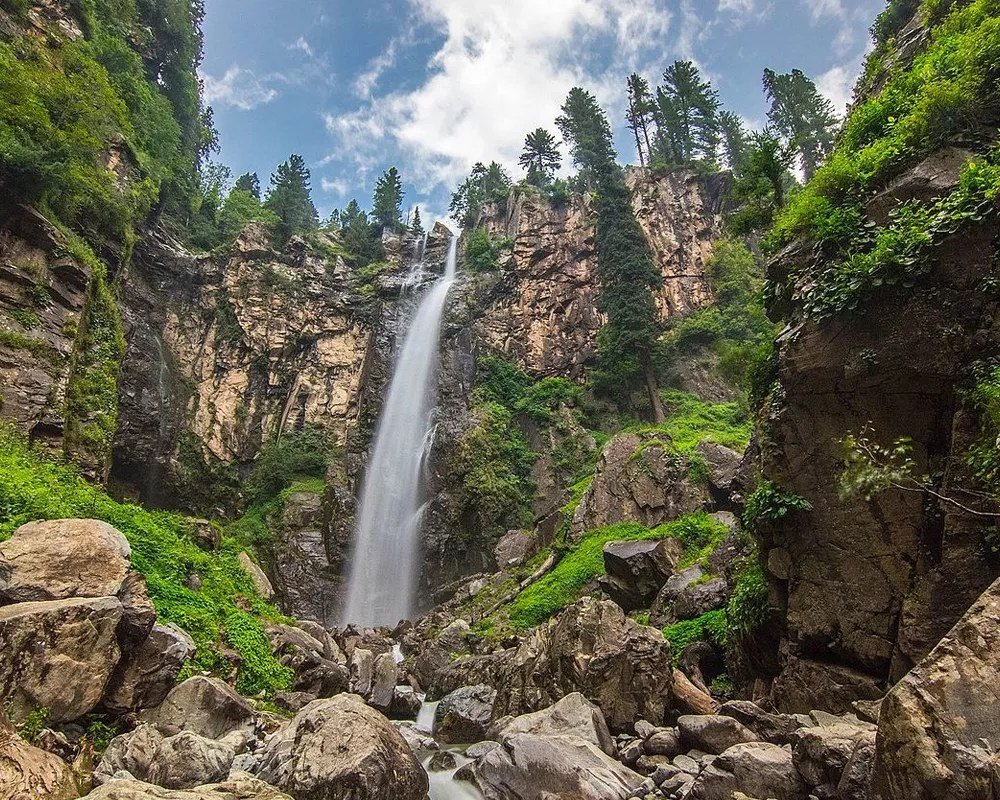
There are waterfalls you glance at from a viewpoint, and then there are waterfalls you earn — and the earning is half the magic at Jarogo. Tucked into the pine forests of the Hindu Kush in Matta Tehsil, this 400-foot cascade is widely described as one of the tallest and most spectacular waterfalls in Pakistan, yet it stays remarkably quiet compared to Swat’s famous Kalam and Malam Jabba crowds. The journey here is the classic Swat adventure compressed into half a day: a drive up the Fazal Banda road past mountain villages, a forest trek guided by painted arrows, several shallow stream crossings where the water runs ice-cold over your shoes, and then the trees open and there it is — a white sheet of water pouring between two giant mountains, filling a bowl of green with thunder and mist.
What sets Jarogo apart from other waterfalls in the valley is the whole experience built around it. This is not a roadside stop. The hike is easy enough that families do it with children, but wild enough that it feels like a real expedition — thick forest on both sides, a small lake along the trail, birds in the tall pines, and at the end a meadow sitting right above the fall where the snow-fed stream flattens out. There is a main waterfall with a massive flow and a smaller companion fall beside it, and above both lies Jarogo Banda, an untouched alpine plateau that only the fitter walkers reach. In one day you can go from a paved road to a genuine high-mountain wilderness.
Jarogo is also newly accessible in a way that changes the trip. In 2022, as part of Khyber Pakhtunkhwa’s Integrated Tourism Zones programme, camping pods were built near the waterfall — the first proper overnight accommodation at the site itself. That means you no longer have to race back to Mingora by sunset; you can stay in the forest, wake to the sound of the fall, and trek up to Jarogo Banda the next morning. For anyone planning a Swat trip, Jarogo deserves a full day of your itinerary — and for the adventurers, a night as well.
History of Jarogo Waterfall
Jarogo has no grand recorded history — no battles fought at its base, no emperors’ chronicles. Its story is the honest story of a wild place in Upper Swat that the outside world simply took a long time to find. The name itself is old, though. In Pashto, “Jarogo” means broom, and the waterfall is also known as Jarogo Banda Waterfall. Local legend ties the name to Jarogai, a Hindu Shahi woman said to have lived in this valley long ago, when Hindu Shahi kingdoms held Swat centuries before the region’s conversion to Islam. Another account says the name comes from the wild straw that local women gathered in these forests to make brooms. Whichever telling you prefer, the name is a reminder that these valleys were named by the people who lived in them, not by tourists.
For most of the 20th century, Jarogo was known mainly to the villagers of the surrounding Chatekal Valley settlements — Baha, Gwalerai, Aghal — and to shepherds who brought livestock to the high meadows. An Express Tribune feature on Swat’s hidden waterfalls back in the mid-2010s described Jarogo as one of the north’s great un-marketed cascades, sitting 55 kilometres northwest of Mingora on the way through Matta tehsil, with “narrow and dilapidated roads” that did not stop determined visitors. The turning point came in 2022, when the federal government’s transfer of 19 Pakistan Tourism Development Corporation motels to the Khyber Pakhtunkhwa Tourism Authority placed Jarogo inside one of the province’s three Integrated Tourism Zones, and camping pods went up near the fall. That is when Jarogo moved from being a word-of-mouth secret to a genuine destination with infrastructure — and when the first wave of travel vloggers and drone photographers brought it to national attention.
Today it is sometimes called the duplicate of Gabin Jabba’s waterfall for its visual similarity, and variously described as Swat’s tallest or Pakistan’s second-tallest waterfall — claims that shift depending on who is measuring, but all pointing at the same fact: at 400 feet (120 metres), this is one of the great cascades of the country, hiding in plain sight in Upper Swat.
Top Things to Do in Jarogo Waterfall
Stand Beneath the 400-Foot Main Fall
The main event needs no introduction: a roughly 400-foot wall of water dropping between two mountains, spreading over an area more than 120 metres wide at its base. The spray reaches you long before the water does, and on a sunny day the mist throws rainbows across the gorge. Go close enough to feel the power, but keep a respectful distance — the rocks around the plunge pool are slick, and the current is stronger than it looks. Early morning is best, when the light cuts through the pine canopy and you may have the place almost to yourself.
Hike the Forest Trail
The trek from the parking area is part of the attraction. The path winds through jungle-thick pine forest, passes a small lake, and is marked with arrows at the confusing points. It takes between 45 minutes and an hour and a half depending on your pace, with a couple of shallow stream crossings where rubber-soled shoes earn their keep. Children manage it fine with adults, and the forest is alive with birdsong the whole way. Take it slowly — the trail is beautiful enough that rushing it is a mistake.
Find the Second, Smaller Waterfall
Beside the main cascade sits a smaller waterfall that most day visitors barely notice. It is quieter, easier to approach, and in some ways more photogenic — a delicate white ribbon against dark rock rather than the main fall’s thunder. If you want photos without other people in them, this is your spot.
Trek Up to Jarogo Banda (Jarogo Meadows)
The fitter should keep going. Beyond the waterfall, a steep 1.5 to 2-hour climb leads to Jarogo Banda, a high alpine meadow sitting above Chatekal Valley with panoramic views of the Hindu Kush peaks. This is the crowd-free camping zone — self-contained camping only, so bring your tent, sleeping bag and food, and find the fresh water source up top. At night the sky here is a proper dark-sky show; stargazers call it one of Swat’s best-kept secrets. Best attempted June to September, when the snow has cleared.
Stay in the Camping Pods
The KPK Tourism Authority’s camping pods near the waterfall let you do the two things day-trippers cannot: sunset at the fall, and sunrise at the fall. Book ahead if you can — the pods are limited and weekends fill in peak season. Waking up in pine forest with the roar of a 400-foot waterfall as your alarm is worth planning around.
Picnic in the Pine Forest
The clearings along the trail and the meadow at the top of the fall are made for picnics. The village of Baha, the largest settlement on the Fazal Banda road, has small shops for snacks and basic supplies, and there is a temporary tea hotel near the waterfall for a hot cup and biscuits. Carry out everything you carry in — this forest stays beautiful only if visitors keep it that way.
Famous Places In and Around Jarogo Waterfall
- Jarogo Banda (Jarogo Meadows): The alpine plateau above the waterfall — 1.5 to 2 hours of steep trekking, self-contained camping and night skies.
- Matta Town: The tehsil headquarters and gateway to the fall, about 30 km away, with bazaars for last supplies.
- Malam Jabba: Swat’s famous ski resort, an easy pairing with a Jarogo day trip for a multi-day Upper Swat itinerary — see our Malam Jabba travel guide.
- Bahrain: The riverside Swat town on the Swat River, a classic stop for food and riverside walks — see our Bahrain, Swat travel guide.
- Fizagat Park: Mingora’s popular riverside park, handy if you are based in Mingora — see our Fizagat Park travel guide.
- Gabin Jabba: The meadow valley whose waterfall Jarogo is often compared with — combine both on a Swat waterfall tour.
- Mingora Bazaar: The valley’s main commercial hub for Swati shawls, handicrafts, dry fruits and honey.
How to Reach Jarogo Waterfall
Jarogo sits about 55 km northwest of Mingora and about 30 km from Matta town, reached by the Fazal Banda road that runs through Chatekal Valley. The drive from Mingora to Matta is straightforward paved road; beyond Matta the road follows the mountains through villages like Barthana, Labat and Gwalerai to Baha, the largest town on the route, and on to the parking areas. There are two parking options: the first parking where the trek starts, and a second, more adventurous one near the “Dada hotel Baha Jarogo” for bikes and high-clearance vehicles, which crosses the river by vehicle. From the parking, the forest trek to the fall is 45 minutes to an hour and a half.
From Islamabad, the drive to Mingora is roughly 270 km via the Swat Expressway (M-16), about 6 to 7 hours door to door. From Lahore, count on about 480 km and 9 to 10 hours of driving. From Karachi, fly to Islamabad (or Peshawar) and continue by road — there are no regular commercial flights to Saidu Sharif airport near Mingora at present. The last stretch from Matta to the waterfall is the part that needs care: a car can do it, but a high-clearance vehicle or jeep is more comfortable, and in the monsoon months check conditions before setting off, as the jeep track can get rough after rain.
Public transport gets you as far as Matta — vans and coasters run from Mingora’s bus stands throughout the day — but from Matta you will need to hire a private jeep or car for the 30 km to Jarogo, which is easiest arranged through your hotel or a local driver in Matta. Tour vans and private operators run Swat packages that include Jarogo as a day trip from Mingora or Malam Jabba in peak season.
Route Details
- Islamabad → Mingora: Take the M-1/M-16 Swat Expressway; roughly 270 km, 6–7 hours by car or coaster.
- Mingora → Matta: Head northwest on the main Swat road toward Matta town, about 30 km of paved mountain road.
- Matta → Fazal Banda Road: Follow the 30-km Fazal Banda road through Barthana, Labat, Gwalerai and Baha (stock up on snacks at Baha’s shops).
- Parking → Waterfall: Park at the first parking area (or continue to the second parking if your vehicle can handle the river crossing), then trek 45 minutes to 1.5 hours through the pine forest, following the painted arrows and crossing the streams.
Where to Stay in Jarogo Waterfall
The most special option is right at the fall: the camping pods built by the Khyber Pakhtunkhwa Tourism Authority in 2022 as part of the Integrated Tourism Zones programme. These are compact, bookable pods in the forest near the waterfall — the only formal accommodation at the site itself. Check the KP Tourism Authority’s current booking channel before your trip and reserve ahead in summer, because pod capacity is small and weekends sell out.
For the truly adventurous, the meadows of Jarogo Banda above the waterfall offer wild camping — strictly self-contained, with your own tent, sleeping bag, warm layers and food. There is a fresh water source at the meadow, but no facilities of any kind, and you must carry out all rubbish.
Most visitors base themselves in Mingora, which has the valley’s widest range of stays — from budget guesthouses and dhabas-with-rooms to comfortable mid-range hotels and a few upmarket options. Matta town has simpler guesthouses and is closer to the trailhead, making it a good choice if you want an early start. Malam Jabba’s resorts are another alternative for combining a ski-resort stay with a Jarogo day trip. Whatever tier you pick, book early for June–August and around Eid holidays.
Where to Eat: Local Foods of Jarogo Waterfall
There are no restaurants at the waterfall itself — plan to eat before the trek or bring a picnic. Baha, the largest village on the Fazal Banda road, has small shops selling milk, biscuits, chips, chocolates and juice, and a temporary tea hotel operates near the fall in peak season serving hot tea and biscuits. The stream and spring water along the trail is famously fresh, though carrying a bottle is still wise.
For real meals, Matta and Mingora are the places. This is Pashtun country, and the food reflects it: chapli kebabs sizzling on roadside grills, kebab-and-naan platters, hearty daal and sabzi dhabas, and sweet milky chai and fresh lassi. In season, buy Gwalerai’s famous apples from roadside stalls along the route — the village is known across Swat for its fruit — and try the local honey sold in Mingora’s bazaar. A dhaba meal for two in Matta or Mingora is genuinely budget-friendly, and even the better restaurants in Mingora are easy on a family budget compared to the big cities.
Weather in Jarogo Waterfall
Jarogo sits at around 7,000 feet in the Hindu Kush, so it runs noticeably cooler than Mingora below. Summer days are warm and pleasant, nights cool enough for a jacket. Spring snowmelt swells the fall to its most dramatic; by late summer the flow eases but stays strong. Winter brings real cold, and the waterfall’s flow drops low while the surrounding forest can hold snow — the trip is still possible on a clear winter day, but the trek is harder and the pods may be closed. Monsoon rains (July–August) keep the fall thundering but make the jeep track and stream crossings trickier, so check conditions after heavy rain.
| Season | Temperature Range | Conditions |
|---|---|---|
| Winter (Dec–Feb) | -2°C to 8°C | Cold, possible snow on the trail; waterfall flow is at its lowest |
| Spring (Mar–May) | 10°C to 22°C | Snowmelt boosts the fall dramatically; fresh green forest; April can still be cool |
| Summer (Jun–Aug) | 15°C to 28°C | Peak season; strongest flow, warm days, cool nights; monsoon showers possible |
| Autumn (Sep–Nov) | 8°C to 20°C | Clear skies, golden forest light; flow begins to recede |
Language and Culture of Jarogo Waterfall
The valleys around Jarogo are Pashtun, and Pashto is the language you will hear in the villages — a little Urdu goes a long way, and in Mingora and Matta you will find Urdu and even some English widely understood. Hospitality here is serious business: it is not unusual for a villager to offer directions that turn into tea, and accepting graciously is the right move.
Swat is culturally conservative, so dress modestly — long trousers and covered shoulders for everyone, and women may feel more comfortable in a shawl or dupatta. Ask before photographing people, especially women and children. On the trail, greet fellow walkers with a salaam, keep noise down in the forest, and respect private and community land — the meadows around Jarogo Banda are grazing land for local livestock. Leave-no-trace principles matter here: carry out all rubbish, avoid lighting fires in the pine forest, and do not disturb wildlife or livestock.
Shopping in Jarogo Waterfall
There is no shopping at the waterfall — the nearest real markets are in Matta and Mingora. Mingora’s main bazaar is the place for Swat’s famous buys: hand-embroidered Swati shawls and woollen cloth, dry fruits and walnuts from the valley orchards, local honey, and carved wooden handicrafts. Gwalerai’s apples, bought in season from roadside stalls on the Fazal Banda road, are the most Jarogo-specific souvenir of all. Do not expect shopping malls here — the commerce of Upper Swat is bazaar commerce, and that is half the charm.
Travel Tips for Jarogo Waterfall
Packing Essentials
Sturdy rubber-soled trekking shoes (the stream crossings are slippery), a change of socks and a small towel, a light rain jacket in summer, warm layers if you are staying in the pods or camping at Jarogo Banda, sunscreen and a hat, drinking water, snacks, a power bank, and a dry bag for your phone and camera near the spray. If you are camping at the meadows, add a full tent kit, sleeping bag, warm jacket and all your food.
Safety Tips
Do not attempt the trek during or immediately after heavy rain — flash floods are a real risk on mountain streams, as Swat learned painfully in the 2022 floods. Keep a safe distance from the plunge pool; rocks near the fall are treacherously slick. Start the trek early enough to be back at the parking before dark. If trekking to Jarogo Banda, go with a companion and tell someone your plan. Carry a basic first-aid kit for scrapes and blisters.
Money & Connectivity
There are no ATMs on the Fazal Banda road — withdraw cash in Mingora or Matta and carry enough for the day. Jazz and Telenor generally have the best mobile signals in Swat, but expect the signal to fade as you climb toward the fall; download offline maps before leaving Mingora.
Best Time to Visit Jarogo Waterfall
Summer (June to August) — Peak Season
The classic window: warm days, the waterfall at its most powerful, the forest at its greenest, and the camping pods open. This is when Jarogo looks like the photographs — but it is also when weekends are busiest, so go on a weekday if you can.
Late Spring (April to May) — The Sweet Spot
Snowmelt supercharges the fall, wildflowers appear in the clearings, and the crowds have not arrived yet. The weather is mild and the trek is at its most pleasant. For many regulars, May is the single best month.
Autumn (September to October) — The Photographer’s Window
Clear skies, golden light through the pines, thinner crowds and comfortable trekking weather. The flow is easing off its summer peak but still impressive.
Winter (November to March) — Only for the Hardy
Possible on a clear day, with the forest hushed under snow and almost no visitors, but the flow is low, the trek can be icy, and the pods may not operate. Check locally before attempting.
Final Thoughts
Jarogo Waterfall is the answer to a question every Swat visitor asks sooner or later: where is the wild one? It is the cascade you reach through forest and stream crossings rather than a car park, the one with camping pods instead of crowds, the one whose name carries a centuries-old Pashto story. At 400 feet it holds its own against any waterfall in Pakistan, and at half a day from Mingora it asks very little of your itinerary while giving back a full adventure.
If you go, go properly: start early, wear the right shoes, picnic in the pines, and if you can, stay the night in a pod and wake to the roar of the fall. Jarogo rewards the travellers who slow down for it — and in a valley as visited as Swat, a place that still rewards slowing down is a place worth choosing. For more ideas on exploring the valley, browse our Explore Pakistan collection.
FAQs
Where is Jarogo Waterfall located?
Jarogo Waterfall is in Chatekal Valley (Jarogo Banda), Matta Tehsil, Upper Swat, Khyber Pakhtunkhwa — about 55 km from Mingora and 30 km from Matta via the Fazal Banda road.
How tall is Jarogo Waterfall?
The waterfall drops about 400 feet (120 metres), making it one of the tallest waterfalls in Pakistan.
What is the best time to visit Jarogo Waterfall?
May to September is the peak season, with May often cited as the sweet spot. April to October is broadly good; winter visits are possible but the flow is low and the trek can be icy.
How do I reach Jarogo Waterfall?
Drive from Mingora to Matta, then 30 km along the Fazal Banda road to the parking area, then trek 45 minutes to 1.5 hours through the pine forest with a few stream crossings.
Is Jarogo Waterfall safe for families?
Yes — the trek is easy to moderate and families with children do it regularly. Wear rubber-soled shoes, keep children away from the plunge pool, and avoid the trek during or after heavy rain.
Can I stay overnight at Jarogo Waterfall?
Yes. The KP Tourism Authority’s camping pods near the waterfall offer overnight stays (book ahead in summer), and experienced campers can wild-camp at Jarogo Banda with their own equipment.
What food is available near Jarogo Waterfall?
A temporary tea hotel near the fall serves tea and biscuits in peak season, and Baha village on the route has shops for snacks. For real meals, eat in Matta or Mingora — chapli kebabs, dhaba platters and fresh lassi.
What does “Jarogo” mean?
“Jarogo” means “broom” in Pashto. Local legend also ties the name to Jarogai, a Hindu Shahi woman said to have lived in this valley centuries ago.