Jordan King Vows Harshest Retaliation After Church Shooting
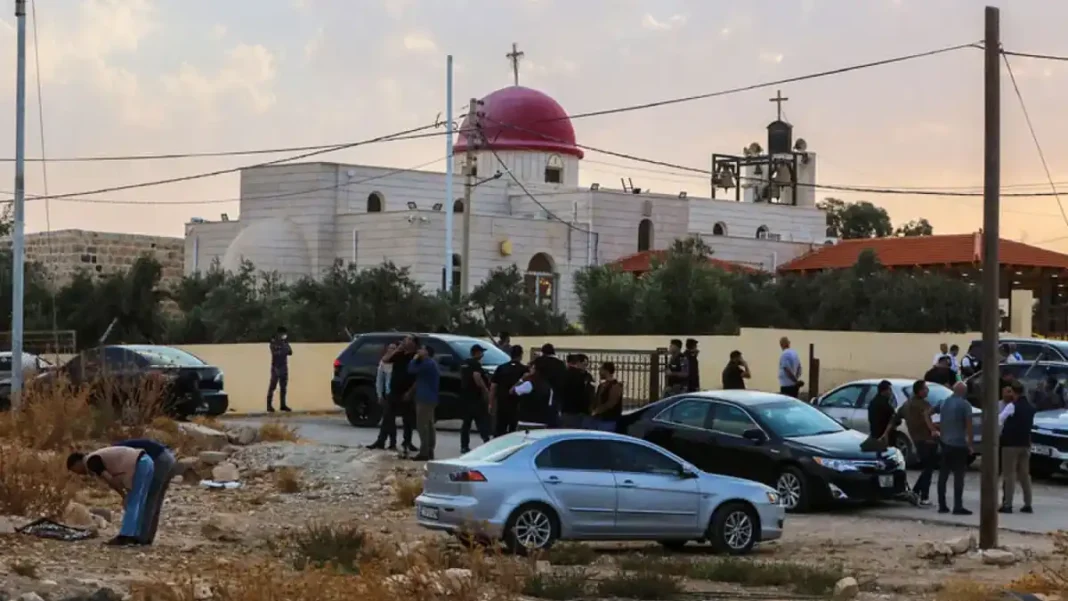
King Abdullah II of Jordan has vowed the harshest retaliation after gunmen killed at least seven people and wounded dozens at a church in southern Jordan on Friday. The Karak church attack took place during a funeral procession at a Greek Orthodox church in the village of Hammoud, in Karak governorate, and it was a rare attack on Christians in the majority Muslim kingdom.
Assailants stormed the compound of the church and opened fire, authorities said. The gunmen got out of a vehicle and started shooting during the funeral procession, the public security directorate said in a statement, adding that a manhunt was under way for the perpetrators.
Karak church attack: what happened in Hammoud
“The terrorist attack against Karak will be met with the harshest retaliation,” King Abdullah II said in a post on X. “We will strike with an iron fist against those who dare to threaten our nation.” Images from state broadcaster Al-Mamlaka showed the king arriving in Karak on Friday evening after the attack.
After authorities first gave a death toll of six, Director of Public Security Major General Abdullah Al-Maaytah said it had risen to seven, with 34 injured, 27 of whom were still receiving treatment. Footage aired by Al-Mamlaka showed two gunmen dressed in casual clothes and carrying pistols, with a third carrying a long gun, as they opened fire on the church.
A witness said the gunmen fired continuously for five minutes before fleeing. Between 150 and 200 people were in and around the church at the time, the witness said.
Condemnation at home and abroad
Jordan’s Prime Minister Jafar Hassan also condemned the incident. In a post on X, he said the attack was the result of a terrorist ideology and blind extremism, and that Jordan would not allow society to go down that path. Interior Minister Mazen Al-Faraya told a press conference that a terrorist group had carried out a horrific act, and that the security services were working round the clock to track the attackers down.
United Nations Secretary General Antonio Guterres condemned the violence, saying attacks against civilians and places of worship are unacceptable. The United States ambassador to the United Nations, Mike Waltz, described the incident as a depraved and brutal attack on a house of worship.
People who gathered at a Karak government hospital to support the wounded expressed shock. One of them, Hani Al-Mbaydeen, told Reuters that people were left unable to speak, and that their only reproach to the state was that it must investigate the dark ideas behind such acts, and where they come from.
Why the king’s visit matters
The king’s visit to Karak on the evening of the attack carried a clear message. Jordan’s monarch rarely faces attacks on Christian targets, and the sight of the king in military uniform at a local hospital, speaking to the wounded, was meant to show that the state stood with the victims. The Royal Court shared a video of the monarch at the Prince Ali Military Hospital in Karak, where an injured man told him the country would not be abandoned.
The attack also tests Jordan’s security apparatus. The gunmen fled after five minutes of firing, and the manhunt now under way will determine whether the state can catch them quickly. The interior minister’s statement that a terrorist group carried out the attack suggests the authorities believe the gunmen acted as part of a network, not alone.
A regional context of heightened tension
Jordan is a major partner of the United States in the fight against militant Islamist groups, and it has been drawn into regional tensions this year. Jordan was among the US allies in the region hit by Iranian attacks after the US and Israel launched strikes against Iran in February. Against that background, an attack on a church during a funeral strikes at the kingdom’s social fabric, since Christians form a small but long-established part of Jordanian society.
Pakistan has also condemned the attack. Pakistan condemned the church attack in Jordan earlier on Saturday, joining the international response to the killings. The wider region remains on edge, with Pakistan and Saudi Arabia ratifying the Makkah defence pact, a Saudi-led coalition intercepting a Houthi missile aimed at Riyadh, and European states warning against a new attack on Iran.