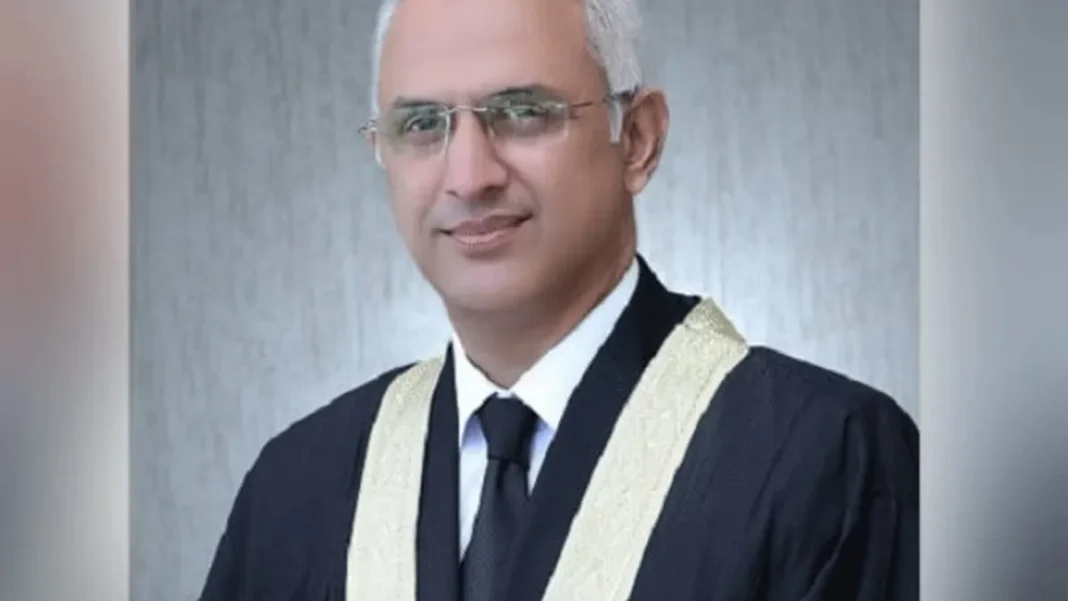
Lahore High Court judge Justice Mohsin Akhtar Kayani tendered his resignation on Wednesday, October 28, saying the independence of the high courts had been compromised by the 26th and 27th Constitutional Amendments. Justice Kayani resigns LHC in a letter addressed to the president, in which he cited personal reasons, including health concerns, and what he described as growing executive interference in judicial affairs.
“In my considered view, the changes introduced through the Twenty-sixth and Twenty-seventh Constitutional Amendments have compromised the independence and institutional integrity of the High Courts,” he wrote. He added that he had witnessed what he regarded as the executive’s growing control over judicial institutions, extending to the appointment and transfer of judges.
Such interference, he said, had seriously eroded public confidence in judicial independence and the fairness of the judicial process. He also raised concern about what he called the plight of the ordinary litigant, whom he described as the principal stakeholder in the justice system, yet whose suffering continued to deepen.
“In these circumstances, my conscience does not permit me to continue on the Bench,” he wrote, calling the decision painful but one that reflected his conviction that judicial office must remain inseparable from independence, fidelity to the Constitution, and the protection of human dignity.
Justice Kayani resigns LHC: what the letter says
Kayani said the needs of people seeking justice had too often been neglected, while other actors became the beneficiaries of a system intended to serve them. He said he would return to legal practice, through which he intended to continue serving the people, protecting their rights and promoting legal awareness.
He also said his years of judicial service remained among the most meaningful and fulfilling of his life. During his tenure, he said, he had disposed of more than 23,000 cases of various categories, endeavouring always to uphold the Constitution, safeguard fundamental rights, and administer justice without fear or favour.
Kayani was transferred from the Islamabad High Court to the Lahore High Court in May this year, and had been serving at the court’s principal seat. Under a newly issued roster, he had been reassigned to the Rawalpindi bench, a move covered in our earlier report on the LHC roster. He was due to retire in 2032, ranked second in seniority at the Islamabad High Court before his transfer, and 10th at the Lahore High Court.
A record built on rights cases
Kayani is known for his rulings on human rights matters, particularly cases involving enforced disappearances. He was appointed to the Islamabad High Court bench in December 2015, and over the years he presided over several high-profile cases concerning fundamental rights and enforced disappearances.
He had also been a vocal critic of the 27th Amendment, and had remarked on it during its passage last year. In April this year, the Judicial Commission of Pakistan approved the transfer of Kayani to the Lahore High Court, Justice Babar Sattar to the Peshawar High Court, and Justice Saman Riffat Imtiaz to the Sindh High Court.
The development marked the first instance of the 27th Amendment, approved in November last year, being applied directly to the high courts. It followed amendments to Article 200, which removed the requirement of obtaining a judge’s consent before transfer and empowered the relocation of high court judges between provinces on the recommendation of the Judicial Commission.
That change is the practical core of Kayani’s complaint. A judge who could once refuse a transfer can now be moved on the commission’s recommendation, and Kayani’s letter treats that shift, together with executive influence over appointments, as a direct threat to independence.
The six-judge letter and the Dogar appointment
The three judges transferred in April were also among the six Islamabad High Court judges who had written a letter to the Supreme Judicial Council, seeking guidance on how to counter alleged interference by intelligence agencies in their affairs.
In February 2025, when Justice Sardar Sarfraz Dogar became Islamabad High Court chief justice, coming from the Lahore High Court, the same three judges were among a group of five who refused to accept his appointment. They raised concerns about his seniority and questioned the legitimacy of his appointment.