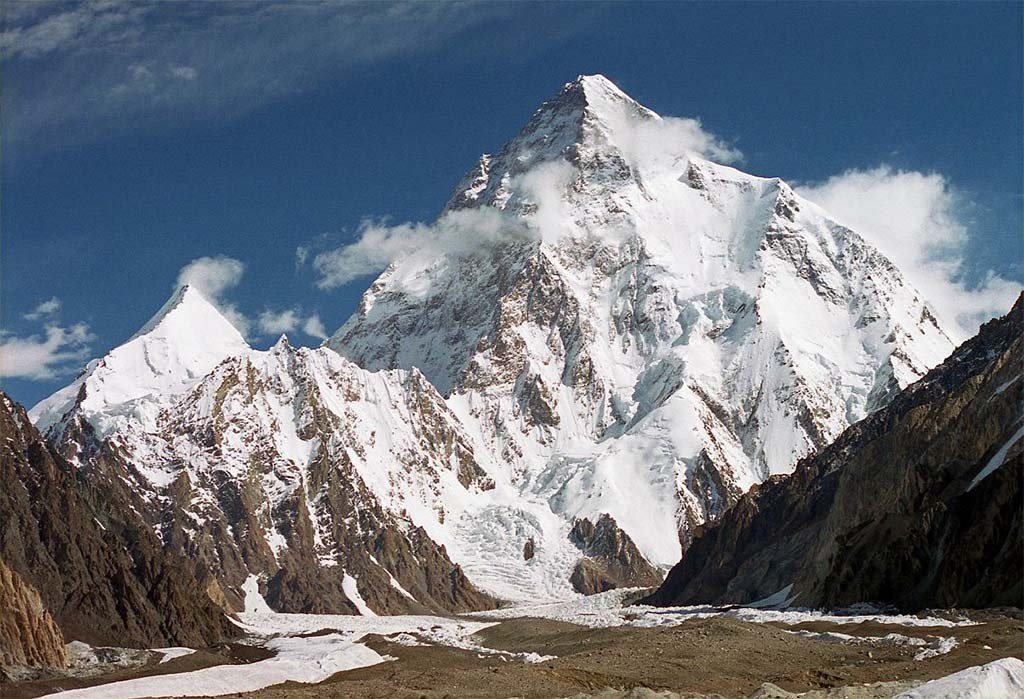
Every mountain has a height. Only one has a reputation like this. K2 — 8,611 metres of granite, ice, and legend on the Pakistan–China border — is the second-highest mountain on Earth and, by near-universal agreement, the hardest. Climbers call it the Savage Mountain. The writer Galen Rowell called its base camp, Concordia, the “Throne Room of the Mountain Gods.” You do not need to be a mountaineer to stand in that throne room. The trek to Concordia and K2 Base Camp is one of the great journeys on the planet, and it is open to any fit, determined traveler willing to walk into the heart of the Karakoram.
Quick Facts
- Location: Karakoram range, on the border of Gilgit-Baltistan (Pakistan) and Xinjiang (China); approached from the Pakistani side via Skardu and Askole
- Altitude: 8,611 metres (28,251 ft) — the second-highest mountain on Earth
- Famous For: Being the world’s most difficult 8,000-metre peak (“the Savage Mountain”); the Concordia panorama; the Baltoro Glacier trek
- Nearest City: Skardu (trek roadhead at Askole, a 6–8 hour jeep ride from Skardu)
- Accessibility: Fly or drive Islamabad–Skardu, jeep to Askole, then a ~14-day guided trek via the Baltoro Glacier. Independent trekking is not practical — go with a licensed operator.
- Known Landmarks: Concordia (4,650 m), K2 Base Camp (around 5,000 m), the Baltoro Glacier, the Abruzzi Spur
- Best For: Serious trekkers, mountaineering history buffs, photographers, and adventure travelers chasing the ultimate Karakoram experience
Why Visit K2
Let us be honest about what K2 is not: it is not Everest. There are no fixed ropes for tourists, no queues of hundreds, no base camp village with bakeries. K2 is wilder, steeper, and far more serious — for every four people who have reached its summit, roughly one has died trying. That danger is exactly why the mountain commands the respect it does, and why simply seeing it properly is a genuine achievement. The trek to Concordia does not ask you to risk your life; it asks you to walk for two weeks through the most spectacular mountain scenery on Earth and stand twelve kilometres from the Savage Mountain itself.
Concordia is the payoff. At 4,650 metres, where the Baltoro and Godwin-Austen glaciers collide, you camp in a natural amphitheatre ringed by four 8,000-metre giants and a court of 7,000-metre peaks — K2, Broad Peak, and the Gasherbrums all in one panorama. Veteran Himalayan travelers consistently rank it above Everest Base Camp for sheer drama: no other single campsite on Earth offers this concentration of the world’s highest mountains. Sunrise on K2’s pyramid from Concordia is one of those sights people remember on their deathbeds.
The journey matters as much as the destination. The Baltoro trek passes the great granite towers of Trango, the photogenic Muztagh Tower, and miles of glacier highway, all supported by the legendary Balti porters of Askole — men whose mountain craft has carried a century of expeditions. You will drink salt tea in shepherd huts, cross roaring meltwater streams, and sleep under more stars than you knew existed. It is hard, it is humbling, and it recalibrates your sense of what “big” means.
And there is the history. You will walk the approach of the 1954 Italian expedition, the 2021 Nepali winter ascent, and every great Karakoram story in between. Standing at K2 Base Camp, looking up the Abruzzi Spur where Compagnoni and Lacedelli made history, you are not just sightseeing — you are standing inside mountaineering’s greatest narrative. For anyone who has ever read a climbing book and dreamed, this is the pilgrimage.
History of K2
K2’s modern story begins with a surveyor’s theodolite. In 1856, during the Great Trigonometrical Survey of India, Thomas Montgomerie designated the two most prominent Karakoram peaks visible from the Indian plains as K1 and K2 — “K” for Karakoram. K1 was later found to have a local name, Masherbrum, but K2 had no widely known local name among the surveyors (the Balti name Chogori, “great mountain,” was recorded later), so the stark surveyor’s label stuck. It was also named Mount Godwin-Austen after Henry Godwin-Austen, an early explorer of the region — a name that survives on maps but never in climbers’ hearts.
The mountain repelled its first suitors. Early reconnaissance expeditions in 1902 (led by Oscar Eckenstein, with Aleister Crowley among the climbers) and 1909 (the Duke of the Abruzzi, whose name now marks the standard route) probed its flanks and retreated. American expeditions in 1938 and 1953 came agonizingly close — the 1953 American team, led by Charles Houston, famously survived a desperate storm high on the Abruzzi Spur in one of mountaineering’s great epics of endurance.
The summit finally fell on 31 July 1954, when Italians Achille Compagnoni and Lino Lacedelli of Ardito Desio’s national expedition reached the top via the Abruzzi Spur. It was a triumph shadowed by controversy — the expedition’s internal disputes over oxygen supplies and the forced high bivouac of climber Walter Bonatti became one of climbing’s longest-running debates — but the achievement itself was monumental: the second-highest point on Earth, climbed in an era of primitive equipment.
Pakistani climbers wrote their own chapters: Ashraf Aman became the first Pakistani to summit K2 in 1977, Nazir Sabir followed in 1981, and Samina Baig became the first Pakistani woman on the summit in 2013. Then, on 16 January 2021, a team of ten Nepali climbers — led by Mingma Gyalje Sherpa and Nirmal “Nims” Purja — achieved the first winter ascent of K2, the last of the fourteen 8,000-metre peaks to be climbed in winter. They summited together, singing their national anthem, in what the mountaineering world instantly recognized as one of the greatest feats in the sport’s history. The same day, Spanish climber Sergi Mingote lost his life descending — a reminder that K2 gives nothing for free.
Today K2 sees more ascents than ever — several hundred summiteers now, most in the stable weather window of July and August — but it remains the connoisseur’s 8,000er: steeper, colder, and more technically demanding than Everest, with the notorious Bottleneck couloir and its hanging seracs guarding the final thousand metres.
Top Things to Do in K2
Trek to Concordia, the Throne Room of the Mountain Gods
The classic K2 experience. From Askole, the trail follows the Braldu River to Jhola, climbs to Paiju (the last village, famous for its apricot orchards), then steps onto the Baltoro Glacier itself — a 63-kilometre river of ice. Days of glacier walking past the Trango Towers, Muztagh Tower, and Masherbrum bring you to Urdukas and Goro II, and then to Concordia (4,650 m), where the Baltoro meets the Godwin-Austen Glacier. Camp here at least one night — two if the weather is kind. The 360-degree panorama of 7,000 and 8,000-metre peaks is the single greatest mountain view accessible to trekkers anywhere. Read our dedicated Concordia travel guide for the full picture.
Stand at K2 Base Camp
From Concordia, a day’s walk up the Godwin-Austen Glacier brings you to K2 Base Camp (around 5,000 m), the staging ground of every expedition. In July and August you may find the camp alive with international teams — colorful tents, prayer flags, and the buzz of summit bids. Walk to the Gilkey Memorial, the stone cairn honoring climbers who died on the mountain, and look up the Abruzzi Spur rising 3,600 metres above you. It is a profoundly moving place even for non-climbers.
Walk the Baltoro Glacier
The Baltoro is one of the longest glaciers outside the polar regions, and walking its rubble-covered highway is an experience in itself — ice pinnacles, meltwater lakes, thundering streams disappearing into moulins, and side glaciers (like the Yermanendu) feeding in from the great peaks. Our Baltoro Glacier guide covers it in depth.
Cross the Gondogoro La (for the Strong)
Fit, well-acclimatized trekkers can extend the journey by crossing the Gondogoro La (around 5,585 m) from Concordia into the Hushe Valley — a spectacular high pass with a sheer drop onto the Gondogoro Glacier and unmatched views of K2’s east face. This is a serious undertaking requiring fixed ropes and an experienced operator; it turns the trek into a true expedition-style circuit.
Meet the Balti Porters of Askole
Askole, the last village of the Braldu Valley, is famous across the mountaineering world for its porters — men of extraordinary strength and mountain craft who have supported every K2 expedition for over a century. Trekking with them is a cultural experience as much as a logistical one: their stories, songs, and good humor carry you through the hard days. Treat them with the respect their profession deserves.
Photograph the Karakoram’s Greatest Hits
Every day of the trek is a photography expedition: the Trango Towers’ granite walls at sunrise, Muztagh Tower’s perfect spire, Masherbrum’s white pyramid, Broad Peak’s long summit ridge, the Gasherbrum group, and above all K2 itself — that unmistakable pyramid, symmetrical and brooding. Bring spare batteries (cold kills them), a sturdy tripod for night skies, and more memory cards than you think you need.
Famous Places In and Around K2
- Concordia (4,650 m) — the great glacial amphitheatre and the heart of the trek.
- Broad Peak (8,051 m) — the world’s 12th-highest mountain, looming over Concordia (see our Broad Peak guide).
- Gasherbrum I & II — the “Hidden Peak” and its neighbour, two more of Pakistan’s five 8,000ers (see our Gasherbrum I guide).
- Trango Towers — the world’s greatest big walls, a mecca for rock climbers.
- Askole — the last village, gateway to the Baltoro (see our Askole guide).
- Skardu — the expedition capital of Baltistan, with its forts, lakes, and bazaars.
How to Reach K2
There is no casual way to “pop over” to K2 — reaching it is a genuine expedition, even for trekkers. The standard route runs Islamabad → Skardu → Askole → Baltoro Glacier → Concordia → K2 Base Camp, and the whole journey from Islamabad typically takes three to four weeks including the trek. Go with a licensed Pakistani tour operator: they handle the permits (required from the Gilgit-Baltistan tourism authorities and the Alpine Club of Pakistan), the logistics, the porters, and the safety net. This is not a trek to attempt independently.
From Islamabad to Skardu: Two options. Fly — PIA and private airlines operate the spectacular one-hour flight past Nanga Parbat (book flexible tickets; weather cancellations are common). Or drive — roughly 630–650 km via the Karakoram Highway and the Skardu road from Jaglot, a grueling but magnificent 22–24 hour journey usually split over two days.
From Lahore: Fly or drive to Islamabad first, then as above. Most Lahore-based trekkers assemble their expedition in Islamabad.
From Karachi: Fly to Islamabad (or to Skardu via Islamabad), then as above. The road journey from Karachi is over 2,000 km and not practical for an expedition schedule.
Skardu to Askole: A 6–8 hour jeep ride on a rough mountain road up the Braldu Valley. This is where the expedition truly begins — the road ends at Askole (around 3,000 m), the last village, and everything beyond goes on foot or on porters’ backs.
The trek: Askole → Jhola → Paiju → Urdukas → Goro II → Concordia (4,650 m) → K2 Base Camp (around 5,000 m). The standard itinerary takes about 14 days round-trip from Askole, with acclimatization built in. Your operator will brief you on the day-by-day plan.
Route Details
- Islamabad → Skardu: Book the morning flight (best mountain views, best on-time odds) with a buffer day in case of cancellation; or drive the KKH to Jaglot and the Skardu road — two long days.
- Skardu (2–3 days): Final preparations — gear checks, permit formalities, briefing with your operator, and acclimatization walks around Skardu.
- Skardu → Askole: Full-day jeep journey up the Braldu Valley. Overnight in Askole.
- Askole → Concordia: 6–7 days of trekking via Jhola, Paiju, Urdukas, and Goro II, gaining altitude gradually.
- Concordia → K2 Base Camp: 1–2 days up the Godwin-Austen Glacier, with the Gilkey Memorial and the great pyramid above.
- Return: Retrace to Askole (5–6 days) or cross the Gondogoro La to Hushe for the strong and well-acclimatized.
The only realistic season is June to August, with July offering the most stable weather. Outside these months the high passes are snowbound and the glaciers dangerous. Even in season, the Karakoram makes its own weather — build buffer days into your schedule.
Where to Stay in K2
On the trek itself, you sleep in tents — high-quality expedition tents provided by your operator, at wilderness campsites from Paiju to Concordia. This is camping at its most dramatic: falling asleep to the groan of the glacier and waking to 8,000-metre sunrises. Your operator provides all camp equipment, kitchen tents, and dining arrangements; you bring your sleeping bag (rated well below freezing) and mat.
Skardu (before/after the trek): The expedition capital has the full range — comfortable mid-range hotels with hot water and heating around the town centre, simpler guesthouses near the bus stands, and a few higher-end hotels and resorts with mountain views. Spend at least two nights here before the trek for final preparations, and a recovery night or two after — you will have earned the hot shower.
Askole: Basic village guesthouses and campsites. One night here before stepping onto the trail is standard.
Islamabad: Most expeditions stage from the capital — a comfortable hotel night before flying to Skardu and a celebration dinner on return are expedition traditions.
Book Skardu accommodation through your trek operator where possible — they know which hotels handle expedition groups well, and in July–August the town fills with climbers.
Where to Eat: Local Foods of K2
On the trek, your operator’s kitchen team feeds you — hearty expedition fare: daal, rice, pasta, soups, porridge, and endless tea and coffee. The cooks who work the Baltoro are artists of the high camp kitchen. In Skardu and Askole, eat Balti cuisine, one of Pakistan’s most distinctive regional foods.
Balti specialities: Chapshuro (meat pie), mamtu (steamed dumplings), dawdo (noodle soup), prapoo (buckwheat pancakes), and balay (noodle stew) — warming, high-energy mountain food.
Apricot products: Baltistan is apricot country. Dried apricots are the classic trek snack — buy a generous bag in Skardu. Apricot oil and jam make good gifts.
Butter tea / salted chai: The traditional high-mountain drink. Your porters swear by it, and at altitude you will understand why.
Fresh trout: Skardu’s restaurants serve excellent river trout — the perfect pre- or post-trek treat.
Carry personal snacks for the trail (nuts, chocolate, energy bars) and a water purification method — your operator will advise, but self-sufficiency on the glacier is good practice.
Weather in K2
The Karakoram is a weather factory. At Concordia (4,650 m) and K2 Base Camp (around 5,000 m), conditions are genuinely extreme outside the summer window — and unpredictable even inside it. Temperatures can plunge far below freezing any night of the year, storms can arrive in hours, and the famous Karakoram wind is no metaphor. This table covers the trekking corridor (Askole to Base Camp); the summit zone is in another league entirely.
| Season | Temperature Range (trek corridor) | Conditions |
|---|---|---|
| Winter (Dec–Feb) | -30°C to -10°C | Brutal; hurricane winds, extreme cold. Trekking impossible; only elite winter expeditions operate. |
| Spring (Mar–May) | -15°C to 5°C | Still winter at altitude; heavy snow on passes. No trekking season. |
| Summer (Jun–Aug) | -10°C to 15°C | The only trekking season. July–August most stable; still expect snow, storms, and freezing nights. |
| Autumn (Sep–Nov) | -20°C to 0°C | Rapid deterioration; early September possible for the hardy, then winter closes in. |
On the summit itself, winter temperatures drop toward -60°C with winds over 200 km/h — the conditions that kept K2 unclimbed in winter until 2021. For trekkers, the rule is simple: June to August only, July preferred, and even then pack for winter.
Language and Culture of K2
The K2 region is Balti country. The Balti people, of Tibetan descent, speak Balti — a Tibetic language — and their culture blends Tibetan heritage with the Islam (predominantly Shia and Noorbakhshi traditions) the region adopted centuries ago. You will see it in the architecture, the food, the polo grounds of Skardu, and the warmth of the welcome.
Askole’s porters are the living culture of the K2 trek. Portering on the Baltoro is a profession passed down generations, and the great names of Karakoram history — from the 1954 Italian expedition’s high porters to today’s expedition sirdars — come from these villages. Learn a few Balti greetings, ask about their mountains (every porter has K2 stories), and understand that the fixed porter wages and welfare standards your operator follows exist because of hard lessons in this valley’s past.
Urdu works with guides and in Skardu’s tourism economy; English is common among expedition staff. As elsewhere in Gilgit-Baltistan, dress modestly in villages, ask before photographing people, and accept offered tea — on the Baltoro, hospitality is a survival tradition, not a pleasantry.
Shopping in K2
Shop in Skardu’s bazaars before the trek — there is nothing to buy beyond Askole except memories.
Trek supplies: Skardu’s bazaars and expedition shops stock last-minute gear, snacks, and supplies. Buy dried apricots, nuts, and chocolate here — trail fuel for two weeks.
Balti handicrafts: Woolen shawls, traditional caps, and woodwork from Skardu’s bazaars are authentic and affordable.
Gemstones: Baltistan produces aquamarine, topaz, and tourmaline. Buy only from reputable dealers with certification.
Souvenirs with meaning: Many trekkers buy a small Karakoram map or a book on K2’s climbing history in Skardu — read it in your tent at Concordia for the full effect.
Travel Tips for K2
Packing Essentials
This is a serious high-altitude trek — pack like it. Four-season sleeping bag (comfort rated to at least -15°C), insulated jacket, waterproof shell, sturdy broken-in trekking boots, gaiters, warm layers, sun protection (the glacier glare is fierce), headlamp with spare batteries, trekking poles, water bottles and purification, and a comprehensive personal first-aid kit including altitude medication (consult your doctor). Your operator provides tents, kitchen, and group gear — confirm the division of equipment in writing before you fly.
Safety Tips
Altitude is the main risk: Concordia sits at 4,650 m and Base Camp around 5,000 m. Ascend on your operator’s schedule, hydrate constantly, and never hide symptoms of altitude sickness — it kills. Glacier travel has objective hazards (crevasses, rockfall, meltwater torrents); stay with your guide, rope up where instructed, and never wander the glacier alone. The region near the Line of Control is sensitive — carry your permits and ID at all times, follow your operator’s instructions at checkpoints, and do not photograph military installations. Rescue infrastructure is thin: consider expedition insurance with helicopter evacuation coverage, and understand its limits.
Money & Connectivity
Bring all the cash you will need in rupees — there are no ATMs beyond Skardu, and none on the trek. Pay your operator’s balance and tip your porters and kitchen staff in Skardu (tipping the crew is expedition custom; your operator will guide you on norms). Mobile coverage ends not far beyond Skardu; on the trek you are offline — which is rather the point. Satellite communicators are worth considering for emergencies; discuss with your operator.
Best Time to Visit K2
July to August — The Summit Window
The only realistic season for the Concordia and Base Camp trek. The high passes are open, the glaciers are at their most passable, and Base Camp buzzes with expedition life. July typically offers the most stable weather. Book your operator 6–12 months ahead — the best teams fill fast.
June — Early Season
Possible for strong teams, with more snow on the glacier and colder camps. Fewer trekkers, more solitude, slightly higher objective risk. Only with an experienced operator.
September — Late Season
A gamble. Early September can be magnificent — clear, empty, golden — but winter can arrive abruptly at 5,000 m. Only for experienced high-altitude trekkers with flexible schedules.
October to May — Closed
Do not attempt. Extreme cold, deep snow, and impassable passes make the trek impossible and genuinely life-threatening. This is expedition-only territory in winter, and even then only for the world’s best.
Final Thoughts
K2 does not need your visit. It stood for millions of years before the first surveyor named it, and it will stand long after the last expedition leaves. But you might need K2 — or at least, the version of yourself that walks for two weeks into the Karakoram, sleeps under impossible stars at Concordia, and stands at the foot of the Savage Mountain understanding, finally, what the word “wild” actually means.
This is not a trip; it is a transformation with a packing list. Train for it, respect it, go with the best operator you can find, and let the Balti porters, the glacier thunder, and that great pyramid do the rest. When you are back in Skardu with dust in every seam and the Gilkey Memorial fresh in your mind, you will know exactly why you came. Start planning with our Explore Pakistan guides — and see you at Concordia.
FAQs
Where is K2 located?
In the Karakoram range on the Pakistan–China border, in Gilgit-Baltistan. Trekkers approach from the Pakistani side via Skardu, Askole, and the Baltoro Glacier.
How high is K2?
8,611 metres (28,251 ft) — the second-highest mountain on Earth after Mount Everest.
Can non-climbers visit K2?
Yes. The trek to Concordia (4,650 m) and K2 Base Camp (around 5,000 m) is a non-technical walk achievable by fit trekkers with a licensed operator. No climbing is involved — but it is still a demanding high-altitude expedition.
What is the best time to trek to K2 Base Camp?
July to August, when the weather is most stable and the route is open. June and early September are possible only for experienced teams with flexible plans.
How long does the K2 Base Camp trek take?
About 14 days round-trip from Askole, plus travel days (Islamabad–Skardu–Askole). Allow three to four weeks door to door from Islamabad.
How do I reach K2 from Islamabad?
Fly or drive to Skardu, take a 6–8 hour jeep ride to Askole, then trek the Baltoro Glacier via Paiju and Urdukas to Concordia and Base Camp — with a licensed tour operator handling permits and logistics.
Is the K2 trek safe?
It is a serious high-altitude undertaking with real risks: altitude sickness, glacier hazards, extreme weather, and remoteness. With a reputable operator, proper acclimatization, and expedition insurance, thousands of trekkers complete it safely — but it demands fitness, preparation, and respect.
Why is K2 called the Savage Mountain?
Because of its extreme steepness, technical difficulty, rockfall and avalanche danger, and historically about one death for every four summits. It is widely considered the hardest of the fourteen 8,000-metre peaks to climb.