Quick Facts
- Location: Kargah Nala (Kargah Nullah), about 9.7 km (6 miles) west of Gilgit city, Gilgit-Baltistan, Pakistan
- Altitude: around 1,500 metres (the site sits in the valley floor west of Gilgit)
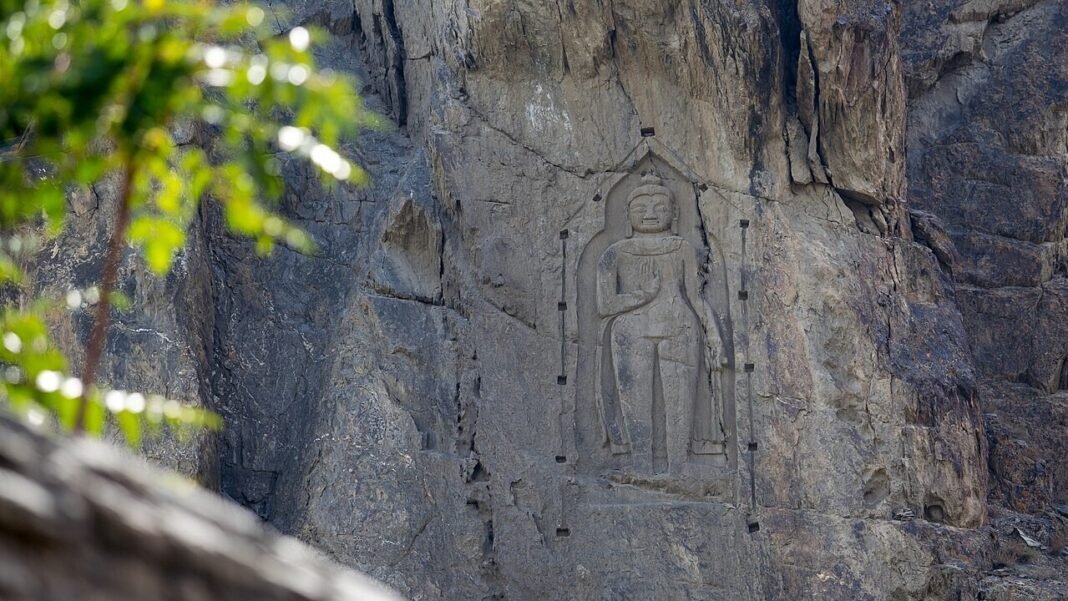
- Famous For: a 15-metre (50 ft) standing Buddha carved into a cliff face, one of Pakistan’s most important Buddhist rock carvings
- Nearest City: Gilgit
- Accessibility: easy — a short drive and short walk from Gilgit town on a paved road
- Known Landmarks: the carved Buddha figure itself, remains of a Buddhist monastery and three stupas excavated nearby, Kargah Bridge
- Best For: history lovers, photography, families, school groups, and travelers combining it with a wider Hunza and Gilgit trip
Why Visit Kargah Buddha, Gilgit
Long before the minarets of Gilgit rose over the valley, this was Buddhist country. For the better part of a thousand years, monks walked the caravan routes through these gorges, manuscripts were copied and hidden in monastery walls, and missionaries traveling the Silk Road stopped here to rest. The Kargah Buddha is the most striking single monument left behind from that era: a 15-metre standing Buddha carved straight into the face of a cliff in the Kargah Nala, calm and towering, looking out over a valley that has changed faiths twice since his sculptors put down their chisels.
A Gorge, a Stream, a Buddha
What makes the visit special is not only the carving but the setting. You drive out of Gilgit’s bustle, follow the clear water of the Kargah stream west. The gorge narrows around you. Then the Buddha comes into view on the rock face — robed, one hand raised in blessing, surrounded by the small holes that once held the wooden frame of a sheltering structure. It is a place that rewards slowing down. Stand at the base of the cliff, listen to the stream.
You are looking at something that was already ancient when the Mughals built their forts and when Gilgit’s rulers converted to Islam around the 11th century.
The Buddha is also the perfect introduction to Gilgit-Baltistan’s deep history. Most travelers race north to Hunza’s peaks and forts. Kargah Buddha gives your trip a cultural anchor in Gilgit itself. It takes only an hour or two, costs little, and leaves you with one of the most photographed heritage images in the north. If you are traveling with children, it is an easy, memorable stop that opens up the story of Buddhism in the region far better than any textbook.
And there is the legend, which every local guide will happily tell you. They say the figure is not a Buddha at all but a yakhshini — a man-eating witch who terrorized the valley — pinned to the rock face by a holy man as punishment. Whether you believe the archaeology or the folklore, Kargah Buddha is one of those rare sites where history and story share the same stone.
History of Kargah Buddha, Gilgit
From the 3rd century to the 11th century, Gilgit was a prominent centre of early Buddhism. During these centuries the region sat at the intersection of the Tibetan Empire, the Kashmiri Karkota dynasty. The Umayyad and Abbasid caliphates, all of which at various times contested control of these mountain corridors. Buddhism took root here early, carried along the trade routes that would later be called the Silk Road. Religious caravans used to stop at the monastery near Kargah, and the valley became a noted centre of Buddhist learning.
The carving itself is estimated to date to the 7th century. Also, In that period Gilgit was ruled by the Buddhist Patola Shahi dynasty. The sculpture was likely commissioned as missionaries traveled through on the Silk Road. The style matches carvings found elsewhere in Baltistan. About 400 metres upstream from the Buddha, a Buddhist monastery and three stupas were excavated in 1931. Sanskrit manuscripts — the famous Gilgit manuscripts, among the oldest surviving Buddhist manuscript collections from the Indian subcontinent — had been found in the same area by cattle grazers earlier in the 1930s.
The monastery finds confirm that this was not an isolated image but a living religious complex.
By the 11th century, Gilgit had become the autonomous Kamboja/Dard kingdom and gradually adopted Islam. Also, the Buddhist era of the valley came to an end. It was remote and partly because the local population folded it into folklore — the witch-pinned-by-a-holy-man legend.. As a result, the carving survived the centuries partly The modern rediscovery of the site came in 1938–39. The Buddha and the monastery ruins were properly brought to archaeological attention. Today the site is protected by the Gilgit-Baltistan Archaeology Department and is open to visitors.
Top Things to Do in Kargah Buddha, Gilgit
See the 15-metre Buddha carving
The main event is the carving itself. Also, the standing figure, roughly 50 feet high, is depicted in monastic robes with one hand raised in the gesture of blessing and protection (abhaya mudra). In fact, walk up close and you can see the ring of holes in the rock around the image. In addition, the anchor points for the wooden house structure that once sheltered it from weather. Photographers should come in the morning or late afternoon. The light rakes across the cliff and the figure gains real depth.
Walk to the monastery and stupa remains
A short walk upstream from the Buddha brings you to the site of the monastery and three stupas excavated in the 1930s. Little stands intact, but the foundations and the setting tell their own story: this was where monks lived, studied. It copied the Sanskrit manuscripts that survived in buried chambers. Ask your guide to point out the excavation lines. It is a quiet, windswept spot that rewards imagination.
Hike from Kargah Bridge
Many visitors park near Kargah Bridge and walk up along the stream to the site. It is an easy stroll rather than a hike, following the clear Kargah water with the gorge walls rising on either side. Also, the views back down the valley toward Gilgit are excellent, and in spring the apricot orchards around the nearby villages of Barmas and Napur are in blossom.
Hear the legend from a local guide
The story of the yakhshini — the witch pinned to the cliff by a pir — is told with genuine local relish. Also, the Shina name for the carving, Yʂhani, carries echoes of it. In fact, hiring a local guide at the site costs little and turns a photo stop into a story you will retell at home.
Famous Places In and Around Kargah Buddha, Gilgit
- Gilgit city — the valley’s bazaars, polo ground, and the starting point for all Kargah visits
- Danyore and the Chinese cemetery — short drives from Gilgit town with their own quiet history
- Hunza Valley and Karimabad — about two hours north, the natural pairing for a full northern itinerary
- Rakaposhi viewpoint — the great peak visible from the Gilgit region on a clear day
How to Reach Kargah Buddha, Gilgit
Reaching the Kargah Buddha is one of the easiest heritage trips in northern Pakistan. Also, From Islamabad, Gilgit is approximately 500–540 km via the Karakoram Highway (N-35) through Abbottabad, Mansehra. In fact, Chilas — a drive of roughly 10–14 hours depending on road conditions, with most travelers breaking the journey overnight. These are weather-dependent and frequently cancelled in winter and bad weather.. Still, PIA also operates flights from Islamabad to Gilgit Airport, From Lahore, add roughly 300 km to the road journey (around 800–840 km total, best done over two days).
From Karachi, the practical route is to fly to Islamabad and continue by road or by connecting flight to Gilgit.
From Gilgit city, the Buddha is only about 10 km west along the Kargah Nala road — a drive of 20–30 minutes. Also, any car can manage it in dry weather. In fact, In winter, ask locally about snow and ice on the short access track. In addition, taxis and hotel-arranged cars in Gilgit know the site well. There is no public bus to the site itself. It shared vans run toward the Kargah side of town and the site can be combined with a hired car for the day.
Route Details
- Islamabad → Gilgit: follow the N-35 (Karakoram Highway) via Hassan Abdal, Abbottabad, Mansehra, Besham, Chilas, and Jaglot. Break at Besham or Chilas if driving.
- Gilgit city → Kargah: head west out of town following signs for the Kargah Nala / Kargah Buddha road.
- Kargah Bridge → site: cross or pass the bridge and follow the stream; the carving is signposted and visible on the cliff face a short walk from the road.
Where to Stay in Kargah Buddha, Gilgit
Nobody stays at the Kargah site itself — it is a day visit from Gilgit, where the accommodation is. Also, Gilgit has a full range of options. In fact, budget guesthouses cluster around the city centre and near the bus stations, offering simple rooms at modest rates. In addition, mid-range hotels line the main roads and offer comfortable rooms with heating, hot water, and often rooftop views of the valley — most Gilgit trips settle happily into this tier. At the upper end, a handful of well-regarded hotels and resort-style properties on the outskirts cater to foreign groups and tour parties. Book ahead in peak season (May–October).
Gilgit fills with Hunza-bound travelers. In winter, confirm that your hotel has heating and hot water, as many smaller places cut services in the cold months.
Where to Eat: Local Foods of Kargah Buddha, Gilgit
You will eat in Gilgit city, and the food is worth the trip on its own. Also, the region’s signature dishes include chapshuro — the famous Hunza-style meat pie, a flatbread stuffed with minced beef or yak, onion, and tomato — and dawdo, a hearty wheat-noodle soup. In fact, try diram, a sweet-savory dish of pounded walnuts and butter, and tumoro tea, the local herbal tea. In addition, Gilgit’s dried apricots, apricot oil, and mulberries are sold everywhere and make excellent snacks for the road.
The main bazaar has dhabas serving chapli kebabs, karahi, and daal alongside the local specialties, and hotel restaurants serve continental and Chinese dishes for less adventurous palates. A full local meal at a mid-range restaurant is budget-friendly by city standards.
Weather in Kargah Buddha, Gilgit
Gilgit sits in a rain-shadow valley with a dry, extreme continental climate. Summer days can be intensely hot — temperatures regularly cross 40°C — while winter nights drop well below freezing. Also, the Buddha site itself, being at the valley floor, follows Gilgit’s weather closely. Spring and autumn are the sweet spots for comfortable visiting.
| Season | Temperature Range | Conditions |
|---|---|---|
| Winter (Dec–Feb) | approximately -10°C to 10°C | cold, dry, occasional snow; road to the site usually open but check ice |
| Spring (Mar–May) | approximately 10°C to 30°C | mild and pleasant; blossom season in April; ideal visiting weather |
| Summer (Jun–Aug) | approximately 25°C to 42°C | hot midday; visit the site early morning or late afternoon |
| Autumn (Sep–Nov) | approximately 8°C to 28°C | clear skies, golden colors; another ideal window |
Language and Culture of Kargah Buddha, Gilgit
The people around Kargah and Gilgit are predominantly Shina speakers, with Urdu and English widely understood in town. Also, the region is religiously diverse, with Shia, Sunni, and Ismaili Muslim communities living side by side. Dress modestly at the site — it is a place of religious heritage — and ask before photographing people in the nearby villages. In fact, locals are famously hospitable. Accepting an offer of tea in a village home is one of the genuine pleasures of a Gilgit visit. Friday afternoons are quiet, and shops in the bazaar may close for prayers.
Shopping in Kargah Buddha, Gilgit
Shopping happens in Gilgit’s bazaars, not at the site. Also, the main markets sell dried apricots, apricot oil, walnuts, mulberries, and the region’s famous cherry and apricot jams. In fact, woolen shawls, caps (the traditional pakol-style caps). Buy only from established dealers. There are no shopping malls at the site.. Still, it carved wooden handicrafts make good souvenirs. Gemstone shops sell locally sourced stones, This is a heritage stop, and Gilgit’s traditional bazaars are the real experience.
Local Events and Festivals
Gilgit marks Nawroz (Nowruz), the spring festival, widely celebrated in March by the region’s Ismaili community with traditional music, dancing, and feasting. A lovely time to be in the valley, with blossom season often overlapping. Gilgit is also famous for polo, and freestyle polo matches at the Gilgit polo ground draw crowds in summer. The grand Shandur Polo Festival takes place each July on the high plateau between Gilgit and Chitral. Dates for sporting events vary year to year, so check locally before planning around them.
Travel Tips for Kargah Buddha, Gilgit
Packing Essentials
Sun protection is essential — the sun at this altitude is fierce even on cool days. Also, carry water, a hat, sunglasses, and sunscreen. In fact, wear sturdy walking shoes for the uneven ground around the cliff. In winter, pack warm layers and a windproof jacket.
Safety Tips
The site is safe and regularly visited by tourists. Also, stay on the paths around the cliff base — the rock face is not for climbing. The stream can run fast in spring melt; supervise children near the water. As with all travel in Gilgit-Baltistan, check local advice before venturing into remote valleys beyond the main roads.
Money & Connectivity
ATMs are available in Gilgit city — withdraw cash before heading to the site, as there are no facilities at Kargah itself. Also, SCOM and Telenor have reasonable coverage in the Gilgit area; signals weaken as you move up the Nala. Carry some cash for small purchases and guide fees.
Best Time to Visit Kargah Buddha, Gilgit
Spring (April–June) — the best window
Mild temperatures, blossoming orchards in the surrounding villages, and clear views of the cliff make spring the ideal time. This is also the main tourist season, so Gilgit’s hotels and transport run at full capacity.
Summer (July–August) — hot but doable
Gilgit’s summer heat makes midday visits uncomfortable; go early in the morning or late in the afternoon. This is the busiest period for Hunza-bound traffic, so the Kargah road can be busy.
Autumn (September–October) — the second-best window
Clear skies, comfortable temperatures, and golden autumn colors in the valley make this an excellent time. Meanwhile, crowds thin out after September, and the light on the cliff is superb for photography.
Winter (November–March) — quiet and cold
The site is usually accessible, but Gilgit’s winter is cold and some services close. Also, the reward is solitude — you may have the Buddha entirely to yourself. Check road conditions after snowfall.
Final Thoughts
The Kargah Buddha is not the biggest monument in Pakistan, nor the most dramatic. Its power is quieter: a 1,300-year-old figure carved by people who believed this valley was the centre of the Buddhist world, still watching the stream flow past. In an hour-long visit you touch Silk Road history, monastic archaeology, and living folklore all at once.
Pair it with Gilgit’s bazaars and polo ground, or make it the first stop on a longer journey up the Karakoram Highway to Karimabad and Hunza. Also, for more on the region, see our Explore Pakistan collection and the Gilgit travel guide. However you fit it in, do not leave Gilgit without standing at the foot of this cliff. The Kargah Buddha is the valley’s memory, carved in stone.
FAQs
Where is the Kargah Buddha located?
The Kargah Buddha is carved into a cliff face in the Kargah Nala, about 9.7 km (6 miles) west of Gilgit city in Gilgit-Baltistan, Pakistan.
How old is the Kargah Buddha?
The carving is estimated to date to the 7th century, from the era when Gilgit was a centre of Buddhism under rulers including the Patola Shahi dynasty.
How do I reach the Kargah Buddha?
Drive or take a taxi about 20–30 minutes west of Gilgit city along the Kargah Nala road. Also, the carving is signposted and a short walk from the road, near Kargah Bridge.
What is the best time to visit the Kargah Buddha?
April to June and September to October offer the most comfortable weather. Summers are very hot at midday; winters are cold but the site is usually accessible.
Is the Kargah Buddha safe to visit?
Yes. Also, it is a well-known, regularly visited heritage site near Gilgit city. In fact, stay on paths around the cliff base and supervise children near the stream.
Is the Kargah Buddha suitable for families?
Yes — the drive is short, the walk is easy, and children enjoy the legend of the witch pinned to the cliff. Also, it is an ideal short educational stop.
Where can I stay near the Kargah Buddha?
In Gilgit city, 10 km away, which has guesthouses, mid-range hotels, and a few higher-end properties. Also, book ahead in peak season (May–October).
What local food should I try around Gilgit?
Chapshuro (meat pie), dawdo (noodle soup), diram (walnut-butter dish), dried apricots, and tumoro herbal tea are the regional specialties.
What is the legend of the Kargah Buddha?
Local folklore says the figure is a yakhshini — a man-eating witch — pinned to the cliff face by a holy man as punishment. Also, this is why the carving is locally called Yʂhani in Shina.
What else can I see near the Kargah Buddha?
The monastery and stupa remains 400 metres upstream, Gilgit’s bazaars and polo ground, and onward trips to Hunza Valley, Karimabad, and Baltit Fort.