Quick Facts
- Location: MA Jinnah Road, Karachi, Sindh — in the old city centre, near Burns Road
- Altitude: around 10 metres (sea-level coastal city)
- Famous For: Karachi’s 1906 Palladian public hall and library; the 1921 sedition trial of Maulana Muhammad Ali Jauhar; the 1947 renaming of the Muslim League
- Nearest City: It is in Karachi itself — Saddar is minutes away
- Accessibility: Easy by car, rickshaw or ride-hailing from anywhere in Karachi; Jinnah International Airport is about 16 km away
- Known Landmarks: Ionic-columned portico, triangular pediment, teak-wood interiors, the restored library hall
- Best For: History lovers, architecture admirers, culture seekers, and anyone exploring old Karachi on foot
Why Visit Khaliq Dina Hall & Library
Karachi is a city that demolishes its past almost as fast as it builds its future — which makes the survival of Khaliq Dina Hall feel like a small miracle. On the roaring thoroughfare of MA Jinnah Road, amid the smog and the frenzy, stands a 1906 Palladian building with Ionic columns and a triangular pediment that has watched the entire political story of modern Pakistan unfold inside its walls. A freedom fighter was tried for sedition here. The country’s founding party was renamed here. And today, after a careful restoration, it has become Karachi’s most atmospheric cultural venue — part heritage monument, part living arts space. If you visit one historic building in Karachi, make it this one.
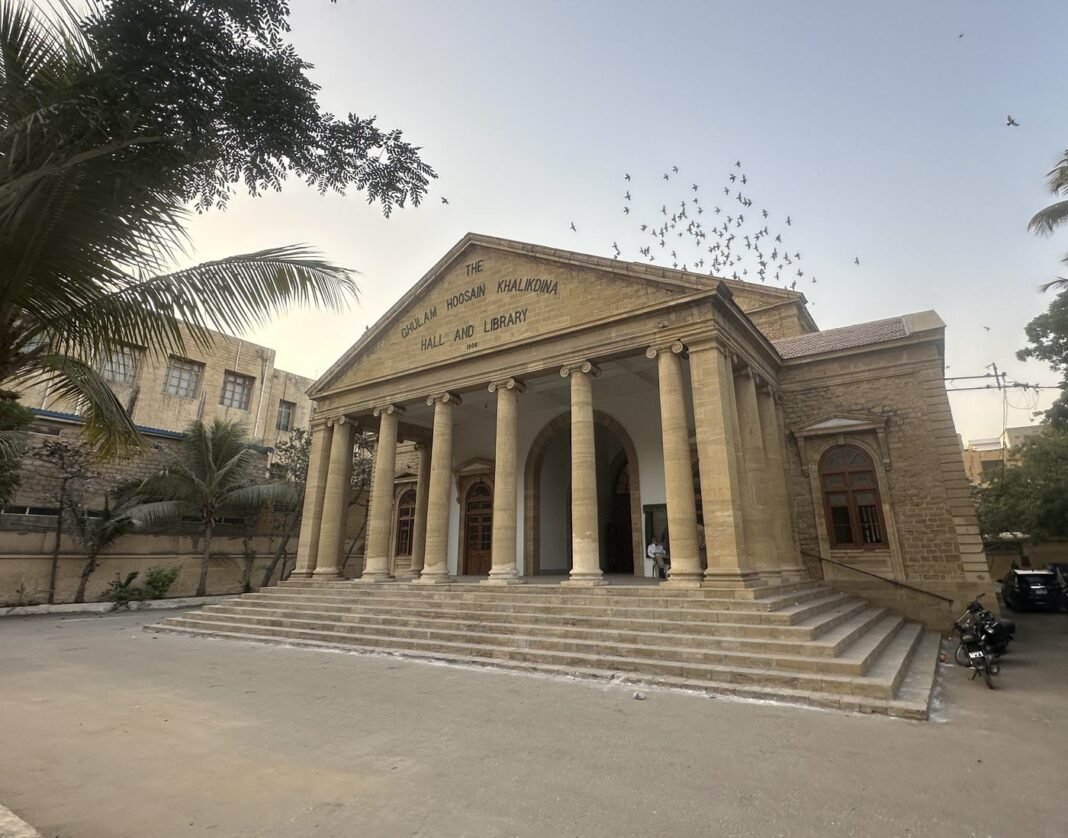
What draws you in first is the architecture. Designed by Moses Somake — the Lahore-born Iraqi-Jewish architect behind some of colonial Karachi’s finest buildings — the hall is Palladian in manner: a sweeping portico of Ionic columns, a grand triangular pediment, lofty ceilings, and heavy teak-wood doors and windows. Step off the chaotic street and into the cool, high-ceilinged interior, and the city’s noise falls away. The interior is deliberately simple, almost austere, which is why it works so well as a cultural stage: the building frames the art instead of competing with it.
Then there is the history under your feet. In 1921, Maulana Muhammad Ali Jauhar — the journalist, scholar and Khilafat Movement leader — stood in this hall to face the British on charges of sedition, conducting his own defence in proceedings that became famous as the Trial of Sedition. On 15 December 1947, Muhammad Ali Jinnah himself stood here to rename the All-India Muslim League as the Pakistan Muslim League. Few buildings in Pakistan compress so much of the freedom story into a single room.
And now the hall has a third life. Restored and revived, it hosts the things Karachi does best when given a stage: handicraft exhibitions and artisan stalls, sitar and tabla evenings, guitar sessions, truck-art workshops, theatre rehearsals, food stalls and cultural pop-ups. The library — the building’s original purpose, holding some 2,000 books including 500 rare editions from the eighteenth and nineteenth centuries — is being brought back to public use. Come for the history, stay for the culture, and leave understanding Karachi a little better than when you arrived.
History of Khaliq Dina Hall & Library
The hall’s story begins with a library. In 1856, Karachi’s residents established the Native General Library — one of the city’s earliest public reading rooms. Half a century later, the library needed a proper home, and the man who gave it one was Ghulam Hussain Khaliqdina, a Khoja merchant and philanthropist. In 1902 he donated Rs 18,000 toward the construction of a new public hall and library; the Karachi Municipal Corporation provided the remaining Rs 15,000 of the Rs 33,000 total. The building, designed by Moses Somake in the Palladian style and constructed in ashlar masonry with a wooden roof, was completed in 1906.
Khaliqdina’s philanthropy extended beyond the hall — he was also instrumental in the establishment of the Sindh Madressatul Islam, one of Karachi’s great educational institutions. His personal story is itself a window into the city’s layered religious history: raised in the Khoja tradition of Shia Islam, he later moved toward the Twelver branch, a shift that cost him his standing with the Aga Khan’s followers. The hall he funded, however, was conceived as a civic space for all of Karachi’s Muslims — for reading, literary debate, community gatherings and recreation.
From its opening, the hall became a stage for the politics of the age. Its most famous moment came in 1921, when Maulana Muhammad Ali Jauhar was tried here for sedition after a speech at a Khilafat Conference meeting that the British deemed incitement to mutiny. Jauhar — already famous for his fiery journalism — conducted his own defence in the lofty hall, and the trial became a landmark of the freedom struggle. A quarter-century later, on 15 December 1947, the hall hosted another hinge of history: Muhammad Ali Jinnah renamed the All-India Muslim League the Pakistan Muslim League here, formally re-founding the party for the new nation.
The decades after independence were less kind. Like many of Karachi’s heritage buildings, the hall suffered neglect; the library that had been its original purpose fell into poor condition even as the building itself survived as a protected monument under the Antiquities Act of 1975. The revival began in earnest in the 2020s: restoration work — supported by heritage advocates, the Karachi Metropolitan Corporation and partners including the British Council — brought the building back to life, restored the library with its rare-book collection, and reopened the hall as a venue for cultural events. Walking in today, you see a building that has finally been given the second century it deserves.
Top Things to Do in Khaliq Dina Hall & Library
Admire the Palladian Architecture
Start with the building itself. Climb the steps to the portico and study the Ionic columns, the triangular pediment, the teak doors and the lofty ceiling of the main hall — the classic Palladian vocabulary, executed in Karachi sandstone. Early morning or late afternoon gives the softest light on the facade, and the contrast between the calm, ordered architecture and the chaos of MA Jinnah Road outside is one of Karachi’s great visual experiences.
Browse the Restored Library
The library was the hall’s original reason for existing, and its restoration is the heart of the revival. Some 2,000 books are being made accessible to the public, including 500 rare editions dating to the eighteenth and nineteenth centuries. Even if you only browse the shelves for half an hour, you are participating in a 170-year-old tradition — this collection descends directly from the Native General Library of 1856.
Stand Where History Happened
Find the spot in the main hall where Maulana Muhammad Ali Jauhar faced his sedition trial in 1921, and where Jinnah renamed the Muslim League in December 1947. There is no plaque grand enough for what happened here, which is rather the point — the hall lets the history speak for itself. Guides and caretakers will happily point out the details if you ask.
Catch a Cultural Event
Check what is on before you visit. The hall’s calendar now includes handicraft exhibitions, artisan stalls, live sitar and tabla performances, guitar sessions by young musicians, truck-art workshops, theatre rehearsals and stage shows, and local food stalls and cultural pop-ups. These events are the hall’s living pulse — and the most enjoyable way to experience the building.
Walk the Old Karachi Circuit
Khaliq Dina Hall anchors a walkable cluster of heritage Karachi. Combine it with Frere Hall and its gardens, Empress Market, the Merewether Clock Tower, and the colonial-era commercial buildings of the old city. End the walk on Burns Road — Karachi’s legendary food street, minutes away — for the perfect heritage-and-food day.
Famous Places In and Around Khaliq Dina Hall & Library
- Frere Hall: Karachi’s beloved colonial-era public hall and gardens, now an art and book-fair venue.
- Empress Market: The 1889 Saddar landmark market — spices, produce and old-Karachi atmosphere.
- Burns Road: The city’s historic food street, a short walk away; come hungry.
- Merewether Clock Tower: A striking 1892 colonial tower at the old city’s edge.
- National Museum of Pakistan: The country’s premier museum, nearby on Dr Ziauddin Ahmed Road.
- Quaid-e-Azam’s Mausoleum (Mazar-e-Quaid): The founder’s white-marble memorial, a short drive away.
- Karachi Parsi Institute & colonial Saddar: More of Moses Somake-era Karachi’s architectural fabric. See our Edulji Dinshaw Dispensary guide for another Somake-era landmark.
How to Reach Khaliq Dina Hall & Library
The hall sits on MA Jinnah Road in central Karachi — one of the easiest heritage sites in Pakistan to reach, because the city comes to it.
Within Karachi: From Saddar/Empress Market it is a 5–10 minute drive; from Clifton and DHA, 20–30 minutes depending on traffic; from Gulshan-e-Iqbal and North Nazimabad, 25–40 minutes. Ride-hailing apps (Careem, inDrive, Bykea) all serve the area, and auto-rickshaws are plentiful. If you are walking the old-city heritage circuit, the hall is a natural stop between Burns Road and Frere Hall.
From Jinnah International Airport (approximately 16 km, 30–45 minutes): Take Shahrah-e-Faisal toward the city centre, then join MA Jinnah Road. Pre-booked airport transfers and ride-hailing are the comfortable options; airport taxis are available at fixed counters.
From Lahore (approximately 1,200 km) and Islamabad (approximately 1,400 km): Fly to Karachi (about 2 hours) — the only sensible option for a heritage weekend. By road, the M9 motorway from Hyderabad connects to the Superhighway into Karachi (4–5 hours from Hyderabad). Pakistan Railways runs daily trains from Lahore and Rawalpindi to Karachi Cantonment station, from where the hall is a 20-minute drive.
Route Details
Set your ride-hailing pin to “Khaliq Dina Hall, MA Jinnah Road” — every Karachi driver knows the road, and most know the hall. The building sits on the main road itself, directly across from the dense commercial blocks near Burns Road; look for the columned portico set back slightly from the traffic. Visit on a weekday morning for the calmest experience; Friday afternoons are quieter for traffic but some offices close. Parking on MA Jinnah Road is chaotic — arrive by ride-hailing, not your own car, if you can.
Where to Stay in Khaliq Dina Hall & Library
You do not stay at the hall — you stay in Karachi, and the hall is your day out. The good news is that central Karachi offers every tier of accommodation within a short drive.
Luxury: Karachi’s grand hotels cluster around Shahrah-e-Faisal and the Clifton/Defence side — the Pearl Continental and Mövenpick are the city’s long-established five-star landmarks, with pools, multiple restaurants and full business facilities. Expect premium city rates.
Mid-range: Saddar and PECHS are full of three- and four-star hotels and serviced apartments, many within 10–15 minutes of the hall — the practical choice for a heritage weekend. Clifton’s sea-facing mid-range hotels add the beach to the bargain.
Budget: Guesthouses and budget hotels around Saddar, Burns Road and Karachi Cantonment station offer clean, basic rooms at very modest rates. Book through a reputable platform and read recent reviews; standards vary widely at this tier. For a heritage trip, basing yourself in Saddar puts the hall, Empress Market, Burns Road and Frere Hall all within easy reach.
Where to Eat: Local Foods of Khaliq Dina Hall & Library
The hall sits at the edge of one of the greatest food neighbourhoods in Pakistan — plan your visit around a meal, not the other way around.
Burns Road (minutes away): Karachi’s legendary food street. The names are institutions: nihari that regulars will defend in argument, sajji, BBQ platters, qulfi and rabri for dessert, and chai dhabas that never close. Come for lunch or dinner; evenings are the liveliest. A full Burns Road meal is budget-friendly — a few hundred rupees per person at the classic eateries.
Around the hall: The Saddar and Pakistan Chowk area has old Irani-style cafes, biryani houses, and the bun-kebab carts of the old city. For a sit-down meal, the restaurants of nearby hotels and the cafes around Frere Hall and Boat Basin (a short drive) cover everything from desi to continental.
What to try: Karachi biryani (the city’s signature), Burns Road nihari, fresh sugarcane juice from street vendors in winter, and qulfi-falooda for dessert. The hall’s own cultural events often include local food stalls and pop-ups — check the calendar.
Weather in Khaliq Dina Hall & Library
Karachi’s coastal climate is famously moderate by Pakistani standards — never truly cold, brutally humid in summer, and at its best in the winter months. The hall is an indoor venue, so weather matters mostly for the walking parts of your visit.
| Season | Temperature Range | Conditions |
|---|---|---|
| Winter (Nov–Feb) | 10–26°C | Pleasant, dry, sunny. The best season for heritage walks. |
| Spring (Mar–Apr) | 22–34°C | Warming; sea breeze still helps. Good for sightseeing. |
| Summer (May–Jul) | 30–38°C | Hot and humid; plan indoor visits for midday. |
| Monsoon/Autumn (Jul–Oct) | 28–36°C | Monsoon showers (sometimes heavy); urban flooding possible in cloudbursts. |
Language and Culture of Khaliq Dina Hall & Library
Karachi is Pakistan’s most cosmopolitan city, and the hall reflects it. Urdu is the lingua franca, English is widely spoken in cultural and heritage circles, and you will hear Sindhi, Punjabi, Pashto, Balochi and Gujarati in the streets outside. The hall’s own history is tied to the city’s Muslim intellectual life, but its events today draw Karachi’s full diversity — students, artists, families and tourists.
Cultural notes for visitors: dress smart-casual and modest (the hall is a heritage and cultural venue, not a beach); ask before photographing performers or fellow visitors at events; silence your phone during performances; and if you visit the library’s rare-book section, handle materials only as the staff direct. Karachi’s street culture outside is boisterous and warm — bargaining is expected in the bazaars, chai is a universal language, and strangers will happily give you directions.
Shopping in Khaliq Dina Hall & Library
The hall’s own cultural events are a shopping opportunity in themselves — handicraft exhibitions and artisan stalls at the venue sell directly from makers: truck-art pieces, basketry, embroidery and crafts from across Sindh and Pakistan. Beyond the hall, you are in one of Karachi’s prime shopping zones. Empress Market (a short drive) is the classic: spices, dry fruits, crockery and old-city atmosphere under an 1889 roof. Zainab Market and Bohri Bazaar nearby are famous for fabrics, clothes and cut-price fashion; Tariq Road and Dolmen Mall Clifton (for those who want the modern mall experience — verifiably there) cover the contemporary end. For heritage souvenirs, the craft stalls at the hall’s own events are the most meaningful buy.
Travel Tips for Khaliq Dina Hall & Library
Packing Essentials
Comfortable walking shoes (the old-city circuit is best on foot), sun protection, a light scarf or shawl, a camera, and a power bank. Carry a bottle of water — Karachi’s humidity dehydrates quietly. If you plan to browse the rare books, bring reading glasses; the print is small and the history is large.
Safety Tips
Central Karachi around MA Jinnah Road and Saddar is busy and generally safe in the daytime, with heavy foot traffic and a visible police presence. Standard big-city precautions apply: keep valuables discreet, use ride-hailing rather than hailing random taxis at night, and avoid the area’s traffic-choked roads on foot after dark. Check the hall’s event schedule in advance — some events require registration or have limited seating.
Money & Connectivity
Cards are widely accepted at hotels, malls and larger restaurants, but the bazaars, food street and craft stalls run on cash — carry rupees in mixed denominations. ATMs are everywhere in Saddar and Clifton. All mobile networks work well in central Karachi, and most hotels and cafes offer Wi-Fi.
Best Time to Visit Khaliq Dina Hall & Library
November to February (Ideal)
Karachi’s winter is made for heritage tourism: dry, sunny, 10–26°C days that make walking the old city a pleasure. The cultural calendar is also at its busiest in these months — more exhibitions, more performances, more reasons to linger at the hall.
March to April (Good)
Still comfortable for sightseeing, with warm afternoons. A fine shoulder season for the hall and the Burns Road food run.
May to October (Indoor Season)
Summer heat and humidity push sightseeing indoors — which suits the hall perfectly, since its cool, high-ceilinged interior is a refuge. Plan heritage walks for early morning and spend midday inside the library and galleries. Avoid the heaviest monsoon downpours for the walking circuit.
Final Thoughts
Khaliq Dina Hall is that rare thing: a building that has been important in three different centuries for three different reasons — a public library in the 1900s, a courtroom of the freedom struggle in the 1920s and a founding chamber of the new nation in 1947, and now a cultural living room for twenty-first-century Karachi. Most cities would build a museum around any one of those lives. Karachi simply restored the building and put it back to work.
Go on a weekday morning, when the light comes through the portico and the hall is quiet enough to hear its own history. Stay for whatever the cultural calendar offers that week. Then walk out into the beautiful chaos of MA Jinnah Road, cross to Burns Road, and eat like the city eats. For more of old Karachi, explore our Christ Church and Cotton Exchange Building guides, and browse the Explore Pakistan collection for your next destination. Some buildings you visit; Khaliq Dina Hall you experience.
FAQs
Where is Khaliq Dina Hall & Library located?
On MA Jinnah Road in central Karachi, Sindh — near Burns Road and Saddar, in the old city centre.
When was Khaliq Dina Hall built?
The building was completed in 1906. It was designed by architect Moses Somake in the Palladian style and funded chiefly by philanthropist Ghulam Hussain Khaliqdina.
Why is Khaliq Dina Hall historically important?
Maulana Muhammad Ali Jauhar was tried for sedition here in 1921 during the Khilafat Movement, and on 15 December 1947 Muhammad Ali Jinnah renamed the All-India Muslim League as the Pakistan Muslim League in this hall.
Can visitors enter the library?
Yes — the restored library, with some 2,000 books including 500 rare editions, is being made accessible to the public as part of the hall’s revival. Check current visiting arrangements before you go.
What events happen at Khaliq Dina Hall?
The hall hosts handicraft exhibitions, artisan stalls, sitar and tabla performances, guitar sessions, truck-art workshops, theatre rehearsals and shows, and local food stalls. Check the calendar before visiting.
What is the best time to visit?
November to February, when Karachi’s weather is ideal for heritage walks and the cultural calendar is busiest.
Is it family-friendly?
Yes. The hall, its events and the surrounding heritage circuit suit all ages; combine with Empress Market and Burns Road for a full family day.
How much time should I spend there?
Allow 1–2 hours for the hall and library itself, and half a day if you combine it with Frere Hall, Empress Market and Burns Road.