Quick Facts
- Location: Near Khalti village, Gupis-Yasin District, Gilgit-Baltistan — in a bend of the Ghizer River, about 116 km west of Gilgit
- Altitude: around 2,200 metres (approximately 7,200 feet)
- Famous For: Trout fishing, mirror-still summer reflections, freezing solid in winter, and the January ice hockey festival
- Nearest City: Gilgit, about 116 km east (3–4 hours by road); Gupis town is the nearest local centre
- Accessibility: On the Gilgit–Chitral road via Gahkuch and Gupis; paved but winding. Gilgit is reached by the Karakoram Highway or by air from Islamabad
- Known Landmarks: The lake itself, the PTDC motel on its shore, the Ghizer River gorges, the Hindu Kush backdrop
- Best For: Anglers, photographers, families, winter-sports curious travelers, and anyone seeking Hunza’s beauty without Hunza’s crowds
Why Visit Khalti Lake
Here is the open secret of Gilgit-Baltistan’s west: the most beautiful lake in Ghizer is not the famous one. Phandar gets the postcards, but Khalti Lake — a dark, still sheet of glacial water in a bend of the Ghizer River, cupped by the Hindu Kush — rivals it for colour and beats it for peace. It sits right on the main road near Gupis, it is famous for its trout, it freezes into a natural ice rink every winter, and a fraction of the tourists who clog the Karakoram Highway ever turn west to find it. This Khalti Lake travel guide exists to correct that.
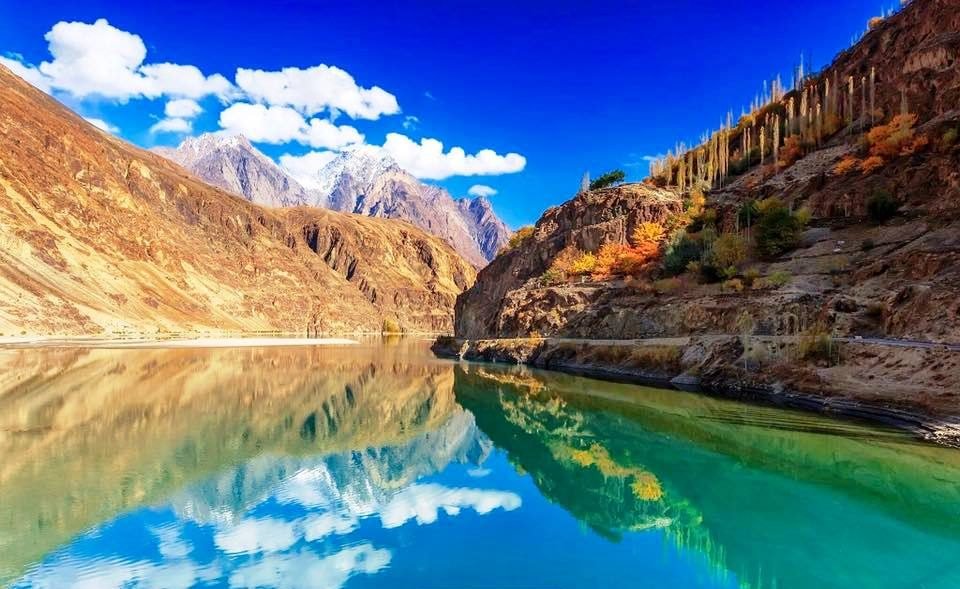
What you get at Khalti is the full northern-lakes experience in miniature and without the circus. In summer the water is a deep, impossible blue-green, fed by glacier melt so cold it numbs your fingers, and the reflections of the surrounding peaks are so sharp that photographers routinely mistake their own shots for paintings. Boats drift across water so still you can hear birdsong from both shores — the quiet here is the thing visitors mention most. In winter the same lake becomes something else entirely: a sheet of ice thick enough for villagers to walk on, for children to play cricket on, and — every January — for an ice hockey festival that turns this remote valley into one of the most unusual sporting venues in Pakistan.
Khalti is also the perfect excuse to discover Ghizer, the valley system that travelers call the quieter Hunza. Base yourself at the PTDC motel with its lake view, or in nearby Gupis, and you are positioned for the whole western circuit: the historic Gupis Fort, the great Phandar Lake further up the valley, the broad green floor of Yasin, and the road to Shandur Pass. It is the rare destination that works as both a peaceful stopover and a base camp.
Who is it perfect for? Anglers — the trout here are the real thing. Photographers chasing reflections without jostling for tripod space. Families who want a mountain lake their grandparents can actually reach (the lake is on the main road, no trekking required). Winter travelers who want to see a Himalayan lake frozen and alive with local sport. And the second-time northern areas visitor who thought they had seen it all. Khalti will change their mind.
History of Khalti Lake
Khalti is a natural lake with a geologist’s biography and a mountaineer’s reputation. It formed where the Ghizer River bends around the settlement of Khalti: river water, glacial melt and springs collected in the bend and the surrounding depression, held in place by moraine and alluvial deposits, until a lake was born. Local accounts describe it as a lake left behind by retreating glaciers — the classic origin story of the high lakes of the Hindu Kush and Karakoram. Its trout population, whether introduced or native to the river system, has made it one of the region’s noted fishing waters for generations.
The human history around the lake is the history of the Ghizer valleys — a frontier story of small mountain states. For centuries this region was a patchwork of tiny principalities between the greater powers of Kashmir, Chitral and Gilgit. The Rajas of Yasin — notably Suleman Shah and the formidable Gohar Aman — extended their rule across these valleys in the nineteenth century, pushing back Dogra influence until Gohar Aman’s death shifted the balance and the Dogras of the Maharaja of Kashmir reasserted control. The British-administered Gilgit Agency then folded the valleys into its frontier system, with forts at Gupis and Gahkuch serving as the local seats of that order.
The modern era began in November 1947, when the Gilgit Scouts’ uprising ended Dogra rule and Gilgit-Baltistan acceded to Pakistan. Gupis and its lake entered the Pakistani tourist imagination slowly — the road west from Gilgit was long an adventure in itself. The establishment of the PTDC motel on Khalti’s shore marked the lake’s arrival as a formal destination, giving travelers the first comfortable base with a direct view of the water. In 2019, the old Ghizer District was administratively split, and Khalti now lies in Gupis-Yasin District — a detail that explains why maps and signs use both names.
Today Khalti’s history is still being written each winter, when the frozen lake hosts ice hockey and winter sports that have put the valley on the national tourism calendar. A lake that began as a bend in a glacial river is now one of the most distinctive winter destinations in Pakistan.
Top Things to Do in Khalti Lake
Trout Fishing
Khalti’s first fame is its fish. The lake’s cold, clear water holds a healthy population of trout, and angling here — with the Hindu Kush rising on every side — is the experience fishermen travel across Pakistan for. Fish from the shore or a hired boat; early morning and late evening are the productive hours. Check local permit rules before you cast — the fishery is a managed resource and the villagers take its protection seriously.
Boating on the Mirror
In summer, hire a boat and drift. Khalti’s surface on a calm morning is famously still — the surrounding peaks reflected so perfectly that the horizon seems to vanish. It is the single most photographed moment of a Ghizer trip, and unlike the famous northern lakes, you will likely have the water nearly to yourself. The PTDC motel can arrange boats, and local boatmen wait near the shore in season.
Walk on the Frozen Lake (Winter)
From December into February, Khalti typically freezes solid — and the villagers walk on it. When local conditions are judged safe, joining them for a walk across the ice, with the frozen surface creaking softly underfoot and the snow peaks blazing white around you, is a once-in-a-lifetime experience. Never venture onto the ice without local guidance; the villagers know exactly where and when it is safe, and their judgment is the only one that counts.
Watch the Ice Hockey Festival
Every January, the frozen lake becomes a stadium. The Khalti Ice Hockey Festival — an official event on the regional tourism calendar — brings teams and crowds to play on natural ice in one of the most dramatic settings in world sport. Even if you have never watched a hockey match, the spectacle of the game against the Hindu Kush is unforgettable. Plan and book well ahead; winter accommodation in Gupis is limited.
Photography at Dawn and Dusk
Khalti is a photographer’s lake. Dawn brings mist on the water and the first gold on the peaks; dusk turns the lake to copper. The canyon walls that open into the lake give strong leading lines, and the flat alluvial plains stretching toward Phandar offer wide panoramas. Bring a tripod and a polarising filter — you will use both.
Visit Gupis Fort and Village
The historic Gupis Fort stands above the nearby town — a reminder of the valley’s frontier past, with commanding views over the river and fields. Gupis town itself, with its maize fields and apple orchards, is worth an unhurried walk; it is the human counterpoint to the lake’s wildness.
Famous Places In and Around Khalti Lake
- Phandar Lake (approx. 40–50 km west): The great lake of the upper valley, famous for its size and trout — the classic onward journey.
- Gupis Fort: The valley’s historic stronghold, minutes from the lake.
- Gahkuch (approx. 40 km east): The district town, with its own fort and tower and the best-stocked bazaar on the route.
- Yasin Valley: West of Gupis — broad green valley floor, glaciers, and the road toward Darkut Pass.
- Shandur Pass: The high route onward to Chitral (seasonal; check conditions).
- Gilgit (116 km): The regional capital and your gateway, with the Kargah Buddha carvings on the way.
How to Reach Khalti Lake
Khalti sits on the Gilgit–Chitral road, which makes it one of the most accessible high lakes in Gilgit-Baltistan — no jeep track, no trek, just a mountain road and three to four hours from Gilgit.
From Islamabad (approximately 475 km to Gilgit, then 116 km to the lake): The classic route is the Karakoram Highway via Mansehra, Besham and Chilas to Gilgit — 10–12 hours of spectacular, demanding driving. In summer (roughly June–September), the Babusar Pass route via Naran shortens the journey considerably. Alternatively, fly Islamabad to Gilgit (about an hour, weather permitting — and the weather frequently does not permit, so keep a buffer day). From Gilgit, take the Gilgit–Chitral road west through Gahkuch and Gupis to Khalti village; the lake is signposted and visible from the road. Allow 3–4 hours for the Gilgit–Khalti drive.
From Lahore (approximately 750 km to Gilgit): Fly to Islamabad and continue as above, or drive the full route via the motorway network to Mansehra and then the KKH. Most Lahore travelers break the journey with a night in Naran or Chilas.
From Karachi (approximately 1,900 km): Fly to Islamabad, then fly or drive to Gilgit as above. This is a full expedition — plan at least a week for the round trip.
Nearest airport: Gilgit Airport, with daily PIA flights from Islamabad (weather-dependent). Skardu is an alternative gateway but adds significant road time.
Route Details
Gilgit → (N-5/Gilgit–Chitral road west) → Gahkuch (~72 km) → Gupis (~40 km further) → Khalti Lake (a few kilometres beyond Gupis, on the main road). The road is paved for much of the way but narrows and roughens in stretches; it follows the Ghizer River through sharp gorges, so drive in daylight and never in heavy rain. In winter (December–February), check locally whether the road is open — snow can close sections, though the route to Khalti is generally kept passable. A 4×4 is advisable in winter and after rain; in summer a sturdy sedan can manage with a careful driver. Public vans run Gilgit–Gupis daily; from Gupis, the lake is a short local ride away.
Where to Stay in Khalti Lake
The PTDC motel: The landmark stay is the PTDC motel near the lake — the property travelers mention most, with rooms overlooking the water and the mountains. Waking to Khalti’s dawn reflections from your window is the experience the motel exists for. Book well ahead in summer and for the January ice hockey festival; winter demand is concentrated and rooms are few.
Gupis and Gahkuch guesthouses: Gupis town has simple hotels and guesthouses — clean, heated-in-winter rooms with local food, at modest rates. Gahkuch, 40 km back toward Gilgit, has a slightly wider selection and the best bazaar provisioning on the route. These are the practical bases for anglers and winter-sports visitors.
Camping: Summer camping near the lake is possible and popular with tour groups, but arrange it through a local operator — the weather at 2,200 metres changes fast, and the lakeshore is ecologically sensitive. Never camp on the ice in winter, for obvious reasons, and always confirm the site with villagers first.
Where to Eat: Local Foods of Khalti Lake
The food around Khalti is the food of Ghizer — hearty mountain cooking built for cold evenings, with the lake’s own trout as the star.
Trout, three ways: If you fish it (or buy it from local fishermen), Khalti trout is superb simply grilled, fried in local style, or cooked in a light masala. The small restaurant near the lake and the PTDC motel both serve trout when available — ask for the catch of the day. It is the meal the lake is famous for; do not leave without it.
Gilgit-Baltistan staples: Chapshuro (the region’s beloved meat-filled flatbread), mamtu (steamed dumplings), dawdo (a hearty wheat-and-meat soup), and fresh apricot juice in summer. Village homes serve these if you are invited — and invitations happen, because Ghizer hospitality is genuine.
Practical eating: Gupis town has dhabas and small hotels serving standard Pakistani food — daal, chicken karahi, fresh roti — at budget-friendly prices. Stock snacks, drinking water and any special supplies in Gilgit or Gahkuch; beyond Gupis, options thin out. A dhaba meal costs a few hundred rupees per person; trout at the lake restaurant costs more but remains reasonable.
Weather in Khalti Lake
At around 2,200 metres in the Hindu Kush, Khalti has a true mountain climate: glorious summers, golden autumns, and winters that freeze the lake solid. The road and the lake both follow the seasons — plan around them.
| Season | Temperature Range | Conditions |
|---|---|---|
| Winter (Dec–Feb) | -10 to 5°C | Lake freezes; snow likely. Ice hockey festival in January. Road may close in heavy snow. |
| Spring (Mar–Apr) | 5–18°C | Thaw begins; apricot blossom in the valleys; quiet and beautiful. |
| Summer (May–Sep) | 15–28°C | Perfect: warm days, cool nights, best boating and fishing. Peak season. |
| Autumn (Oct–Nov) | 5–18°C | Golden foliage; crisp air; last chance before the freeze. |
Language and Culture of Khalti Lake
The Gupis side of Ghizer speaks Shina as its first language, with Khowar widely heard toward the west and Burushaski in pockets of the wider region; Urdu works everywhere for visitors, and English is understood at the PTDC motel and by tour operators. The people of the Ghizer valleys are known across Gilgit-Baltistan for their calm hospitality — travelers consistently remark on it.
Cultural notes: the valleys are conservative and deeply community-minded. Dress modestly, ask before photographing people, and respect prayer times and local customs around the villages. If you are invited into a home — for chai, for a meal, to watch a polo practice — accept with grace; refusing hospitality is the only real faux pas. During the winter festival season, the villages are celebrating their own traditions, not performing for tourists; watch respectfully, cheer loudly, and leave the ice cleaner than you found it.
Shopping in Khalti Lake
Khalti has no bazaar — its shopping is Gupis town’s small market and, better, Gahkuch’s bazaar on the way in. What to buy: dried apricots, mulberries and other dry fruits (the valleys’ most famous export — buy from the orchard families, not the middlemen, when you can); pure apricot oil; hand-woven wool shawls and caps; and simple woodwork. There are no shopping malls anywhere in Ghizer — Gilgit city, 116 km away, is the nearest place for anything beyond local goods. The dry fruits are the essential purchase; everything else is a bonus.
Local Events and Festivals
Khalti Ice Hockey Festival (January): The lake’s signature event — an official fixture on the regional tourism calendar, held on the frozen lake each January. Teams compete on natural ice beneath the Hindu Kush, drawing spectators from across Gilgit-Baltistan and a growing number of winter tourists. If you plan around it, book accommodation in Gupis or at the PTDC motel well in advance and confirm ice conditions locally, since exact dates follow the freeze.
Winter sports season (December–February): Beyond the festival, the frozen lake hosts informal ice skating, and villagers traditionally play cricket, football and volleyball on the ice — visitors are often welcomed to watch and sometimes to join.
Spring and harvest (seasonal): The wider Ghizer valleys celebrate the agricultural calendar — spring blossom and the autumn harvest are community occasions. These are local celebrations rather than tourist events; if your visit coincides with one, you will be welcomed as a guest, not sold a ticket.
Travel Tips for Khalti Lake
Packing Essentials
Summer: sun protection (mountain sun is fierce), layers for cool evenings, sturdy walking shoes, swim-proof bag for boat trips, fishing gear if you are serious (or hire locally). Winter: proper cold-weather clothing — thermal base layers, insulated jacket, gloves, hat, and boots with grip for the ice. Year-round: a power bank, basic medicines, drinking water, and cash.
Safety Tips
The Ghizer valleys are peaceful and the crime risk to tourists is minimal. The real hazards are the mountain environment: altitude (take it easy on day one if you flew in), the cold water (never swim in the glacial lake), the ice (only with local guidance), and the road (daylight driving only, 4×4 in winter). Register your travel plans with your hotel and carry a charged phone.
Money & Connectivity
Carry all the cash you will need from Gilgit — there are no reliable ATMs beyond Gahkuch, and nothing at the lake takes cards. Mobile signals are intermittent: the main networks reach Gupis and the lake area patchily, so download offline maps, confirm bookings in Gilgit, and tell family you may be out of contact.
Best Time to Visit Khalti Lake
May to September (Classic Season)
The lake at its bluest, the road at its most reliable, boating and trout fishing at their best. This is the season most travelers choose, and the Khalti Lake travel guide default recommendation. Book the PTDC motel ahead in July–August.
October to November (Golden Shoulder)
Autumn colour in the orchards, crisp air, thinning crowds. The lake is still unfrozen and the photography is arguably at its finest.
December to February (Frozen Magic)
For the adventurous: a frozen lake, snow peaks, the January ice hockey festival, and a Ghizer most travelers never see. Cold, demanding, and utterly unforgettable. Check road status before committing.
March to April (Thaw)
The in-between months — melting ice, blossom in the lower valleys, very few visitors. Beautiful but unpredictable; confirm conditions locally.
Final Thoughts
Khalti Lake is proof that the best destinations are not always the famous ones. It has everything the celebrated northern lakes have — glacial water, trout, mountain reflections, a winter transformation — and almost none of their crowds. What it asks in return is a little more effort: the longer drive west from Gilgit, the willingness to travel in winter for the full magic, and the respect to treat a village’s lake as the living place it is.
Go in summer for the mirror water and the trout, or in January for the ice hockey festival on the frozen lake — either way, pair it with Gupis Fort and Gahkuch, and browse the Explore Pakistan collection for the rest of the west. Khalti does not shout for attention. It just sits there, impossibly blue, waiting for the travelers who look beyond the obvious.
FAQs
Where is Khalti Lake located?
Khalti Lake is near Khalti village in Gupis-Yasin District, Gilgit-Baltistan — in a bend of the Ghizer River, about 116 km west of Gilgit on the Gilgit–Chitral road.
What is Khalti Lake famous for?
Its trout fishing, mirror-like summer reflections, freezing solid in winter, and the annual January ice hockey festival played on the frozen lake.
How do I reach Khalti Lake?
Drive or fly to Gilgit, then take the Gilgit–Chitral road west through Gahkuch and Gupis — about 3–4 hours. The lake sits right on the main road near Gupis.
What is the best time to visit Khalti Lake?
May to September for boating, fishing and easy road access; December to February (especially January) for the frozen lake and ice hockey festival.
Can you walk on Khalti Lake in winter?
Yes — the lake typically freezes solid in winter and villagers walk on it — but only ever with local guidance on where and when the ice is safe.
Is Khalti Lake family-friendly?
Very. The lake is on the main road with no trekking required, making it accessible for children and older travelers. The PTDC motel offers family rooms with lake views.
Where can I stay near Khalti Lake?
The PTDC motel on the lakeshore is the landmark stay; Gupis and Gahkuch have simpler hotels and guesthouses. Book well ahead for summer and January.
Do I need a 4×4 to reach Khalti Lake?
In summer a sturdy car with a careful driver can manage; in winter and after rain a 4×4 is strongly advisable. Always drive the mountain road in daylight.