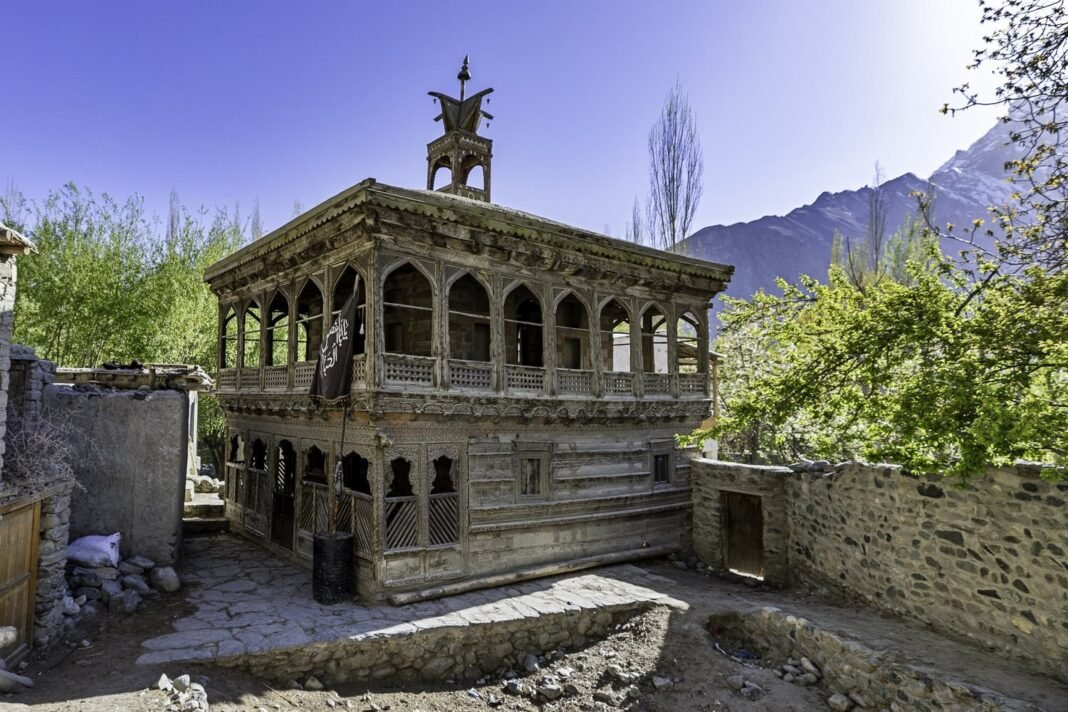
In the Shigar Valley of Baltistan, down a quiet lane shaded by ancient chinar trees, stands a building that seems to have grown out of the mountains themselves. The Khanqah-e-Mualla of Shigar — a 400-year-old wooden mosque and Sufi lodge — is one of the finest surviving examples of Baltistan’s wooden architecture: hand-carved balconies, intricate ceilings, and walls of mud and timber that have sheltered worshippers and travelers since the early 1600s. It is not the most famous monument in Gilgit-Baltistan. It may be the most soulful.
A khanqah is more than a mosque — it is a Sufi lodge, a place where travelers rested, scholars taught, and devotees gathered. Shigar’s Khanqah-e-Mualla (“the exalted lodge”) has played all these roles for four centuries, and it still does. This khanqah-e-mualla shigar travel guide is for travelers who want more than scenery from the north: who want to stand inside living history, to understand how Islam and mountain culture wove together in Baltistan, and to see craftsmanship that no machine could ever reproduce.
Quick Facts
- Location: Shigar town, Shigar Valley, Baltistan, Gilgit-Baltistan, Pakistan — about 30 km from Skardu.
- Altitude: Around 2,300 metres above sea level (the Shigar Valley floor).
- Famous For: 17th-century wooden mosque and Sufi lodge; exquisite hand-carved woodwork; ancient chinar trees; Nurbakhshi Sufi heritage.
- Nearest City: Skardu, approximately 30 km away (roughly 1.5-2 hours by road).
- Accessibility: Road only — Skardu to Shigar by jeep or car on a scenic mountain road; no air access to Shigar itself.
- Known Landmarks: Amburiq Mosque (14th century), Shigar Fort, Manthal Buddha rock carvings, the Shigar River.
- Best For: History lovers, architecture enthusiasts, spiritual travelers, photographers, and culture seekers.
Why Visit Khanqah-e-Mualla, Shigar
The first reason is the building itself. In an age of concrete and glass, the Khanqah-e-Mualla is a revelation: a great wooden structure raised on stone foundations, its balconies and ceilings covered in carvings cut by hand four centuries ago. The craftsmanship is the kind that stops you mid-step — geometric patterns, floral motifs, and joinery fitted without a single nail in the traditional manner. Photographs do not do it justice; you need to stand beneath those carved ceilings and feel the scale of what human hands achieved here. For anyone who loves architecture, this alone justifies the trip to Shigar.
The second reason is what the building represents. The khanqah is a living chapter of how Islam came to Baltistan — not by conquest, but through Sufi preachers and Persian artisans who traveled these mountain valleys centuries ago, building mosques that blended Persian, Kashmiri, Tibetan, and local Balti traditions into something entirely new. Standing inside the Khanqah-e-Mualla, you are standing inside that story. It is history you can touch, in a region where most “historical sites” are either ruins or reconstructions. This one is still alive, still used, still prayed in.
Third, Shigar itself is one of Baltistan’s most rewarding valleys, and the khanqah is its spiritual heart. A visit here pairs naturally with the 14th-century Amburiq Mosque (a UNESCO-recognized heritage treasure), the magnificent Shigar Fort, and the ancient Buddhist rock carvings at Manthal — a full day of wonders within a few kilometers. The valley’s orchards, the Shigar River, and the views toward the Karakoram make the journey as beautiful as the destination.
Finally, there is the quiet. Unlike the region’s famous forts and lakes, the khanqah draws few crowds. You will likely have its carved halls and shaded courtyard almost to yourself, with only the sound of the wind in the chinar trees. For travelers seeking a spiritual or contemplative experience — or simply a break from the selfie-stick circuit — the Khanqah-e-Mualla offers something increasingly rare: a sacred place that still feels sacred.
History of Khanqah-e-Mualla, Shigar
The history of the Khanqah-e-Mualla is firmly anchored in the early 1600s. According to historical accounts, its foundations were laid in 1602 by Shah Nasir Tussi, a Sufi figure who had traveled from Tus in Persia to the mountains of Baltistan, and the building was completed around 1614. It was conceived as both a mosque and a khanqah — a lodge for Sufi devotees and travelers — in the tradition of the great Central Asian and Persian Sufi institutions.
The khanqah belongs to the era when the Nurbakhshi Sufi order was spreading through Baltistan. Islam had first reached these valleys centuries earlier through preachers like the Persian scholar Syed Ali Hamdani, whose artisans built Shigar’s even older Amburiq Mosque in the 14th century. By the 1600s, Sufi lodges like the Khanqah-e-Mualla had become the centers of religious and community life — places of prayer, teaching, and refuge on the mountain routes. The same master craftsmen appear to have worked across the region’s great wooden mosques: the Khanqah and the Amburiq Mosque share construction patterns with Khaplu’s historic Chaqchan Mosque and khanqah, suggesting traveling artisans who carried their skills from valley to valley.
Shigar itself was once the seat of the Amacha rajas, the local dynasty that ruled this valley for centuries from their palace on the rock — the fort now known as Shigar Fort. The khanqah thus stood at the intersection of spiritual and royal power, serving a kingdom as well as a faith. Over four centuries, the wooden structure has been carefully maintained and renovated through the devotion of the local community, surviving in a region where wood, weather, and time are unforgiving. Its ancient chinar trees — some of them centuries old — have watched over it all. Today it remains an active place of worship and one of the most important cultural landmarks of the Shigar Valley.
Top Things to Do in Khanqah-e-Mualla, Shigar
Explore the Carved Wooden Halls
The heart of the visit is the interior: the prayer hall and its surrounding galleries, where every beam, balcony, and ceiling panel carries the mark of 17th-century craftsmen. Look up — the ceilings are the masterpiece, layered with carved and painted woodwork in geometric and floral designs. Look closely at the joinery, fitted in the traditional cribwork style without nails. Take your time; the details reveal themselves slowly. Remember this is an active mosque: visit outside prayer times, dress modestly, remove your shoes, and keep your voice low.
Sit Beneath the Ancient Chinar Trees
The khanqah’s courtyard is shaded by magnificent old chinar trees, some of them centuries old, their massive trunks and broad canopies creating a natural sanctuary. In autumn, their leaves turn gold and crimson — one of the most beautiful sights in the valley. Sit a while. This is a place designed for contemplation, and the combination of ancient trees and ancient woodwork has a calming effect that no modern space can replicate.
Visit the Amburiq Mosque
A short distance away stands Shigar’s other great treasure: the 14th-century Amburiq Mosque, the first Islamic religious monument in the Shigar Valley. Built by Persian artisans who accompanied Syed Ali Hamdani, it was awarded UNESCO-protected heritage status in 2005 and is considered one of the oldest mosques in Baltistan. Seeing the Amburiq Mosque and the Khanqah-e-Mualla together — two centuries apart in age, united in craftsmanship — is the essential Shigar experience for heritage lovers.
Tour Shigar Fort
The restored Shigar Fort — the “Palace on the Rock” of the Amacha rajas, around 400 years old — is one of Pakistan’s great heritage restorations. Part of it operates as a heritage hotel and part as a museum, with a beautiful central baradari on a marble base surrounded by spring water, in the Mughal style. The grapevine-covered terrace restaurant overlooks the valley. Even if you do not stay the night, the fort’s architecture and gardens are worth a long visit.
See the Manthal Buddha Rock Carvings
Near Shigar, the village of Manthal holds remarkable 7th-century Buddhist rock carvings — serene Buddha figures etched into the mountainside, dating from the era before Islam reached Baltistan. Combined with the khanqah and the Amburiq Mosque, they complete a extraordinary timeline: from Buddhism to Sufi Islam, carved in stone and wood within a few kilometers. It is one of the densest concentrations of religious heritage anywhere in the northern areas.
Walk the Orchards and the Shigar River
Shigar is famous for its orchards — apricots, apples, and mulberries — and for the Shigar River rushing down from the Karakoram. A walk through the village lanes, past traditional Balti houses and along the irrigation channels, is the perfect gentle counterpoint to the monuments. In summer, buy fresh fruit from the orchards; in autumn, the valley turns to gold.
Famous Places In and Around Khanqah-e-Mualla, Shigar
- Amburiq Mosque — 14th-century wooden mosque, UNESCO-recognized heritage, the valley’s oldest Islamic monument.
- Shigar Fort — the restored 400-year-old palace of the Amacha rajas, now a heritage hotel and museum.
- Manthal Buddha — 7th-century Buddhist rock carvings near Shigar village.
- Skardu — the gateway city, with its bazaar, lakes, and Kharpocho Fort.
- Khaplu Valley — further east, with its own historic khanqah and Chaqchan Mosque in the same architectural tradition.
- Deosai National Park — the high plateau wilderness, an epic day trip from Skardu; see our Deosai National Park travel guide.
- Altit and Baltit Forts — Hunza’s great restored forts, for travelers continuing north; see our Altit Fort and Baltit Fort guides.
How to Reach Khanqah-e-Mualla, Shigar
Shigar is reached via Skardu — there is no way around it, and that is fine, because the Skardu-Shigar road is one of the most scenic short drives in Baltistan. From Islamabad: Fly to Skardu (about 1 hour, weather permitting) or drive via the Karakoram Highway and the Skardu road (approximately 630-650 km, 18-24 hours). From Skardu to Shigar: The khanqah is about 30 km from Skardu, roughly 1.5-2 hours by jeep or car along the Shigar Valley road, following the Shigar River through dramatic gorges and past scattered villages. From Lahore: Fly or drive to Islamabad first, then continue north. From Karachi: Fly to Islamabad, then connect to Skardu — allow at least two days of travel each way.
Nearest airport: Skardu International Airport, with regular flights from Islamabad. Road conditions: The Skardu-Shigar road is generally open year-round, though winter snow can cause temporary disruptions — check conditions in December-February. A jeep or sturdy car is recommended; the road is paved in parts and rough in others. Transport options: Hiring a private jeep with a driver in Skardu is the standard and most reliable option — drivers know Shigar well and can combine the khanqah with the fort, the Amburiq Mosque, and Manthal in a single day trip. Public vans run between Skardu and Shigar but are infrequent and will not wait at the sights.
Route Details
- Skardu to the Shigar turnoff (approx. 10 km, ~20 minutes): Leave Skardu heading east, then turn north into the Shigar Valley along the Shigar River.
- Into the valley (approx. 20 km, ~1-1.5 hours): The road climbs through a dramatic gorge before opening into the wide, green Shigar Valley with its orchards and villages.
- Shigar town and the khanqah: In Shigar town, the Khanqah-e-Mualla sits in its historic quarter near the old settlement — your driver or any local will point you to it. The Amburiq Mosque, Shigar Fort, and Manthal Buddha are all within a few kilometers.
- Return: Most visitors return to Skardu the same day, though staying a night in Shigar — at the fort hotel or a local guesthouse — lets you see the valley at dawn and dusk.
Where to Stay in Khanqah-e-Mualla, Shigar
Shigar offers one of the most special stays in all of Gilgit-Baltistan: the restored Shigar Fort operates as a heritage hotel, letting you sleep within 400-year-old walls overlooking the valley — an experience worth planning your trip around. Book well in advance in the summer season, as its rooms are limited and much sought after. Beyond the fort, Shigar town has a growing number of guesthouses and small hotels serving mid-range and budget travelers, many of them family-run with home-cooked Balti food.
Most visitors, however, base themselves in Skardu, which has the full range — from comfortable mid-range hotels to upscale resorts near the lakes and budget guesthouses in the city. A day trip from Skardu covers the khanqah and Shigar’s other sights comfortably. If you are exploring deeper into Baltistan (Khaplu, Hushe), Shigar makes a natural stop on the circuit. Whatever you choose, confirm heating for winter visits — nights in the valley drop well below freezing from December to February.
Where to Eat: Local Foods of Khanqah-e-Mualla, Shigar
There are no restaurants at the khanqah itself — it is a place of worship, not a tourist complex — but Shigar’s food is one of the valley’s quiet pleasures. The local cuisine is Balti, the hearty mountain cooking of Baltistan. Start with balay, the handmade-noodle soup that warms you from the inside out, and mamtu, steamed meat dumplings served with chutney. Kisir (buckwheat pancake) and other buckwheat dishes are ancient Balti staples you will not find in the plains, and marzan — a rich, layered dish — is a local favorite for special occasions.
Shigar’s orchards define its flavors: fresh apricots in summer, dried apricots year-round, apricot oil, and mulberries. The fort’s terrace restaurant serves excellent food with a view — the natural choice for a memorable lunch — while the town’s small restaurants and dhabas offer Balti and standard Pakistani dishes at budget-friendly prices. A simple local meal costs roughly PKR 400-1,000 per person; the fort restaurant is a splurge worth making at least once. Drink the local butter tea (namkeen chai) if you get the chance — it is an acquired taste and a genuine piece of Balti culture.
Weather in Khanqah-e-Mualla, Shigar
Shigar sits at about 2,300 metres, giving it a classic Central Asian mountain climate: warm, dry summers and cold, snowy winters. Summer days are pleasantly warm (perfect for sightseeing), while nights stay cool. Spring brings blossoms to the orchards — April in Shigar, with apricot and cherry trees in flower against the mountains, is magical. Autumn paints the chinar and orchard trees gold. Winter is stark and beautiful but cold, with the valley often snow-covered; the khanqah is visitable year-round, but the journey is easiest from May to October.
| Season | Temperature Range | Conditions |
|---|---|---|
| Winter (Dec-Feb) | Approximately -10 to 5°C | Cold with snowfall; stark, beautiful landscapes; the Skardu-Shigar road can face temporary closures — check before traveling. |
| Spring (Mar-May) | Approximately 5 to 20°C | Orchard blossoms in April; the khanqah and valley at their most photogenic; the road fully reopens. |
| Summer (Jun-Sep) | Approximately 18 to 30°C | Best season — warm days, cool nights, green valley, all sights accessible. Peak visitor months. |
| Autumn (Oct-Nov) | Approximately 5 to 18°C | Golden chinar and orchard foliage; crisp air; thinning crowds. Superb for photography. |
Language and Culture of Khanqah-e-Mualla, Shigar
Shigar is Balti country. The people speak Balti, a Tibetic language, alongside Urdu — and the valley’s religious life follows the Nurbakhshi Sufi tradition (with Shia and Sunni communities as well), the very order whose lodges include the khanqah you are visiting. This is a deeply devout, traditional society, and the khanqah is not a museum — it is a living house of worship. That single fact should shape your whole visit.
Dress modestly and respectfully: covered shoulders and knees, and women should carry a headscarf for entering the prayer areas. Remove your shoes before stepping onto the mosque floors. Keep your voice low, do not interrupt worshippers, and always ask permission before photographing people — many will decline, and that must be accepted gracefully. If you are offered tea by the caretakers, accept it; hospitality is sacred here. Friday is the main prayer day, so plan your interior visit for another day or outside prayer hours. The people of Shigar are renowned for their warmth toward respectful visitors — meet their courtesy with your own, and your visit will be richer for it.
Shopping in Khanqah-e-Mualla, Shigar
Shigar’s bazaar is small but rewarding for authentic souvenirs. Look for hand-woven woolen shawls and caps, traditional Balti handicrafts, and wood carvings that echo the artistry of the khanqah itself. Dried apricots from the valley’s orchards — among the finest in Baltistan — and apricot oil are the edible souvenirs to bring home. Skardu’s larger bazaar, on your way back, has a wider selection of the same crafts plus pashmina-style wraps and traditional jewelry.
There are no shopping malls in Shigar or anywhere in the valley — the shopping here is about craft, not commerce. Buy directly from local artisans and orchard sellers when you can; the work is genuine, the prices are fair, and your money supports the community that maintains these heritage treasures. Bargain gently in the bazaar, but pay fairly for handmade work — the carving you admired at the khanqah took someone’s lifetime to master.
Travel Tips for Khanqah-e-Mualla, Shigar
Packing Essentials
Pack for a heritage day trip in the mountains: modest clothing that covers shoulders and knees (essential for mosque visits), a headscarf for women, and shoes that slip off easily. Sun protection is vital at 2,300 metres — sunscreen, sunglasses, and a hat. A warm layer is needed even in summer for the cool valley evenings. Carry drinking water, snacks, and a power bank; facilities in Shigar town are basic. A camera is a must, but remember that photography inside the prayer hall may be restricted — ask the caretakers first.
Safety Tips
Shigar is a safe, welcoming valley for travelers, and the khanqah visit itself is entirely peaceful. The main cautions are the mountain roads: the Skardu-Shigar road demands a careful driver and daylight travel — never rush it, and avoid night driving. The old wooden structures are precious: do not lean on, climb, or touch the carvings more than necessary, and never light fires or smoke near the wooden buildings. Keep children close in the historic quarter’s lanes. As with all of Gilgit-Baltistan, let your hotel know your day-trip plans.
Money & Connectivity
Bring all the cash you need from Skardu — there are no ATMs in Shigar town that you can rely on, and the khanqah area, guesthouses, and small shops are cash-only. Mobile signals are patchy in the Shigar Valley; expect limited coverage around the historic quarter, with better reception in Skardu. Download offline maps before leaving Skardu. The fort hotel and some guesthouses offer Wi-Fi, but it can be slow — embrace the disconnection; the 17th century did not have Wi-Fi either.
Best Time to Visit Khanqah-e-Mualla, Shigar
Summer (June to September) — The Prime Season
The classic window: warm days, green orchards, all roads open, and the valley at its most vibrant. The khanqah’s courtyard is at its best, the fort gardens are in bloom, and combining Shigar with the rest of Baltistan is easiest. Book accommodation early — summer is peak season across Gilgit-Baltistan.
Spring (April-May) — The Blossom Season
April in Shigar is quietly spectacular: apricot, cherry, and apple blossoms fill the valley, the crowds have not arrived, and the light is perfect for photography. The khanqah framed by blossoming trees is unforgettable. If your dates are flexible, this may be the single most beautiful time to visit.
Autumn (October-November) — The Golden Season
The chinar trees around the khanqah turn gold and crimson, the orchards glow, and the air is crystal clear. Fewer visitors, lower prices, and superb photography. Nights get cold — pack accordingly — but the days are glorious.
Winter (December to March) — For the Hardy
Winter brings snow, silence, and stark beauty — and very few visitors. The khanqah in snow is hauntingly beautiful, but the journey requires checking road conditions and packing serious cold-weather gear. Best for experienced winter travelers.
Final Thoughts
Most travelers come to Baltistan for the mountains — the peaks, the lakes, the high passes. The Khanqah-e-Mualla, Shigar offers something the mountains cannot: the human story written in wood. Four hundred years ago, Persian Sufis and Balti craftsmen raised a building that blended their worlds into one, and it still stands, still prays, still welcomes the traveler. In a region of superlatives — the highest, the deepest, the most dramatic — this quiet wooden lodge is a different kind of wonder: the most human.
So when you plan your Skardu trip, reserve a day for Shigar. Walk the carved halls of the khanqah, stand before the ancient Amburiq Mosque, climb to the fort on its rock, and let the valley’s four centuries settle over you. You will return to Skardu with more than photographs — you will return with an understanding of Baltistan that few visitors ever gain. For more journeys into Pakistan’s heritage, explore our Explore Pakistan series.
FAQs
1. Where is the Khanqah-e-Mualla, Shigar located?
In Shigar town, Shigar Valley, Baltistan, Gilgit-Baltistan — about 30 km (1.5-2 hours by road) from Skardu.
2. How old is the Khanqah-e-Mualla?
Its foundations were laid in 1602 by Shah Nasir Tussi of Tus, Persia, and it was completed around 1614 — making it over 400 years old.
3. What is the best time to visit?
June to September for the best weather and access; April-May for orchard blossoms; October-November for golden autumn foliage around the ancient chinar trees.
4. How do I reach Shigar from Skardu?
Hire a jeep with a driver in Skardu for the 30 km Shigar Valley road (1.5-2 hours). A day trip comfortably covers the khanqah, Amburiq Mosque, Shigar Fort, and Manthal Buddha.
5. Is the khanqah an active mosque?
Yes — it is a living place of worship in the Nurbakhshi Sufi tradition. Visit outside prayer times, dress modestly, remove shoes, and keep voices low.
6. Can I take photographs inside?
The exterior and courtyard are generally fine to photograph, but ask the caretakers before photographing inside the prayer hall, and always ask before photographing people.
7. Where can I stay in Shigar?
The restored Shigar Fort operates as a heritage hotel (book well ahead in summer); Shigar town also has family-run guesthouses, and Skardu offers the full range as a day-trip base.
8. What else is worth seeing near the khanqah?
The 14th-century Amburiq Mosque (UNESCO-recognized), the 400-year-old Shigar Fort, the 7th-century Manthal Buddha rock carvings, and the valley’s orchards and the Shigar River.