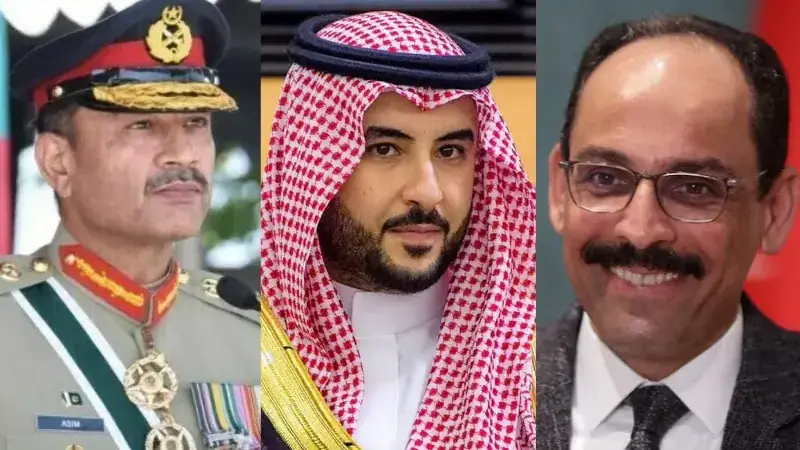
Senior officials from Saudi Arabia, Pakistan and Turkiye travelled to Tehran on Monday for talks aimed at lowering tensions in the Middle East. Makkah pact Tehran visit plans were confirmed by Iranian state media and a Saudi official, with meetings scheduled with Iran’s president and security chief.
Iran’s state-run IRNA news agency quoted Ali Bagheri Kani, deputy secretary of Iran’s top security body, as saying the visit was part of efforts to implement the idea of endogenous security in West Asia. That phrase, in Tehran’s usage, means security built by regional states themselves rather than imposed from outside.
Kani told state television that the visiting dignitaries would include Saudi Defence Minister Prince Khalid bin Salman, Turkish intelligence chief Ibrahim Kalin, and Pakistan’s Chief of Defence Forces and Chief of Army Staff, Field Marshal Asim Munir. In Pakistan, the military’s media affairs wing confirmed that Munir was visiting Tehran, but shared no further details.
Iran’s foreign ministry spokesperson, Esmaeil Baqaei, said at a media briefing that the meeting would cover the most pressing issues threatening the region, including Israel’s expansionist policies and developments in Palestine and Lebanon. He added that the top priority on the agenda would be the consequences of the United States-Israeli aggression against Iran and its ramifications for the entire region.
Makkah pact Tehran visit and the de-escalation agenda
Saudi Deputy Minister for Public Diplomacy Rayed Krimly also confirmed the visit in a post on X. He said officials from the three Makkah Defence Alliance members would hold meetings with Iranian President Masoud Pezeshkian and security chief Mohsen Rezaei.
Krimly described the visit as part of continued efforts by the alliance members for de-escalation between parties involved in the ongoing crisis, and for promoting dialogue and diplomatic solutions, in support of mediation efforts carried out by Qatar and Pakistan.
Monday’s talks would be the first high-level contact between Iran and all members of the Makkah Defence Alliance since Saudi Arabia was drawn deeper into the conflict. Under the Makkah Joint Defence Agreement, signed in August, an armed attack on one member is considered an attack on all. That clause gives the alliance real weight, and it also raises the stakes of any miscalculation in the region.
The visit comes as attacks by the Houthis have spiralled over recent weeks and rhetoric between Washington and Tehran has grown more heated. War has engulfed the Middle East since late February, when the United States and Israel launched a wave of surprise attacks on Iran, just as Washington and Tehran were in the middle of negotiations on Iran’s nuclear programme.
An April ceasefire brought an end to the initial phase of intense bombardment, but the two sides have continued to vie for control of the Strait of Hormuz, through which around a fifth of the world’s oil and liquefied natural gas travels. Iran claims control over the strait and regularly targets vessels that attempt to cross without its authorisation, while the United States has imposed a naval counter-blockade on Iranian ports.
Why Pakistan’s presence in Tehran matters
For Pakistan, the visit carries a direct interest. The country sits between the Gulf, Iran and the wider region, and any widening of the conflict would hit Pakistan through energy prices, trade routes and security pressures at home.
The visit also follows a recent precedent. Munir visited Iran last week as well. During that visit, Iranian leaders conveyed that the United States must take the first steps to rebuild trust, and that acceptance of Tehran’s seven-point proposal could provide a starting point for renewed negotiations. According to Iran’s ISNA news agency, Baqaei said the suggestion for the current meeting was made during Munir’s visit last week, and Tehran reviewed the proposal favourably.
Diplomatic efforts to resolve the crisis remain stalled since the collapse of a June deal which laid out a pathway to a permanent settlement.
That test is the real measure of Monday’s visit. If the meetings produce a shared line on de-escalation, or a date for further talks, the trip will have done useful work. Pakistan’s own recent diplomacy in the region, including Dar’s review of CPEC progress with China’s envoy, shows the same pattern: meetings set the agenda, and follow-up decides whether anything changes.