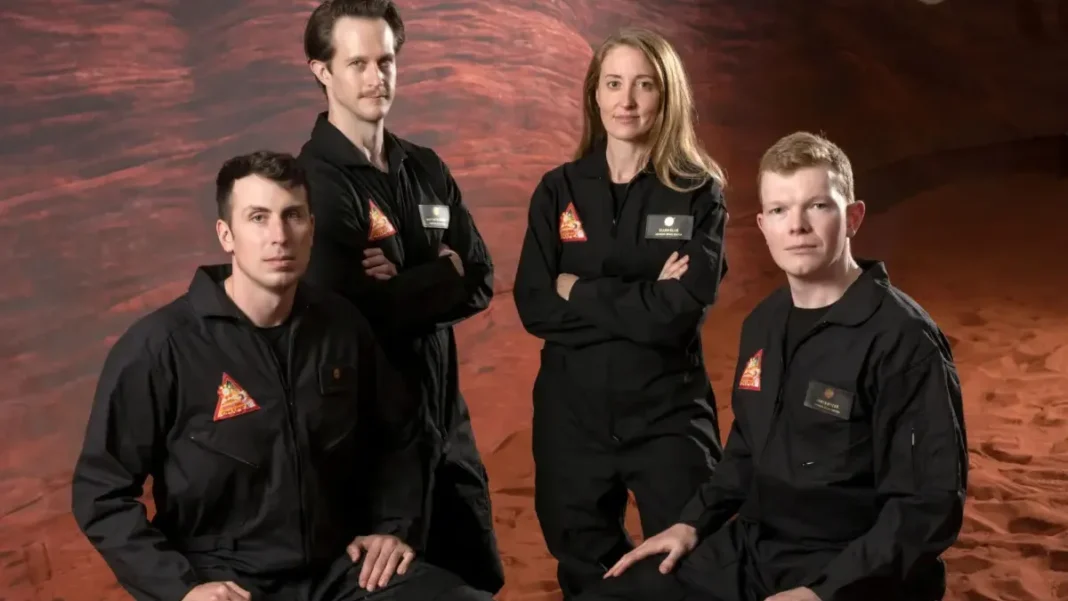
NASA Mars Simulation Crew Emerges After 378 Days
Four volunteers have walked out of a simulated Mars base in Houston after 378 days sealed inside, closing NASA’s second year-long test of how people cope with life on a distant planet. The crew left the 3D-printed habitat at the Johnson Space Center on Saturday, ending a mission that began on 19 October 2025.
They spent more than a year growing food, running daily mission operations and living with the kind of message delays a real Mars crew would face. NASA plans to use what it learns from the mission, called CHAPEA, to prepare for a human trip to Mars, possibly in the 2030s. Before that, the agency wants to return astronauts to the Moon for the first time since 1972.
What the NASA Mars simulation tested
The habitat covers 158 square metres, about 1,700 square feet, and holds living quarters, work areas and a simulated Martian landscape. Inside, the crew grew crops in simulated Martian soil and handled the daily routines of a Mars outpost, from maintaining the habitat to managing supplies with limited resources.
Messages between the crew and mission control carried built-in delays, recreating the lag of interplanetary communication. That forced the crew to plan ahead, solve problems on their own and wait for replies instead of getting instant guidance. Johnson Space Center director Vanessa Wyche, who greeted the crew when they emerged, said those delays demand patience, careful planning and greater independence, qualities she called essential for astronauts travelling millions of miles from home.
The crew was made up of mission commander Ross Elder, science officer Matthew Montgomery, flight engineer James Spicer and medical officer Ellen Ellis. Ellis described the year as a demanding one, lived in confinement by choice. Elder said the risks of a Mars trip are great, but with vision, hard work and strong foundations, putting humans on Mars is achievable and even inevitable.
Why a second mission matters
This was NASA’s second CHAPEA mission. The first four-person crew spent 378 days in isolation at the same Houston site between 2023 and 2024. Running the same length of mission twice gives NASA something a single test cannot: a comparison. Scientists can check whether different crews handle the same routines, food limits and isolation in similar ways, and which problems show up again and again.
That matters because a real Mars mission would keep astronauts away from Earth far longer than a trip to the Moon. Food, health, teamwork and daily routine all have to hold up for the whole journey, not just the first few months. A year-long simulation on Earth is the closest NASA can come to testing that without leaving the planet.
The crew will now spend two weeks in post-mission evaluations and debriefing with NASA scientists. Researchers will study their health, their performance and how they adapted to the routines and demands of daily life in a sealed habitat. Wyche said the lessons from the crew will help pave the way for missions first to the Moon and, one day, to Mars.
What happens next
NASA has explored Mars with robotic rovers and orbiting spacecraft, but sending people there is a different challenge. The agency’s plan puts a return to the Moon first, with a human Mars mission to follow in the 2030s. Ellis used her remarks after emerging to urge the United States to hold on to its lead in space, arguing for science that benefits the economy and leaves a legacy for future generations.
What is CHAPEA?
CHAPEA stands for Crew Health and Performance Exploration Analog. It is NASA’s programme of year-long simulated Mars missions inside a 3D-printed habitat at the Johnson Space Center in Houston.
Who were the four crew members?
Mission commander Ross Elder, science officer Matthew Montgomery, flight engineer James Spicer and medical officer Ellen Ellis made up the second CHAPEA crew.
How long did the mission last?
The crew entered the habitat on 19 October 2025 and emerged after 378 days, the same length as the first CHAPEA mission in 2023 and 2024.
What did the crew do inside the habitat?
They grew crops in simulated Martian soil, ran daily mission operations, maintained the habitat with limited resources and communicated with mission control through built-in message delays.
When could NASA send astronauts to Mars?
NASA has ambitions for a human mission to Mars as early as the 2030s, with a return of astronauts to the Moon planned before that.