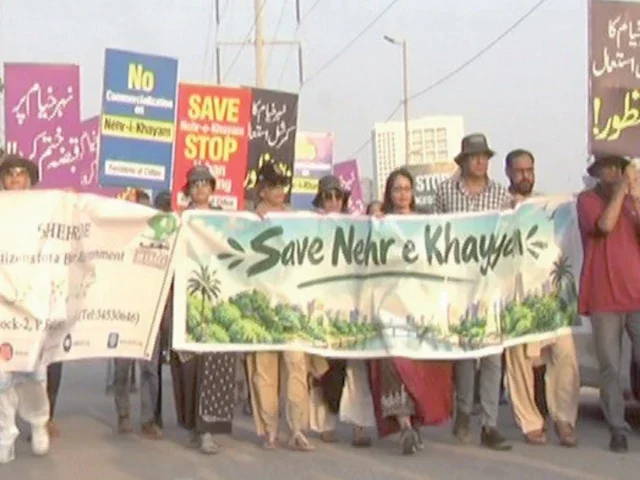
Residents of Clifton Block 5 in Karachi have raised fresh alarm over construction along Nehr-e-Khayyam, saying the waterway has been narrowed sharply. Nehr-e-Khayyam narrowing Karachi residents warn has cut the channel from its original width of 120 feet to about 50 to 60 feet.
The residents were joined by environmentalists, architects, engineers and public representatives. They inspected the waterway for the third consecutive Sunday, and raised concerns over ongoing construction, newly erected barricades and the channel’s drainage capacity.
Nehr-e-Khayyam narrowing Karachi: what residents found
During the resident-led inspection, participants documented the installation of three to four rows of concrete box drains, each measuring three metres. Residents said those drains had narrowed the waterway from 120 feet to roughly 50 to 60 feet.
The residents demanded the disclosure of project documents, engineering designs, environmental assessments and details of the approved scope of work. They also objected to proposed commercial activities, including shops and a food street, on Nehr-e-Khayyam land.
The third inspection in as many Sundays matters. It shows a sustained local campaign, not a single protest. Residents have returned week after week to record the same site, and their demands have stayed the same: show the documents, explain the design, and consult the people who live beside the channel.
Engineering and environmental concerns
Climate Action Centre representative Yasir Hussain said the project raised questions about legal compliance. He pointed to prior information for residents, environmental assessment, and disclosure of the project proponent and public-private partnership arrangements.
Hussain also questioned the absence of sewage treatment provisions and sought clarification on the engineering design. His point is simple: a covered drain system still has to handle sewage, storm water and waste, and residents have not seen the plan for any of it.
Leader of the Opposition in the Karachi Metropolitan Corporation City Council, Advocate Saifuddin, warned that sewage mixed with garbage could clog the concrete drainage system. That, he said, would create serious maintenance and sanitation problems.
Pakistan Maholiyati Tahaffuz Movement representative Ahmad Shabbar raised a further set of risks. He questioned the arrangements for sewage disposal beyond the Nehr, warning that without a clear plan, contaminated water could return to the channel during high tide.
Shabbar also sought details on sludge removal, waste management, possible methane accumulation and the possible heat-island effect linked to concrete covering. Boat Basin Food Street President Naeem Sajjad raised concerns about potential hazards from enclosing sewage in concrete drains.
A retired civil engineer associated with the Karachi Water and Sewerage Board stressed that the design must account for high tides, downstream water levels and their effects on gravity-driven discharge. In plain terms, a channel that drains by gravity fails when the sea pushes back, unless the design plans for that moment.
What residents want, and what is still missing
With construction continuing, residents urged the relevant authorities to disclose outstanding information, address engineering and environmental concerns, and ensure meaningful public consultation.
One gap in the public record deserves plain statement. The report of the inspection names no project proponent and quotes no official response. Residents’ width figures, from 120 feet to 50 to 60 feet, are their own observations, not official measurements. Until the authorities publish the approved designs and assessments, the dispute will rest on residents’ measurements against an unpublished plan.
That gap is itself the residents’ central complaint. They are not only asking for a wider channel. They are asking to see the documents that would show whether the narrower channel can safely carry sewage, storm water and high-tide flows.
What happens next
Residents have not announced their next step beyond continued inspections and public pressure. The authorities have not, in the reported account, answered the demand for documents.
The test for the weeks ahead is straightforward: will the project documents, designs and environmental assessments be made public, and will the design be shown to handle high tides, sludge and sewage without clogging? Until then, Clifton residents say they will keep returning to the site each Sunday.
What is Nehr-e-Khayyam?
It is a waterway in Clifton, Karachi, beside which Block 5 residents live, and which carries drainage through the area.
How much do residents say it has narrowed?
From an original width of 120 feet to about 50 to 60 feet, after rows of concrete box drains were installed.
What documents are residents demanding?
Project documents, engineering designs, environmental assessments and details of the approved scope of work.