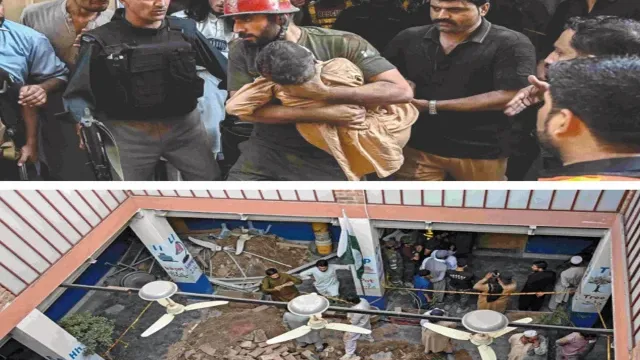
The Peshawar school collapse has exposed safety gaps across Khyber-Pakhtunkhwa, after residents said warnings about the dilapidated condition of a private school in Peshawar’s Dir Colony were repeatedly ignored before the building collapsed and killed more than 30 children.
Tahir Khan pulled several children alive from the rubble, but he could not save his two nephews and a niece. He demanded the strictest possible punishment for those responsible, and criticised the school management for what he described as negligence. Police have arrested the school owner, and an investigation is under way.
Shahab Khan, a resident of Dir Colony, said local residents had repeatedly approached the school principal to warn that the building was in a dilapidated condition and could collapse at any time. He alleged that their concerns were not taken seriously. That claim, if confirmed by the investigation, turns a single building failure into a failure of warning systems.
The Peshawar school collapse and the province-wide data
The collapse has brought renewed attention to school infrastructure across the province. According to a report on public-sector schools in Khyber-Pakhtunkhwa, 36,967 classrooms are in a dilapidated state. The province has 34,784 government schools, of which 19,284 classrooms require reconstruction, while another 17,743 need repairs.
Those figures describe government schools, but the Dir Colony tragedy happened in a private school. That gap matters. The Elementary and Secondary Education Department has issued directives to suspend teaching in dilapidated schools, yet the order only helps if someone checks which buildings are dilapidated and enforces the suspension.
The private sector is harder to monitor still. According to the available report, no records are available for 11,542 private schools in Khyber-Pakhtunkhwa. Irshad Jadoon, administrative officer at the Private Schools Regulatory Authority, told The Express Tribune that more than 12,000 private schools operate in the province, while the authority has a staff of only 45 people.
A regulator with 45 staff for 12,000 schools
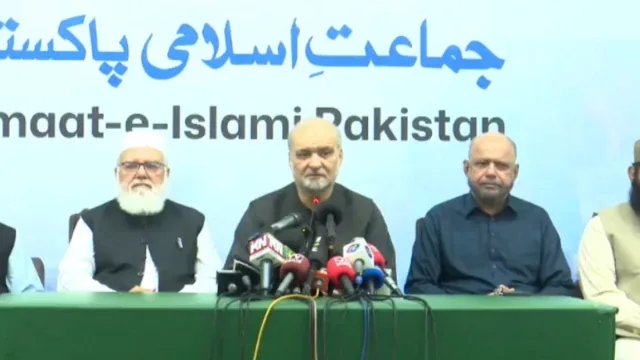
Jadoon said the limited workforce made it extremely difficult to monitor private schools across the province and ensure compliance with safety and regulatory requirements. He called for a Private Schools Regulatory Authority sub-office in every district, so complaints about school buildings and their management could be handled closer to where they arise.
The arithmetic is stark. With 45 staff for more than 12,000 schools, each officer would need to cover roughly 270 schools, across districts separated by mountains and long road journeys. A decentralised system would not fix unsafe buildings on its own, but it would shorten the distance between a resident’s warning and an official visit. In Dir Colony, residents say that distance proved fatal.
The problem is not confined to one province either. Sindh has closed unsafe school buildings, Rawalpindi has sealed schools after safety inspections, and Khyber-Pakhtunkhwa itself has run identification drives for unsafe school buildings. The pattern across these drives is the same: the unsafe buildings are found only after an inspection, and inspections only happen when staff and records exist to support them.
What happens next for the Peshawar school collapse case
The investigation into the Dir Colony collapse will test the residents’ account directly. Investigators will need to establish who was warned, when, and what action followed. The arrest of the school owner is a first step, but accountability that stops at one owner would leave the monitoring gap untouched.
Three measures would address the gap the Tribune report exposes. The first is a complete register of private schools, closing the 11,542-school record gap. The second is district-level regulatory offices with staff to act on complaints. The third is a public list of schools ordered to suspend teaching, so parents can check a building’s status before they send a child through its gate.
For families in Dir Colony, none of that can undo what happened. The deaths of the children have intensified calls for accountability, effective regulation and urgent action to ensure that schools remain safe places for learning rather than sites of preventable tragedy. The province-wide figures show that Dir Colony is not an isolated warning. It is a warning about a system that already knows how many of its classrooms are unsafe.
Source reporting: The Express Tribune.
Related coverage: Feature Pakistan has reported on the Peshawar school collapse inquiry report, the Peshawar High Court seeking a government response to school collapse petitions, the Khyber-Pakhtunkhwa school buildings safety audit after the collapse and Rawalpindi’s safety inspections of 8,300 schools.
What do residents say was warned about the Peshawar school?
Residents of Dir Colony say they repeatedly warned the school principal that the building was dilapidated and could collapse at any time, but their concerns were not taken seriously.
How many Khyber-Pakhtunkhwa classrooms need work?
A report on public-sector schools puts 36,967 classrooms in a dilapidated state, with 19,284 needing reconstruction and 17,743 needing repairs.
Why is private school monitoring so difficult in the province?
More than 12,000 private schools operate in Khyber-Pakhtunkhwa, no records exist for 11,542 of them, and the Private Schools Regulatory Authority has only 45 staff.