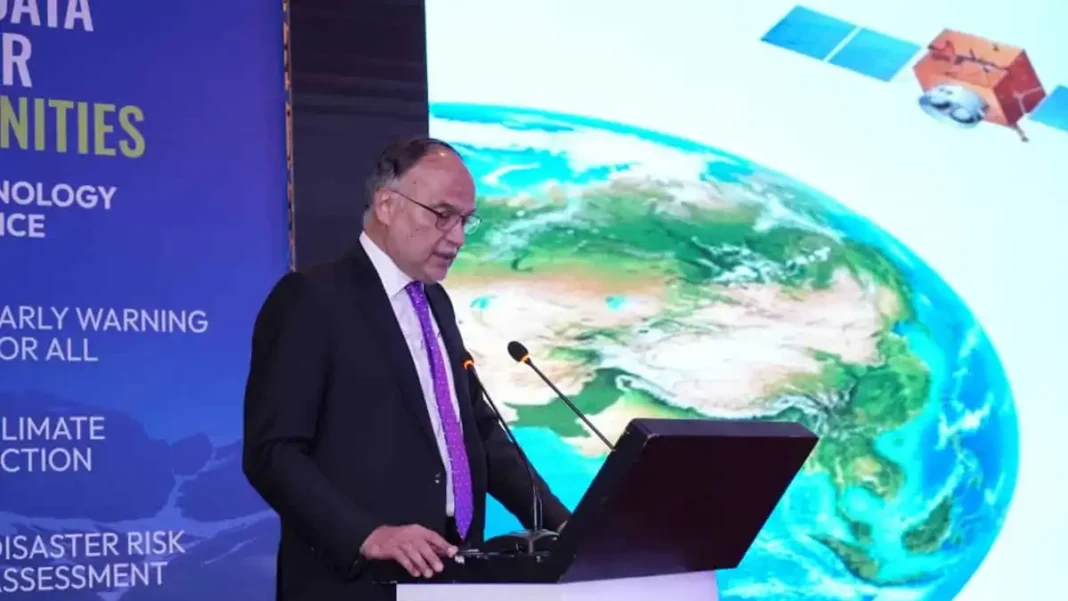
Planning Minister Ahsan Iqbal has confirmed that Pakistan is preparing to send its first astronaut into space. The Pakistan first space mission was confirmed at an international conference in Islamabad on October 27, organised in collaboration with the United Nations Office for Outer Space Affairs.
Iqbal said Pakistan had successfully launched five satellites over the past 18 months. He said space technology was essential for protecting vulnerable communities from climate change and natural disasters, including floods, cyclones and glacial melting.
The confirmation is a follow-up to earlier reporting on the mission. Feature Pakistan reported on October 18 that the first Pakistani astronaut was set to undertake a space mission from China, in First Pakistani astronaut to fly from China on November 25. Tuesday’s statement did not name an astronaut or give a new launch date, and this article does not add either.
Pakistan first space mission: what Iqbal confirmed
The minister’s point was broader than a single flight. He presented space technology as a tool for disaster preparedness, not only as a prestige project.
Satellite data and early warning systems, he said, could help reduce casualties and economic losses by improving how Pakistan prepares for disasters. That argument connects the astronaut mission to everyday risks: floods that displace families, cyclones that threaten coasts, and glacial melting that affects river flows.
The confirmation came at the same day’s SUPARCO conference, reported in SUPARCO opens space technology conference in Islamabad.
Satellites, floods and climate finance
Iqbal referred to the devastating floods of 2022 and 2025. He said Pakistan had suffered economic losses exceeding $30 billion from those floods, despite contributing less than one percent of global greenhouse gas emissions.
He criticised international partners and financial institutions for failing to provide adequate new grant financing for reconstruction. Repurposing previously approved loans for education and health, he said, was inconsistent with climate justice.
He called for reforms to the international financial system. Developed countries and financial institutions, he said, should provide grant-based assistance to vulnerable nations rather than adding to their debt.
That criticism is the political core of the speech. Pakistan’s case, as Iqbal put it, is that countries hit hardest by climate change did least to cause it, and should not have to borrow to rebuild from its effects.
What space data would change
The minister stressed the need to incorporate satellite data into development planning. Roads, bridges and hospitals, he said, should be planned with that data in view, so infrastructure is built for the risks it will actually face.
He also called for better information-sharing among government institutions. Space data helps only if the institutions that need it can use it, and if it reaches planners before disasters rather than after them.
Investment in space-related skills was another theme. Iqbal urged more opportunities for young people, especially women, in space science and geospatial technologies. A space programme that trains only a small circle of specialists will not build the workforce the country needs.
Regional cooperation was the final theme. He urged cooperation to improve disaster preparedness and the exchange of information on shared rivers, mountain systems and climate risks. Floods and glacial melt do not respect borders, and neither does the data needed to predict them.
What is still unknown
Tuesday’s confirmation leaves the key details open. No astronaut was named in the ProPakistani report, and no launch date was given in it.
That gap matters for readers. The earlier October 18 report carried a November 25 target and a China connection. Tuesday’s statement confirms the mission is being prepared, but it does not, on its own, confirm a name or a date.
Until an official announcement names the astronaut and sets the flight, those details should be treated as previously reported, not as newly confirmed. The confirmed news on Tuesday is the minister’s statement, the five satellites launched in 18 months, and the climate-finance argument that framed it.
Source: ProPakistani, “Ahsan Iqbal Confirms Pakistan’s First Space Mission”, published 27 October 2026 (21:05 PKT), https://propakistani.pk/2026/10/27/ahsan-iqbal-confirms-pakistans-first-space-mission/
Frequently asked questions
What did Ahsan Iqbal confirm on October 27?
He confirmed that Pakistan is preparing to send its first astronaut into space, speaking at an international conference in Islamabad organised with the United Nations Office for Outer Space Affairs.