Pakistan is preparing a $2.25 billion lithium battery plant in Rawalpindi, with production expected to begin within six to eight months of the government approving a policy for the sector, ProPakistani reported, citing Arab News.
The factory will be owned by Margalla Heavy Industries Limited, a military-owned company based at Heavy Industries Taxila in Rawalpindi district. The company already makes defence equipment, including battle tanks, armoured vehicles, unmanned drones and protective gear, as well as compact battery energy storage systems and electric buses and two-wheelers.
Hamad Ali Mansoor, chief executive of the Engineering Development Board, told Arab News that the building is ready and the machines are installed. “The building is ready, the machines are installed, so after the policy comes, the production will start within six to eight months,” he said. “They are investing $2.25 billion in Pakistan.”
What the lithium battery plant will make first
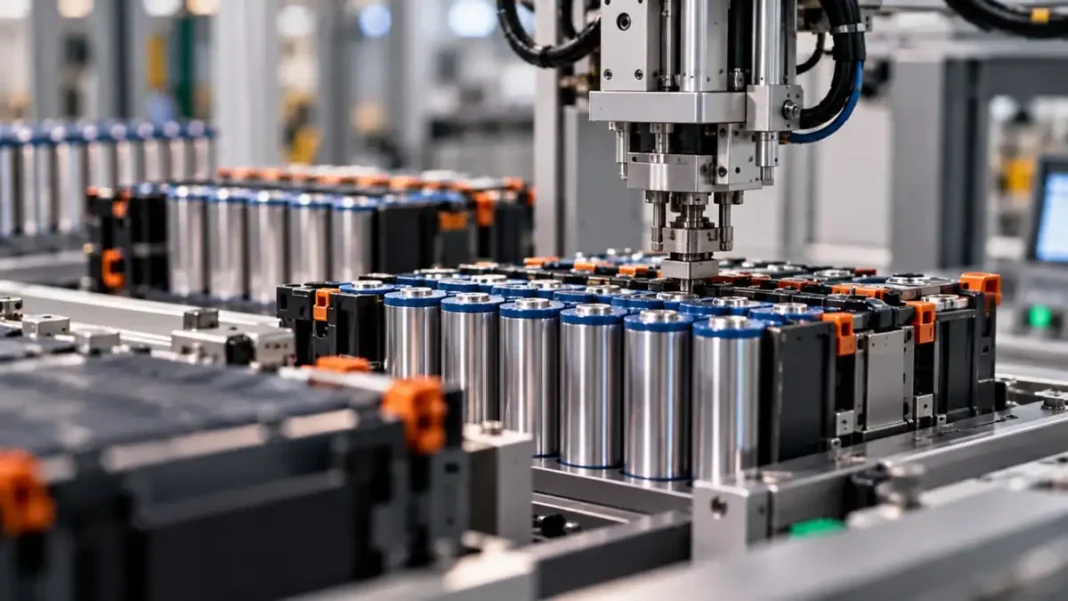
The project was signed in July with a Chinese company that Mansoor described as one of China’s top-tier manufacturers, alongside a local private-sector investor. He would not name either investor for now. The factory will manufacture lithium-ion cells, starting at 200 to 300 megawatts of capacity before rising to its planned annual capacity of more than 1,000 megawatts.
Feasibility studies for the project are complete, Mansoor said. Arab News reached out to Margalla Heavy Industries general manager for digital media Muhammad Ameen for comment, but he was not immediately available.
The government has prepared a lithium battery manufacturing policy and submitted it to the Ministry of Industries in March. It is still awaiting approval. The plan covers four major factories: three in Punjab’s Lahore, Faisalabad and Rawalpindi divisions, and one in Karachi. Under the proposed policy, manufacturers would have to export a specified share of their production, though Mansoor declined to disclose the target before approval. He said the framework includes international safety and performance standards.
Why Pakistan wants its own battery factories
Lithium-ion batteries sit at the centre of two shifts in Pakistan: storing electricity from solar and wind power, and powering electric vehicles. At present, Pakistan assembles around 3,000 to 4,000 megawatts of batteries and related parts, including motors, controllers and chargers, but it still depends on imports for much of the technology. Mansoor said the government wants those parts to be manufactured fully in Pakistan by next year.
That goal connects directly to plans readers have already seen on Feature Pakistan. The government plans electric vehicle fast chargers every 50 kilometres on major highways by 2030, with around 3,000 stations in total. Chargers need batteries, and batteries made in Taxila would cut the import bill for the same charging network. Local electric models are also arriving, including the Nora NEO and Metro quadricycles aimed at city commuters and the Millat-XDAO electric motorcycle localisation deal. A domestic cell factory would supply all three kinds of vehicles instead of leaving each one dependent on imported packs.
The demand figures behind the plan are large, and they depend on how fast the economy grows. The Engineering Development Board estimates that demand for battery energy storage systems could reach 100,000 megawatts by June 2030 if the economy grows by 5 percent or more. If growth falls below 3 percent, demand would reach around 80,000 megawatts instead. That demand would come from households, commercial buildings, industry and electric vehicles, from two-wheelers to buses and trucks. Grid stabilisation alone could need 3,000 to 5,000 megawatts of storage, and meeting total demand could require four to five gigafactories, each costing around $1 billion to $1.25 billion.
What still has to happen before production starts
Two approvals stand between the Taxila factory and its first production run. The first is the lithium battery manufacturing policy itself, submitted in March and still awaiting approval. The second is the wider Automotive and Auto Parts Manufacturing Policy for 2026 to 2031, which Prime Minister Shehbaz Sharif has approved but which still awaits International Monetary Fund approval over proposed tax incentives and their effect on government revenue. The Engineering Development Board expects that auto policy to support demand for battery storage as Pakistan shifts from imported fuel towards electric mobility.