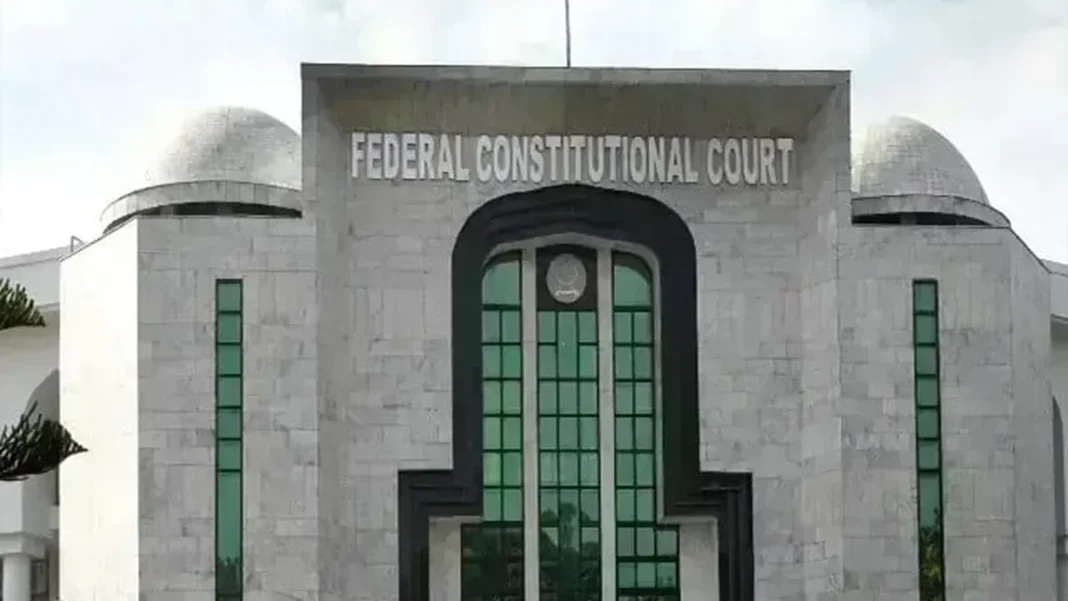
FCC Warns Executive Over Ignored Court Orders
FCC sacked employees orders must be followed in letter and spirit, the Federal Constitutional Court has ruled, warning the executive that compliance with a judicial decision is a constitutional requirement, not a matter of courtesy.
“To disregard or to delay in implementation of [a court] verdict amounts to challenging the very framework of the legal system,” said a 10-page judgement authored by Justice Ali Baqar Najafi. Justice Najafi was part of a three-member bench led by Chief Justice Amin-Ud-Din Khan, which heard a case about the implementation of a Supreme Court judgement in a sacked employees’ case.
The order stated that non-compliance disturbs the balance between the court’s prestige and the enforcement of rights, and sets a dangerous precedent that could lead to executive overreach. If decisions can be easily ignored, public trust in the judiciary and the government is seriously undermined, the court said.
“Consequently, the erosion of trust in the judicial system may undermine the democratic system,” the order added.
FCC sacked employees: what the court ordered
The case goes back to December 2021, when the Supreme Court, exercising suo motu jurisdiction, restored thousands of government workers. Those workers had been sacked through the court’s earlier August 17 judgement, which struck down the Sacked Employees (Reinstatement) Ordinance Act 2010.
The Federal Constitutional Court asked whether the December 17, 2021 order was implemented in letter and spirit. It also questioned whether non-implementation of the order amounted to contempt of court.
Disposing of the listed cases, the court directed government authorities to comply with the detailed judgement in the sacked employees’ case in letter and spirit, and to consider the petitioners as unconditionally and regularly appointed beneficiary employees.
The court held that conditions imposed on the beneficiary employees had been waived or diluted by the respondent departments due to the passage of time and their own lethargy, not any fault of the petitioners. It marked its concern, while exercising restraint at this stage rather than acting on its own motion.
The court noted that in a constitutional democracy, the rule of law is the foundation on which the legitimacy and good governance of any system of government rests. “The Supreme Court of Pakistan and, after the 27th amendment, this [FCC] being the apex court of the country is entrusted with performing the responsibility of interpreting the law, ensuring justice and upholding the Constitution of Islamic Republic of Pakistan,” the order said.
Orders of the Supreme Court, as the then apex court, are not merely recommendations or advisories but a legal mandate that must be followed, the court said.
A wider warning on unimplemented orders
The judgement lands at a sensitive moment for the new apex court. Some legal experts believe that after the 27th Constitutional Amendment, the biggest challenge for the superior courts is to establish their judicial authority, while the executive now has a dominant role in appointing judges.
A second unimplemented order drew the court’s attention. In May last year, the Supreme Court ordered legislation giving a right of appeal to civilians convicted by military courts in the May 9, 2023 cases. That order is yet to be implemented.
Both courts are silent on the non-implementation of the order in the military courts case, the report noted. Dozens of PTI activists convicted by military courts remain behind bars while waiting for legislation that would let them appeal.
That contrast is the heart of the judgement’s warning. The sacked employees’ order gives thousands of workers the regular appointments promised in 2021. Whether the warning changes how the executive treats court orders more broadly will be tested by the next order that proves inconvenient to implement.
Frequently asked questions
What did the Federal Constitutional Court rule?
The court directed government authorities to comply with the Supreme Court’s sacked employees’ judgement in letter and spirit, treating the petitioners as unconditionally and regularly appointed employees.
Who wrote the judgement?
Justice Ali Baqar Najafi authored the 10-page judgement, as part of a three-member bench led by Chief Justice Amin-Ud-Din Khan.
What did the Supreme Court decide in December 2021?
The Supreme Court restored thousands of government workers who had been sacked after its August 17 judgement struck down the Sacked Employees (Reinstatement) Ordinance Act 2010.