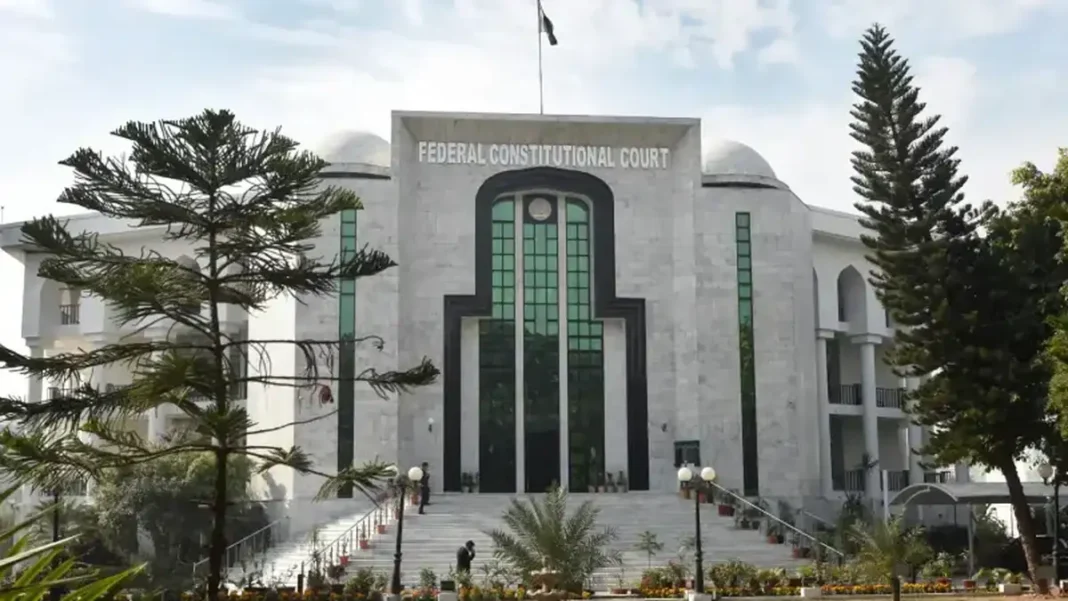
The FCC state land ruling on Monday rejected a claim to private ownership of protected agricultural land in Pakpattan. The Federal Constitutional Court held that state property held by public functionaries in trust for the community cannot be alienated, except under the law.
Chief Justice Aminuddin Khan gave the ruling. He headed a two-judge bench that also included Justice Ali Baqar Najafi. The bench took up a challenge by the member (colonies) of the Punjab Board of Revenue against a 2016 Lahore High Court decision, which had favoured the respondent, Rasheeda Bibi, who has since died.
The land and the lease at the centre of the case
The respondent had been leased 49 acres, 5 kanals and 13 marlas of agricultural land in Chak No. 2/KB, Pakpattan. The lease came under the Temporary Cultivation Lease Scheme and ran from Kharif 1968 to Rabi 1978, with extensions granted periodically.
Later, the respondents sought proprietary rights under a government notification dated September 3, 1979. That application was rejected on May 14, 2001, because the land fell within a prohibited zone.
After appeals and remands, the Pakpattan executive district officer (revenue) accepted the claim in 2008 and directed a challan for deposit of the land price. That order was later reviewed with the permission of the member (colonies) of the Board of Revenue, and the claim was rejected on August 24, 2011.
The Lahore High Court subsequently set aside that rejection. The Board of Revenue then appealed to the Federal Constitutional Court.
The two questions before the court
During the hearing, the court framed two questions for determination. The first was whether the land in dispute could be given proprietary rights under the policy notification of September 3, 1979. The second was whether the executive district officer (revenue) was competent to review the October 28, 2008 order.
Justice Aminuddin observed that rules of pleadings, though essential to procedural fairness, cannot be invoked to perpetuate an illegality that results in unauthorised divestment of state property. He added that courts must act on any established legal impediment apparent from the record, so public property is not alienated through administrative error, omission or acquiescence, contrary to law.
The court ruled that a temporary cultivation lease conferred no vested or indefeasible right to proprietary title. The respondents’ entitlement remained subject to the conditions of the September 1979 notification, in particular the prohibition relating to land falling within the prohibited zone.
Likewise, the successor revenue officer was competent, subject to the statutory requirements and prior sanction under section 163 of the Punjab Land Revenue Act, 1967, to review an order of his predecessor, the Chief Justice observed.
Why the FCC state land ruling matters
The judge noted that the controversy had to be decided under the governing law and policy, rather than on the basis of prolonged possession, extension of lease or payment of government dues.
That distinction is the heart of the ruling. A temporary cultivation lease merely permits possession and cultivation without affecting state title, while proprietary title results in permanent divestment of public property. The respondents’ reliance on the original lease was therefore misconceived, the judgement said, as it set aside the Lahore High Court order.
For readers, the practical point is wider than one family’s claim. The ruling confirms that long occupation under a temporary lease, even with extensions and payments, does not by itself create ownership where the land sits in a prohibited zone. It also confirms that revenue officers can revisit a predecessor’s order when the law allows it.
The case adds to a busy period for the courts. Justice Kayani will head a single bench at the Lahore High Court Rawalpindi registry under the new November-December roster, and the Lahore High Court has disposed of a petition seeking the release of Imran Khan’s sisters after the government extended their detention. The National Assembly passed bills before a quorum count ended its sitting, while the Punjab Assembly session was adjourned after a quorum failure.
Frequently asked questions
What did the Federal Constitutional Court decide?
It rejected a proprietary rights claim on 49 acres, 5 kanals and 13 marlas of agricultural land in Chak No. 2/KB, Pakpattan, and set aside the Lahore High Court order that had favoured the claimants.