Democrats Widen Lead Before US Midterm Polls
Democrats have widened their lead in national polling with less than 24 hours to go before Americans vote in the midterm elections. The Call the Map polling average on Sunday showed Democrats ahead by 7.8 percentage points, raising hopes in the party that it could wrest control of Congress from Republicans.
President Donald Trump, however, remains defiant. He insists his party will win and surprise its critics, even as the polls point the other way.
A new Big Data Poll, conducted on October 30, put Democratic support at 52.3 per cent among likely voters, against 40 per cent for Republicans. Among registered voters, the figures stood at 51.2 per cent and 39.5 per cent. The same poll found Trump’s disapproval rating at 58.6 per cent among likely voters.
These are national measurements, and they do not predict individual state races. Control of Congress will be decided seat by seat.
US midterm polls: what Democrats need to win
The House of Representatives offers Democrats their clearest path to change control. They need a net gain of three seats to take the chamber. The Senate presents a harder challenge, requiring a gain of four seats to overcome the Republican majority.
Michigan, Ohio, Texas, Kansas and Alaska are among the Senate contests drawing particular attention. In Michigan, Democratic candidate Abdul El-Sayed is challenging Republican Mike Rogers in a race that could influence control of the Senate.
El-Sayed has also become the target of personal attacks by Trump, who has questioned his loyalty to the United States and invoked the September 11, 2001 attacks while discussing his Muslim identity. The attacks have drawn attention to the Michigan race well beyond the state itself.
Trump’s campaign appearances in Iowa and Kansas underline the importance Republicans attach to defending Senate seats in states he carried comfortably in 2024, but where Democratic candidates have become competitive. The pattern shows a contest fought on Republican ground as much as on Democratic ground.
For Democrats, the central campaign message has been the rising cost of living. Groceries, housing, healthcare and petrol have become major sources of voter frustration, while tariffs and the economic effects of the war with Iran have added to household anxieties.
Record early voting before Election Day
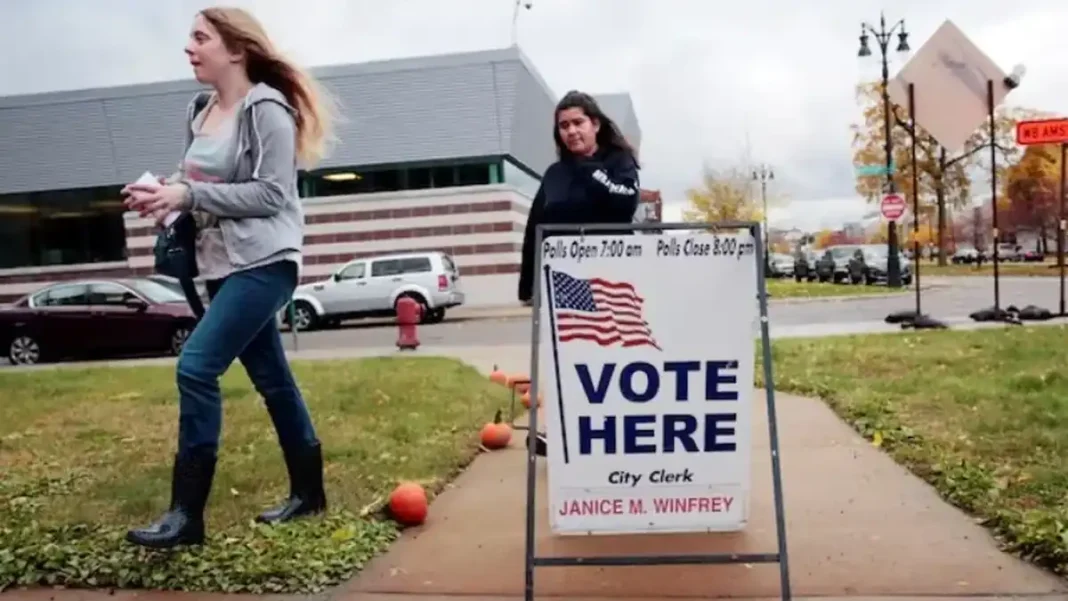
Millions of Americans have already cast ballots, with several states reporting record turnout as early in-person voting entered its final days. By Sunday afternoon, more than 53 million early votes had been cast nationally, including about 30 million in-person votes, according to the University of Florida Election Lab.
The total has already set a national midterm record, passing the previous high of 45.9 million set in 2022. Early voting was drawing to a close across much of the country on Sunday. New York, New Jersey, Michigan and Connecticut reached their final day of early voting, while California, Illinois and Arkansas allowed voters to cast ballots through Monday. Colorado and Hawaii were continuing early voting through Election Day on November 3.
Texas, California and Florida led the states in early voting, with 7,630,789, 5,504,307 and 5,148,276 ballots cast, respectively, according to the Election Lab’s latest figures. Georgia and North Carolina followed, with 2,823,265 and 2,612,250 votes.
Why the result matters beyond the United States
How far ahead are Democrats in national polls?
The Call the Map average put Democrats 7.8 points ahead, while a Big Data Poll on October 30 put them at 52.3 per cent among likely voters, against 40 per cent for Republicans.
How many Americans have voted early?
More than 53 million early votes had been cast by Sunday afternoon, including about 30 million in person, a national midterm record above the 45.9 million of 2022.
What do Democrats need to take Congress?
They need a net gain of three seats in the House of Representatives and four seats in the Senate.
When is Election Day?
Election Day is November 3, with early voting continuing through that day in Colorado and Hawaii, and through Monday in California, Illinois and Arkansas.
Do national polls predict who wins Congress?
No. National polls measure the overall vote, while control of Congress is decided in individual state and district races.