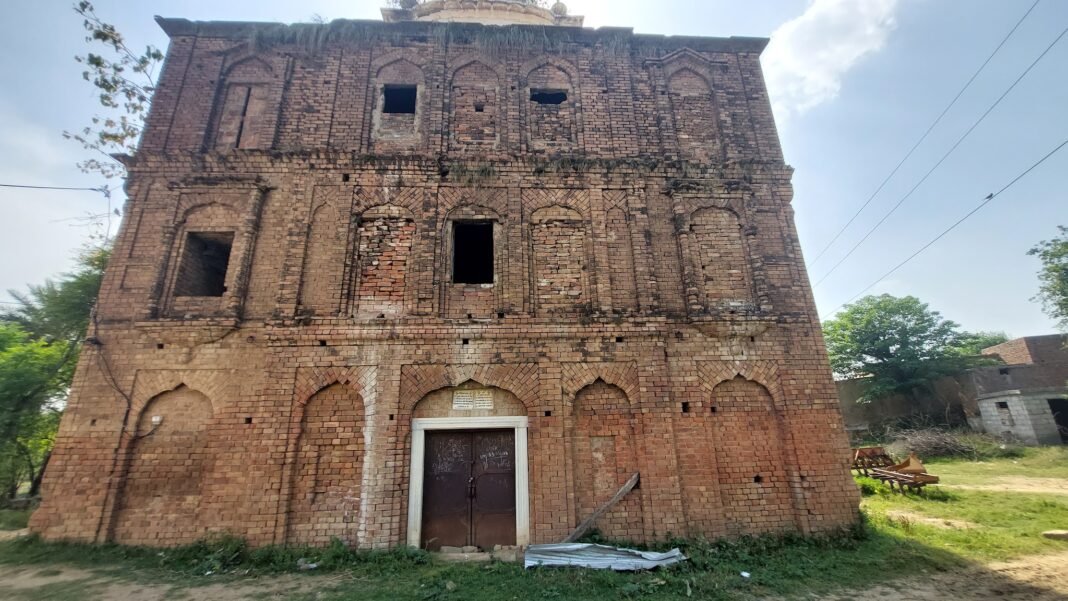
In a small village in the Potohar countryside, about fifty kilometres from Islamabad, stands a tall brick gurdwara that most Pakistanis have never heard of. For example, Kanoha Gurdwara is not a grand pilgrimage centre like Nankana Sahib or Panja Sahib. It is something quieter and, in its own way, more moving: a late-1930s Sikh house of worship whose walls still carry the names of the villagers who built it, standing in the village where the revered Sant Attar Singh is believed to have meditated in the 1890s. This Kanoha Gurdwara Rawalpindi travel guide explains why this forgotten monument deserves your visit. To go, and how to reach it.
Quick Facts
- Location: Village of Kanoha, near Kallar Syedan, Rawalpindi district, Punjab, about 50 km from Islamabad
- Altitude: Lowland Potohar plateau; no significant elevation
- Famous For: Late-1930s Sikh architecture, donor plaques in Gurmukhi, association with Sant Attar Singh’s meditation
- Nearest City: Rawalpindi/Islamabad, roughly an hour’s drive away
- Accessibility: Reachable by road from Rawalpindi via Kallar Syedan; the last stretch is a rural village road
- Known Landmarks: The three-storey gurdwara building with its dome, surrounding village and fields of the Potohar
- Best For: Heritage lovers, photographers, Sikh history enthusiasts and offbeat day-trippers from Islamabad
Why Visit Kanoha Gurdwara, Rawalpindi
Pakistan’s famous gurdwaras draw pilgrims from around the world. Also, Kanoha Gurdwara offers a different kind of encounter: an intimate, unvarnished meeting with history. In fact, there are no crowds here, no ticket counters, no souvenir shops. In addition, there is a tall brick building in a village, its plaster weathered, its iron doors closed. Its walls inscribed with the names of ordinary people, farmers, contractors and widows from Bewal, Choha Khalsa, Thamali and Gujar Khan. They gave a few rupees each in the 1930s to raise it.
For anyone interested in Sikh heritage, the building is a remarkably complete example of a rural gurdwara from the last decade of undivided Punjab: three storeys, entrances on all four sides, white marble door frames carved with flowers, blind arches in cut brick. Also, a dome rising from an octagonal interior. The anthropologist Zulfiqar Ali Kalhoro has documented it under the name Tapiana Sahib, Kanoha.
The spiritual layer is just as compelling. Sikh tradition holds that Sant Attar Singh Ji came to this area in 1894 and undertook prolonged meditation in the grove at Kanoha, first for forty days, then for six months, and finally for a full year, turning the spot into a centre of kirtan and langar that drew devotees from across the Rawalpindi district. Whether you come as a pilgrim or a curious traveller, standing where such discipline was practised is a humbling experience.
And then there is the village itself: the scattered houses, the wheat fields, the small brook nearby, the unhurried Potohar way of life. Kanoha is a reminder that heritage in Pakistan is not only in museums and famous shrines. It is living, breathing and waiting in villages like this one.
History of Kanoha Gurdwara, Rawalpindi
The deeper spiritual history of Kanoha begins in 1894, when Sant Attar Singh Ji arrived in Rawalpindi. According to the Kalgidhar Trust’s account of his life, he first meditated at Tapovan for some time, then met Sant Ram Singh Ji at Thamali. On Sant Ram Singh’s recommendation, a dense forest area called Kanohe di Jhangi, land belonging to Bhai Wazir Singh, was chosen as the site for prolonged, secluded meditation.
Three Periods of Intense Meditation
At Kanoha, Sant Attar Singh undertook three intense periods of meditation: first for forty days, then for six months, and finally for a full year. He spoke very little during these years, sustained by a small quantity of food served once daily by the devoted couple Bhai Wazir Singh and Mai Bhag Bhari. His prolonged discipline drew widespread attention: devotees from across the Rawalpindi district began flocking to the grove at Kanoha, where continuous Gurbani kirtan was rendered and Guru ka Langar was served. In a short time, his fame spread across the region.
Sant Attar Singh (1866-1927) would go on to become one of the most revered Sikh saints of the modern era.
The standing gurdwara building itself belongs to a later chapter. Also, plaques inside the building, inscribed in Gurmukhi, record that the current structure was constructed in the late 1930s, with dates corresponding to 1936-1938 AD (Nanak Shahi 467-469). The plaques name the donors who funded each part: marble door frames, iron gates, windows and walls, paid for by Sikh families from surrounding villages, in sums of twenty-five, fifty and a hundred rupees. It was a community-built gurdwara in the truest sense.
Architecturally, the building is a fine specimen of its period: constructed of standard-sized bricks in lime mortar, three storeys high and about ten metres tall, with entrances on all four sides, a multi-cusped arch, white marble door jambs with fine floral decoration. A facade of blind arches flanked by decorative cut-brick pillars. The exterior is square while the interior converts to an octagon to carry the dome. Also, Pakistan’s Directorate of Archaeology and Museums has documented it as a historic-period monument of the Rawalpindi district.
Top Things to Do in Kanoha Gurdwara, Rawalpindi
Study the Architecture
Walk slowly around the building and read it like a book. Also, the cut-brick pillars, the blind arches, the marble door frames with their floral carving and the iron doors set into them are all original 1930s craftsmanship. In fact, step back to take in the full three-storey height, and notice how the square exterior gives way to the octagonal interior beneath the dome, a classic solution for raising a dome on a square plan.
Read the Donor Plaques
The Gurmukhi plaques inside are the building’s most touching feature. Also, each records a name, a village and a sum: Harnam Kaur of Bewal, Santokh Singh of Thamali in memory of his father, Kirpal Singh of Gujar Khan in memory of his wife, Manjit Singh the contractor of Rawalpindi. In fact, together they are a census of a vanished community. A testament to how this gurdwara was raised, rupee by rupee, by the sangat itself.
Reflect at the Meditation Grove
The tradition of Sant Attar Singh’s meditation belongs to the grove at Kanoha rather than to the 1930s building. Also, the spiritual atmosphere of the place is real. Find a quiet spot near the trees and the small brook that flows nearby, and take a few minutes of silence. Pilgrims and meditators will understand why this secluded corner of the Potohar was chosen for prolonged simran.
Walk the Village
Kanoha is a small, scattered village with all the charm of the Potohar region. Also, a respectful walk through its lanes, past wheat fields and village houses, gives you the context the gurdwara belongs to. The building sits on low ground surrounded by houses, with only its top visible from the main road about 350 metres away, so exploring on foot is part of the discovery.
Photograph a Vanishing Heritage
The gurdwara is not a protected monument. Also, its plaster is falling, some windows are bricked up, and parts of the interior have deteriorated. Photographing it now is a form of documentation. The contrast of the weathered brick against the green fields makes for powerful images, especially in the soft light of morning and late afternoon.
Combine with Kallar Syedan’s Countryside
The area around Kallar Syedan is classic Potohar: rolling fields, small shrines and village life. Also, a slow drive through the countryside, with stops for tea at a roadside dhaba, turns the gurdwara visit into a full and satisfying day out from Islamabad.
Famous Places In and Around Kanoha Gurdwara, Rawalpindi
- Kallar Syedan: The nearest town, a typical Potohar market town and the reference point for reaching Kanoha.
- Gurdwara Panja Sahib, Hassanabdal: One of Sikhism’s most sacred shrines, a longer but natural extension for pilgrims.
- Rawalpindi’s Old City: Raja Bazaar and the surrounding old neighbourhoods, home to several historic gurdwaras and temples.
- Rohtas Fort: The great sixteenth-century fortress near Jhelum, combinable on a longer heritage circuit.
- Islamabad’s Margalla Hills: Trails and viewpoints for the drive back to the capital.
How to Reach Kanoha Gurdwara, Rawalpindi
Kanoha lies about 50 kilometres from Islamabad, near Kallar Syedan in Rawalpindi district. Also, from Islamabad, drive out via the Islamabad Expressway toward Rawat and continue toward Kallar Syedan on the rural road network. In fact, the journey takes roughly an hour to an hour and a half depending on traffic and the exact route. From Rawalpindi, head toward Kallar Syedan and ask locally for the village of Kanoha; villagers know the gurdwara well.
From Lahore, the distance is approximately 300 to 320 km: take the M-2 motorway to Islamabad/Rawalpindi (about four hours), then follow the route above. Also, from Karachi, fly to Islamabad (about two hours) and drive from there. The overland journey is well over 1,400 km and not practical for this trip.
The nearest airport is Islamabad International Airport. Also, from the airport, hire a car or take a ride-hailing service toward Kallar Syedan. In fact, the final approach to the village is on narrow rural roads. A small car is more practical than a large van. There is no public transport directly to the village. Having your own vehicle or a hired car with a driver who knows the area is strongly recommended.
Road conditions are paved but narrow on the rural stretches. The site is accessible year-round, though the unpaved village tracks are easiest in dry weather.
Route Details
From Islamabad: Take the Islamabad Expressway south toward Rawat. Also, continue on the road toward Kallar Syedan. In fact, From Kallar Syedan, ask for Kanoha village. The gurdwara is about 350 metres off the main road, visible by the top of its tall brick building above the houses. Total time: one to one and a half hours.
From Lahore: M-2 motorway to the Islamabad/Rawalpindi area (about four hours), then follow the Islamabad route above.
From Karachi: Fly to Islamabad, then follow the Islamabad route above.
Where to Stay in Kanoha Gurdwara, Rawalpindi
Kanoha is a day-trip destination; there is no accommodation in the village itself, and visitors stay in Rawalpindi or Islamabad. Also, both cities offer every tier: luxury five-star hotels, comfortable mid-range hotels and guesthouses, and budget options near the old city and main roads. In fact, for this trip, staying in Rawalpindi puts you closest to the Kallar Syedan road. Islamabad offers more choice and comfort.
If you are building a Sikh heritage circuit, consider basing yourself in Rawalpindi for a couple of nights: it gives you easy access to Kanoha, the old city’s historic gurdwaras and the road to Hassanabdal’s Panja Sahib. Book ahead on weekends, when Islamabad’s hotels fill with visitors from across the country.
Where to Eat: Local Foods of Kanoha Gurdwara, Rawalpindi
There are no restaurants in Kanoha village, so plan your meals around the journey. Also, the Potohar region’s country cooking is the cuisine of the area: saag with makai ki roti in winter, dal, desi chicken curries and fresh lassi at roadside dhabas. On the road to Kallar Syedan you will find dhabas serving karahi, BBQ, daal fry and hot chapati at budget-friendly prices.
For a fuller meal, eat in Rawalpindi or Islamabad before or after your visit. Also, Rawalpindi’s food streets and old-city eateries serve everything from nihari and paye to chapli kebabs. Islamabad’s restaurants cover every cuisine. Carry water and snacks for the village visit itself, as there are no shops at the site.
Weather in Kanoha Gurdwara, Rawalpindi
Kanoha shares the Potohar climate of the Rawalpindi region: hot summers, mild winters and pleasant spring and autumn seasons. The open fields around the village offer little shade, so sun protection matters for much of the year.
| Season | Temperature Range | Conditions |
|---|---|---|
| Winter (Dec-Feb) | Around 2-20°C | Mild days, chilly nights; occasional fog; comfortable for walking the village |
| Spring (Mar-May) | Around 12-32°C | Pleasant and green; wheat fields at their best; ideal visiting season |
| Summer (Jun-Aug) | Around 25-40°C | Hot; visit early morning or late afternoon; monsoon rains possible |
| Autumn (Sep-Nov) | Around 12-32°C | Clear skies and comfortable temperatures; excellent for photography |
Language and Culture of Kanoha Gurdwara, Rawalpindi
The language of the area is Punjabi in its Potohari dialect, with Urdu widely understood. Also, the village culture is warm and traditional. Visitors, especially those who show interest in the gurdwara, are usually welcomed with curiosity and kindness.
This is a Sikh religious site, so respectful conduct matters: dress modestly, cover your head if you enter the building (carry a scarf or handkerchief), remove your shoes before stepping inside, and keep your voice low. Do not climb on the structure or remove anything, including loose bricks or plaster; the building is unprotected and fragile. If you meet villagers, a greeting in Punjabi and a little patience go a long way, and asking permission before photographing people is essential.
Shopping in Kanoha Gurdwara, Rawalpindi
There is no shopping at the gurdwara or in the village. Also, for souvenirs and supplies, stop at Kallar Syedan’s bazaar for everyday goods. It do your shopping in Rawalpindi, where Raja Bazaar and the old city’s markets sell everything from traditional sweets and spices to textiles and handicrafts. Potohar’s roadside vendors also sell seasonal fruit, desi ghee and honey worth picking up on the drive.
Travel Tips for Kanoha Gurdwara, Rawalpindi
Packing Essentials
Bring a head covering, sun protection, water and snacks. Also, wear sturdy shoes for the village tracks, and carry a camera: the gurdwara and its plaques deserve careful documentation. In fact, a small notebook is useful for copying down the plaque inscriptions.
Safety Tips
Kanoha is a quiet, safe village, and day visits are straightforward. The old building is fragile, so do not climb stairs or floors that look unstable, and watch your step inside. Visit during daylight hours and let someone know your plans, as mobile coverage in the village can be patchy.
Money & Connectivity
Carry cash; there are no ATMs or card facilities in the village. Mobile signals from the major networks reach the area but can be inconsistent inside the village. Fuel up and withdraw cash in Rawalpindi or Islamabad before heading out.
Best Time to Visit Kanoha Gurdwara, Rawalpindi
Spring (March to May) — Best Overall
Spring is the finest season: green wheat fields, mild temperatures and clear light. Also, the village is at its most beautiful, and walking around the gurdwara is a pleasure.
Autumn (September to November) — Clear and Calm
Autumn brings clear skies and comfortable weather, with harvest activity in the fields adding life to the landscape. Also, an excellent time for photography.
Winter (December to February) — Quiet and Mild
Winter days are mild and the village is quiet. Morning fog can slow the drive from Islamabad, so travel after it lifts.
Summer (June to August) — Go Early
Summer heat makes midday visits uncomfortable, and monsoon rains can muddy the village tracks. If you visit in summer, go early in the morning.
Final Thoughts
Kanoha Gurdwara will not appear on any list of Pakistan’s famous monuments. That is exactly why it stays with you. It is a building raised by a village community in the last years before Partition, inscribed with their names, standing in the fields where a saint once meditated in silence. It asks for nothing except an hour of your time and a little respect.
Go in spring, when the wheat is green and the light is soft. Also, read the plaques, walk the village lanes, and sit quietly for a moment where Sant Attar Singh sat. Some places you visit for spectacle; Kanoha you visit for stillness. Find more of Pakistan’s overlooked heritage in our Explore Pakistan series.
FAQs
Where is Kanoha Gurdwara?
Kanoha Gurdwara is in the village of Kanoha, near Kallar Syedan in Rawalpindi district, Punjab, about 50 kilometres from Islamabad.
What is the best time to visit Kanoha Gurdwara?
Spring (March to May) is best, with green fields and mild weather. Autumn (September to November) is also excellent.
How do I reach Kanoha Gurdwara?
Drive from Islamabad or Rawalpindi toward Kallar Syedan (about one to one and a half hours), then ask locally for Kanoha village. A private car is recommended as there is no direct public transport.
Is Kanoha Gurdwara open to visitors?
It is an unprotected, unattended heritage building rather than an active managed shrine. Visitors can view it from outside and, where accessible, inside, but should treat it with care and respect.
What is the history of Kanoha Gurdwara?
Sikh tradition links the site to Sant Attar Singh’s prolonged meditation here in the 1890s. Also, the standing three-storey building was constructed by the local Sikh community in the late 1930s, as recorded on its donor plaques.
Is Kanoha Gurdwara suitable for families?
Yes, as a daytime heritage outing. The village is safe and the visit is short, but supervise children inside the old building and bring your own food and water.
Where can I stay near Kanoha Gurdwara?
There is no accommodation in the village. Also, stay in Rawalpindi or Islamabad, both roughly an hour to an hour and a half away by car.
What should I wear when visiting?
Dress modestly, carry a head covering for entering the building, and remove your shoes before stepping inside, in keeping with gurdwara etiquette.