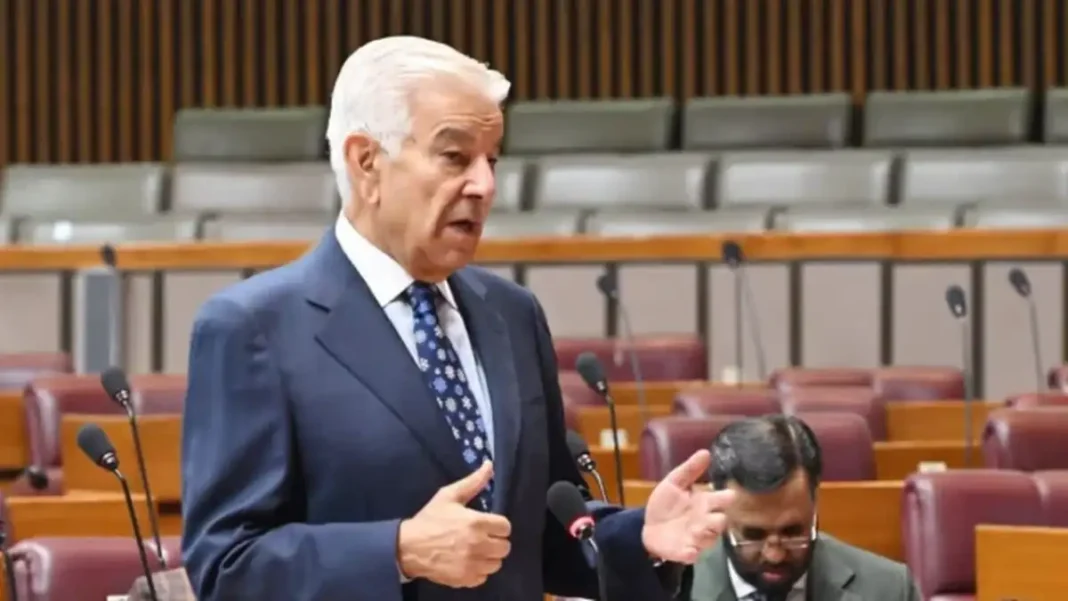
Tehran talks progress is the reading Defence Minister Khawaja Asif offered on Monday, after officials from the Makkah Defence Alliance met Iranian leaders in Tehran. Asif said the meeting appeared to have produced a conclusion that could help end the conflict between Saudi Arabia and the Houthis in Yemen.
Feature Pakistan reported that Iranian President Masoud Pezeshkian urged Islamic countries to stand together at the Tehran meeting, and that the four countries agreed to keep talking. Asif’s comments are the first reaction from a senior Pakistani minister to that outcome, and they add a Pakistani reading to a meeting that had so far been described mainly through Iranian statements.
What Tehran talks progress means, in Asif’s words
Asif said it seemed that some progress had taken place in Tehran, given the joint statement that followed the meeting. He said he believed the participants had arrived at a conclusion that will help close out the war, and he expressed hope that steps towards peace would follow the Iranian statement.
Asked whether the meeting was mainly about the wider United States-Iran war or about the Saudi-Houthi conflict, Asif said the talks were directed more at what is happening in Saudi Arabia. He added that the United States-Iran aspect would also have been discussed, and he noted the presence of the Saudi defence minister and the Turkish intelligence chief as significant.
The Tehran meeting brought together Iran, Pakistan, Saudi Arabia and Turkiye. Pakistan was represented by Field Marshal Asim Munir and Interior Minister Mohsin Naqvi, while Saudi Defence Minister Prince Khalid bin Salman and Turkiye’s intelligence chief Ibrahim Kalin attended for their countries.
Why Pakistan says defending Saudi Arabia is binding
Asif stressed that it remains binding on Pakistan to safeguard Saudi Arabia, especially as Houthi attacks have targeted Riyadh airport and the holy sites. He said Pakistan will defend Saudi Arabia with all of its might and capability, and he described the defence of Saudi Arabia as compulsory for Pakistan under the agreement, just as Pakistan’s own defence is indispensable.
Under the Makkah pact, signed in August, an armed attack on one member is considered an attack on all. Ministers from the pact countries held an emergency meeting in Riyadh earlier this month and agreed to ensure the rapid deployment of military forces and capabilities in Saudi Arabia. Egypt approved military support for Saudi Arabia after Houthi attacks escalated, which shows how the conflict has pulled in states beyond the pact itself.
Asif also addressed the question of whether Iran could bring the Houthis to the negotiating table or make them stop attacks on the kingdom. He said groups such as the Houthis operated as independent actors and did not necessarily require patronage. In a country where no state structure exists, he said, groups of this kind can operate in that manner.
Pakistan condemned Houthi attacks near Makkah and Madina earlier on October 26, and Makkah pact officials travelled to Tehran for de-escalation talks on the same day. Asif’s remarks link those two strands: condemnation of the attacks, and a diplomatic effort to stop them.
The wider war behind the meeting
Saudi Arabia intercepted another wave of missiles and drones on Sunday, as fighting with the Houthis continued. The Houthi attacks have become a destabilising element in the wider United States-Israeli conflict with Iran, turning Saudi Arabia into a pressure point in a war that began in late February.
Tensions between Washington and Tehran have sharpened in recent days. United States President Donald Trump said on Friday that the United States may carry out another military operation against Iran, while Iranian leaders have said a renewed campaign would be met with a stronger response. Efforts by Turkiye’s parliament to ratify the Makkah agreement began last week and are still under way, while Pakistan approved the pact last week.
Asif said Pakistan’s peace initiatives, led by Field Marshal Munir, had positive effects. He also commented on elections in Israel and the United States, saying it was unfair to create and continue conflicts for political reasons. In his view, wars should not be started for limited political objectives.