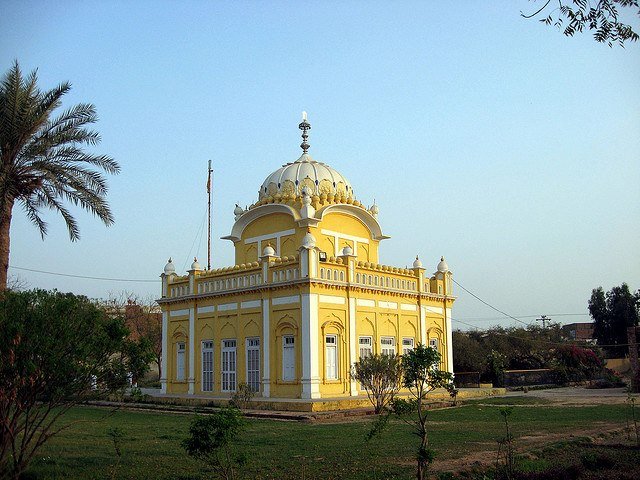
Nankana Sahib is where the Sikh story begins — the birthplace of Guru Nanak, the founder of Sikhism, and home to nine historic gurdwaras. Most pilgrims come for the great Janam Asthan, and rightly so. But tucked between two of the town’s famous shrines stands a smaller, stranger, deeply human monument: the Gurdwara Nihang Singhan. This is the Nihang Singhs’ own prakash place, founded not by a king or a committee but by a single defiant act of devotion — when Nihang Ujagar Singh, refusing to accept the new management of the neighbouring Tambu Sahib, set up his own separate prakashasthan beside it. A camp (chaoni) that became a gurdwara. A disagreement that became heritage. If you want to understand Sikhism as a living, debating, evolving faith — not just its monuments but its arguments — this Gurdwara Nihang Singhan travel guide will show you why this quiet shrine deserves your visit, when to go, and how to reach it.
Quick Facts
- Location: Between Gurdwara Sri Tambu Sahib and Gurdwara Sri Hargobind Sahib, Nankana Sahib, Punjab, Pakistan — about 91 km west of Lahore
- Famous For: The Nihang Singhs’ separate prakashasthan, founded by Nihang Ujagar Singh beside Tambu Sahib; also called the Nihang Singh Chaoni (camp)
- Nearest City: Lahore (91 km east); Faisalabad about 75 km west
- Accessibility: Easy road access from Lahore (~1.5–2 hours); nearest international airport Lahore; Nankana Sahib has a railway station
- Known Landmarks: Gurdwara Janam Asthan (birthplace of Guru Nanak), Gurdwara Tambu Sahib, Gurdwara Hargobind Sahib — six more historic gurdwaras in the town ensemble
- Best For: Sikh heritage pilgrims, history lovers, photographers, and anyone exploring the nine gurdwaras of Nankana Sahib
- Visit Tip: Come in November for Guru Nanak’s birth anniversary, when Nankana Sahib fills with yatris and the whole town glows
Why Visit Gurdwara Nihang Singhan, Nankana Sahib
Every great pilgrimage town has its famous shrine and its quiet corners — and the quiet corners are often where the real stories live. The Gurdwara Nihang Singhan is Nankana Sahib’s quiet corner with the loudest story. It exists because of a principled stand: when the Parbandhak Committee took charge of Gurdwara Tambu Sahib and installed Mahant Bhai Sharam Singh to serve the Guru Granth Sahib there, Nihang Ujagar Singh opposed the change and established his own separate prakashasthan right beside it. That act of devotion-by-defiance became the Nihang Singh Chaoni — the camp — and the camp became the Gurdwara Nihang Singhan. To visit is to stand inside a moment when faith, pride, and principle collided, and to see how beautifully a community can hold even its disagreements as sacred.
The shrine is also your key to understanding the Nihangs themselves. The Nihang Singhs — the blue-robed, weapon-bearing warrior order of the Khalsa — are among Sikhism’s most distinctive and least understood traditions. Their history in Nankana runs through the great traumas and triumphs of the faith, including the Nankana massacre of 1921, when the Akali movement’s confrontation with the corrupt mahant Narain Das left between 82 and 156 Sikhs dead and ultimately returned the Janam Asthan to Sikh control. Standing at the Nihangs’ own gurdwara, between Tambu Sahib and the Sixth Guru’s shrine, you are standing in the landscape where that history unfolded.
Then there is Nankana Sahib itself — quite simply one of the most significant religious towns in the world. This is where Guru Nanak was born in 1469, in what was then Rai Bhoi Ki Talwandi. The town holds nine historic gurdwaras, the great Janam Asthan among them, rebuilt by Maharaja Ranjit Singh in 1819–20 and now a protected heritage monument. A visit to the Gurdwara Nihang Singhan naturally unfolds into a walk through the whole ensemble: Tambu Sahib, Hargobind Sahib, Bal Lila, Kiara Sahib, Mal Ji Sahib, and the Janam Asthan itself. Few day trips in Pakistan offer that density of living heritage.
And there is a poignancy here worth sitting with. The old surveys note, with heartbreaking honesty, that prakash is no longer held at the Nihang Singhan gurdwara — nor at Tambu Sahib beside it — and that no land endowment stands in its name. The buildings stand, and Sikhs visit them “to get solace.” Come with that understanding, and your visit becomes an act of remembrance in itself: honoring a shrine that remembers, even when the daily rituals have fallen silent.
History of Gurdwara Nihang Singhan, Nankana Sahib
The Gurdwara Nihang Singhan sits in the middle of one of Sikhism’s most storied landscapes. Nankana Sahib — originally founded as Raipur, destroyed in the medieval conquests, refounded as Rai Bhoi Ki Talwandi during the Delhi Sultanate, and renamed for Guru Nanak after his birth here in 1469 — is the faith’s Bethlehem. The first gurdwara at the Janam Asthan site is believed to have been built in the 16th century by Baba Dharam Chand, Guru Nanak’s grandson; the current complex was rebuilt by Maharaja Ranjit Singh in 1819–20. By the 18th century, Diwan Kaura Mal had endowed the town’s holy tanks and memorial gurdwaras with generous land holdings, creating the estate of Nankana Sahib that endured until 1947.
Within this landscape, Gurdwara Sri Tambu Sahib was long under the control of Nihang Sikhs. The shrine’s modern story turns on a changing of the guard: at the behest of the Gurdwara Parbandhak Committee, Mahant Bhai Sharam Singh took over the task of serving Guru Granth Sahib at Tambu Sahib. Nihang Ujagar Singh opposed this arrangement — a Nihang unwilling to surrender the Nihangs’ custodianship — and established a separate prakashasthan near Tambu Sahib. That separate establishment, known as the Nihang Singh Chaoni (the Nihang camp), became known as Gurdwara Nihang Singhan. It still stands beside Gurdwara Sri Tambu Sahib, between it and Gurdwara Sri Hargobind Sahib, on the road from Nankana Sahib station toward the Janam Asthan.
The shrine’s history cannot be separated from the Nankana massacre of 20 February 1921 — Saka Nankana — the defining trauma of modern Nankana. During the Akali movement’s campaign to free the gurdwaras from corrupt mahants, Narain Das, the Udasi mahant of the Janam Asthan gurdwara, ordered his men to fire on Akali protesters. The killing of between 82 and 156 Sikhs shocked the Sikh world, triggered a massive agitation, and ultimately led to the restoration of the historic gurdwaras to Sikh control. The Nihang tradition, with its martial ethos, stood at the heart of the Akali movement — and the Gurdwara Nihang Singhan belongs to that same continuum of Sikh self-assertion.
Today, the historical record is candid about the shrine’s condition: prakash of Guru Granth Sahib does not take place at the Gurdwara Nihang Singhan, nor at Tambu Sahib, and no land endowment stands in the gurdwara’s name. The buildings stand as visited monuments — places of solace rather than active worship. For the heritage traveler, this honesty is valuable: you come not to a polished, restored attraction but to a genuine survivor, carrying its history in its walls.
Top Things to Do in Gurdwara Nihang Singhan, Nankana Sahib
Stand Between Tambu Sahib and Hargobind Sahib
The gurdwara’s location is its first lesson. Position yourself in the lane between Gurdwara Sri Tambu Sahib and Gurdwara Sri Hargobind Sahib and look at the modest building of the Nihang Singhan shrine. This is the physical footprint of Nihang Ujagar Singh’s stand — a separate prakashasthan raised within sight of the shrine whose management he rejected. Few heritage sites anywhere make an abstract principle (custodianship, devotion, dissent) this concrete and this walkable.
Walk the Nine-Gurdwara Ensemble
Nankana Sahib holds nine historic gurdwaras, and the Nihang Singhan shrine is best experienced as one stop on a walking circuit. Start at the Janam Asthan — the birthplace itself, the town’s beating heart — then work outward through Gurdwara Bal Lila Sahib, Gurdwara Kiara Sahib, Gurdwara Mal Ji Sahib, Tambu Sahib, Hargobind Sahib, and the Nihang Singhan shrine. The town is compact; the circuit is walkable; and each shrine adds a layer to the story. Hire a local guide at the Janam Asthan — the oral histories they carry are worth every rupee.
Visit the Janam Asthan Complex
No visit to the Nihang Singhan gurdwara is complete without the Janam Asthan. The great gurdwara marking Guru Nanak’s birthplace — first built in the 1600s, rebuilt by Ranjit Singh in 1819–20, now a protected heritage monument managed by the Pakistan Sikh Gurdwara Parbandhak Committee — is one of Sikhism’s holiest sites. The sarovar, the grand facades, the yatri crowds in season: this is the major chord to the Nihang Singhan shrine’s quiet minor key. Visit both, and you hear the whole music of Nankana.
Reflect at the Saka Nankana Memorial Context
The massacre of 20 February 1921 is commemorated in Nankana, and understanding it transforms your visit. The Akali protesters who died at the Janam Asthan were fighting for exactly the principle Nihang Ujagar Singh embodied at his own shrine: that the gurdwaras belong to the Sikh sangat, served in the Sikh way. Ask locally about the commemorations held each February — they are solemn, well-attended, and open a window onto how this community carries its history.
Photograph the Old Town Lanes
The lanes around the gurdwaras — the road from the railway station toward the Janam Asthan, the bazaar streets, the old havelis — are a photographer’s delight, especially in the soft light of a winter morning. The contrast of the modest Nihang Singhan building against the grandeur of the Janam Asthan tells a visual story about scale, power, and devotion. Always ask before photographing people, and remember that active shrines deserve the same camera restraint as any place of worship.
Famous Places In and Around Gurdwara Nihang Singhan, Nankana Sahib
- Gurdwara Janam Asthan — the birthplace of Guru Nanak, Nankana’s crown jewel
- Gurdwara Sri Tambu Sahib — the neighbouring shrine at the heart of the Nihang Singhan story
- Gurdwara Sri Hargobind Sahib — the Sixth Guru’s shrine, on the other side of the lane
- Gurdwara Bal Lila Sahib — marking Guru Nanak’s childhood pastimes
- Gurdwara Kiara Sahib and Gurdwara Mal Ji Sahib — more of the nine-shrine ensemble
- Nankana Sahib railway station — the historic station on the road to the Janam Asthan
- Lahore — 91 km east, for the Badshahi Mosque, Lahore Fort, and Shalimar Gardens on a combined trip
How to Reach Gurdwara Nihang Singhan, Nankana Sahib
Nankana Sahib is one of the easiest pilgrimage towns in Pakistan to reach. From Lahore, it is about 91 km west — a drive of roughly 1.5 to 2 hours via the Lahore–Sheikhupura–Nankana road network. The route is straightforward and well-traveled, especially in the yatra seasons when buses and vans run frequently. From Islamabad, take the M-2 motorway toward Lahore and exit for Nankana Sahib — about 340 km, roughly 4 to 4.5 hours. From Faisalabad, the town is about 75 km east, an easy hour’s drive.
The nearest international airport is Lahore’s Allama Iqbal International Airport. From the airport, hire a private car or take a Daewoo-style coach toward Sheikhupura/Nankana Sahib; ride-hailing cars also do the Lahore–Nankana run routinely. Nankana Sahib has its own railway station on the historic line, and trains from Lahore are a charming, budget-friendly option — the gurdwara lane runs from near the station toward the Janam Asthan, so you can literally walk the pilgrim’s path on arrival.
From Karachi, the journey is long — over 1,000 km by road — so flying to Lahore and driving west is the sensible plan. Public transport between Lahore and Nankana is plentiful: coaches, wagons, and Suzuki pickups ply the route all day. Within Nankana town, the gurdwaras are close together — the Nihang Singhan shrine sits between Tambu Sahib and Hargobind Sahib — and rickshaws handle hops between the farther shrines of the ensemble.
Road conditions are good year-round on the Lahore–Nankana corridor. In the winter fog season (December–January), allow extra time for the drive — Punjab’s famous fog can slow the highways to a crawl in the early morning. Travel after 10 a.m. on foggy days if you have the flexibility.
Route Details
- Lahore to Nankana Sahib: Head west from Lahore toward Sheikhupura, then follow signs for Nankana Sahib. About 91 km; allow 1.5–2 hours (longer in fog season).
- Into town: Follow signs for Gurdwara Janam Asthan — the town orients itself around the birthplace shrine.
- Finding the shrine: The Gurdwara Nihang Singhan stands between Gurdwara Sri Tambu Sahib and Gurdwara Sri Hargobind Sahib, on the road from the railway station toward the Janam Asthan. Ask for “Nihang Singhan gurdwara” or “Tambu Sahib” — everyone knows the lane.
- On arrival: Cover your head, remove your shoes, and dress modestly. Note that prakash is not currently held here — visit as a heritage pilgrim, quietly and respectfully.
Where to Stay in Gurdwara Nihang Singhan, Nankana Sahib
Nankana Sahib is a pilgrimage town, and its accommodation is built for yatris: simple, clean, budget-friendly hotels and guesthouses clustered near the Janam Asthan and the railway station. Expect functional rooms with attached baths, fans or air-conditioning, and honest local hospitality. During the big yatra seasons — especially around Guru Nanak’s Gurpurab in November — the town fills up, so book ahead if you are visiting then.
Many travelers do Nankana as a day trip from Lahore, and this is an excellent strategy: Lahore’s hotels span every tier from backpacker hostels to five-star luxury, the drive is under two hours each way, and you return to the city’s restaurants and comforts by evening. If you want to experience the town at dawn — when the Janam Asthan is at its most serene — stay overnight in Nankana itself; a simple guesthouse near the shrine puts you within walking distance of the whole ensemble.
For longer Sikh-heritage itineraries, Nankana pairs naturally with Kartarpur (Narowal district) and Lahore’s own gurdwaras — a three- or four-day circuit that covers the great arc of Guru Nanak’s Punjab. The Bal Lila, Kiara Sahib, and Mal Ji Sahib guides in this series cover the neighbouring shrines in detail.
Where to Eat: Local Foods of Gurdwara Nihang Singhan, Nankana Sahib
Nankana Sahib eats like the Punjabi heartland town it is. Winter visitors are in for a treat: sarson da saag with makki di roti, white butter melting on top, is the season’s great dish, served at dhabas across town. Year-round staples include tandoori roti and naan straight from the clay oven, dal fry, chana chaat, samosas and pakoras from bazaar fry-shops, and towering glasses of lassi — sweet or salted — that Punjab does better than anywhere on earth.
The town’s bazaar around the Janam Asthan has rows of small eateries catering to yatris: paye (trotter curry) for breakfast devotees, halwa puri on weekend mornings, chicken karahi and mutton kunna-style slow curries at the bigger dhabas. Meals are very budget-friendly — a full thali-style lunch costs little. In the yatra season, many gurdwaras and community kitchens serve langar; if it is being served, join the pangat. The simple dal, roti, and kheer of a langar hall, eaten cross-legged among hundreds, is one of travel’s great leveling experiences.
Sweet tooths should try jalebi fresh from the kadhai in the morning bazaar and barfi from the town’s mithai shops — good for carrying home. As always in small-town Punjab, drink bottled or filtered water, and go easy on the street ice in summer.
Weather in Gurdwara Nihang Singhan, Nankana Sahib
Nankana Sahib sits on the Punjab plains, and its weather follows the classic central-Punjab rhythm: cold, foggy winters; a brief perfect spring; long, blazing summers; and a humid monsoon. Winter days are crisp and clear — ideal for walking the gurdwara circuit — though December and January bring the famous Punjab fog that can blanket the highways. Summer is genuinely harsh, with temperatures in the mid-40s, and best avoided for a walking pilgrimage.
| Season | Temperature Range | Conditions |
|---|---|---|
| Winter (Nov–Feb) | 5–20°C | Cold mornings, dense fog in Dec–Jan, clear pleasant afternoons; peak yatra season |
| Spring (Mar–Apr) | 18–32°C | The most comfortable weather of the year; green fields, mild days |
| Summer (May–Jul) | 30–45°C | Very hot with loo winds; avoid midday; early mornings only for shrine visits |
| Autumn (Aug–Oct) | 25–38°C | Monsoon humidity through August, then cooling; October is pleasant |
Language and Culture of Gurdwara Nihang Singhan, Nankana Sahib
Punjabi is the mother tongue here, spoken in the warm central-Punjab dialect, with Urdu universally understood. You will hear Punjabi in the bazaar, at the dhabas, and in the devotional music around the shrines — the language of Bulleh Shah and Waris Shah is still gloriously alive in Nankana’s streets. “Sat Sri Akal” is the greeting that opens Sikh hearts here; “Assalam-o-Alaikum” works everywhere else.
Culturally, Nankana Sahib is a town built around reverence. The local Muslim population holds the Sikh shrines in genuine respect — the town’s identity and much of its economy are intertwined with the yatras — and visiting Sikh pilgrims are received with notable warmth. At the shrines, standard etiquette applies: cover your head, remove shoes, dress modestly, and keep voices low in the darbar halls. The Nihang Singhan gurdwara, where prakash is not currently held, should be approached as a memorial: quiet, contemplative, camera-shy unless permission is given.
One thing to carry with you: Nankana’s history includes real trauma — the 1921 massacre is within living community memory — and the February commemorations are solemn occasions. If your visit coincides with them, observe respectfully, dress somberly, and follow the lead of the local sangat. Heritage tourism here is not entertainment; it is witness.
Shopping in Gurdwara Nihang Singhan, Nankana Sahib
The bazaar around the Janam Asthan is pilgrim-oriented in the best way: religious souvenirs — framed images of the Gurus, khandas (the double-edged sword emblem), kara bracelets, rumallas (cloths for the Guru Granth Sahib) — alongside everyday Punjabi goods. Phulkari embroidery, khussas (embroidered Punjabi shoes), and lawn and khaddar fabrics make good buys, and the prices are local rather than tourist-inflated.
Food souvenirs travel well: barfi and pattisa from the mithai shops, desi ghee, and in winter, gur (jaggery) and shakkar. There are no shopping malls in Nankana Sahib — the bazaar is the shopping experience, and it is all the better for it. For serious retail therapy, Lahore’s malls and markets are 91 km east.
Local Events and Festivals
Nankana Sahib’s calendar is set by the Sikh religious year, and two occasions stand above all others. Guru Nanak Gurpurab — the birth anniversary of Guru Nanak, falling in November — is the town’s great festival. Thousands of yatris pour in from across Pakistan and abroad, the Janam Asthan glows with lights, akhand paths (continuous readings of the Guru Granth Sahib) run day and night, and the whole town takes on a carnival solemnity. If you want to see Nankana at its most alive, come for Gurpurab — but book accommodation well ahead.
Saka Nankana, the commemoration of the 20 February 1921 massacre, is observed each February with solemn gatherings remembering the Akali martyrs. It is a more somber occasion than Gurpurab, but a profoundly moving one, and it connects directly to the history of the Nihang Singhan shrine’s tradition. Vaisakhi in April also brings yatri movement through Punjab’s gurdwara towns. Check the Pakistan Sikh Gurdwara Parbandhak Committee’s yatra calendar before planning, as dates and programs are announced annually.
Travel Tips for Gurdwara Nihang Singhan, Nankana Sahib
Packing Essentials
A head covering is essential — a light scarf or dupatta you can keep on all day as you move between shrines. Comfortable walking shoes that slip off easily are the ideal footwear for a multi-gurdwara day. In winter, pack warm layers and a shawl — mornings are cold and the fog is damp; in summer, sun protection, a hat, and a water bottle are survival gear. A small donation budget for the golaks of the shrines you visit is customary.
Safety Tips
Nankana Sahib is a peaceful pilgrimage town accustomed to visitors, including large numbers of foreign yatris, and it is generally very safe. Standard sense applies: keep valuables discreet in the bazaar crowds, travel the highways in daylight during fog season, and stay hydrated in summer. The shrine lanes are calm; the only real risk is getting happily lost among the gurdwaras — which is hardly a risk at all.
Money & Connectivity
Carry cash for the bazaar, dhabas, rickshaws, and golak donations — small-town Punjab runs on cash, though ATMs are available in town. Mobile signals from all major networks (Jazz, Telenor, Zong, Ufone) are strong in Nankana Sahib and along the Lahore corridor, with good 4G coverage. The town has no shortage of tea stalls with Wi-Fi if you need to get online.
Best Time to Visit Gurdwara Nihang Singhan, Nankana Sahib
Winter (November to February) — The Yatra Season
This is Nankana’s great season. Guru Nanak’s Gurpurab falls in November, drawing thousands of yatris and filling the town with devotional energy. December and January are quieter but equally beautiful — crisp air, clear light, perfect walking weather between the shrines. The only caveat is the fog, which can delay highway travel on some mornings; plan drives for late morning.
Spring (March to April) — The Sweet Spot
Ask a local when Nankana is at its prettiest and many will say spring: mild days, green wheat fields around the town, and comfortable temperatures for a full day of shrine-hopping. Vaisakhi in April adds festive color. For a relaxed heritage visit without the Gurpurab crowds, spring is ideal.
Summer (May to July) — For the Determined Only
Central Punjab summers are brutal — mid-40s, dust, and the fierce loo wind. The shrines are open and the town is quiet, but walking between gurdwaras at noon is punishing. If you must come now, visit at dawn, rest through the day, and return to the Janam Asthan in the evening.
Autumn (August to October) — Warming Down
The monsoon keeps things humid through August, but by October the air clears and temperatures ease into the pleasant range. Late October is a lovely shoulder season: pre-Gurpurab calm, good light, and easy accommodation.
Final Thoughts
The Gurdwara Nihang Singhan will never be Nankana Sahib’s most famous shrine, and it was never trying to be. It is a monument to a single act of principled devotion — a Nihang’s refusal, a separate prakashasthan, a camp that became a gurdwara — standing quietly between two grander neighbours. In its modesty is its message: that faith is kept not only in great domes but in small, stubborn acts of conscience.
Walk the lane from the station to the Janam Asthan, pause at Tambu Sahib and Hargobind Sahib, and give the Nihang Singhan shrine its due moment of your attention. Then let the nine gurdwaras of Nankana do what they have done for centuries: remind you that this small Punjabi town changed the spiritual history of the world. For more journeys through Pakistan’s sacred geography, explore the Explore Pakistan collection.
FAQs
Where is Gurdwara Nihang Singhan located?
It stands between Gurdwara Sri Tambu Sahib and Gurdwara Sri Hargobind Sahib in Nankana Sahib, Punjab — on the road from the railway station toward the Janam Asthan, about 91 km west of Lahore.
What is the story behind the Gurdwara Nihang Singhan?
When the Parbandhak Committee installed Mahant Bhai Sharam Singh at the Nihang-run Tambu Sahib, Nihang Ujagar Singh opposed the change and set up his own separate prakashasthan beside it. That “Nihang Singh Chaoni” (camp) became the Gurdwara Nihang Singhan.
Is prakash still held at the gurdwara?
According to the historical surveys, prakash of Guru Granth Sahib is no longer held at the Gurdwara Nihang Singhan (nor at Tambu Sahib), and no land endowment stands in its name. Sikhs visit the buildings for solace and remembrance.
What is the best time to visit Nankana Sahib?
November, for Guru Nanak’s Gurpurab, when the town fills with yatris — or the winter and spring months generally (November–April) for pleasant weather. Summers are very hot.
How do I reach Nankana Sahib from Lahore?
Drive west from Lahore toward Sheikhupura and on to Nankana Sahib — about 91 km, 1.5 to 2 hours. Coaches and wagons run the route all day, and Nankana has its own railway station.
Can non-Sikhs visit the gurdwaras of Nankana Sahib?
Yes — all are welcome. Cover your head, remove your shoes, dress modestly, and follow the sangat’s lead. The town is accustomed to visitors of all backgrounds.
Where should I stay?
Nankana has simple, budget-friendly yatri hotels near the Janam Asthan. Many visitors day-trip from Lahore (under 2 hours each way), which offers hotels at every tier.
What else is there to see in Nankana Sahib?
The town holds nine historic gurdwaras — including the Janam Asthan, Bal Lila Sahib, Kiara Sahib, Mal Ji Sahib, Tambu Sahib, and Hargobind Sahib — all within a compact, walkable circuit.