Quick Facts
- Location: Tharparkar District, Sindh — 21 kilometres south of Mithi, at approximately 24.615°N, 69.916°E
- Altitude: around 130 metres (Thar Desert plain)
- Famous For: A 5,000-year-old well of Pandava legend, medieval Makwana monuments, and living Hindu temples of the Thar
- Nearest City: Mithi, 21 kilometres north (about 30 minutes by road)
- Accessibility: Reachable by road from Mithi; Mithi itself is 4–5 hours from Karachi by road. No airport in Tharparkar
- Known Landmarks: The ancient well, memorial hero stones of the Makwana rulers, temples of Oghar Nath and Pir Pithora
- Best For: History lovers, cultural travelers, photographers, and anyone seeking the soul of Tharparkar
Why Visit Kertee
Most travelers who make it to Tharparkar stop at Mithi and Nagarparkar and believe they have seen the desert. Also, Kertee is the village that proves them wrong. Twenty-one kilometres south of Mithi, down a quiet desert road, lies a settlement where a well is said to be five thousand years old, where the ruined stones of a twelfth-century Rajput clan still stand in the open desert, and where temples older than most of Pakistan’s famous monuments are still worshipped in every day. Kertee is not a tourist attraction. It is a living museum.
That is exactly why this Kertee travel guide exists: to convince you that the detour is worth it.
A Five-Thousand-Year-Old Well
Come to Kertee for the stories. Local tradition holds that the ancient well here was dug by the Pandavas during their fourteen-year exile — the same brothers of the Mahabharata whose footprints wander all across the subcontinent. Whether or not you believe the legend, you will stand at a well so old that its masonry has outlasted kingdoms. You will feel the weight of it. Then walk to the memorial stones of the Makwanas, the clan that ruled this corner of Sindh in the 1100s, and read the desert’s own archive in carved rock.
Kertee is also perfect for travelers who want Tharparkar beyond the postcard. This is a Hindu-majority village — mostly Sodha Rajputs — where the rhythms of temple bells and desert life continue exactly as they have for generations. The festivals, the music, the embroidery, the food: everything here is unfiltered Thar. If you came to Pakistan to understand its plural heritage, there is no better classroom.
Who is it perfect for? Also, photographers will find the Thar light and the temple architecture irresistible. In fact, history buffs can combine Kertee with the Jain temples and sacred hills of Nagarparkar for a full circuit of Sindh’s medieval heritage. Cultural travelers — the ones who travel to meet people, not to collect sights — will be welcomed into a village that rarely sees foreign faces and greets visitors with genuine curiosity and chai. Kertee rewards the slow traveler and the curious one. This guide will show you how to reach it, when to go, and what to do once you arrive.
History of Kertee
The recorded history of Kertee begins in legend and continues through some of the most dramatic centuries of Sindh’s medieval past. Local tradition says the village’s famous well is five thousand years old, built by the Pandavas during their fourteen-year exile described in the Mahabharata. Such claims cannot be verified by archaeology, but they place Kertee firmly in the mythic geography of the subcontinent. Tharparkar is dotted with places that claim a connection to the epic wanderers. Kertee’s well is among the most persistent of them.
The Makwana Clan of Kertigarh
The first historically grounded chapter belongs to the Makwana clan, who ruled the region in the twelfth century and called the settlement Kertigarh — the fort of Kerti. Also, In Gujarati the place was known as Karli Nagar. According to the accounts preserved by local bards and documented by Sindh’s historians, the Makwanas’ great crisis came in the 1100s: Kesar Makwana, the Maharaja of Kirtigarh, went to war with Hamir Soomro, the Sumra emperor of Sindh, after Hamir murdered his own father. Kesar Makwana swore an oath to avenge the dead, and the war that followed ended in catastrophe for the Makwanas.
Only two princes — Kesardevji and Harpal Devji — survived the onslaught, hiding in the jungle. The family’s monuments still stand around the present village: memorial hero stones of Makwana warriors, the remains of a fort. The old well.
The Makwana story does not end there. Bards record that Harpal Makwano later went to Nagarparkar, and another Makwana hero, Derel Makwano, ruled Nagarparkar with an iron hand until he was killed on his way to a temple. Also, Many Makwana families embraced Islam in the fourteenth to sixteenth centuries and, as Mangwanas, settled in Dadu, Matiari and other districts of Sindh. Today not a single Makwana family lives in Kerti — only their monuments remain: eight hero stones set around the village (several of which, sadly, have been stolen or lie fallen in recent years), the fort’s remains. The ancient well.
The present village of Kerti was founded during the Talpur period (1783–1843) by Khet Singh Nabo Sodho. Also, the Sodhas remain the dominant community to this day. Ravoji Singh Sodho — a later chief who settled Kerti with his friend Kalji Mahar Rajput — was killed in an encounter with the Khosa tribe. It is now worshipped by his descendants. His memorial stone stands in Veh Hingorja village, about eight kilometres south of Kerti, where he fell. Under British rule, Tharparkar was administered as part of Sindh, and after 1947 the village became part of independent Pakistan.
A Hindu-majority settlement in a Muslim-majority country, sustained by Tharparkar’s celebrated tradition of communal harmony.
Top Things to Do in Kertee
Stand at the Ancient Well
The ancient well is Kertee’s signature sight. A shaft of water in the desert that local tradition says is five thousand years old and was built by the Pandavas during their exile. Go early in the morning, when the desert light is soft and the village is just waking up. Ask an elder to tell you the story. Every family in Kertee has a version, and the telling is half the experience. Whatever your view on the legend, the well is genuinely ancient masonry. It is still the village’s reference point — the place by which Kertee measures its own memory.
Read the Makwana Hero Stones
Scattered around the village — to the south, north and west — are the memorial stones (paliya) of the Makwana rulers, carved hero stones commemorating warriors who fell in battle centuries ago. The northern stones lie close to the Marhi of Swami Ogharnath. Two once stood beside the Marhi, though one has fallen and another has been stolen. Walk between them slowly and you are walking through the twelfth-century history of Kertigarh. Because the stones are unprotected and some have already been lost, treat them with care and do not attempt to move or clean them.
Visit the Temples
Kertee’s living temples are the heart of its spiritual life: the shrines of Oghar Nath, Pir Pithora, Pir Bhavsingh, Mard Ali Shah, Mauji and Mataji, along with three temples of Shiva and one of Krishna. These are not museum pieces — they are working places of worship, tended daily. Visit in the early morning or around evening aarti, remove your shoes before entering the sanctum area, dress modestly, and ask before photographing people at prayer. If you visit during Diwali or Holi, the temples come alive in ways you will remember for years.
Walk the Desert Around the Village
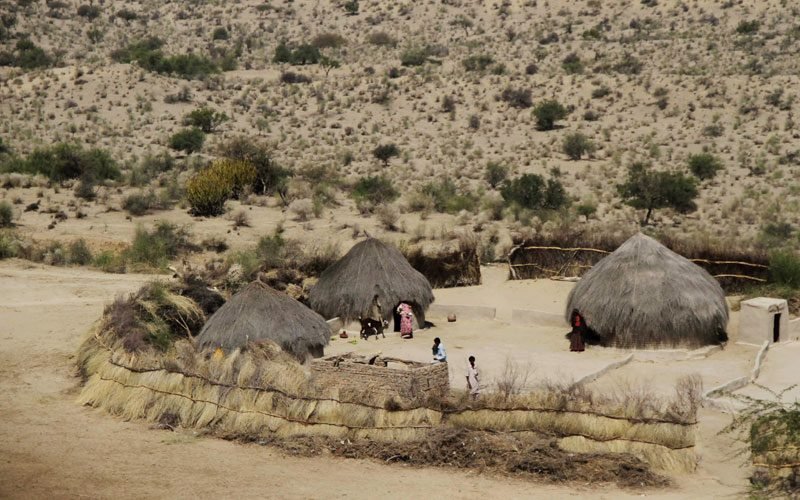
Kertee sits in classic Thar country — rolling dunes, thorn scrub, khejri and ber trees, and after the monsoon, a sudden green carpet that surprises every first-time visitor. Also, Take a late-afternoon walk out of the village toward the dunes. In fact, you may see herds of goats, women in bright embroidered cholis carrying water, and peacocks — Thar’s famous peafowl — feeding at the field edges. Carry water and sun protection; the desert is beautiful and indifferent in equal measure.
Visit the Fort Remains
Little remains of the Makwana-era fort, but its footprint and a few standing stretches of wall are still traceable. Also, stand where the garrison of Kertigarh once watched the approaches from Mithi and Nagarparkar. The twelfth-century war with the Sumras stops being a bard’s tale and becomes geography you can see.
Meet the Craftspeople
Kertee’s Bheel, Meghwar and Suthar communities keep Tharparkar’s craft traditions alive — intricate mirror embroidery, wood carving, and pottery. If you show genuine interest and ask respectfully, you will often be shown work in progress and offered pieces for sale. Also, buy directly from the maker; the money stays in the village and the story stays with the piece.
Famous Places In and Around Kertee
- Mithi (21 km): The district capital, with its bazaars and the closest hotels and transport.
- Nagarparkar (approx. 90 km southeast): Home to medieval Jain temples and the sacred Churrio Jabal hill of Durga Mata.
- Bhodesar Mosque (near Nagarparkar): A beautiful white-marble mosque of the Samma period, a masterwork of medieval Sindhi architecture.
- Karoonjhar Mountains (Nagarparkar): The sacred granite range of Thar, sacred to Hindus, Muslims and Jains alike.
- Sant Nenuram Ashram (Islamkot): A major Hindu religious centre of Tharparkar, drawing pilgrims from across the region.
- Veh Hingorja (8 km south): Where the memorial stone of Ravoji Singh Sodho stands at the spot where he fell.
How to Reach Kertee
Kertee is reached by road via Mithi, the district capital of Tharparkar. Also, there is no airport and no railway anywhere near the village. In fact, the Thar journey is entirely by road, which is half the pleasure of it.
From Karachi (approximately 450 km, 4.5–5.5 hours to Mithi): Take the N-5 / Superhighway toward Hyderabad, then continue via Mirpurkhas and Naukot (or via Badin) to Mithi. The road is paved throughout but narrows and roughens in stretches after Mirpurkhas. From Mithi, Kertee is 21 kilometres south — about a 30-minute drive on a local road. Hire a car or jeep in Mithi. A small sedan can make it in the dry season but a higher-clearance vehicle is more comfortable.
From Lahore (approximately 950 km) and Islamabad (approximately 1,100 km): Drive or bus south via the M5/N5 motorways to Hyderabad, then follow the Karachi route above. Also, this is a long journey — most travelers from the north break it with an overnight stop in Hyderabad or Mirpurkhas. There is no direct public transport to Kertee. Reach Mithi by van or bus from Karachi (daily services) and hire local transport for the final leg.
Nearest airport: Jinnah International Airport, Karachi. Also, Hyderabad’s airport has very limited service; realistically, Karachi is your air gateway.
Route Details
Day 1: Fly or drive into Karachi. Drive Karachi → Hyderabad (Superhighway, ~150 km) → Mirpurkhas (~65 km further) → Naukot → Mithi. Also, refuel in Mirpurkhas; fuel availability thins out in the desert. Overnight in Mithi. Day 2: Mithi → Kertee (21 km south). The road is signposted locally; ask in Mithi’s bazaar for “Kertee road” if unsure. Spend the day in the village, then return to Mithi or push on to Nagarparkar. Road conditions are best from October to March; monsoon rains (July–September) can make local roads muddy and slow.
Where to Stay in Kertee
Kertee itself has no hotels. Also, it is a working village, and visitors sleep either in simple village guest rooms arranged through local contacts or, more practically, in Mithi. In fact, this is not a drawback. Basing yourself in Mithi lets you cover Kertee, the surrounding villages and the Nagarparkar circuit from one comfortable hub.
Mithi options: Mithi has a handful of mid-range hotels and guesthouses clustered around the town centre and bazaar — clean, air-conditioned rooms with attached baths are the standard expectation, along with simple restaurants attached to or near the hotels. Book through a phone call rather than online platforms, which rarely list Tharparkar properties accurately. Also, prices are modest by Pakistani city standards. For village stays in Kertee itself, ask the village elders or your Mithi driver-guide to arrange a spare room. Expect very basic facilities (charpai, shared washroom), warm hospitality, and an unforgettable night of desert sounds.
Camping: Winter camping on the dunes outside the village is possible and spectacular, but arrange it through a local guide — water, firewood and permission are all local matters. Never camp on cultivated fields or near the temples without asking.
Where to Eat: Local Foods of Kertee
Kertee’s food is Thari Hindu and Sindhi village food — hearty, vegetarian-leaning, and built around what the desert provides. You will not find restaurants in the village; you will find home cooking, and it is better than most restaurants.
Thari staples to try: Bajra (millet) roti with lassi or buttermilk. Also, sai bhaji (the beloved Sindhi dish of spinach, lentils and seasonal greens). In fact, lolo and koki (the flatbreads of Thari Hindu homes, often eaten with pickles and jaggery). Dal pakwan; and rabri — the thick, sweetened milk dessert of the region. During the monsoon and winter, look for fresh bajra and seasonal greens. Gur (jaggery) features heavily in Thari sweets.
Where to eat: In Kertee, accept any invitation to eat — refusing is the only rude option. Also, For self-arranged meals, eat in Mithi, where small hotels and dhabas serve Sindhi and standard Pakistani food: biryani, daal, sabzi, and fresh tandoori roti. A full meal at a Mithi dhaba is budget-friendly. Expect to pay modestly, in the range of a few hundred rupees per person. Carry snacks and drinking water when heading out to the village, and ask before photographing anyone’s kitchen or family meal.
Weather in Kertee
Kertee has a classic Thar Desert climate: brutally hot summers, a brief monsoon, and mild, pleasant winters. Rainfall is low — Tharparkar averages roughly 250 mm a year — and droughts are a recurring hardship that shapes local farming and life. Plan your visit around the weather, because the desert does not compromise.
| Season | Temperature Range | Conditions |
|---|---|---|
| Winter (Nov–Feb) | 8–25°C | Mild, sunny days; cool nights. The best season to visit. |
| Spring (Mar–Apr) | 20–35°C | Warming up; still comfortable mornings, hot afternoons. |
| Summer (May–Jul) | 35–48°C | Extreme heat; dust storms possible. Avoid unless necessary. |
| Monsoon/Autumn (Jul–Oct) | 28–40°C | Brief, dramatic rains; desert turns green; roads can get muddy. |
Language and Culture of Kertee
Kertee is a Hindu-majority village. Also, the Sodha Rajputs form the largest community, alongside Bheel, Meghwar, Bhatti and Jadeja Rajput families and Muslim neighbours. The languages you will hear are Sindhi and Dhatki (the language of the Thar), with some Gujarati among older residents. Urdu works for basic communication, though a Sindhi-speaking guide transforms the experience.
Tharparkar is famous across Pakistan for its communal harmony. Also, Kertee lives that reputation daily — Hindu and Muslim neighbours share water, work and festivals. As a visitor, return the courtesy: dress modestly (cover shoulders and knees, especially near temples), remove shoes before entering temple courtyards, ask permission before photographing people, and accept offered food and chai — hospitality here is a point of honour. Evening bhajans (devotional songs) at the temples are open to respectful visitors; sit quietly at the back and listen.
Shopping in Kertee
Kertee has no bazaar to speak of. Also, its shopping is the village craft economy, which is all the more worth supporting. Buy Thari mirror-and-thread embroidery directly from Bheel and Meghwar craftswomen: cholis, dupattas and cushion covers, each piece dense with the geometric patterns of the Thar. Suthar woodwork and local clay pottery make sturdy, beautiful souvenirs. For a wider selection, Mithi’s bazaar has embroidery shops, ajrak and rilli (Sindhi quilts), Thari silver jewellery, and desert crafts from across the district. There are no shopping malls anywhere in Tharparkar — and that is rather the point.
Travel Tips for Kertee
Packing Essentials
Sun protection (hat, sunscreen, sunglasses), a refillable water bottle, comfortable walking shoes for sand and scrub, a light jacket for winter nights (desert nights are cold), a power bank (electricity can be intermittent), and basic medicines. Also, the nearest well-stocked pharmacy is in Mithi. In fact, carry cash in small notes; there are no card machines and ATMs are unreliable beyond Mithi.
Safety Tips
Tharparkar is among the most peaceful districts in Sindh. Meanwhile, Kertee is a small, close-knit village where visitors are noticed and looked after. In fact, the real safety issues are environmental: heat in summer, dehydration, and getting lost on unmarked desert tracks. Travel with a local driver-guide, tell someone your plan, and do not wander the desert alone at night.
Money & Connectivity
Bring cash from Karachi or Hyderabad. ATMs exist in Mithi but can run dry, and nothing in Kertee accepts cards. Mobile signals (Jazz and Zong generally work best in Tharparkar) are patchy in the village. Download offline maps before leaving Mithi and let family know you may be unreachable for a day.
Best Time to Visit Kertee
October to March (Ideal)
This is the Kertee sweet spot. Also, days are warm and golden, nights are cool, the desert is at its most photogenic, and temple life is in full swing. Diwali (October–November) and Holi (February–March) fall in this window — if your trip coincides with either, the village’s temples become the centre of a celebration you will never forget.
April to June (Challenging)
The Thar summer is genuinely extreme, with temperatures pushing toward 48°C. Also, travel is possible only for the hardy and the hurried. In fact, carry abundant water and plan all activity for dawn and dusk. Most travelers should skip these months.
July to September (Monsoon)
The rains transform the desert — dunes go green, peacocks dance, and the whole of Tharparkar exhales. Also, it is magical and muddy in equal measure. Local roads can become impassable after heavy showers, so check conditions in Mithi before heading to the village.
Final Thoughts
Kertee will never have a five-star resort, a ticket booth, or a souvenir plaza. And that is precisely its value. In a country whose tourist map is increasingly crowded, Kertee remains a place where history is not displayed but lived: a five-thousand-year-old well still drawn from, hero stones still honoured by the descendants of those who raised them, and temples whose bells have rung through the Talpur era, the British Raj, and independent Pakistan without missing a beat.
Go to Kertee with a guide, a camera, an open afternoon, and no fixed expectations. Also, sit with the elders, walk to the dunes at dusk, and listen to what the desert says. For more inspiration on Pakistan’s heritage corners, browse the Explore Pakistan collection, and if your northern valleys are calling too, our Hunza Valley guide waits on the other side of the country. Kertee is the Thar at its most honest — and honesty, in travel, is the rarest luxury of all.
FAQs
Where is Kertee located?
Kertee is a village in Tharparkar District, Sindh, Pakistan — 21 kilometres south of Mithi, the district capital.
What is Kertee famous for?
Its ancient well (said to be 5,000 years old and built by the Pandavas), the twelfth-century Makwana hero stones and fort remains. Also, its living Hindu temples.
How do I reach Kertee?
By road via Mithi: drive from Karachi to Mithi (approximately 450 km, 4.5–5.5 hours), then 21 km south to Kertee. There is no airport or railway in Tharparkar.
What is the best time to visit Kertee?
October to March, when the desert weather is mild and pleasant. Avoid the extreme heat of May to July.
Is Kertee safe for tourists?
Yes. Also, Tharparkar is one of Sindh’s most peaceful districts and Kertee is a close-knit village. The main risks are environmental — heat, dehydration and desert navigation — so travel with a local guide.
Can families visit Kertee?
Absolutely. Also, it is a calm, welcoming village. In fact, base the family in Mithi’s hotels and make Kertee a day trip; carry snacks and water for children.
Where can I stay near Kertee?
There are no hotels in the village itself. Also, stay in Mithi’s mid-range hotels and guesthouses, or arrange a simple village guest room through local contacts.
What is the story of the ancient well of Kertee?
Local tradition holds that the well is five thousand years old and was constructed by the Pandavas during their fourteen-year exile described in the Mahabharata. It remains one of the village’s most revered landmarks.