Nehr-e-Khayyam Karachi Protest Demands Work Halt
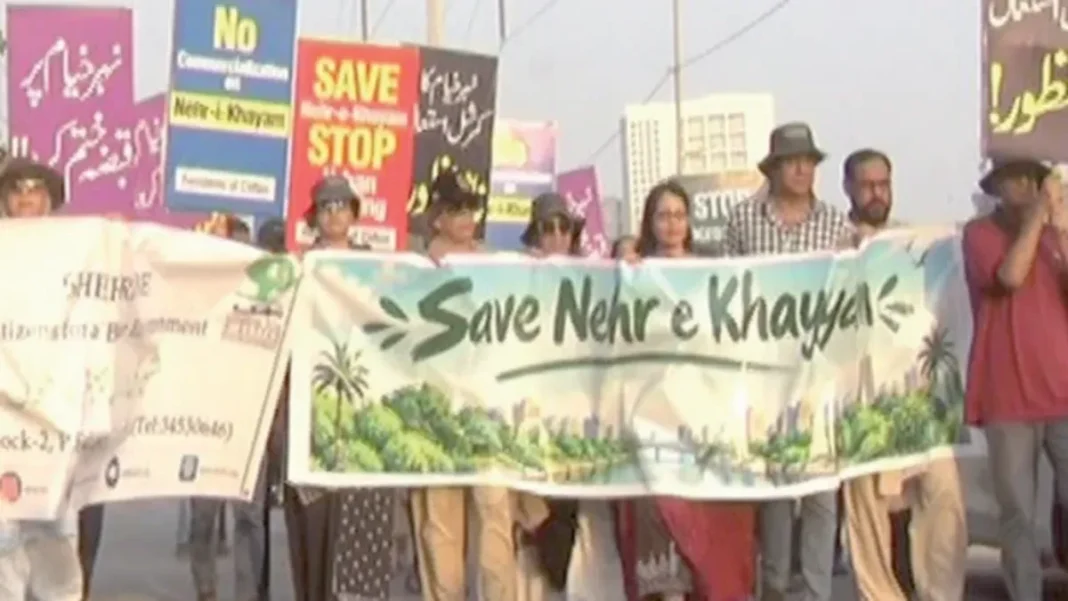
The Nehr-e-Khayyam Karachi protest gathered pace on Sunday as Clifton Block 5 residents were joined by environmental activists, legal professionals and political representatives. They demanded an immediate halt to construction until environmental approvals, technical studies and project details are made public. The protest is part of the residents’ continuing Sunday campaign.
Participants rallied around concerns that the project could compromise the historic waterway’s drainage capacity, increase urban flooding risks and pave the way for encroachment on public land. The programme began with a Baithak at Karachi Urban Forest, followed by a walk to Nehr-e-Khayyam, where participants observed that construction work was continuing despite mounting objections from the neighbourhood.
Nehr-e-Khayyam Karachi protest: the residents’ demands
Protesters maintained that work should not have commenced before completion of the mandatory Environmental Impact Assessment, approval from the Sindh Environmental Protection Agency and relevant technical studies. They demanded that all such documents be disclosed for public scrutiny. Their argument is procedural as much as environmental: if the approvals exist, they should be shown, and if they do not, work should pause until they are obtained.
Lawyer and Clifton resident Ahmer Jamil Khan stressed the need to involve local communities in decisions affecting their neighbourhoods. He also discussed possible legal avenues and called for sustainable solutions to Karachi’s sewage and wastewater problems, including properly planned treatment plants and effective wastewater management. His point links the Nehr dispute to a wider city problem, where drainage and sewage systems are under strain.
Residents Rasha Tarek and Nusrat Khwaja warned that narrowing Nehr-e-Khayyam could undermine its drainage capacity and expose surrounding neighbourhoods to greater flooding risks during heavy rainfall. They called for hydrological assessments and sustainable engineering solutions before any changes to the waterway. In a city where a single heavy rain can flood a road, a drainage channel is not a minor detail.
Claims about plots and the legal route
Ahmad Shabbar, representing the Pakistan Maholiyati Tahaffuz Movement, expressed solidarity with the residents and said the movement was examining legal options to support their campaign. Deputy Parliamentary Leader of the Opposition in the Karachi Metropolitan Corporation, Taimoor Ahmed, raised concerns over alleged plans to encroach upon Nehr-e-Khayyam land through the creation of six flat sites and two multi-storey commercial plots. He claimed that a proposed map was already circulating in the builders’ market. That claim about plots and a map was presented at the protest and has not been verified in the Tribune account against an official document.
The protesters reiterated their demand for an immediate suspension of construction until all environmental and technical concerns were independently examined, necessary approvals obtained and project details made public. They stressed that urban development must not come at the expense of public land, essential drainage infrastructure, environmental protection and the safety of surrounding communities.
Why a waterway dispute matters beyond Clifton
Nehr-e-Khayyam is a local waterway, but the dispute follows a familiar Karachi pattern. A project begins, residents say they were not shown the approvals, and the argument becomes about documents as much as about concrete. If the approvals and studies are published, residents can test them. If they are not, the protest will likely continue on Sundays and move towards the courts, as Shabbar’s remarks suggest.
For readers outside Clifton, the case is a reminder to ask for the same documents in any neighbourhood project: the environmental assessment, the agency approval and the technical study. Those three papers decide whether a waterway can be narrowed safely, or whether a neighbourhood is being asked to carry a flood risk it did not agree to.
What do the protesters want?
They want construction halted until environmental approvals, technical studies and project details are made public and independently examined.
Which approvals are named?
The protesters name the mandatory Environmental Impact Assessment and approval from the Sindh Environmental Protection Agency, plus relevant technical studies.
Who took part in the protest?
Clifton Block 5 residents were joined by environmental activists, legal professionals and political representatives, including the Pakistan Maholiyati Tahaffuz Movement.
What flooding concern was raised?
Residents warned that narrowing Nehr-e-Khayyam could undermine its drainage capacity and expose surrounding neighbourhoods to greater flooding risks during heavy rainfall.
What legal step may follow?
The Pakistan Maholiyati Tahaffuz Movement said it was examining legal options to support the residents’ campaign.