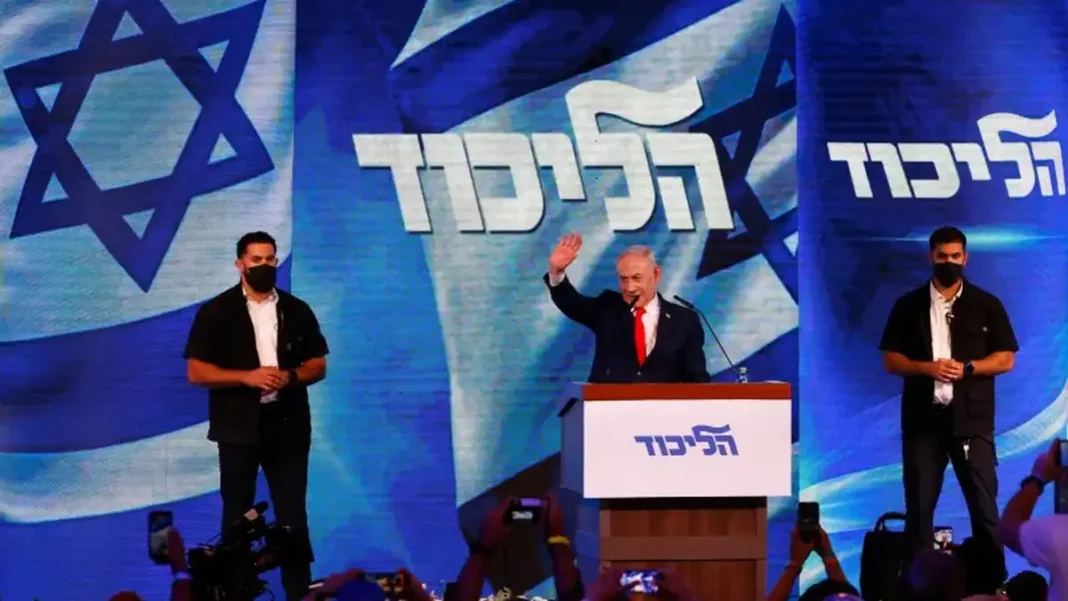
The Netanyahu bloc leads after two-thirds of the votes were counted in Israel’s general election, but remains short of a majority. Neither side was projected to win outright, setting up weeks of coalition talks.
With 66 per cent counted, Netanyahu’s bloc held 54 of 120 seats, Eisenkot’s bloc 48 and the non-aligned Arab parties 18. The partial results were likely to change as counting continued.
Voters turned out in record numbers to judge Netanyahu, Israel’s longest-serving prime minister, who has pushed the country sharply to the right since Hamas’s October 7, 2023 attack.
Netanyahu bloc leads the count
Both men vowed to form a government. Full results were expected by Thursday evening or Friday morning.
The count marked a shift from the exit polls, which had shown Eisenkot, a former military chief and political novice, neck-and-neck with Netanyahu’s hard-right camp, with both winning about 51 seats, well away from the threshold for a majority. Feature Pakistan reported those exit polls showing the opposition in the lead as voting closed.
The strongest gains went to Arab Israeli parties, whose voters turned out in soaring numbers against Netanyahu. He has relentlessly warned that the minority would dilute the Jewish nationalist direction in which he has taken Israel. Exit polls had shown Israeli Arab lists projected to win 18 or 19 seats, a sharp gain. The Arab parties’ role in ousting Netanyahu has been debated throughout the campaign.
Netanyahu, greeting cheering supporters at a Jerusalem convention centre after 3am on Wednesday, called for a “strong government of the right” and said the “Jewish and Zionist majority must unite”. The 77-year-old did not directly claim victory.
Trump claimed his endorsement of Netanyahu had helped “a lot”.
Coalition maths: 61 seats needed
A government needs 61 of 120 seats. On the partial count, Netanyahu’s bloc was seven short and Eisenkot’s 13 short.
The partial results suggest Eisenkot’s bloc would reach a majority with the Arab parties, something most of its members resisted on the campaign trail.
Yair Golan, head of Israel’s main left-wing party in Eisenkot’s camp, called for precisely that on Wednesday. “We must no longer accept Netanyahu’s racist division between Jewish votes and Arab votes,” he said on X. “We have a responsibility. And we have an opportunity to form a government of change in partnership with Israel’s Arab citizens.”
Eisenkot had said he would not govern with Israeli Arab lawmakers, echoing Netanyahu, who has suggested such a government would lack legitimacy. Arab lawmakers could also give Eisenkot support in parliamentary votes on an ad hoc basis, enabling him to maintain a minority government without joining a coalition.
Arab Israelis, also known as Palestinian citizens of Israel, account for about 21 per cent of the country’s population.
What happens next
A lack of clear majority could mean weeks of coalition talks, with possible new elections if negotiations fail. A stalemate would leave Netanyahu as caretaker prime minister until a new government is formed.
In Tel Aviv, Eisenkot warned Netanyahu against using security for political needs. “Netanyahu, don’t you dare use Israel’s security for your political needs,” Eisenkot said. He called Netanyahu “a caretaker prime minister, without a mandate or the people’s trust”.
After a turnout of nearly 78 per cent, the highest since 1999, Eisenkot vowed to work “swiftly” to form a government. “The public has voted for change,” he said. “A worthy leader would accept the people’s vote of no confidence and announce his retirement from political life today.”
The vote came as Israel faces increasing isolation over the wars in Iran and Gaza, settlement construction and violence against Palestinians in the occupied West Bank. Eisenkot shares many of Netanyahu’s security views and backed the Gaza offensive, but has vowed a more inclusive atmosphere, repaired international standing and curbs on violent settlers.
The contest has also drawn attention in Pakistan’s press, including Eisenkot’s argument that Netanyahu is unfit to lead and the debate over the next Israeli government.
Frequently asked questions
Who leads in the Israel election count?
Netanyahu’s bloc leads with 54 of 120 seats after two-thirds counted. Eisenkot’s bloc has 48 and the Arab parties 18.
Has anyone won a majority?
No. A government needs 61 seats, and neither camp has reached that figure in the partial count. The results are likely to change as counting continues.
When will full results be known?
Full results are expected by Thursday evening or Friday morning.