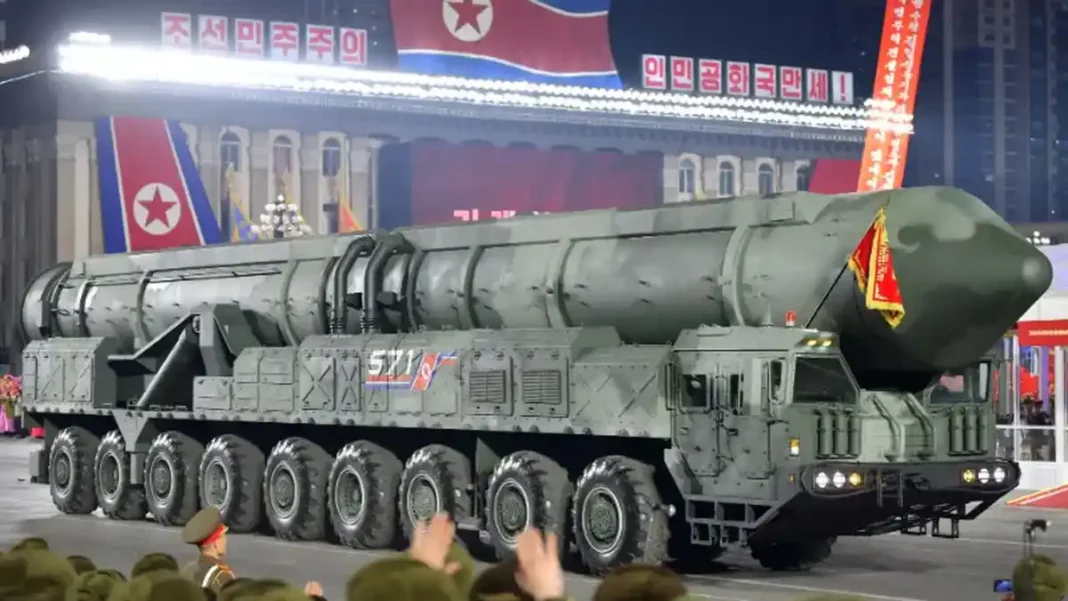
US, South Korea, Japan Vow North Korea Denuclearisation
The United States, South Korea and Japan reaffirmed their commitment to the complete denuclearisation of North Korea on Saturday, as Pyongyang continues to reject disarmament ahead of possible talks with Washington. The pledge came from the three countries’ foreign ministers during talks on Friday on the sidelines of a Group of 20 meeting in Atlanta.
US Secretary of State Marco Rubio, South Korean Foreign Minister Cho Hyun and his Japanese counterpart Toshimitsu Motegi “reaffirmed their resolute commitment to the complete denuclearisation” of North Korea, the US State Department said. They also pledged “full implementation” of UN Security Council resolutions, including a ban on supporting revenue for North Korea’s nuclear and ballistic missile programmes.
The meeting was the first trilateral gathering of the three ministers in about a month, and the fourth this year. It followed fresh tension: North Korea launched around 10 short-range ballistic missiles from the Wonsan area a day earlier, according to South Korea’s Joint Chiefs of Staff.
Why the timing matters
Speculation is mounting over a potential meeting between US President Donald Trump and North Korean leader Kim Jong Un at next month’s APEC summit in China. Trump has made repeated overtures to Pyongyang for nuclear talks, while scaling back joint military drills with ally South Korea.
The US leader even bucked long-held US policy last year by conceding that North Korea was already “sort of a nuclear power”, while reaching out to Pyongyang for talks and saying he was “100 per cent” open to a meeting. That suggestion went unanswered.
Analysts and South Korea’s spy agency say Kim may have conveyed Pyongyang’s position on potential talks with Trump to Beijing during a recent visit to the Chinese border city of Dandong. Feature Pakistan earlier reported on Kim Jong Un’s Dandong visit and what it signalled for talks.
South Korea’s President Lee Jae Myung, who has repeatedly offered Pyongyang talks without preconditions, suggested in September that Washington seek a freeze, rather than the immediate elimination, of the North’s nuclear programme in return for sanctions relief. Critics have said such an approach risks tacitly accepting North Korea as a nuclear-armed state while allowing Pyongyang to win sanctions relief without giving up its arsenal.
What else the ministers agreed
Beyond the nuclear pledge, the three ministers signed a memorandum of cooperation establishing a Trilateral Arctic Pacific Partnership, aimed at expanding maritime and economic cooperation in the Pacific Arctic region. They also agreed to deepen cooperation on critical mineral supply chains, small modular reactors and artificial intelligence.
Rubio also raised concerns over China’s actions in the South China Sea, East China Sea and Yellow Sea, as well as cooperation between China and Russia that Washington says threatens peace and stability in the Indo-Pacific region.
The ministers praised the work of the Multilateral Sanctions Monitoring Team, which tracks and reports violations and evasion of UN sanctions against Pyongyang. That praise landed on the same day Pyongyang denounced a joint statement by the sanctions-monitoring group, vowing that what it called the “stereotyped sanctions racket of the US and the West” could not influence its position as a nuclear weapons state.
Despite long-running UN sanctions, North Korea has enshrined its status as a nuclear-armed state in law, with its regime repeatedly declaring its atomic arsenal permanent and irreversible. Analysts say China may also be moving towards tacit acceptance, pointing to the omission of North Korean denuclearisation from statements after Kim and Chinese President Xi Jinping met in June.
For now, the Atlanta meeting shows the three allies still speaking with one voice on the goal, even as they differ on how fast that goal can be reached.
Frequently asked questions
What did the US, South Korea and Japan agree on North Korea?
Their foreign ministers reaffirmed a resolute commitment to the complete denuclearisation of North Korea and pledged full implementation of UN Security Council resolutions, including a ban on revenue support for its nuclear and missile programmes.
Why is a Trump-Kim meeting being talked about?
Speculation is mounting over a possible meeting at next month’s APEC summit in China, after Trump made repeated overtures for nuclear talks and said he was fully open to meeting Kim. Pyongyang has not yet answered.
What does North Korea say about giving up its weapons?
Pyongyang rejects disarmament. It has written its nuclear-armed status into law, calls its arsenal permanent and irreversible, and on Saturday denounced Western sanctions pressure as unable to change its position.
What else came out of the Atlanta meeting?
The ministers signed a memorandum creating a Trilateral Arctic Pacific Partnership for maritime and economic cooperation, and agreed to work together on critical minerals, small modular reactors and artificial intelligence.