Gen Z Protests Germany Draw 160,000 to Rallies
More than 160,000 people are expected to join Gen Z protests Germany wide on Saturday, as a youth-led movement takes to the streets to demand better education and lower living costs. The rallies, planned in 34 cities, coincide with Halloween festivities.
The protests are organised by the campaign group Gen Z regelt, which translates as Gen Z takes charge. Reuters reported that the group opposes compulsory military service and wants greater investment in education.
Organisers put the expected turnout above 160,000 across the country.
What the organisers want
The campaign centres on three demands. First, more money for education, from school buildings to university facilities. Second, relief from living costs that have squeezed younger workers and students. Third, opposition to compulsory military service, which the group argues would place a fresh burden on the same generation.
Steve, an 18-year-old due to speak at a rally in Munich, addressed Chancellor Friedrich Merz directly in comments carried by Reuters.
“The government has offered no response to our concerns other than to continue making cuts and piling further burdens upon us,” he said. “We will continue to exercise our fundamental right to assemble until you stop ignoring us.”
Sean Baker, a student at the Technical University of Berlin, said he would join the protests to draw attention to the poor state of buildings on campus. “When you go inside and enter the rooms, it looks like an abandoned building,” he told Reuters.
Why shops boarded up
German authorities say they expect Saturday’s demonstrations to be largely peaceful. At the same time, they have warned that extremist groups may try to exploit the movement, and some businesses have taken no chances.
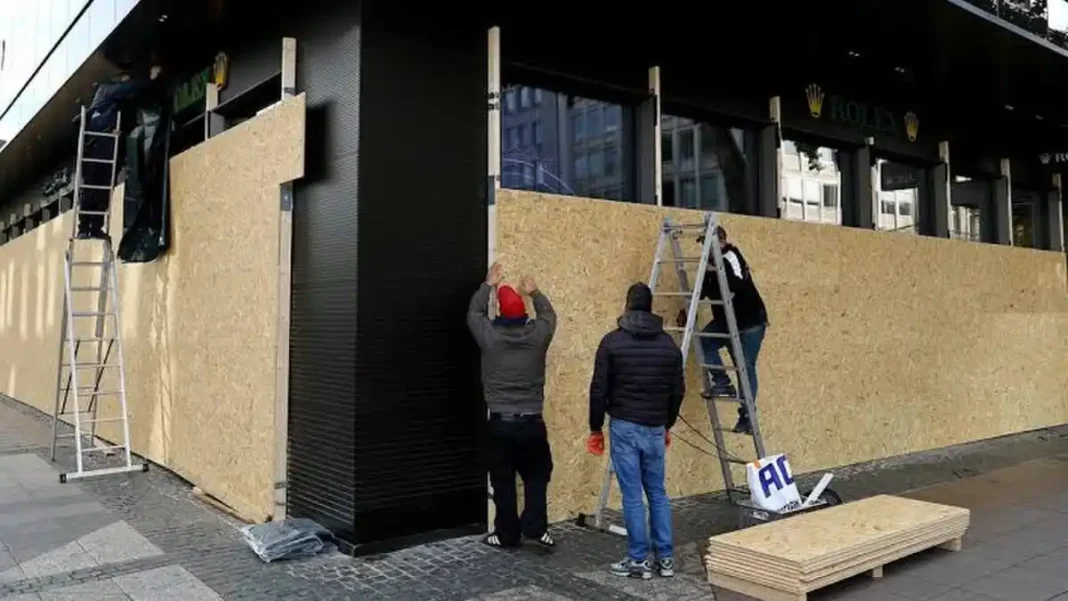
In Berlin, shops along the luxury Kurfuerstendamm boulevard boarded up windows and planned early closures. Workers were photographed on Friday fitting boards across shopfronts in Berlin and Frankfurt.
The federal interior ministry said parts of Germany’s far-left extremist scene, along with some groups linked to foreign extremist movements, had joined efforts to mobilise support. That warning explains much of the nervous preparation in city centres.
Roman Poseck, interior minister for Hesse, whose capital is Frankfurt, pointed to the scenes in France as the fear in officials’ minds. “We all have those images from France in our minds – looting, burning houses, burning police vehicles, and attacks on police officers,” he said. “France must not be held up as a model in this regard.”
A wider European wave
The German rallies do not stand alone. They follow a wave of Gen Z-led demonstrations across Europe this year.
In Serbia, student-led activism helped unseat the country’s long-time leader at the ballot box. In France, protests have descended at times into rioting and looting, and France imposed curfews in Paris, Lyon and Lille as protest violence escalated. In Italy, students and workers took to the streets across the country, with the trade union claiming a turnout of nearly 1.5 million.
Germany’s national school student umbrella organisation, BSK, has distanced itself from the initiative. It plans a separate day of protest on November 20. “We are distancing ourselves from ‘Gen Z regelt,’ but not from the students themselves, who have legitimate concerns,” BSK secretary-general Amy Kirchhoff said on Thursday.
Why it matters
Germany is Europe’s largest economy, and it struggles to revive growth while facing growing pressure on pensions and public services as baby boomers retire and the working-age population shrinks. Young Germans sit at the sharp end of that squeeze.
Young people in Pakistan have also pressed their case in public life, and Feature Pakistan has tracked how Pakistan’s Gen Z sees its own freedoms. The same pressures, over education, jobs and living costs, are driving street politics across Europe, from pro-Palestinian marches in European cities to Saturday’s rallies.
A peaceful turnout above 160,000 would give the organisers a strong claim to be heard. Any disorder would hand their critics the argument they have already made.
Frequently asked questions
When and where are the Gen Z protests in Germany?
They are planned for Saturday, October 31, 2026, in 34 cities across Germany, including Berlin, Frankfurt and Munich. Organisers expect more than 160,000 people to take part.
What do the protesters want?
They want greater investment in education, lower living costs, and an end to plans for compulsory military service. The group behind the rallies is Gen Z regelt, or Gen Z takes charge.
Are the protests expected to be peaceful?
Authorities expect the demonstrations to be largely peaceful, but warn extremist groups may try to exploit them. Some Berlin shops boarded up windows as a precaution.
Why have some people questioned the movement?
Questions have been raised about who drives the campaign, given the mix of groups involved. Germany’s national school student body, BSK, has distanced itself from Gen Z regelt and plans its own protest day on November 20.