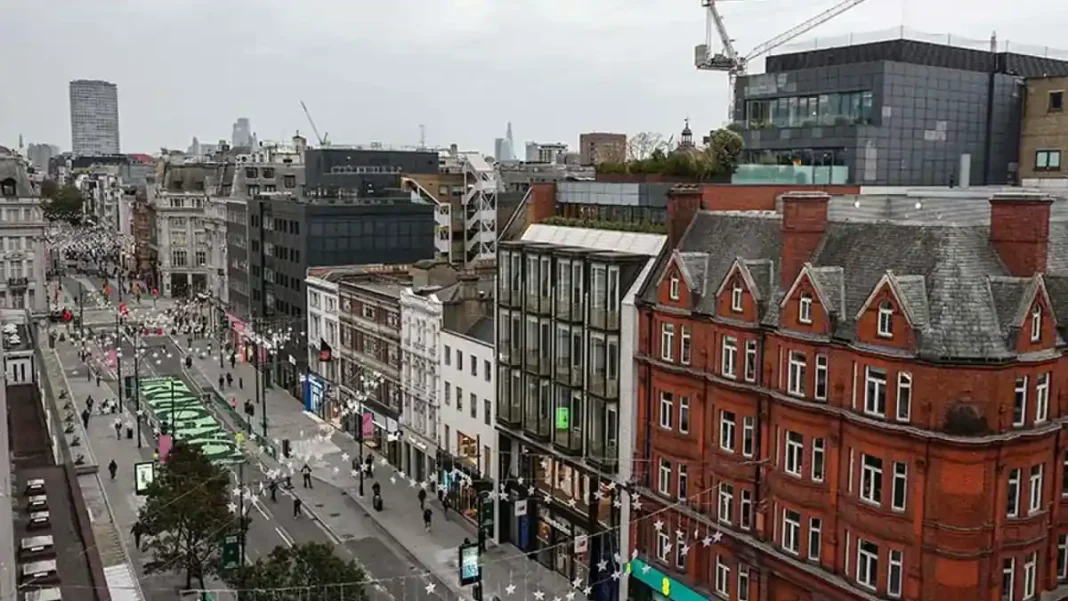
A stretch of London’s Oxford Street went traffic-free on Monday, October 26, 2026, as pedestrians took over one of the world’s most famous shopping streets. The Oxford Street traffic-free move covers almost one kilometre, close to half the street, between the Selfridges and IKEA stores.
Buses, cars, taxis, cycles, scooters and pedicabs are now barred from that section. It is the first time a central London shopping street has been closed to traffic in this way, and the change is permanent rather than a trial.
What the Oxford Street traffic-free change covers
London Mayor Sadiq Khan attended the opening ceremony on the street on Monday. He called it a momentous day for Oxford Street and for London, and said he wants a kilometre of the street to stay traffic-free forever.
“I want to be supporting our shops in Oxford Street and have a kilometre worth of this street, almost half of this street, traffic-free forever,” Khan said. He added that pedestrianisation would increase the number of shoppers.
Shoppers on a rainy Monday backed the move. John Oxford, an 83-year-old professor of virology, said it was a very good idea and should have been done before. Madaki Kanya, 19, visiting from Manchester, said it gave people more of a chance to explore the shops. Paul Facer, 62, from Weymouth, said it was far more comfortable walking around without dodging cars and traffic.
Why London acted
Oxford Street brings in some £3.1 billion in spending each year. It draws around half a million visitors every day, according to the mayor’s office. Yet the street has struggled in recent years.
Shops closed during the Covid-19 pandemic, and footfall fell as more shopping moved online. Some flagship stores, including House of Fraser and Topshop, have shut. Rows of US-style candy stores, souvenir shops and vaping outlets have taken their place, putting off many shoppers.
Khan described the decline in blunt terms. “Over the last couple of decades it’s been in decline, I’d say managed decline,” he told BBC Radio 4. “I’m not willing to stand by as shops leave this street, as jobs leave this street,” he added.
The wider plan aims to put Oxford Street back among top global shopping destinations, alongside New York’s Times Square, Paris’s Champs-Elysees and Barcelona’s La Rambla. Khan said the move would revitalise the road and make the capital greener.
The access dispute
The scheme has proved controversial. Black cab drivers rejected the move, and disability rights activists raised access concerns. Jason Harvey, 51, a black cab driver, told AFP that to pedestrianise any part of Oxford Street was crazy, citing the needs of people with disabilities and young children.
Another driver, Brendan Cooper, said people with disabilities will have to walk 150 yards around the back of the stores to get a taxi, calling that ridiculous. Residents have also worried about traffic jams in neighbouring areas as vehicles divert around the closed section.
Khan insisted that cab ranks and bus stops near the street mean people can still reach the area with ease. He said the street has reinvented itself for centuries, adapting to changing times and helping shape British culture.
Retailers welcomed the change. Meave Wall, chief retail and digital officer at Selfridges, said the day marked an exciting new chapter for Oxford Street as work begins to transform one of the world’s most iconic high streets. Selfridges opened on the West End road more than a century ago.
What comes next
Around half the street is now pedestrianised. Plans to close the rest to vehicles will depend on the success of this first phase.
Minimal construction will take place during the run-up to Christmas, a busy shopping period. Plans for 2027 include more than 50 new trees, 100 new seats, two public squares, rest areas and better signage and lighting.
The test for the scheme is simple: whether shoppers return, shops stay open and the street earns back its place as a destination rather than a route through central London.
How much of Oxford Street is traffic-free?
Almost one kilometre, close to half the street, between the Selfridges and IKEA stores.
Which vehicles are barred?
Buses, cars, taxis, cycles, scooters and pedicabs are barred from the pedestrianised section.
Why did London pedestrianise the street?
The street earns £3.1 billion a year but has faced decline from Covid closures, online shopping and the loss of flagship stores.