Lahore Second Most Polluted City as Punjab Smog Grows
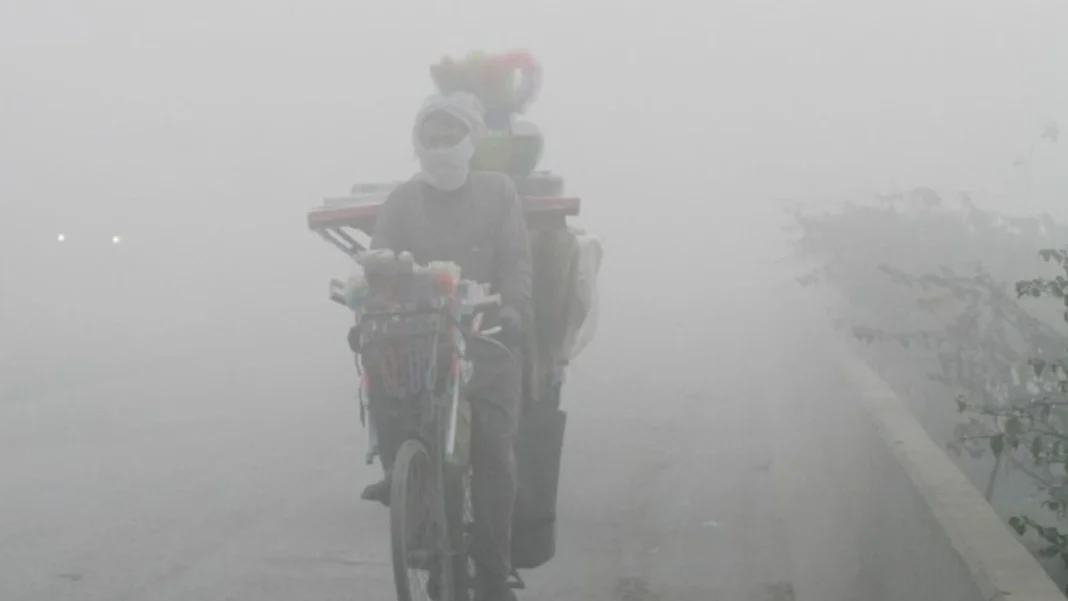
Lahore ranked second among the world’s most polluted major cities on Monday, recording an Air Quality Index (AQI) of 199 on IQAir’s live tracker, as pollution remained a concern across Punjab ahead of the peak winter smog season.
The city’s position and reading fluctuated during the day, which is normal for a live ranking. IQAir’s Lahore city page recorded an AQI of 139 at 3pm on Monday, with fine particulate matter (PM2.5) identified as the main pollutant at 51 micrograms per cubic metre. That reading placed Lahore in the unhealthy-for-sensitive-groups category on the US AQI scale.
The fluctuation is a useful warning against reading a single live figure as a fixed result. Lahore’s air can move between categories within hours as wind, traffic, and temperature change.
Worse readings outside Lahore
The Punjab Environmental Protection Agency’s monitoring data showed considerable variation across the province, and several districts recorded worse air than Lahore.
Pakpattan recorded an AQI of 210, followed by Multan at 204 and Sargodha at 195. Vehari registered 178, Kot Addu 176, Dera Ghazi Khan 165 and Khushab 160.
Mandi Bahauddin recorded 159, Sahiwal 158, Jhelum 157 and Attock 156. Lahore’s reading stood at 151 in the provincial ranking, placing it 18th among 31 cities, while Nankana Sahib recorded the lowest reading at 35.
The figures highlight the uneven distribution of pollution across Punjab. An AQI of 151 falls into the unhealthy-for-sensitive-groups category, while readings above 200 indicate very unhealthy air. The gap between Nankana Sahib at 35 and Pakpattan at 210 shows that smog in Punjab is not a single-city problem, even though Lahore draws most of the attention.
Dry weather ahead, no rain relief
Weather conditions are also relevant as the province enters the winter smog period. The Pakistan Meteorological Department’s forecast issued on Monday predicted dry weather across most districts of Punjab on Tuesday, with cold conditions expected in the morning and at night in hilly areas.
Lahore’s maximum temperature was forecast to range between 29 degrees Celsius and 31 degrees on Tuesday, with a similar range expected on Wednesday. The forecast did not indicate rain over the provincial capital in the period covered.
The absence of forecast rainfall means there is no immediate indication of rain-related relief for Lahore, although actual pollution levels will continue to depend on changing atmospheric conditions and emissions. Dry weather alone does not establish how the AQI would change.
As temperatures decline, air quality remains a concern for residents, particularly children, older people and those with respiratory or heart conditions. Health experts advise people to reduce outdoor exertion when pollution levels are elevated and to limit the entry of polluted outdoor air into indoor spaces.
Residents checking live rankings should remember that the numbers move through the day. The Monday picture is clear enough on one point, though: with Pakpattan and Multan above 200 and a long list of Punjab districts in the unhealthy range, the smog season has arrived across the province, not just in Lahore.
What was Lahore’s AQI on Monday?
Lahore recorded an AQI of 199 on IQAir’s live tracker on Monday, ranking second among the world’s most polluted major cities, before easing to 139 by 3pm.