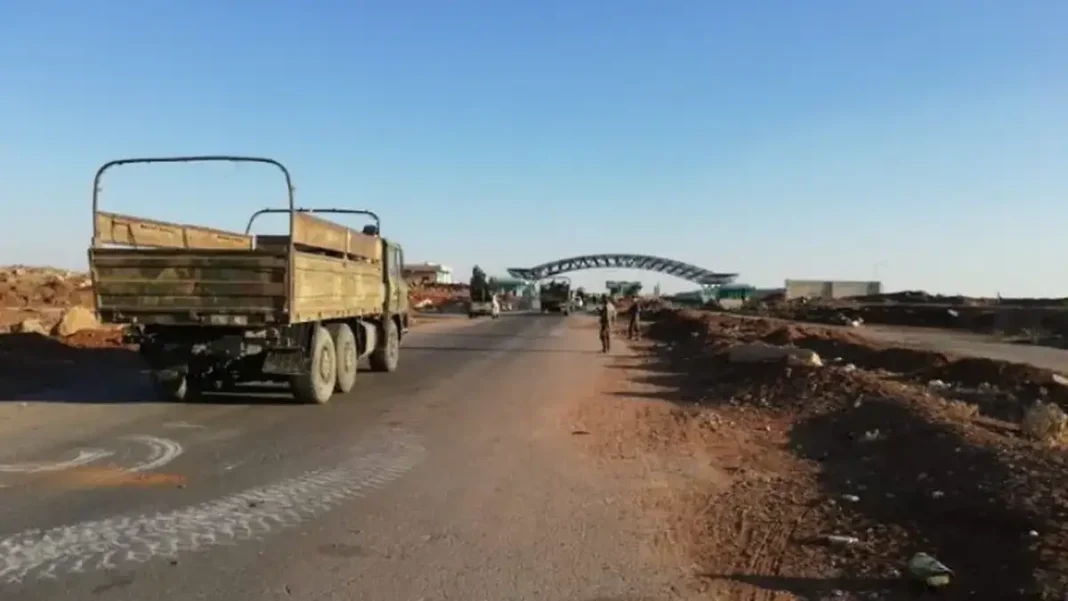
Syria reopened the Jordan border crossing at Nassib on Wednesday, as the two countries reaffirmed ties strained by a deadly retaliatory strike by Jordanian forces. Passenger and commercial movement through the crossing returned to normal on Wednesday morning.
The Nassib crossing, known as Jaber on the Jordanian side, had been closed following the strikes. Customs official Mazen Alloush told SANA that movement would return to normal on Wednesday morning.
Jordan’s strike sparked the worst crisis between the two countries since the ousting of longtime Syrian ruler Bashar al-Assad in December 2024.
Jordan border crossing reopens
Jordan sought to ease tensions on Tuesday, saying it had “great respect” for its neighbour and expressing regret for civilian casualties. Jordan’s Foreign Minister Ayman Safadi spoke to his Syrian counterpart the same day and emphasised Jordan’s “full respect for Syria’s sovereignty and security”, with “sorrow and grief over the death of innocent civilian victims”, according to a joint statement.
The two officials also discussed raids against what the statement branded as “Daesh sites”, referring to the Islamic State group. A joint Syrian-Jordanian security committee will meet in the coming days to discuss operations against IS, a government source told SANA.
Emergencies Minister Raed al-Saleh said both sides were handling the dispute through “diplomatic and legal channels” to secure justice for the victims.
The reopening follows Jordan’s strikes on militant groups in Syria after the church attack earlier this week.
How the crisis unfolded
Last week, gunmen opened fire during a funeral service at a Greek Orthodox church in Karak governorate, killing nine people and wounding 25, prompting a military response from Amman.
While Jordan insisted it coordinated its airstrikes with Syria, Damascus denied the claim. Syria condemned the strikes as an “unacceptable violation”, while Jordan said it killed more than 20 fighters in its raid.
Syria’s foreign ministry called the strikes “an unacceptable violation and breach of Syrian airspace without any prior coordination” and “a blatant violation of the principles of good-neighbourliness and Syrian national sovereignty”.
Jordan’s government spokesman Mohammad al-Momani said preliminary results indicated more than 20 Daesh fighters killed and “a large weapons depot belonging to the organisation” destroyed.
Syria’s civil defence agency said the raids killed seven people, including three children: five in the village of Al-Taf in Daraa province, which borders Jordan, and two elsewhere in the south.
“We were asleep when the missile hit us. My mother, my older brother and his three children, two boys and a girl, were killed,” said Nassouh al-Salim in Al-Taf, staring at a grey body bag. An AFP reporter saw a huge crater in the destroyed home, with school books and furniture strewn among the rubble.
On Monday, Amman said three Jordanians accused of the church killings had been arrested, two of them brothers and the other related by marriage, after a shootout in which the suspects were wounded.
Karak is home to a significant Christian community in Muslim-majority Jordan, where Christians make up between two and three per cent of the population. King Abdullah II vowed the terrorists would not escape punishment.
What happens next
The joint security committee due to meet soon will test whether the two sides can coordinate without a repeat of last week’s rupture. Regional capitals are also coordinating on security, as shown by the GCC extraordinary meeting in Riyadh on military readiness.
IS was territorially defeated in Syria in 2019. Remnants remain, mainly attacking Syrian security forces, and the group has previously been present in parts of Daraa province, which borders Jordan.
For traders and travellers, the crossing is open again. For diplomats, the harder question remains, namely how Jordan and Syria handle the next cross-border security threat without a public breach. The joint committee’s work will give the first answer.
Syria has also featured in wider regional diplomacy, including Pakistan’s UN stance on Israeli actions in Syria and the wider regional war’s rising costs.
Frequently asked questions
Which border crossing reopened?
The Nassib crossing on the Syrian side, known as Jaber on the Jordanian side.
Why was it closed?
It was closed after Jordanian airstrikes in southern Syria, launched in reprisal for a church attack in Karak that killed nine people.
How many people died in the Jordanian strikes?
Syria’s civil defence agency said seven people were killed, including three children. Five died in the village of Al-Taf in Daraa province and two elsewhere in the south.